
What does marriage mean in the Bible? Scripture presents marriage as a God-given covenant in which a man and a woman leave their former households, unite faithfully, and become “one flesh.” It includes companionship, sexual faithfulness, shared service, family life, and enduring responsibility before God.
Marriage also serves as a living sign of divine love. From Genesis to Revelation, its meaning develops through creation, Israel’s covenant history, Jesus’ teaching, apostolic instruction, and the promised marriage supper of the Lamb. Your study therefore begins with God’s purpose rather than human custom.
Key Marriage Scripture References
| Verse | Passage Snippet | Context |
|---|---|---|
| Genesis 1:27-28 | Male and female created | Humanity bears God’s image |
| Genesis 2:18 | Not good to be alone | God provides companionship |
| Genesis 2:24 | They become one flesh | Foundational marriage pattern |
| Proverbs 5:18-19 | Rejoice in your wife | Faithful marital delight |
| Malachi 2:14 | Wife of your covenant | Marriage witnessed by God |
| Matthew 19:4-6 | God joined together | Jesus affirms Genesis |
| 1 Corinthians 7:3-5 | Mutual marital obligations | Faithfulness and mutuality |
| Ephesians 5:25 | Husbands, love your wives | Christlike sacrificial love |
| Hebrews 13:4 | Marriage held in honor | Purity within marriage |
| Revelation 19:7-9 | Marriage supper of Lamb | Final covenant celebration |
Genesis 2:24 supplies the Bible’s basic pattern. Jesus later quotes this passage when teaching that marriage is not merely a private agreement. God joins the couple, and their union creates a new family bond that should not be casually broken.
Marriage Bible Translation Comparison
| Verse | KJV | NIV | ESV | NASB |
|---|---|---|---|---|
| Genesis 2:18 | help meet for him | suitable helper | helper fit for him | helper suitable for him |
| Genesis 2:24 | cleave unto his wife | united to his wife | hold fast to his wife | joined to his wife |
| Proverbs 18:22 | findeth a wife | finds a wife | finds a wife | finds a wife |
| Malachi 2:14 | wife of thy covenant | wife of your covenant | wife by covenant | wife by covenant |
| Matthew 19:6 | no more twain | no longer two | no longer two | no longer two |
| 1 Corinthians 7:2 | his own wife | his own wife | his own wife | his own wife |
| Ephesians 5:25 | gave himself for it | gave himself up for her | gave himself up for her | gave himself up for her |
| Hebrews 13:4 | marriage is honourable | marriage honored | marriage held in honor | marriage held in honor |
| Revelation 19:7 | marriage of the Lamb | wedding of the Lamb | marriage of the Lamb | marriage of the Lamb |
The translations differ mainly in English expression rather than in the central doctrine. “Cleave,” “be united,” “hold fast,” and “be joined” all communicate a committed attachment that establishes a new and durable union.
People and Characters Associated with Marriage
| Person | Role | Connection |
|---|---|---|
| Adam | First man | Receives Eve as one flesh |
| Eve | First woman | Created as corresponding helper |
| Abraham | Patriarch | Married to Sarah |
| Sarah | Matriarch | Shares covenant pilgrimage |
| Isaac | Promised son | Comforted through marriage to Rebekah |
| Rebekah | Matriarch | Willingly enters Isaac’s household |
| Jacob | Patriarch | Family reveals polygamy’s sorrows |
| Ruth | Moabite widow | Marries Boaz through redemption |
| Boaz | Kinsman-redeemer | Protects and marries Ruth |
| Hosea | Prophet | Marriage portrays covenant unfaithfulness |
Biblical narratives do not hide marital failure. Abraham and Sarah struggle with fear, Jacob’s household suffers rivalry, David’s family bears consequences of sexual sin, and Solomon’s marriages turn his heart toward idolatry. Description is not always approval.
Ruth and Boaz offer a more constructive portrait. Their story joins covenant loyalty, honorable conduct, family responsibility, protection of the vulnerable, and God’s providential work in the ancestry of David.
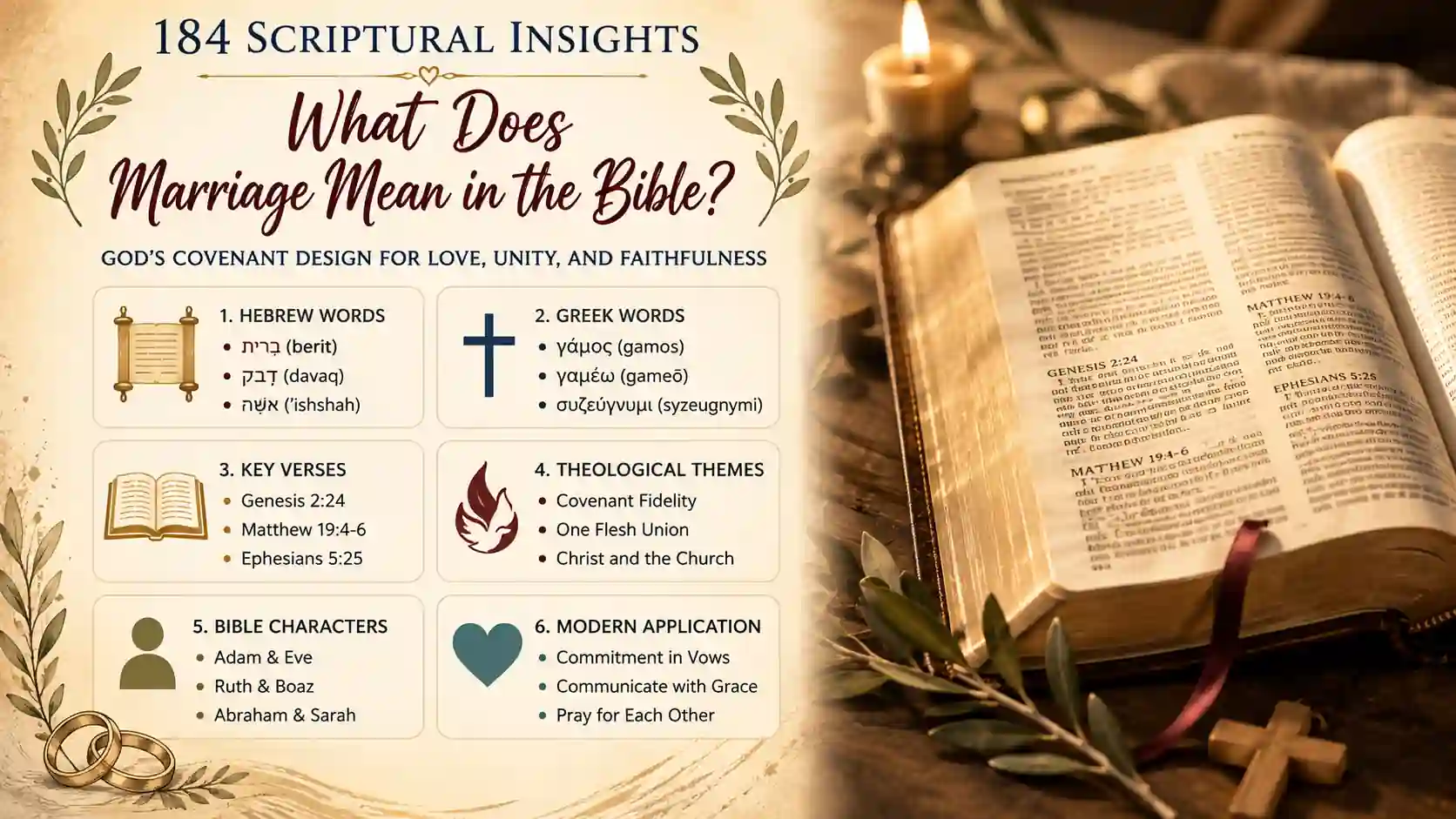
Original Hebrew and Greek Marriage Words
| Original Word | Transliteration | Strong’s # | Literal Meaning |
|---|---|---|---|
| אִישׁ | ʾish | H376 | man, husband |
| אִשָּׁה | ʾishshah | H802 | woman, wife |
| בָּעַל | baʿal | H1166 | marry, become husband |
| בְּרִית | berit | H1285 | covenant |
| דָּבַק | davaq | H1692 | cling, hold fast |
| חָתַן | chathan | H2859 | become related by marriage |
| γαμέω | gameō | G1060 | marry, wed |
| γαμίσκω | gamiskō | G1061 | give in marriage |
| γάμος | gamos | G1062 | marriage, wedding feast |
| συζεύγνυμι | syzeugnymi | G4801 | join together, yoke |
The Hebrew noun אִשָּׁה, ʾishshah, can mean either “woman” or “wife,” with context determining the sense. The verb בָּעַל, baʿal, may describe becoming a husband or marrying, while דָּבַק, davaq, expresses the strong attachment of holding fast.
In the New Testament, γάμος, gamos, refers to a marriage, wedding, or wedding feast. The verb γαμέω, gameō, means to marry. Jesus’ phrase “God has joined together” uses συζεύγνυμι, syzeugnymi, portraying the spouses as joined in a shared bond.
Related Biblical Marriage Concepts
| Concept | Connection | Supporting Verse |
|---|---|---|
| Creation | Marriage begins in God’s design | Genesis 2:18-24 |
| Covenant | Spouses are accountable to God | Malachi 2:14 |
| One flesh | Two lives form a bodily union | Genesis 2:24 |
| Companionship | Isolation is answered by partnership | Genesis 2:18 |
| Faithfulness | Exclusive devotion protects marriage | Proverbs 5:18 |
| Fruitfulness | Marriage commonly welcomes children | Genesis 1:28 |
| Mutuality | Spouses owe care to each other | 1 Corinthians 7:3 |
| Sacrifice | Love seeks the spouse’s good | Ephesians 5:25 |
| Sanctification | Marriage trains holy character | Ephesians 5:26-27 |
| Witness | Marriage reflects covenant love | Ephesians 5:31-32 |
The Bible’s “one flesh” language includes sexual union but exceeds it. It describes the formation of a shared life in which bodies, loyalties, resources, responsibilities, joys, and sorrows are joined.
Marriage is therefore personal without being merely private. It affects households, congregations, future generations, and public witness. Scripture repeatedly connects marital faithfulness with truthfulness before God.
Historical and Cultural Marriage Context
| Aspect | Detail | Biblical Source |
|---|---|---|
| Betrothal | Binding pledge before cohabitation | Matthew 1:18-19 |
| Bride-price | Gift associated with marriage agreement | Genesis 34:12 |
| Family involvement | Households often arranged unions | Genesis 24 |
| Wedding feast | Celebration could last several days | John 2:1-10 |
| Household formation | Husband and wife formed a new kinship | Genesis 2:24 |
| Inheritance | Marriage affected family property | Numbers 36:6-9 |
| Levirate duty | Brother preserved a deceased man’s line | Deuteronomy 25:5-6 |
| Divorce certificate | Law regulated an existing practice | Deuteronomy 24:1 |
| Polygamy | Practiced but marked by conflict | Genesis 29:30-35 |
| Covenant witness | God witnessed marital promises | Malachi 2:14 |
Ancient marriages normally involved families, property, inheritance, public recognition, and communal celebration. Betrothal was more binding than a modern engagement, which explains Joseph’s intention to divorce Mary quietly before they had begun married life together.
Scripture records patriarchs and kings with multiple wives, yet the creation account establishes one man and one woman becoming one flesh. The narratives frequently expose jealousy, favoritism, succession disputes, and spiritual compromise arising from departures from that pattern.
Theological Themes within Marriage
| Theme | Explanation | Scripture |
|---|---|---|
| Divine institution | God forms the first marriage | Genesis 2:22 |
| Covenant fidelity | Marriage rests on pledged loyalty | Malachi 2:14 |
| Complementary union | Man and woman share one humanity | Genesis 2:23 |
| Permanence | God’s joining should be honored | Matthew 19:6 |
| Mutual belonging | Each spouse serves the other | 1 Corinthians 7:4 |
| Sacrificial love | Christ shapes marital love | Ephesians 5:25 |
| Respect | Marriage includes willing honor | Ephesians 5:33 |
| Holiness | Sexual faithfulness honors God | 1 Thessalonians 4:3-4 |
| Gospel mystery | Marriage points to Christ and church | Ephesians 5:32 |
| Final fulfillment | Lamb and bride celebrate victory | Revelation 19:7 |
Marriage is a creation ordinance, not simply an arrangement belonging to ancient Israel or the Christian church. It appears before sin enters the world and before any civil government or covenant nation exists.
Yet marriage also gains redemptive symbolism. The prophets portray the Lord as Israel’s faithful covenant husband, and Paul presents the union of husband and wife as a mystery that points beyond itself to Christ and the church.
Modern Marriage Application for Believers
| Area | Practice | Scripture |
|---|---|---|
| Commitment | Treat vows as sacred promises | Malachi 2:14 |
| Communication | Speak truth with grace | Ephesians 4:25 |
| Conflict | Forgive rather than keep records | Colossians 3:13 |
| Sexual fidelity | Reserve intimacy for marriage | Hebrews 13:4 |
| Affection | Delight in your spouse | Proverbs 5:18 |
| Service | Seek the other’s good | Philippians 2:4 |
| Prayer | Approach God with understanding | 1 Peter 3:7 |
| Finances | Practice honesty and stewardship | Luke 16:10 |
| Hospitality | Use your household to serve | Romans 12:13 |
| Discipleship | Center the home on God’s word | Deuteronomy 6:6-7 |
Modern Christian marriage should be shaped less by self-fulfillment and more by covenant faithfulness. This does not make personal joy unimportant. It places joy within a larger calling to love, serve, forgive, remain truthful, and grow in holiness together.
No spouse should use biblical language to excuse cruelty, coercion, manipulation, or violence. Christlike authority is never permission to harm. Scripture calls believers to protect the vulnerable, confront sin, seek wise help, and walk in truth.
דָּבַק Davaq and the One-Flesh Bond of Genesis
Genesis says a man leaves his father and mother and “holds fast” to his wife. The verb דָּבַק, davaq, conveys clinging, adhering, or remaining closely attached. Marriage creates a primary human allegiance without erasing proper love for parents.
“One flesh” includes bodily intimacy, but it also names a new kinship. Adam recognizes Eve as “bone of my bones and flesh of my flesh,” language of shared identity and family belonging. Marriage unites two distinct persons without dissolving either person’s dignity.
What Does Marriage Mean in the Bible as Covenant?
Malachi calls a wife “your companion and your wife by covenant.” A biblical covenant is a solemn, morally binding relationship established through pledged faithfulness. Marriage therefore involves more than romantic feeling, legal status, or temporary compatibility.
God is presented as a witness to marital promises. This makes faithfulness an act of worship and betrayal a spiritual wrong. Feelings may change through seasons, but covenant love continues to seek the other person’s good with patience, honesty, tenderness, and repentance.
Jesus, Moses, and the Creation Pattern for Marriage
When questioned about divorce, Jesus does not begin with later social customs. He returns to Genesis, affirming humanity’s creation as male and female and the command that the two become one flesh. His words restore attention to God’s original purpose.
Jesus explains that Moses regulated divorce because of human hardness of heart. Regulation limited injustice, but it did not redefine the creation ideal. His teaching joins permanence with moral seriousness while the wider Gospel calls wounded and sinful people toward repentance, mercy, and restoration.
γάμος Gamos and the Marriage Supper of the Lamb
The Greek word γάμος, gamos, can describe a marriage, a wedding celebration, or a wedding feast. Jesus uses wedding imagery in parables about God’s kingdom, readiness, invitation, judgment, and joy. Earthly marriage becomes a familiar picture of a greater divine reality.
Revelation culminates in the marriage supper of the Lamb. Christ is the Lamb, and his redeemed people appear as the prepared bride. Human marriage is temporary, but its covenant faithfulness can bear witness to the eternal communion, purity, and joy promised to God’s people.
Marriage Questions Bible Students Often Ask
Does אִשָּׁה, ʾishshah, always mean “wife”?
No. It can mean “woman” or “wife,” and the surrounding context determines the intended sense.
Why does Jesus quote Genesis 2:24 when discussing divorce?
He returns to creation to show that marriage’s governing ideal is faithful one-flesh union rather than human hardness of heart.
Does the Bible approve of polygamy because some patriarchs practiced it?
No. Scripture records polygamy honestly, while its narratives expose conflict and Genesis supplies the foundational one-man, one-woman pattern.
What does Paul mean by calling marriage a “mystery” in Ephesians 5:32?
He means that the one-flesh union ultimately points to the covenant relationship between Christ and his church.
Is marriage required for every Christian believer?
No. Scripture honors marriage while also recognizing faithful singleness as a gift and calling within God’s kingdom.