
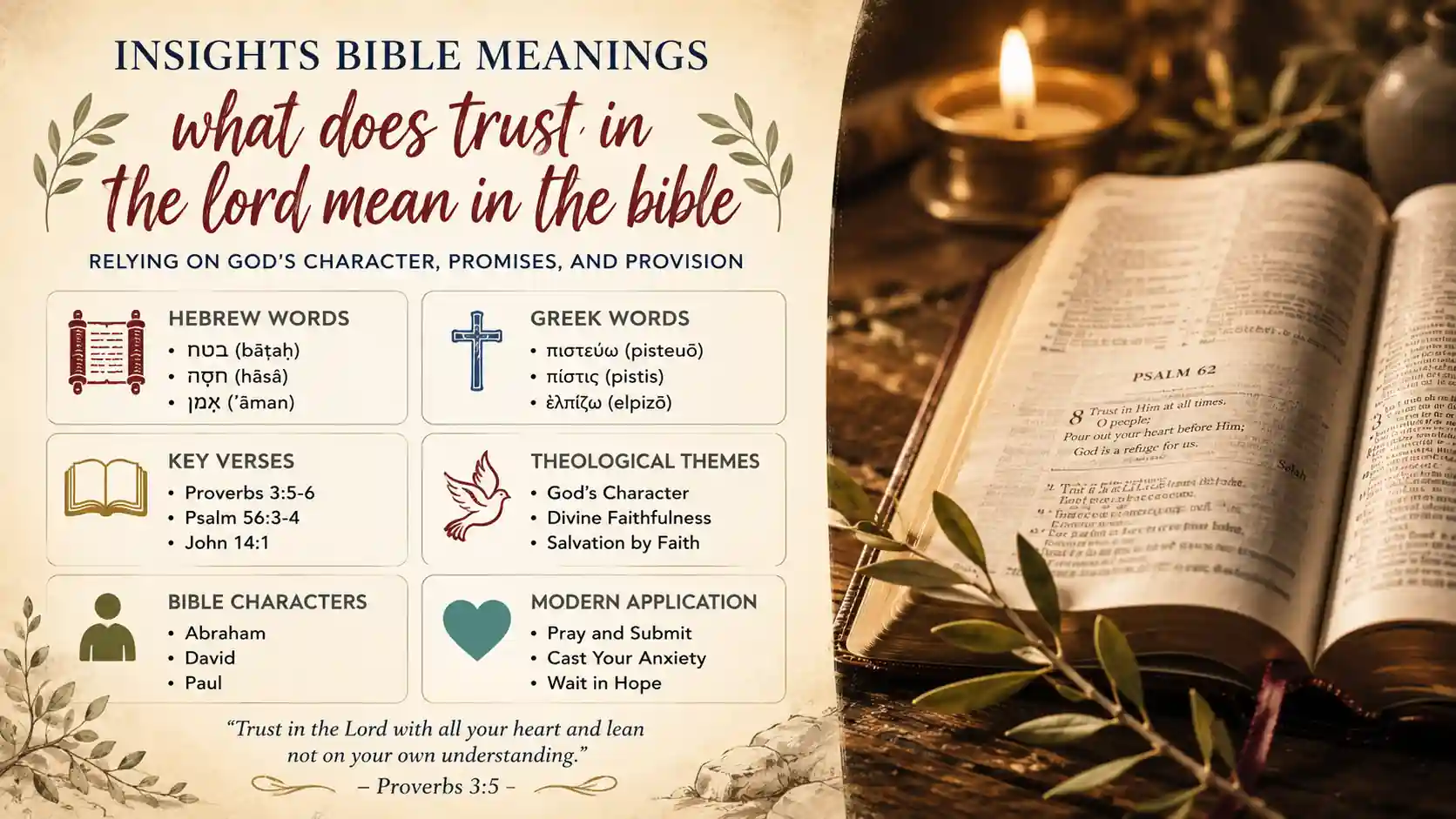
What does trust in the Lord mean in the Bible? It means resting your confidence in God’s character, promises, wisdom, and saving power rather than treating your own understanding, strength, or circumstances as the final authority. Biblical trust is not vague optimism or the denial of hardship.
It is a deliberate reliance on the God who has revealed himself through creation, covenant, Scripture, and ultimately Jesus Christ. As you study trust, you encounter faith, refuge, obedience, patience, prayer, and hope woven together throughout the biblical story.
Trust Key Scripture References
| Verse | Passage Snippet | Context |
|---|---|---|
| Proverbs 3:5-6 | Trust in the Lord wholeheartedly | Wisdom for daily decisions |
| Psalm 37:3-5 | Trust, do good, and commit | Faithfulness amid evildoers |
| Psalm 56:3-4 | When afraid, I trust | David facing hostile enemies |
| Psalm 62:8 | Trust him at all times | God as refuge and rock |
| Isaiah 26:3-4 | Trust in the Lord forever | Peace for steadfast minds |
| Jeremiah 17:7-8 | Blessed is the trusting person | A tree beside water |
| Nahum 1:7 | He knows those seeking refuge | Comfort during divine judgment |
| John 14:1 | Believe in God and Christ | Jesus comforts troubled disciples |
| Romans 10:11 | Believers will not be ashamed | Salvation offered through Christ |
| 1 Peter 5:7 | Cast every anxiety on him | Humility under God’s care |
Trust Bible Translation Comparison
| Verse | KJV | NIV | ESV | NASB |
|---|---|---|---|---|
| Proverbs 3:5 | Trust in the LORD | Trust in the LORD | Trust in the LORD | Trust in the LORD |
| Psalm 37:5 | Commit thy way | Commit your way | Commit your way | Commit your way |
| Psalm 56:3 | I will trust | I put my trust | I put my trust | I will put my trust |
| Psalm 62:8 | Trust in him | Trust in him | Trust in him | Trust in Him |
| Isaiah 26:4 | Everlasting strength | Eternal Rock | Everlasting rock | Everlasting Rock |
| Jeremiah 17:7 | Trusteth in the LORD | Trusts in the LORD | Trusts in the LORD | Trusts in the LORD |
| John 14:1 | Believe also in me | Believe also in me | Believe also in me | Believe also in Me |
| Romans 10:11 | Believeth on him | Believes in him | Believes in him | Believes in Him |
| 2 Corinthians 1:9 | Trust in God | Rely on God | Rely not on ourselves | Trust in ourselves |
| 1 Peter 5:7 | He careth for you | He cares for you | He cares for you | He cares about you |
Trust People and Characters Associated
| Person | Role | Connection |
|---|---|---|
| Abraham | Covenant patriarch | Trusted God’s promise of an heir |
| Sarah | Matriarch | Judged the Promiser faithful |
| Moses | Israel’s mediator | Relied on God before Pharaoh |
| Joshua | Conquest leader | Obeyed God amid fortified cities |
| Ruth | Moabite believer | Sought refuge under God’s wings |
| David | King and psalmist | Trusted God while pursued |
| Hezekiah | King of Judah | Trusted God during Assyrian threat |
| Jehoshaphat | King of Judah | Prayed when powerless before armies |
| Daniel | Exile and prophet | Trusted God despite the lions |
| Paul | Apostle | Relied on God who raises the dead |
Trust Original Hebrew and Greek Words
| Original Word | Transliteration | Strong’s # | Literal Meaning |
|---|---|---|---|
| בָּטַח | bāṭaḥ | H982 | Trust, feel secure |
| חָסָה | ḥāsâ | H2620 | Seek refuge |
| אָמַן | ʾāman | H539 | Be firm, believe |
| קָוָה | qāvâ | H6960 | Wait, hope eagerly |
| מִבְטָח | mibṭāḥ | H4009 | Confidence, refuge |
| πιστεύω | pisteuō | G4100 | Believe, entrust oneself |
| πίστις | pistis | G4102 | Faith, trust, faithfulness |
| πεποίθησις | pepoithēsis | G4006 | Confidence, reliance |
| ἐλπίζω | elpizō | G1679 | Hope, place confidence |
| παρατίθημι | paratithēmi | G3908 | Entrust, commit to another |
Trust Related Biblical Concepts
| Concept | Connection | Supporting Verse |
|---|---|---|
| Faith | Receives God’s testimony as true | Hebrews 11:1 |
| Refuge | Runs to God for protection | Psalm 46:1 |
| Obedience | Acts upon God’s trustworthy word | Genesis 22:3 |
| Hope | Waits confidently for God’s future | Romans 15:13 |
| Prayer | Places needs before God | Philippians 4:6-7 |
| Wisdom | Submits human judgment to God | Proverbs 3:7 |
| Peace | Grows from a steadfast mind | Isaiah 26:3 |
| Courage | Faces danger under God’s presence | Joshua 1:9 |
| Humility | Rejects self-sufficiency | 1 Peter 5:6 |
| Perseverance | Continues through delayed fulfillment | Hebrews 10:35-36 |
Trust Historical and Cultural Context
| Aspect | Detail | Biblical Source |
|---|---|---|
| Ancient warfare | Cities trusted walls and armies | Psalm 20:7 |
| Royal power | Kings were warned against military pride | Deuteronomy 17:16 |
| Covenant life | Israel depended on God’s pledged faithfulness | Deuteronomy 7:9 |
| Wilderness travel | Daily manna trained dependence | Exodus 16:4 |
| Agriculture | Farmers depended on seasonal rain | Deuteronomy 11:14 |
| Family inheritance | Abraham left land and kin | Genesis 12:1-4 |
| Refuge imagery | Rocky heights pictured divine safety | Psalm 18:2 |
| Assyrian crisis | Hezekiah resisted imperial intimidation | 2 Kings 18:5 |
| Babylonian exile | Faith continued without national security | Daniel 6:23 |
| Roman world | Christians confessed Jesus as Lord | Romans 10:9-11 |
Trust Theological Themes
| Theme | Explanation | Scripture |
|---|---|---|
| God’s character | Trust rests on who God is | Exodus 34:6-7 |
| Divine faithfulness | God keeps covenant promises | Deuteronomy 7:9 |
| Human limitation | Personal understanding is incomplete | Proverbs 3:5 |
| Providence | God directs the believer’s path | Proverbs 3:6 |
| Salvation by faith | Sinners receive righteousness through belief | Romans 3:22 |
| Christ’s sufficiency | Jesus is the object of saving faith | John 3:16 |
| Resurrection power | God raises the dead | 2 Corinthians 1:9 |
| Sanctification | Faith produces obedient living | Galatians 5:6 |
| Perseverance | Genuine faith endures testing | 1 Peter 1:6-7 |
| Final vindication | Trust will not end in shame | Romans 10:11 |
Trust Modern Application for Believers
| Area | Practice | Scripture |
|---|---|---|
| Decision-making | Pray and submit plans to God | Proverbs 3:5-6 |
| Anxiety | Cast specific concerns on God | 1 Peter 5:7 |
| Finances | Reject wealth as ultimate security | 1 Timothy 6:17 |
| Work | Serve faithfully before the Lord | Colossians 3:23 |
| Relationships | Refuse revenge and wait for God | Romans 12:19 |
| Suffering | Remember God’s loving purpose | Romans 8:28 |
| Temptation | Depend on God’s provided escape | 1 Corinthians 10:13 |
| Waiting | Strengthen your heart in hope | Psalm 27:14 |
| Prayer | Ask with confidence in God’s will | 1 John 5:14 |
| Witness | Speak without fearing human opposition | Acts 4:29 |
בָּטַח Bāṭaḥ and the Security of God’S Character
The Hebrew verb בָּטַח, bāṭaḥ, describes confidence, security, and reliance. It often contrasts trusting God with leaning on military strength, political alliances, riches, idols, or personal insight. The issue is not whether you trust, but where your confidence finally rests.
Proverbs 3:5 commands wholehearted trust because divided confidence produces unstable obedience. You may use reason, seek counsel, and make plans, but you do not enthrone your understanding. You acknowledge God in every path because his wisdom exceeds the limits of your perception.
What Does Trust in the Lord Mean in the Bible During Fear?
Biblical trust does not require you to pretend that danger is unreal. David said, “When I am afraid,” before declaring his trust in God. Fear described his experience, but it did not become his master or determine his final response.
Trust redirects fear toward God’s promises, presence, and authority. David could acknowledge enemies, tears, and uncertainty while believing that God remained for him. Your faith may tremble, yet it still acts as faith when it turns toward the Lord rather than away from him.
חָסָה ḤāSâ and the Covenant Image of Refuge
The verb חָסָה, ḥāsâ, pictures someone seeking shelter beneath dependable protection. Ruth used this imagery when she came under the wings of Israel’s God. The Psalms describe God as a rock, fortress, shield, and safe height because trust involves personal nearness, not merely correct information.
This refuge language grows from the covenant relationship between God and his people. Israel’s security was never guaranteed by geography, armies, or kings. Safety rested in the Lord who had bound himself to his people and remained faithful even when their visible circumstances collapsed.
Πιστεύω Pisteuō and Trust Centered on Jesus Christ
In the New Testament, πιστεύω, pisteuō, means to believe, trust, or place confidence in someone. When Jesus tells troubled disciples to believe in God and in him, he presents himself as worthy of the same personal reliance that belongs to God.
Saving trust includes believing the gospel’s truth, but it is more than agreeing with facts. You entrust yourself to the crucified and risen Christ. His death addresses your guilt, his resurrection confirms his victory, and his intercession gives you confidence to approach God.
This Christ-centered trust produces obedience without turning obedience into the basis of salvation. Faith receives grace, then expresses itself through love, endurance, generosity, courage, and holiness. You obey because Christ is trustworthy, not because your performance makes him faithful.
Trust Questions from Bible Students
Does בָּטַח bāṭaḥ mean that a believer should ignore practical wisdom?
No. It means practical wisdom must remain submitted to God rather than replacing him as your final source of security.
Why does Proverbs 3:5 warn against leaning on your own understanding?
Your understanding is limited and affected by sin, while God sees every circumstance within his perfect wisdom and purpose.
Is πιστεύω pisteuō merely intellectual belief about Jesus?
No. In its saving context, it includes receiving Christ’s testimony and entrusting yourself personally to him.
How can Psalm 56 connect fear and trust without contradiction?
The psalm shows that trust is the faithful response made within fear, not always the absence of fearful emotion.
What should you do when God’s promises seem delayed?
Continue praying, obeying, and waiting in hope, because biblical trust depends on God’s faithfulness rather than your preferred timing.