
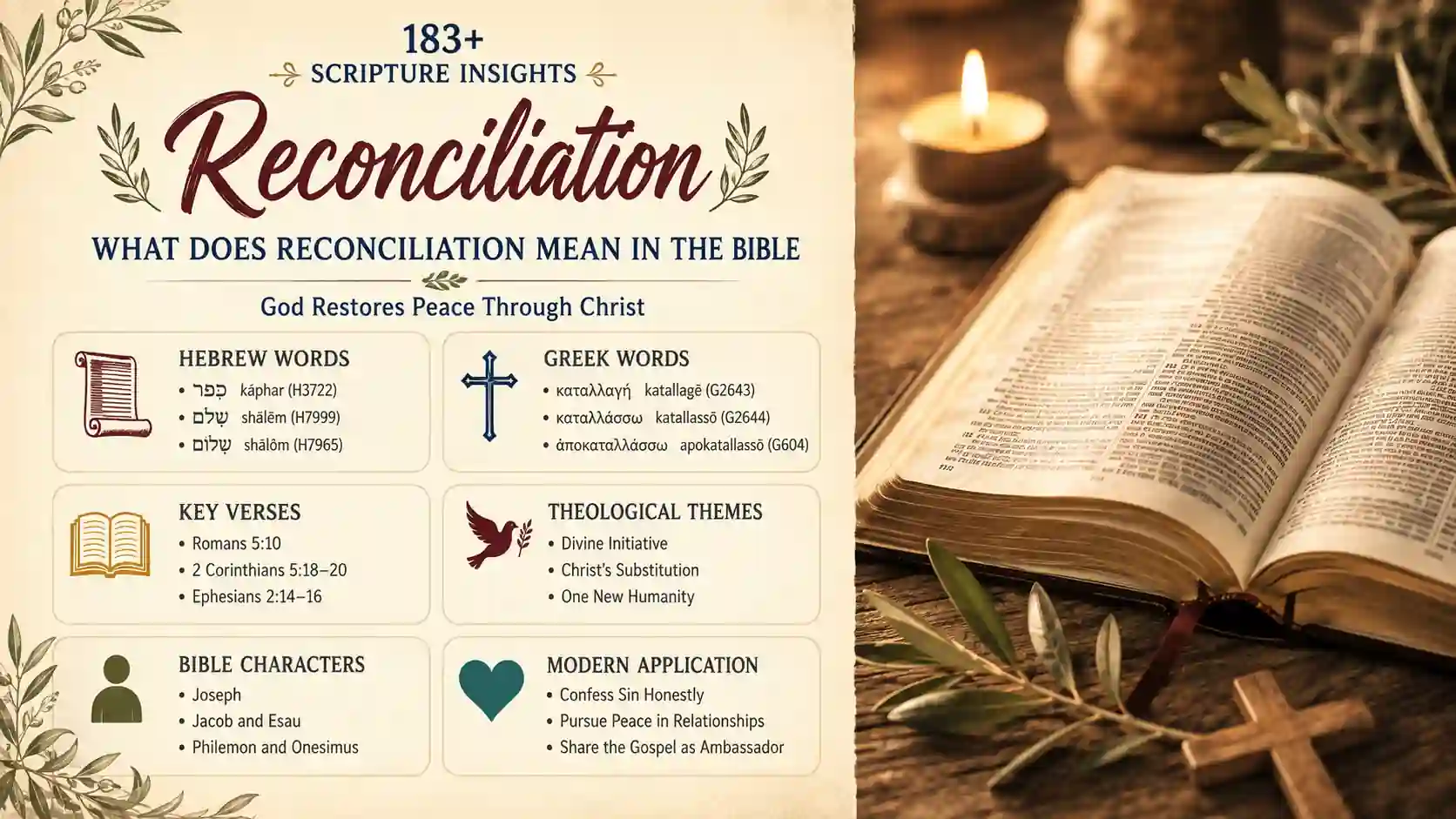
What does reconciliation mean in the Bible? Reconciliation is the restoration of peace and fellowship after hostility, alienation, or broken relationship. Scripture presents it chiefly as God’s gracious work of bringing sinners back to himself through the death and resurrection of Jesus Christ.
Your study of reconciliation also reaches into worship, covenant, forgiveness, justice, and restored human relationships. God does not merely overlook evil. He deals with sin through Christ, removes hostility, and creates a reconciled people who now carry his message of peace to others.
Key Reconciliation Scripture References
| Verse | Passage Snippet | Context |
|---|---|---|
| Romans 5:10 | Reconciled to God by his Son’s death | Former enemies receive life through Christ |
| Romans 5:11 | We have now received reconciliation | Believers rejoice in God through Jesus |
| 2 Corinthians 5:18 | God reconciled us to himself | Reconciliation begins with divine grace |
| 2 Corinthians 5:19 | Not counting their trespasses | God acts in Christ to restore sinners |
| 2 Corinthians 5:20 | Be reconciled to God | Christ’s ambassadors announce God’s appeal |
| Colossians 1:20 | Making peace through his blood | The cross addresses cosmic disorder |
| Colossians 1:21-22 | Alienated and hostile in mind | Christ presents believers holy before God |
| Ephesians 2:16 | Reconcile both unto God | Jews and Gentiles become one body |
| Matthew 5:23-24 | First be reconciled to thy brother | Worship requires attention to broken relationships |
| 1 Corinthians 7:11 | Be reconciled to her husband | Marriage reconciliation is urged where possible |
Reconciliation Bible Translation Comparison
| Verse | KJV | NIV | ESV | NASB |
|---|---|---|---|---|
| Romans 5:10 | Reconciled to God | Reconciled to him | Reconciled to God | Reconciled to God |
| Romans 5:11 | Received the atonement | Received reconciliation | Received reconciliation | Received the reconciliation |
| 2 Corinthians 5:18 | Ministry of reconciliation | Ministry of reconciliation | Ministry of reconciliation | Ministry of reconciliation |
| 2 Corinthians 5:19 | Reconciling the world | Reconciling the world | Reconciling the world | Reconciling the world |
| 2 Corinthians 5:20 | Be ye reconciled | Be reconciled | Be reconciled | Be reconciled |
| Colossians 1:20 | Reconcile all things | Reconcile to himself | Reconcile to himself | Reconcile all things |
| Ephesians 2:16 | Reconcile both | Reconcile both | Reconcile us both | Reconcile them both |
| Matthew 5:24 | Reconciled to thy brother | Reconciled to them | Reconciled to your brother | Reconciled to your brother |
People and Characters Associated with Reconciliation
| Person | Role | Connection |
|---|---|---|
| Jesus Christ | Mediator and sacrifice | Reconciles sinners through his blood |
| Paul | Apostle to the Gentiles | Explains reconciliation and its ministry |
| Jacob | Estranged brother | Seeks peace with Esau through humility |
| Esau | Offended brother | Receives Jacob with unexpected compassion |
| Joseph | Betrayed son and ruler | Forgives and restores his brothers |
| Joseph’s brothers | Guilty family members | Confess wrongdoing and receive mercy |
| David | King of Israel | Restores Absalom without resolving guilt fully |
| Absalom | Banished prince | Illustrates incomplete human reconciliation |
| Philemon | Christian householder | Asked to receive Onesimus as a brother |
| Onesimus | Enslaved man and believer | Returns within a transformed relationship |
Original Hebrew and Greek Words for Reconciliation
| Original Word | Transliteration | Strong’s # | Literal Meaning |
|---|---|---|---|
| כָּפַר | kāphar | H3722 | Cover, purge, make atonement |
| כִּפֻּר | kippur | H3725 | Atonement, expiation |
| שָׁלֵם | shālēm | H7999 | Make whole, repay, restore peace |
| שָׁלוֹם | shālôm | H7965 | Peace, wholeness, welfare |
| רָצָה | rāṣâ | H7521 | Accept, favor, be pleased |
| καταλλαγή | katallagē | G2643 | Reconciliation, restored relationship |
| καταλλάσσω | katallassō | G2644 | Change from hostility to peace |
| ἀποκαταλλάσσω | apokatallassō | G604 | Reconcile fully or completely |
| ἱλασμός | hilasmos | G2434 | Atoning sacrifice, propitiation |
| εἰρηνοποιέω | eirēnopoieō | G1517 | Make peace |
Related Biblical Concepts of Reconciliation
| Concept | Connection | Supporting Verse |
|---|---|---|
| Atonement | Sin is dealt with before fellowship is restored | Leviticus 16:30 |
| Forgiveness | God no longer counts trespasses against believers | 2 Corinthians 5:19 |
| Justification | The reconciled sinner is declared righteous by faith | Romans 5:1 |
| Redemption | Christ’s blood purchases freedom from sin | Ephesians 1:7 |
| Propitiation | Christ’s sacrifice addresses divine judgment | 1 John 2:2 |
| Peace | Hostility with God is replaced by peace | Romans 5:1 |
| Adoption | Reconciled sinners enter God’s family | Galatians 4:4-5 |
| New creation | Reconciliation produces transformed identity | 2 Corinthians 5:17 |
| Unity | Christ joins divided peoples into one body | Ephesians 2:14-16 |
| Confession | Honest acknowledgment opens relational healing | 1 John 1:9 |
Historical and Cultural Context of Reconciliation
| Aspect | Detail | Biblical Source |
|---|---|---|
| Covenant sacrifice | Blood signified life offered before God | Leviticus 17:11 |
| Day of Atonement | Annual cleansing addressed Israel’s uncleanness | Leviticus 16 |
| Temple worship | Offerings expressed repentance and restored access | Leviticus 6:1-7 |
| Kinship duty | Family peace protected inheritance and community | Genesis 33:1-12 |
| Patronage language | Favor could restore an offender’s standing | Genesis 32:20 |
| Jewish and Gentile division | Circumcision and food laws marked social boundaries | Ephesians 2:11-15 |
| Roman diplomacy | Ambassadors carried appeals between estranged parties | 2 Corinthians 5:20 |
| Household structure | Conversion reshaped social relationships | Philemon 15-17 |
| Shared meals | Table fellowship demonstrated restored acceptance | Galatians 2:11-14 |
| Public worship | Unresolved conflict could compromise an offering | Matthew 5:23-24 |
Theological Themes within Reconciliation
| Theme | Explanation | Scripture |
|---|---|---|
| Divine initiative | God acts first toward hostile sinners | 2 Corinthians 5:18 |
| Human guilt | Alienation arises from sin, not divine weakness | Colossians 1:21 |
| Christ’s substitution | Reconciliation comes through Jesus’ death | Romans 5:10 |
| Resurrection life | The risen Christ preserves reconciled believers | Romans 5:10 |
| Grace | Restoration is received, not earned | Romans 5:11 |
| Justice and mercy | God confronts sin while welcoming sinners | Romans 3:25-26 |
| Union with Christ | Reconciled people receive a new identity | 2 Corinthians 5:17 |
| One new humanity | Christ removes covenantal hostility | Ephesians 2:15 |
| Cosmic restoration | Christ’s peace reaches all creation | Colossians 1:20 |
| Mission | Reconciled believers announce God’s appeal | 2 Corinthians 5:20 |
Modern Reconciliation Application for Believers
| Area | Practice | Scripture |
|---|---|---|
| Relationship with God | Trust Christ rather than personal merit | Romans 5:1 |
| Confession | Name sin honestly before God | 1 John 1:9 |
| Family conflict | Pursue peace with humility and truth | Genesis 33:3-4 |
| Church unity | Reject ethnic and social superiority | Ephesians 2:14 |
| Marriage | Seek restoration when covenant faithfulness permits | 1 Corinthians 7:11 |
| Worship | Address personal offenses promptly | Matthew 5:23-24 |
| Forgiveness | Release personal vengeance to God | Romans 12:19 |
| Justice | Join mercy with truthful accountability | Luke 19:8 |
| Evangelism | Speak as Christ’s ambassador | 2 Corinthians 5:20 |
| Community life | Welcome repentant believers as family | Philemon 16-17 |
Katallagē and God’S Movement Toward His Enemies
The central New Testament noun is καταλλαγή, katallagē, which describes a decisive change from hostility to restored relationship. Paul uses it in Romans 5:11 and 2 Corinthians 5:18-19. The change is not produced by human spiritual improvement. God initiates it through Christ.
Romans 5 places reconciliation within humanity’s helpless and hostile condition. Christ dies not for people who have already repaired themselves, but for sinners and enemies. You receive reconciliation as a gift, then rejoice in the God whose mercy has overcome your estrangement.
What Does Reconciliation Mean in the Bible Through the Cross?
Biblical reconciliation cannot be separated from atonement. The Hebrew verb כָּפַר, kāphar, concerns covering, purging, or making atonement for sin. Israel’s sacrifices taught that guilt and impurity obstruct communion with the holy God and require divinely appointed cleansing.
The cross fulfills what the sacrificial system anticipated. Colossians 1:20 says Christ makes peace through the blood of his cross. God’s forgiveness is therefore neither sentimental nor careless. The evil that alienated humanity is judged, and peace is established through Christ’s self-giving death.
Apokatallassō and the One New Humanity
Paul uses ἀποκαταλλάσσω, apokatallassō, in Ephesians 2:16 and Colossians 1:20-22. The intensified verb emphasizes full reconciliation. In Ephesians, Christ does more than help Jews and Gentiles tolerate one another. He creates one new humanity and reconciles both groups to God in one body.
This vertical and horizontal work must not be divided. Peace with God forms a people who practice peace across former boundaries. Ethnic pride, social contempt, and spiritual superiority contradict the cross because Christ has killed the hostility that once defined those divisions.
Joseph, Esau, and the Cost of Restored Fellowship
Genesis gives you vivid portraits of reconciliation before the New Testament vocabulary appears. Jacob approaches Esau with fear, gifts, humility, and acknowledgment. Esau runs to meet him, embraces him, and weeps. Their meeting shows that reconciliation may involve repentance, vulnerability, and freely offered mercy.
Joseph’s reconciliation with his brothers goes deeper. He tests their character, hears their confession, reveals his identity, and provides for their survival. His forgiveness does not call their betrayal good. Instead, he recognizes God’s providence while restoring guilty brothers to fellowship and responsibility.
Questions About Biblical Reconciliation
Why does the KJV say “atonement” in Romans 5:11 instead of “reconciliation”?
The underlying Greek word is καταλλαγή, katallagē, so most modern translations use “reconciliation.”
Is reconciliation the same as forgiveness?
No. Forgiveness releases guilt or personal vengeance, while reconciliation describes restored relationship and may require repentance, truth, and rebuilt trust.
Does 2 Corinthians 5:19 teach that every person is already saved?
No. Paul announces God’s reconciling work in Christ while still pleading with people to receive it by being reconciled to God.
How is kāphar connected to New Testament reconciliation?
כָּפַר, kāphar, describes atonement for sin, while New Testament reconciliation explains the restored relationship made possible through Christ’s sacrifice.
Must you reconcile with someone who remains dangerous or unrepentant?
You should reject vengeance and remain willing to forgive, but restored access and trust may require repentance, wisdom, accountability, and appropriate boundaries.