
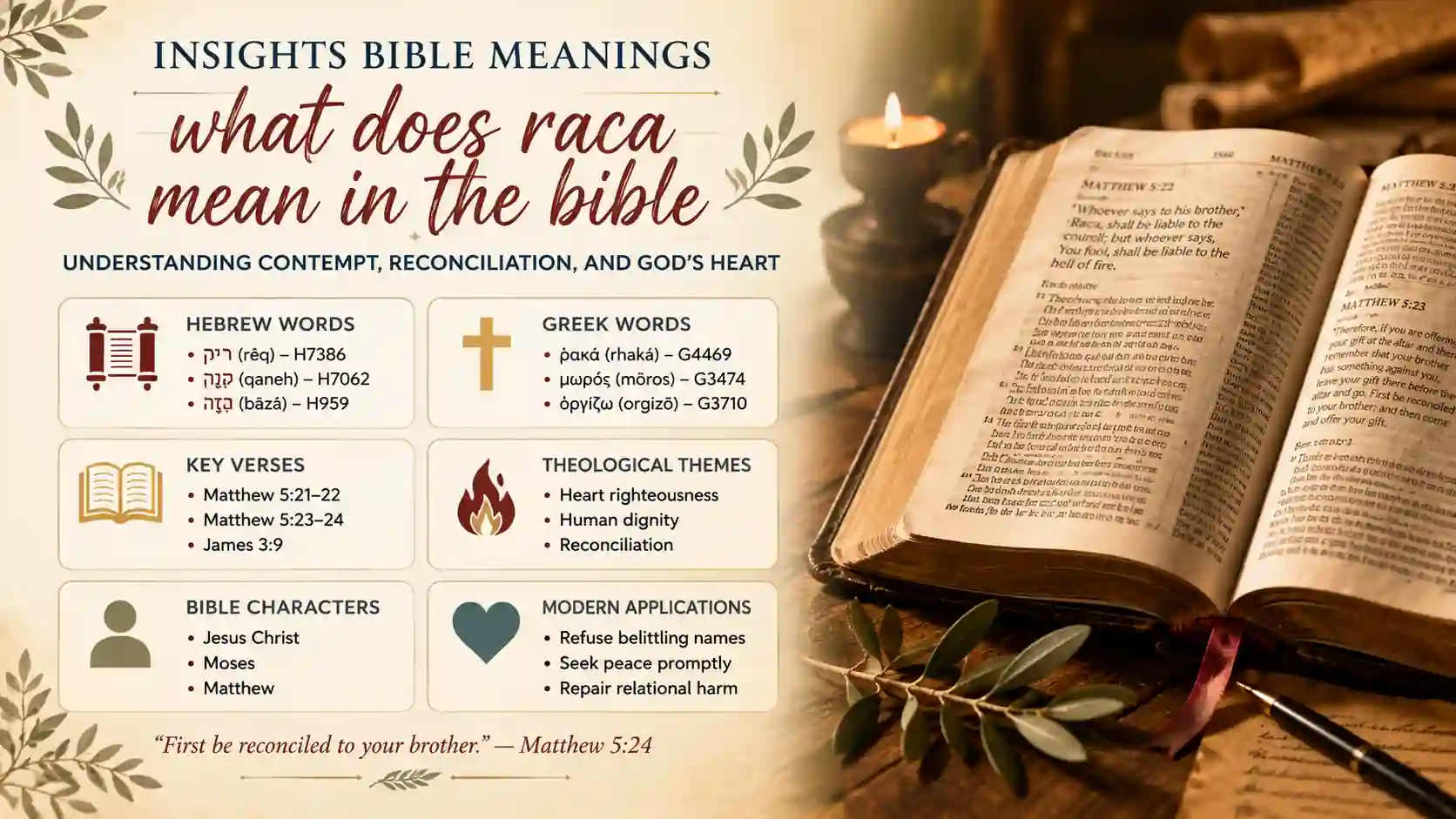
What does raca mean in the Bible? In Matthew 5:22, Jesus uses raca as a grave example of contemptuous speech. The Greek text preserves the Semitic insult ῥακά (rhaká), a word associated with emptiness, worthlessness, or being empty-headed. It is more than a casual expression of frustration.
As you study Christ’s warning, you discover that His concern reaches beneath vocabulary to the anger, pride, and disregard for another person that produce insulting words. Jesus calls you toward reconciliation, reverence for human dignity, and righteousness that begins within the heart.
Key Raca Scripture References
| Verse | Passage Snippet | Context |
|---|---|---|
| Matthew 5:21 | “You shall not murder” | Jesus introduces the sixth commandment |
| Matthew 5:22 | “Whoever says…Raca” | Contempt brings divine accountability |
| Matthew 5:23 | “Offering your gift” | Worship cannot excuse broken relationships |
| Matthew 5:24 | “First be reconciled” | Reconciliation precedes resumed worship |
| Matthew 5:25 | “Agree…quickly” | Urgent settlement prevents escalating judgment |
| Matthew 5:26 | “Paid the last penny” | Unresolved guilt has serious consequences |
| Exodus 20:13 | “You shall not murder” | Commandment underlying Jesus’ teaching |
| Deuteronomy 5:17 | “You shall not murder” | Covenant repetition of the command |
| James 3:9 | “Curse people” | People bear God-given likeness |
| 1 John 3:15 | “Hates his brother” | Hatred shares murder’s moral character |
Raca Bible Translation Comparison
| Verse | KJV | NIV | ESV | NASB |
|---|---|---|---|---|
| Matthew 5:21 | “Thou shalt not kill” | “You shall not murder” | “You shall not murder” | “You shall not murder” |
| Matthew 5:22 | Retains “Raca” | Retains “Raca” | Renders it “insults” | Retains “Raca” |
| Matthew 5:23 | “Bring thy gift” | “Offering your gift” | “Offering your gift” | “Presenting your offering” |
| Matthew 5:24 | “Be reconciled” | “Be reconciled” | “Be reconciled” | “Be reconciled” |
| Matthew 5:25 | “Agree…quickly” | “Settle matters quickly” | “Come to terms quickly” | “Come to good terms quickly” |
| James 3:9 | “Curse we men” | “Curse human beings” | “Curse people” | “Curse people” |
| Ephesians 4:29 | “No corrupt communication” | “No unwholesome talk” | “No corrupting talk” | “No unwholesome word” |
| Colossians 3:8 | “Filthy communication” | “Filthy language” | “Obscene talk” | “Abusive speech” |
People and Characters Associated with Raca
| Person | Role | Connection |
|---|---|---|
| Jesus Christ | Teacher and Messiah | Gives the warning against raca |
| Moses | Covenant mediator | Received the command against murder |
| Matthew | Gospel writer | Preserves ῥακά in Greek text |
| The disciple | Intended hearer | Must reject anger and contempt |
| The brother | Injured neighbor | Receives the degrading insult |
| The worshiper | Offering a gift | Must pursue reconciliation |
| The adversary | Legal opponent | Illustrates urgency in making peace |
| The judge | Judicial authority | Represents accountability |
| The council | Jewish tribunal | Linked with contemptuous speech |
| James | Apostolic teacher | Condemns cursing God’s image-bearers |
Original Hebrew and Greek Words Behind Raca
| Original Word | Transliteration | Strong’s # | Literal Meaning |
|---|---|---|---|
| ῥακά | rhaká | G4469 | Empty one, worthless person |
| רֵיק | rêq | H7386 | Empty, vain, worthless |
| κενός | kenos | G2756 | Empty, without content |
| μωρός | mōros | G3474 | Foolish, morally senseless |
| ὀργίζω | orgizō | G3710 | To become angry |
| ἀδελφός | adelphos | G80 | Brother, fellow member |
| συνέδριον | synedrion | G4892 | Council, assembled court |
| γέεννα | geenna | G1067 | Gehenna, place of judgment |
| φονεύω | phoneuō | G5407 | To murder or kill |
| διαλλάσσω | diallassō | G1259 | To reconcile fully |
The term ῥακά (rhaká) occurs only in Matthew 5:22 in the New Testament. Greek lexicons identify it as a Semitic expression of bitter contempt, commonly explained through the idea of emptiness and connected with Hebrew or Aramaic רֵיק (rêq), “empty” or “worthless.”
Related Biblical Concepts of Raca
| Concept | Connection | Supporting Verse |
|---|---|---|
| Anger | Inner hostility can precede violence | Matthew 5:22 |
| Contempt | Raca dismisses another’s worth | Matthew 5:22 |
| Murder | Jesus traces murder toward its root | Matthew 5:21–22 |
| Reconciliation | Christ commands restored relationships | Matthew 5:24 |
| Human dignity | People bear God’s likeness | James 3:9 |
| Speech | Words reveal the heart | Matthew 12:34 |
| Judgment | God evaluates hidden attitudes | Matthew 5:22 |
| Worship | Devotion includes relational obedience | Matthew 5:23–24 |
| Peacemaking | Kingdom citizens pursue peace | Matthew 5:9 |
| Neighbor love | Love refuses degrading treatment | Matthew 22:39 |
Historical and Cultural Context of Raca
| Aspect | Detail | Biblical Source |
|---|---|---|
| Language | Semitic insult preserved in Greek | Matthew 5:22 |
| Setting | Sermon on the Mount | Matthew 5:1–2 |
| Audience | Disciples and surrounding crowds | Matthew 5:1 |
| Legal background | Murder was subject to judgment | Matthew 5:21 |
| Local courts | Communities heard serious cases | Matthew 5:21 |
| The council | Likely evokes the Sanhedrin | Matthew 5:22 |
| Temple worship | Gifts were brought to the altar | Matthew 5:23 |
| Personal disputes | Adversaries could bring legal action | Matthew 5:25 |
| Gehenna imagery | Symbol of severe divine judgment | Matthew 5:22 |
| Honor culture | Public insults attacked social standing | Matthew 5:22 |
Jesus taught within the Jewish world of the Second Temple era, where local judgment, the Jerusalem council, altar offerings, and public honor were familiar realities. His references move from ordinary judgment to the council and finally to fiery Gehenna, emphasizing the seriousness of heart-level rebellion rather than supplying a simple schedule of earthly penalties.
Theological Themes within Raca
| Theme | Explanation | Scripture |
|---|---|---|
| Heart righteousness | God judges motives beneath conduct | Matthew 5:22 |
| Sanctity of life | Murder begins with devaluing persons | Matthew 5:21–22 |
| Divine image | Contempt dishonors God’s workmanship | James 3:9 |
| Kingdom ethics | Christ calls for deeper obedience | Matthew 5:20–22 |
| Final judgment | Human speech matters before God | Matthew 12:36 |
| Repentance | Sinful anger must be confronted | Ephesians 4:26 |
| Reconciliation | Restored fellowship is spiritually urgent | Matthew 5:24 |
| Mercy | Kingdom people refuse vindictive contempt | Matthew 5:7 |
| Peacemaking | God’s children work toward peace | Matthew 5:9 |
| Redeemed speech | Grace should shape every word | Colossians 4:6 |
Modern Application of Raca for Believers
| Area | Practice | Scripture |
|---|---|---|
| Family | Refuse belittling names | Ephesians 4:29 |
| Marriage | Address anger without contempt | Ephesians 4:26 |
| Church | Honor brothers and sisters | Romans 12:10 |
| Workplace | Correct without humiliation | Colossians 4:6 |
| Social media | Avoid dehumanizing labels | James 3:9–10 |
| Conflict | Seek peace promptly | Matthew 5:25 |
| Worship | Repair known relational harm | Matthew 5:23–24 |
| Prayer | Ask God to examine your heart | Psalm 139:23 |
| Conversation | Speak words that build others | Ephesians 4:29 |
| Repentance | Confess hatred and receive cleansing | 1 John 1:9 |
What Does Raca Mean in the Bible’S Sermon on the Mount?
In Matthew 5:21–22, Jesus begins with the command, “You shall not murder,” then directs your attention toward anger and contempt. He is not weakening the commandment or replacing Moses. He is uncovering the inward corruption from which murderous conduct grows.
The question is therefore not merely whether you have physically injured someone. Jesus asks whether you have entertained hostility, treated another person as beneath consideration, or spoken as though that person were empty of value. Raca gives contempt a voice.
Why ῥακά Exposes More than an Impolite Word
The insult ῥακά (rhaká) communicated scorn. Depending on context, its force can be represented by expressions such as “empty-head,” “worthless fellow,” or “fool.” Some English translations preserve “Raca,” while others communicate its function with “insults.”
Jesus is not teaching that one particular arrangement of sounds automatically condemns a person. The moral issue is the contempt being expressed. A polite sentence can carry the same sin when it is designed to humiliate, dismiss, or strip another person of dignity.
Raca, the Sanhedrin, and the Fire of Gehenna
Matthew 5:22 mentions judgment, the council, and the fire of Gehenna. The “council” translates συνέδριον (synedrion), a term used for an assembled judicial body and especially associated with the Jewish Sanhedrin. Gehenna, γέεννα (geenna), represents severe divine judgment.
You should read the escalating language as a solemn warning, not as permission to rank insults mechanically. Anger, contempt, and abusive condemnation all expose a heart accountable to God. Jesus presses beyond earthly courts to the final authority of the Judge who sees motives.
How Christ’S Warning Leads You Toward Reconciliation
Immediately after warning about anger and insulting speech, Jesus describes a worshiper remembering that a brother has something against him. The worshiper must leave the gift, pursue reconciliation, and then return. True devotion cannot be separated from how you treat people.
This does not mean every disagreement can be resolved instantly or that reconciliation ignores truth, justice, and safety. It means you must not cherish contempt while pretending that worship is unaffected. Christ calls you to repent, speak honestly, seek peace, and recognize God-given worth in others.
Questions Bible Students Ask About Raca
Is ῥακά, rhaká, a Greek or Aramaic word?
It is a Semitic, commonly identified as Aramaic, insult preserved in the Greek text as ῥακά and listed as Strong’s G4469.
Why does the ESV say “insults” while the KJV says “Raca”?
The KJV transliterates the original expression, while the ESV translates its contemptuous function for English readers.
Is raca the same as μωρός, mōros, meaning “fool”?
They overlap as insults, but Matthew 5:22 presents ῥακά and μωρός separately to expose contemptuous and condemnatory speech.
Does saying the word raca automatically send someone to hell?
No. Jesus warns that the anger and contempt expressed through degrading speech make the heart accountable to divine judgment.
How should you apply Matthew 5:22 during a serious disagreement?
Reject humiliation, examine your anger, speak truth without contempt, and pursue reconciliation as far as faithfulness and safety allow.