
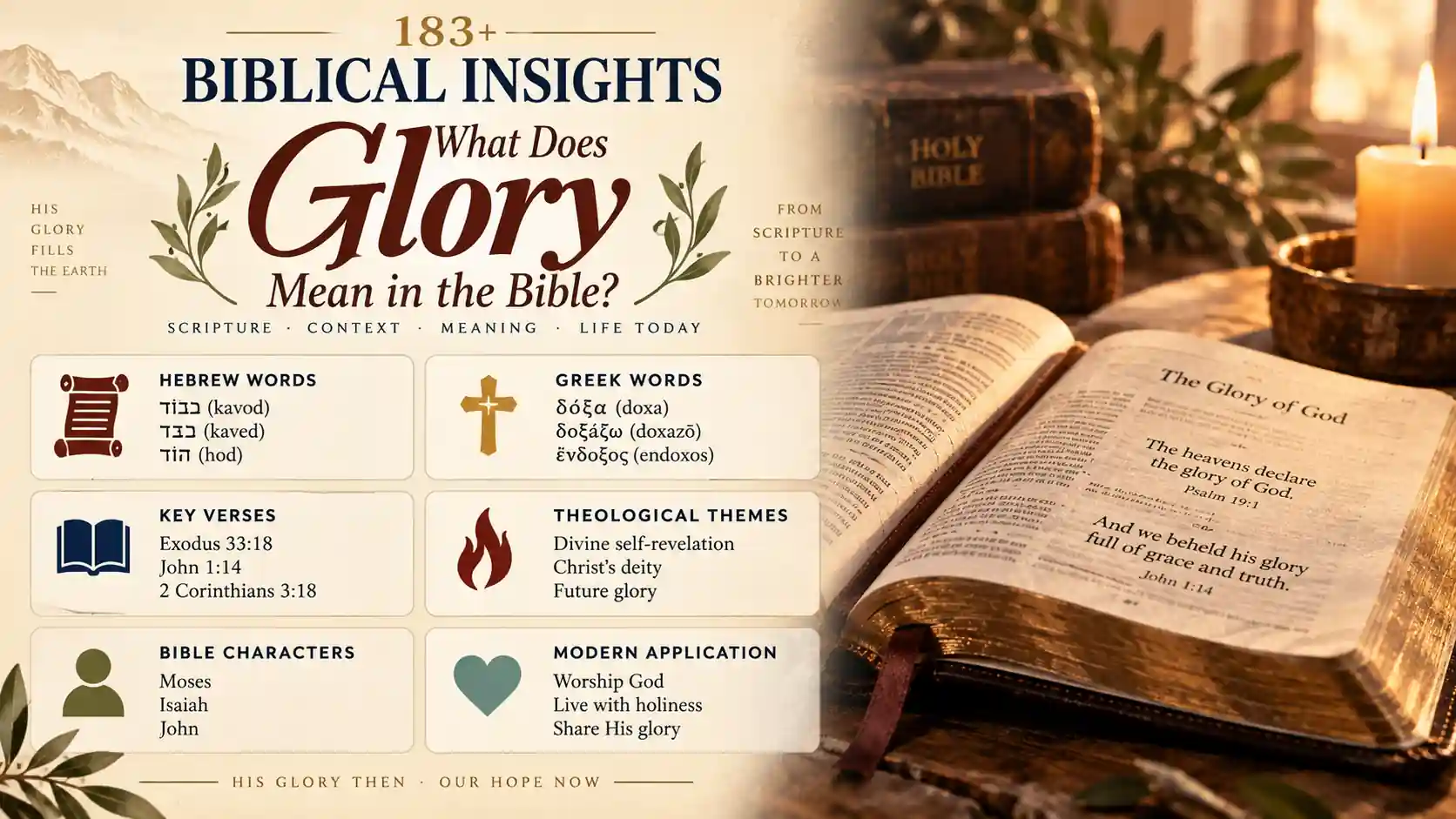
What does glory mean in the Bible? Scripture uses glory to describe weight, honor, splendor, divine presence, revealed character, and the praise rightly given to God. The idea reaches from the visible glory of the Lord at Sinai to the glory revealed in Jesus Christ and promised to believers.
The Bible’s principal words are Hebrew כָּבוֹד (kavod) and Greek δόξα (doxa), but several related terms enrich the picture. As you study them in context, glory emerges not as religious decoration, but as a major biblical theme revealing who God is and how His people respond to Him.
Glory in Key Scripture References
| Verse | Passage Snippet | Context |
|---|---|---|
| Exodus 16:10 | Glory of the LORD appeared | Israel sees divine glory in the wilderness |
| Exodus 24:16-17 | Glory settled on Sinai | God’s covenant presence appears like consuming fire |
| Exodus 33:18 | Show me Your glory | Moses asks for a deeper revelation of God |
| Exodus 40:34-35 | Glory filled the tabernacle | God’s presence consecrates Israel’s sanctuary |
| Psalm 19:1 | Heavens declare God’s glory | Creation displays the Creator’s greatness |
| Isaiah 6:3 | Earth is full of His glory | Seraphim proclaim God’s holiness and majesty |
| Ezekiel 1:28 | Likeness of the LORD’s glory | Ezekiel receives a throne vision during exile |
| John 1:14 | We beheld His glory | God’s glory is revealed in the incarnate Son |
| Romans 3:23 | Fall short of God’s glory | Human sin is measured against God’s holy purpose |
| Revelation 21:23 | Glory of God gives it light | God’s presence illuminates the new Jerusalem |
Glory in Bible Translation Comparison
| Verse | KJV | NIV | ESV | NASB |
|---|---|---|---|---|
| Exodus 33:18 | show me thy glory | show me your glory | show me your glory | show me Your glory |
| Psalm 19:1 | declare the glory of God | declare the glory of God | declare the glory of God | tell of the glory of God |
| Isaiah 6:3 | full of his glory | full of his glory | full of his glory | full of His glory |
| Isaiah 40:5 | glory of the LORD revealed | glory of the LORD revealed | glory of the LORD revealed | glory of the LORD revealed |
| John 1:14 | beheld his glory | seen his glory | seen his glory | saw His glory |
| John 11:40 | see the glory of God | see the glory of God | see the glory of God | see the glory of God |
| Romans 3:23 | come short of glory | fall short of glory | fall short of glory | fall short of glory |
| 2 Corinthians 3:18 | glory to glory | ever-increasing glory | one degree of glory to another | glory to glory |
| Colossians 1:27 | hope of glory | hope of glory | hope of glory | hope of glory |
Glory and the People Who Encountered It
| Person | Role | Connection |
|---|---|---|
| Moses | Covenant mediator | Asked to see God’s glory in Exodus 33 |
| Aaron | High priest | Witnessed divine glory before Israel |
| Solomon | King | Temple filled with glory at its dedication |
| Isaiah | Prophet | Saw the Lord enthroned in radiant holiness |
| Ezekiel | Exilic prophet | Repeatedly saw visions of divine glory |
| Shepherds | Bethlehem witnesses | Saw the glory of the Lord at Jesus’ birth |
| John | Apostle | Testified to Christ’s incarnate glory |
| Peter | Apostle | Witnessed Christ’s majesty at the Transfiguration |
| Paul | Apostle | Presented Christ as Lord of glory |
| Jesus Christ | Son of God | Reveals, possesses, and receives divine glory |
Glory in the Original Hebrew and Greek Words
| Original Word | Transliteration | Strong’s # | Literal Meaning |
|---|---|---|---|
| כָּבוֹד | kavod | H3519 | weight, honor, glory |
| כָּבֵד | kaved | H3513 | to be heavy, honored |
| הוֹד | hod | H1935 | splendor, majesty |
| הָדָר | hadar | H1926 | magnificence, honor |
| תִּפְאָרָה | tipharah | H8597 | beauty, glory, ornament |
| δόξα | doxa | G1391 | glory, honor, splendor |
| δοξάζω | doxazō | G1392 | to glorify, honor |
| ἔνδοξος | endoxos | G1741 | glorious, honored |
| καυχάομαι | kauchaomai | G2744 | boast, glory, rejoice |
Glory and Related Biblical Concepts
| Concept | Connection | Supporting Verse |
|---|---|---|
| Holiness | God’s glory displays His absolute holiness | Isaiah 6:3 |
| Presence | Glory often signifies God’s manifest presence | Exodus 40:34 |
| Name | God’s glory is linked with His revealed character | Exodus 33:18-19 |
| Goodness | Moses’ request for glory receives a revelation of goodness | Exodus 33:18-19 |
| Worship | Seeing God’s majesty calls forth worship | Psalm 29:1-2 |
| Creation | The created order displays God’s glory | Psalm 19:1 |
| Christ | Jesus uniquely reveals divine glory | John 1:14 |
| Cross | Jesus speaks of His death as glorification | John 12:23-28 |
| Transformation | Believers are changed as they behold God’s glory | 2 Corinthians 3:18 |
| Hope | Future glory belongs to God’s redeemed people | Romans 8:18 |
Glory in Historical and Cultural Context
| Aspect | Detail | Biblical Source |
|---|---|---|
| Ancient honor | Glory could describe social honor and reputation | Genesis 45:13 |
| Material abundance | Kavod can refer to wealth or substantial possessions | Genesis 31:1 |
| Sinai | Glory appeared with cloud and consuming fire | Exodus 24:16-17 |
| Wilderness | Israel witnessed glory during God’s provision | Exodus 16:10 |
| Tabernacle | Glory filled Israel’s portable sanctuary | Exodus 40:34-35 |
| Temple | Glory filled Solomon’s temple | 1 Kings 8:10-11 |
| Prophetic visions | Glory appears around God’s heavenly throne | Ezekiel 1:26-28 |
| Exile | Ezekiel sees glory depart from Jerusalem | Ezekiel 10:18-19 |
| Incarnation | Divine glory becomes visible in the Son | John 1:14 |
| Early church | Glory language shapes Christian worship and hope | 2 Corinthians 4:6 |
Glory in Major Theological Themes
| Theme | Explanation | Scripture |
|---|---|---|
| Divine self-revelation | Glory makes God’s greatness known | Exodus 33:18-19 |
| God’s uniqueness | God refuses to yield His divine glory to idols | Isaiah 42:8 |
| Holy presence | Glory accompanies God’s dwelling among His people | Exodus 40:34 |
| Christ’s deity | Christ displays the Father’s glory | John 1:14 |
| Incarnation | Eternal glory is revealed in human flesh | John 1:14 |
| Cross | Christ’s sacrificial hour reveals divine glory | John 12:23 |
| Resurrection | The Father raises Christ in glory | Romans 6:4 |
| Transformation | Christians are conformed increasingly to Christ | 2 Corinthians 3:18 |
| Future inheritance | Present suffering gives way to revealed glory | Romans 8:18 |
| New creation | God’s glory fills the final dwelling of His people | Revelation 21:23 |
Glory in Modern Application for Believers
| Area | Practice | Scripture |
|---|---|---|
| Worship | Give God honor appropriate to His name | Psalm 29:2 |
| Prayer | Seek God’s presence rather than mere benefits | Exodus 33:15-18 |
| Character | Reflect Christ through growing holiness | 2 Corinthians 3:18 |
| Work | Do ordinary tasks for God’s honor | 1 Corinthians 10:31 |
| Humility | Refuse self-exaltation and boast in the Lord | 1 Corinthians 1:31 |
| Suffering | View present trials beside promised glory | Romans 8:18 |
| Witness | Let good works direct attention toward God | Matthew 5:16 |
| Community | Receive fellow believers for God’s glory | Romans 15:7 |
| Hope | Await Christ’s appearing with confidence | Colossians 3:4 |
| Worshipful living | Recognize that everything ultimately belongs to God | Romans 11:36 |
כָּבוֹד Kavod Gives Biblical Glory Its Sense of Weight
The dominant Old Testament noun for glory is כָּבוֹד (kavod), Strong’s H3519. It belongs to a word family associated with heaviness or weight. Depending on context, kavod can describe honor, dignity, abundance, reputation, splendor, or the majestic presence of God. Biblical glory therefore carries a sense of substance rather than superficial brilliance.
This helps explain why God’s glory is so overwhelming in passages such as Exodus 24 and Exodus 40. His glory is not simply bright light. The visible phenomena announce the presence of the God whose holiness, authority, goodness, and majesty possess immeasurable weight. When Scripture commands you to give God glory, you are acknowledging the worth that already belongs to Him.
What Does Glory Mean in the Bible When Moses Asks to See It?
Exodus 33 provides one of Scripture’s clearest interpretations of glory. After Israel’s sin with the golden calf, Moses pleads for God’s presence and then asks, “Show me your glory.” God’s response is revealing. He promises that His goodness will pass before Moses and that He will proclaim His divine name.
Glory here involves God’s self-revelation. Exodus 34 continues the scene as the Lord proclaims Himself compassionate, gracious, patient, faithful, forgiving, and just. You therefore should not separate God’s glory from God’s character. His glory is the majestic manifestation of who He truly is, including both His mercy and His holiness.
From δόξα Doxa to the Glory Revealed in Jesus Christ
The principal New Testament noun is δόξα (doxa), Strong’s G1391. In wider Greek usage its history involved ideas such as opinion or reputation, but New Testament usage frequently carries the biblical sense of honor, splendor, majesty, and divine manifestation shaped by the Greek Old Testament’s use of doxa for Hebrew kavod.
John brings this theme directly to Jesus. John 1:14 says that the Word became flesh and that His disciples saw His glory. Later signs reveal His glory, yet John’s Gospel also connects glorification surprisingly with the cross. Jesus announces that His hour of glorification has come as His sacrificial death approaches.
From Sinai’s Glory to Transformation and the New Jerusalem
Biblical glory develops across the canon without losing its central focus on God. The glory that appears at Sinai fills the tabernacle, fills Solomon’s temple, dominates prophetic visions, and becomes central to Israel’s hope. Ezekiel’s vision is especially dramatic because the glory departs from the polluted temple and later appears in his vision of restoration.
The New Testament presents Christ as the decisive revelation of this divine glory. Believers now behold the Lord’s glory and are transformed “from glory to glory” in 2 Corinthians 3:18. The story finally reaches Revelation 21, where the new Jerusalem requires no created luminary for its ultimate splendor because God’s glory illuminates it and the Lamb is its lamp.
Questions About Glory in the Bible
Does כָּבוֹד (kavod) literally mean “weight” every time it appears?
No. Its word family carries the idea of heaviness, but context can give kavod meanings such as honor, wealth, splendor, reputation, or divine glory.
Why does God answer Moses’ request to see His glory by revealing His goodness in Exodus 33?
Because biblical glory includes God’s revealed character, so His goodness, name, mercy, holiness, and sovereign grace disclose who He is.
Are כָּבוֹד (kavod) and δόξα (doxa) exact equivalents?
Not in every possible context, but the Greek Old Testament regularly uses doxa to represent kavod, strongly shaping New Testament glory language.
Why does John’s Gospel connect Jesus’ glory with the cross instead of only with visible splendor?
John presents the cross as the hour in which Jesus’ obedient love, divine mission, and relationship with the Father are uniquely revealed.
How can you glorify God if God already possesses glory?
You do not add greatness to God. You glorify Him by recognizing, honoring, proclaiming, and living in a way that displays the greatness already His.