
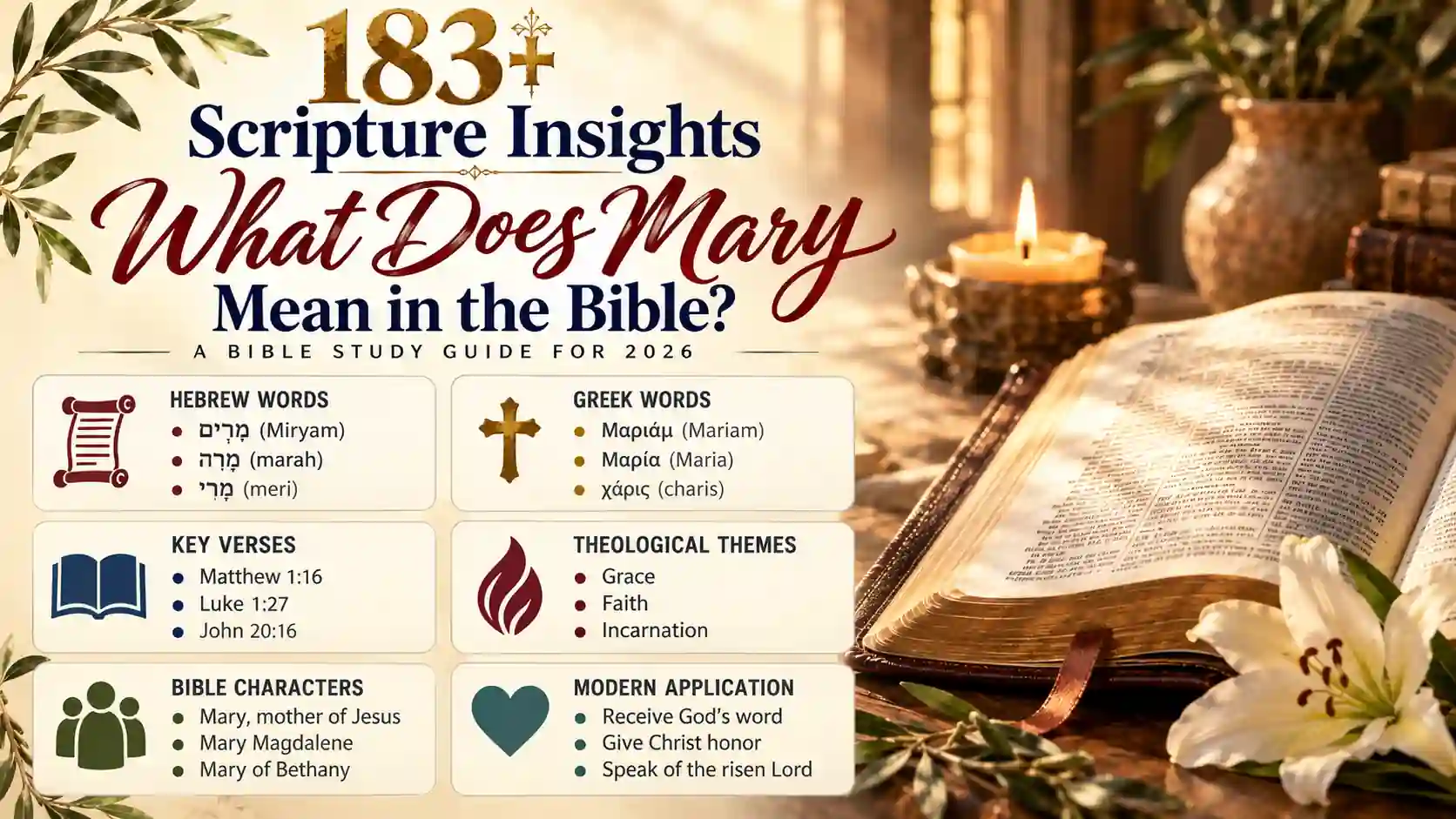
If you are asking what does Mary mean in the Bible, the answer begins with the Hebrew name מִרְיָם (Miryam) and its Greek New Testament forms Μαριάμ (Mariam) and Μαρία (Maria). The precise ancient etymology is uncertain, so meanings such as “bitter,” “rebellious,” and “beloved” should be treated as proposals rather than settled definitions.
Your study also needs to go beyond the name itself. Several women named Mary appear in the New Testament, and their stories illuminate discipleship, suffering, worship, resurrection witness, and faithful devotion to Jesus Christ.
Mary Key Scripture References
| Verse | Passage Snippet | Context |
|---|---|---|
| Matthew 1:16 | Mary, of whom Jesus was born | Jesus’ genealogy identifies Mary |
| Matthew 1:18 | Mary was pledged to Joseph | Jesus’ miraculous conception |
| Luke 1:27 | Virgin named Mary | Gabriel comes to Nazareth |
| Luke 1:30 | Fear not, Mary | Gabriel announces divine favor |
| Luke 1:38 | Servant of the Lord | Mary submits to God’s word |
| Luke 1:46 | My soul magnifies the Lord | Mary begins her praise |
| John 11:2 | Mary anointed the Lord | Mary of Bethany identified |
| John 19:25 | His mother stood nearby | Mary witnesses the crucifixion |
| John 20:16 | Jesus said, Mary | Magdalene meets risen Christ |
| Acts 12:12 | House of Mary | Church gathers for prayer |
Mary Bible Translation Comparison
The following comparison keeps the wording abbreviated. The translations generally preserve Mary rather than attempting to translate the proposed meaning of her name.
| Verse | KJV | NIV | ESV | NASB |
|---|---|---|---|---|
| Matthew 1:16 | Mary | Mary | Mary | Mary |
| Matthew 1:18 | Mary | Mary | Mary | Mary |
| Luke 1:27 | Mary | Mary | Mary | Mary |
| Luke 1:30 | Mary | Mary | Mary | Mary |
| Luke 1:38 | Lord’s handmaid | Lord’s servant | Lord’s servant | Lord’s bond-servant |
| Luke 1:46 | Magnifies | Glorifies | Magnifies | Exalts |
| John 20:16 | Mary | Mary | Mary | Mary |
| Acts 12:12 | Mary | Mary | Mary | Mary |
Mary People and Characters Associated
| Person | Role | Connection |
|---|---|---|
| Mary, mother of Jesus | Mother of Messiah | Conceives Jesus by Holy Spirit |
| Mary Magdalene | Disciple and witness | Encounters risen Jesus |
| Mary of Bethany | Disciple at Bethany | Listens to and anoints Jesus |
| Mary, mother of James | Crucifixion witness | Present among faithful women |
| Mary, mother of John Mark | Jerusalem believer | Hosts praying Christians |
| Mary of Rome | Christian worker | Commended by Paul |
| Joseph | Husband of Mary | Receives Mary faithfully |
| Elizabeth | Mary’s relative | Blesses Mary and her child |
| Martha | Sister of Mary | Shares Bethany household |
| Jesus Christ | Mary’s son and Lord | Central to Mary narratives |
Mary Original Hebrew and Greek Words
| Original Word | Transliteration | Strong’s # | Literal Meaning |
|---|---|---|---|
| מִרְיָם | Miryam | H4813 | Meaning uncertain |
| Μαριάμ | Mariam | G3137 | Greek form of Miriam |
| Μαρία | Maria | G3137 | Variant form of Mariam |
| מָרָה | marah | H4784 | To be bitter |
| מָרַר | marar | H4843 | To be bitter |
| מְרִי | meri | H4805 | Rebellion |
| χάρις | charis | G5485 | Grace, favor |
| παρθένος | parthenos | G3933 | Virgin |
| δούλη | doulē | G1399 | Female servant |
| μακαρίζω | makarizō | G3106 | Call blessed |
The last seven entries are related lexical terms, not alternate spellings of Mary. They help distinguish uncertain name-etymology proposals from words actually used in passages concerning Mary.
Mary Related Biblical Concepts
| Concept | Connection | Supporting Verse |
|---|---|---|
| Virgin conception | Mary conceives by Holy Spirit | Luke 1:34-35 |
| Divine favor | Gabriel addresses Mary graciously | Luke 1:28-30 |
| Obedience | Mary receives God’s word | Luke 1:38 |
| Praise | Mary magnifies God | Luke 1:46-55 |
| Incarnation | Jesus is born from Mary | Galatians 4:4 |
| Discipleship | Mary listens at Jesus’ feet | Luke 10:39 |
| Worship | Bethany Mary anoints Jesus | John 12:3 |
| Crucifixion | Marys remain near Jesus | John 19:25 |
| Resurrection | Magdalene encounters Jesus | John 20:16-18 |
| Prayer | Mark’s mother hosts believers | Acts 12:12 |
Mary Historical and Cultural Context
| Aspect | Detail | Biblical Source |
|---|---|---|
| Jewish naming | Mary reflects Hebrew Miryam | Luke 1:27 |
| Nazareth | Mary lives in Galilee | Luke 1:26-27 |
| Betrothal | Mary is pledged to Joseph | Matthew 1:18 |
| Davidic setting | Joseph belongs to David’s house | Luke 1:27 |
| Kinship | Mary visits Elizabeth | Luke 1:36, 39 |
| Bethlehem | Jesus is born there | Luke 2:4-7 |
| Purification | Family observes Torah practice | Luke 2:22-24 |
| Bethany | Another Mary lives near Jerusalem | John 11:1 |
| Burial customs | Magdalene visits Jesus’ tomb | John 20:1 |
| House churches | Mary hosts believers | Acts 12:12 |
Mary Theological Themes
| Theme | Explanation | Scripture |
|---|---|---|
| Grace | God graciously favors Mary | Luke 1:28-30 |
| Christology | Mary bears Jesus the Messiah | Luke 1:31-35 |
| Holy Spirit | Conception is God’s work | Luke 1:35 |
| Faith | Mary accepts God’s promise | Luke 1:38 |
| Reversal | God lifts the humble | Luke 1:48-52 |
| Covenant mercy | Mary recalls Abrahamic promise | Luke 1:54-55 |
| Discipleship | Hearing Jesus takes priority | Luke 10:39-42 |
| Sacrificial devotion | Mary anoints Jesus | John 12:3-8 |
| Resurrection | Magdalene announces risen Christ | John 20:17-18 |
| Christian service | Mary of Rome labors faithfully | Romans 16:6 |
Mary Modern Application for Believers
| Area | Practice | Scripture |
|---|---|---|
| Scripture | Receive God’s word faithfully | Luke 1:38 |
| Worship | Magnify God rather than self | Luke 1:46 |
| Humility | Remember God exalts the lowly | Luke 1:48-52 |
| Trust | Believe God can fulfill promises | Luke 1:37 |
| Learning | Sit attentively under Christ’s word | Luke 10:39 |
| Devotion | Give Christ costly honor | John 12:3 |
| Suffering | Remain faithful near the cross | John 19:25 |
| Witness | Speak of the risen Lord | John 20:18 |
| Prayer | Gather with other believers | Acts 12:12 |
| Service | Labor for fellow Christians | Romans 16:6 |
What Does Mary Mean in the Bible and How Certain Is the Meaning?
The biblical name Mary comes through Greek Μαριάμ (Mariam) or Μαρία (Maria), Strong’s G3137, corresponding to Hebrew מִרְיָם (Miryam), Strong’s H4813. Miriam is already familiar from the Old Testament as the sister of Moses and Aaron. By the New Testament period, the related Greek forms were common Jewish female names.
You will sometimes see Mary defined confidently as “bitter,” “rebellious,” “beloved,” or even “wished-for child.” Those definitions represent different etymological proposals rather than an explicit biblical interpretation. Scripture never pauses to define Mary’s name, and the ancient linguistic origin of Miryam remains disputed. A careful Bible study should therefore distinguish lexical certainty from devotional tradition.
From מִרְיָם Miryam to Μαριάμ Mariam
The connection between מִרְיָם (Miryam) and Μαριάμ (Mariam) explains why English Bibles contain both Miriam and Mary. They are historically related forms of the same ancient name. The change does not mean that New Testament Mary received a new theological title. It reflects the movement of a Semitic name into a Greek-speaking environment.
This matters especially when studying proposed connections with Hebrew words such as מְרִי (meri, “rebellion”) or roots associated with bitterness. Similar sounds can suggest possible etymologies, but similarity alone does not establish a definition. The safest conclusion is that Mary represents the Hebrew name Miryam, while its earliest literal derivation is uncertain.
Mary of Nazareth and the Covenant Hope of Luke 1
When you ask what Mary means biblically, Luke’s Gospel directs attention from speculative name meanings toward what God does through Mary. Gabriel announces that she will conceive Jesus, who will receive David’s throne and be called the Son of the Most High. Mary responds, “Behold the handmaid of the Lord” in the KJV, expressing humble submission to God’s word.
Her Magnificat in Luke 1:46-55 then places her story inside Israel’s covenant history. Mary praises God for mercy, remembers His promises, speaks of Abraham, and celebrates God’s concern for the humble. Her significance therefore arises not from a hidden meaning encoded in her name, but from her place within the fulfillment of God’s promises through Jesus.
The Many Marys Who Follow Jesus in the New Testament
You should also avoid treating every New Testament Mary as the same woman. Mary the mother of Jesus, Mary Magdalene, Mary of Bethany, Mary the mother of James, Mary the mother of John Mark, and the Mary greeted in Romans 16:6 represent distinct people or contexts. Their shared name demonstrates how familiar the name had become.
Their stories nevertheless converge around Christ. Mary of Bethany listens at Jesus’ feet and later anoints Him. Mary Magdalene witnesses His death and encounters the risen Lord. Mary the mother of Jesus remains present near the cross, while another Mary provides a home where Jerusalem Christians gather. Together, these passages associate women named Mary with hearing, worship, suffering, witness, prayer, and service.
Questions Bible Students Ask About Mary
Does Mary literally mean “bitter” in Hebrew?
Not with certainty. A connection with Hebrew roots concerning bitterness has been proposed, but the etymology of מִרְיָם (Miryam) remains disputed.
Are Μαριάμ Mariam and Μαρία Maria two different biblical names?
They are Greek forms of the same underlying name, represented together under Strong’s G3137 and rendered “Mary” in English New Testaments.
Why does Luke 1:38 call Mary a handmaid, servant, or bond-servant in different translations?
These renderings express Greek δούλη (doulē), the feminine form associated with Strong’s G1399, emphasizing Mary’s humble identification as the Lord’s servant.
Does Luke 1:48 saying generations will call Mary “blessed” explain the meaning of her name?
No. The verse describes Mary’s blessed condition because of God’s gracious action toward her, rather than providing an etymological definition of Mariam.
What is the safest biblical answer to what Mary means?
Mary is the English form of Greek Μαριάμ (Mariam) or Μαρία (Maria), corresponding to Hebrew מִרְיָם (Miryam); its ultimate literal etymology is uncertain, while Scripture clearly emphasizes faithful participation in God’s work.