
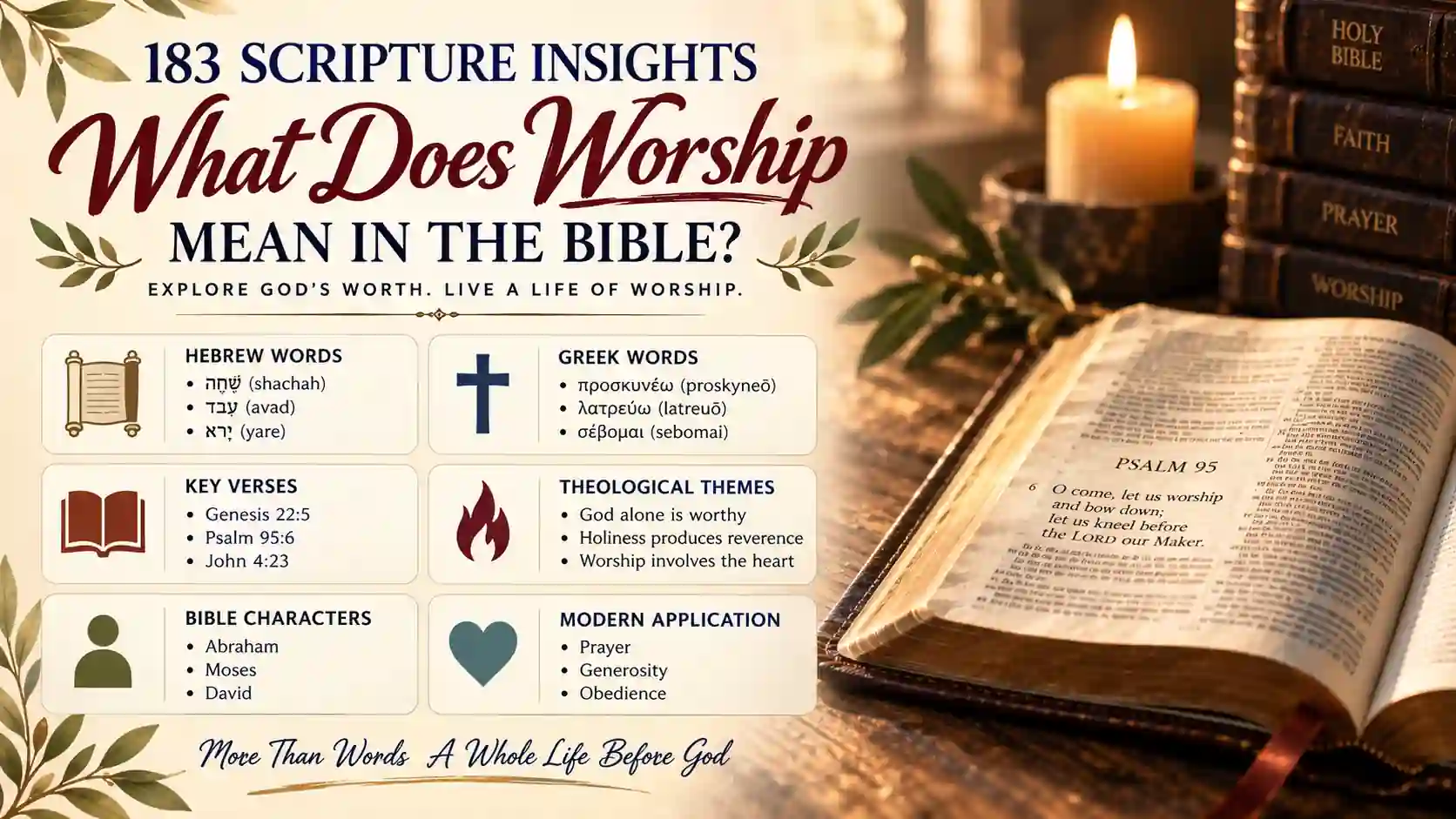
What does worship mean in the Bible? Scripture presents worship as far more than singing, music, or a weekly church gathering. Biblical worship involves bowing before God, serving Him faithfully, praising His character, offering grateful sacrifice, and ordering your whole life around His worth.
The Hebrew and Greek vocabulary adds important depth to your study. Words such as שָׁחָה, shachah, and προσκυνέω, proskyneō, describe bowing or prostration, while עָבַד, avad, and λατρεύω, latreuō, emphasize service. Together they show worship as reverence expressed through allegiance, obedience, praise, sacrifice, and faithful living.
Worship in Key Scripture References
| Verse | Passage Snippet | Context |
|---|---|---|
| Genesis 22:5 | “I and the lad will go…and worship” | Abraham describes approaching God during the Isaac narrative |
| Exodus 34:8 | Moses “bowed his head…and worshipped” | Moses responds to God revealing His name and character |
| Psalm 95:6 | “come, let us worship and bow down” | Israel is summoned to kneel before its Creator and Shepherd |
| Isaiah 6:1-5 | “Holy, holy, holy” | Isaiah encounters God’s holiness in the temple vision |
| Matthew 4:10 | “Worship the Lord your God” | Jesus rejects Satan’s demand for false worship |
| John 4:23 | “true worshipers” | Jesus teaches the Samaritan woman about worship in spirit and truth |
| Romans 12:1 | “your…service” | Paul describes bodily self-offering as worshipful service |
| Revelation 4:10-11 | “worship him that liveth” | Heavenly elders worship God as Creator |
Worship in Bible Translation Comparison
| Verse | KJV | NIV | ESV | NASB |
|---|---|---|---|---|
| Genesis 22:5 | “go yonder and worship” | “worship and then…come back” | “worship and come again” | “worship and return” |
| Psalm 95:6 | “worship and bow down” | “bow down in worship” | “worship and bow down” | “worship and bow down” |
| Matthew 4:10 | “worship the Lord thy God” | “Worship the Lord your God” | “worship the Lord your God” | “worship the Lord your God” |
| John 4:23 | “worship…in spirit and in truth” | “worship…in the Spirit and in truth” | “worship…in spirit and truth” | “worship…in spirit and truth” |
| Acts 13:2 | “ministered to the Lord” | “worshiping the Lord” | “worshiping the Lord” | “serving the Lord” |
| Romans 12:1 | “reasonable service” | “true and proper worship” | “spiritual worship” | “spiritual service of worship” |
| Hebrews 12:28 | “serve God acceptably” | “worship God acceptably” | “offer to God acceptable worship” | “offer to God an acceptable service” |
| Revelation 22:9 | “worship God” | “Worship God!” | “Worship God.” | “Worship God!” |
People and Characters Associated with Worship
| Person | Role | Connection |
|---|---|---|
| Abraham | Patriarch | Used worship language while approaching Mount Moriah |
| Moses | Covenant mediator | Bowed before God after the revelation of divine mercy |
| David | King and psalmist | Organized praise and repeatedly called Israel to worship |
| Asaph | Worship leader | Composed psalms reflecting temple praise and covenant faith |
| Isaiah | Prophet | Responded to God’s holiness with confession and surrender |
| Jesus | Messiah | Taught that God alone must be worshiped |
| Samaritan woman | Listener of Jesus | Received teaching on worship in spirit and truth |
| John | Apostle | Witnessed heavenly worship and was corrected when he bowed to an angel |
Original Hebrew and Greek Words for Worship
| Original Word | Transliteration | Strong’s # | Literal Meaning |
|---|---|---|---|
| שָׁחָה | shachah | H7812 | Bow down, prostrate oneself |
| עָבַד | avad | H5647 | Work, serve |
| יָרֵא | yare | H3372 | Fear, revere |
| בָּרַךְ | barak | H1288 | Bless, kneel |
| תְּהִלָּה | tehillah | H8416 | Praise, song of praise |
| προσκυνέω | proskyneō | G4352 | Bow before, prostrate oneself |
| λατρεύω | latreuō | G3000 | Serve, render sacred service |
| σέβομαι | sebomai | G4576 | Revere, worship |
Related Biblical Concepts of Worship
| Concept | Connection | Supporting Verse |
|---|---|---|
| Holiness | Worship responds to God’s unique holiness | Isaiah 6:3 |
| Reverence | God’s majesty calls for holy fear | Hebrews 12:28 |
| Sacrifice | Offerings expressed devotion under the covenant | Leviticus 1:3-9 |
| Obedience | Submission matters more than empty ritual | 1 Samuel 15:22 |
| Praise | God’s works and character invite proclamation | Psalm 150:1-6 |
| Thanksgiving | Gratitude belongs in God’s presence | Psalm 100:4 |
| Service | Worship includes serving God faithfully | Deuteronomy 6:13 |
| Truth | Genuine worship accords with God’s revelation | John 4:24 |
Historical and Cultural Context of Worship
| Aspect | Detail | Biblical Source |
|---|---|---|
| Patriarchal altars | Abraham built altars at places of divine encounter | Genesis 12:7-8 |
| Tabernacle | Israel worshiped around God’s covenant presence | Exodus 25:8-9 |
| Priesthood | Priests served in sacrifices and sanctuary ministry | Leviticus 8 |
| Sacrificial system | Offerings included burnt, grain, peace, sin, and guilt offerings | Leviticus 1-7 |
| Jerusalem temple | Central sanctuary shaped Israel’s national worship | 1 Kings 8 |
| Psalms | Songs guided communal praise, lament, thanksgiving, and trust | Psalms 95 to 100 |
| Synagogue setting | Scripture reading and instruction marked Jewish gatherings | Luke 4:16-21 |
| Early church | Prayer, teaching, fellowship, and breaking bread shaped gatherings | Acts 2:42 |
Theological Themes within Biblical Worship
| Theme | Explanation | Scripture |
|---|---|---|
| God alone is worthy | Biblical worship excludes rival gods and idols | Exodus 20:3-5 |
| Creation grounds worship | The Creator deserves honor from His creatures | Revelation 4:11 |
| Redemption inspires praise | God’s saving acts become reasons for worship | Exodus 15:1-2 |
| Holiness produces reverence | God’s purity exposes human sinfulness | Isaiah 6:1-5 |
| Worship involves the heart | External ritual without sincerity is condemned | Isaiah 29:13 |
| Christ receives worship | Jesus is worshiped in significant New Testament scenes | Matthew 14:33 |
| Worship involves sacrifice | Christian devotion includes self-offering | Romans 12:1 |
| Worship reaches all nations | Revelation pictures every people worshiping before God | Revelation 7:9-12 |
Modern Application of Worship for Believers
| Area | Practice | Scripture |
|---|---|---|
| Prayer | Approach God with reverence and dependence | Matthew 6:9 |
| Singing | Sing psalms, hymns, and spiritual songs | Colossians 3:16 |
| Scripture | Let God’s Word shape your response to Him | Colossians 3:16 |
| Work | Serve wholeheartedly as serving the Lord | Colossians 3:23 |
| Generosity | Give willingly as an act of grace | 2 Corinthians 9:7 |
| Holiness | Offer your body to God in faithful obedience | Romans 12:1 |
| Gratitude | Give thanks in every circumstance | 1 Thessalonians 5:18 |
| Community | Gather to encourage fellow believers | Hebrews 10:24-25 |
שָׁחָה Shachah Shows That Worship Begins with Bowing Before God
The Hebrew verb שָׁחָה, shachah, H7812, is one of the Old Testament’s central words connected with worship. Its basic imagery is physical and relational. A person bows low, prostrates himself, or places himself in a posture of submission before someone greater.
That helps explain scenes such as Exodus 34:8. After God proclaims His compassionate, gracious, patient, and covenantally faithful character, Moses quickly bows to the ground and worships. His physical posture corresponds to an inward recognition that the Lord is sovereign and worthy of reverence.
Worship, then, begins with recognizing who God is. Psalm 95 joins worship with bowing and kneeling before “the LORD our maker.” The emphasis is not on producing a particular emotional state. You worship because the Creator possesses an authority, goodness, and majesty that call for humble submission.
This also explains why biblical authors treat idolatry so seriously. Bowing before another god is not merely performing the wrong religious ceremony. It signifies misplaced allegiance. When Jesus cites Deuteronomy during His temptation, He insists that worship and service belong exclusively to the Lord.
עָבַד Avad and λατρεύω Latreuō Connect Worship with Service
The biblical meaning of worship also includes service. Hebrew עָבַד, avad, H5647, can describe ordinary work, servitude, or service rendered to God. In covenant passages, Israel is repeatedly called to serve the Lord rather than the gods of surrounding nations.
This vocabulary prevents you from reducing worship to songs. Singing certainly belongs within biblical worship, but worship also involves whom you obey, whose purposes you serve, and to whom you give your loyalty. Joshua’s challenge to “serve the LORD” makes worship a matter of covenant allegiance.
The Greek verb λατρεύω, latreuō, G3000, similarly refers to service, especially religious service offered to God. Translation differences in passages such as Romans 12:1 and Hebrews 12:28 reveal how closely the New Testament connects the ideas of worship and sacred service.
Romans 12:1 is especially significant. Paul calls believers to present their bodies as a living sacrifice, holy and acceptable to God. Worship therefore reaches into embodied life. Your choices, relationships, work, purity, generosity, and obedience can all express devotion to God.
What Does Worship Mean in the Bible Through Jesus’ Teaching in John 4?
Jesus’ conversation with the Samaritan woman occurs against a real dispute about sacred geography. Samaritans associated legitimate worship with Mount Gerizim, while Jewish worship centered on Jerusalem. The woman therefore asks a question rooted in centuries of religious division.
Jesus does not merely choose one mountain. He announces an approaching redemptive change in which true worshipers will worship the Father “in spirit and truth.” God is spirit, so true worship cannot finally be confined to a particular sacred location.
“Spirit and truth” should not be reduced to sincerity alone. Biblical worship must correspond to the reality God has revealed. Jesus places this teaching within His own messianic mission, and the Gospel of John consistently presents Him as the one through whom the Father is made known.
For your study, John 4 shows that worship is both inward and truth-governed. External forms cannot substitute for genuine devotion, yet sincerity cannot replace revealed truth. Christian worship responds to the Father according to the revelation brought through the Son.
From Temple Sacrifice to the Living Sacrifice of Romans 12
Old Testament worship frequently involved altars, priests, sacrifices, appointed festivals, sacred space, and covenant regulations. These practices taught Israel that approaching the holy God was not casual. Sin, cleansing, thanksgiving, fellowship, and consecration all appeared within Israel’s worship.
The Psalms add another dimension. Worship includes lament, confession, thanksgiving, joyful praise, remembrance, awe, and trust. Biblical worship therefore has room for both celebration and sorrow because both can be directed faithfully toward God.
The New Testament presents Jesus in relation to the fulfillment of Israel’s sacrificial and priestly patterns, especially in Hebrews. Believers no longer approach God through repeated animal sacrifices. Hebrews points instead to Christ’s decisive priestly work and calls God’s people to grateful, reverent service.
That movement helps explain Romans 12. A living sacrifice is not an attempt to earn redemption. It is the fitting response of people who have received God’s mercies. Biblical worship is therefore responsive. God reveals, creates, saves, provides, forgives, and reigns, and His people answer with praise, trust, obedience, and self-offering.
Questions About Worship in the Bible
Does שָׁחָה, shachah, always mean worshiping God?
No. The word can describe bowing before human authorities as well, so context determines whether the action is religious worship.
Why does Romans 12:1 say “service,” “worship,” or “service of worship” in different translations?
The Greek expression includes λατρεία, latreia, language of sacred service, which allows translators to emphasize either service or worship.
What does προσκυνέω, proskyneō, add to the New Testament meaning of worship?
It emphasizes bowing or prostrating oneself before another and often expresses reverence, submission, or worship depending on the object and context.
Does John 4:24 mean physical gatherings and outward practices no longer matter?
No. Jesus rejects worship limited by sacred geography, while the wider New Testament still portrays believers praying, singing, learning, sharing the Lord’s Supper, and gathering together.
Can everyday obedience really be considered worship?
Yes. Romans 12:1 connects bodily self-offering with worshipful service, showing that devotion to God extends beyond a worship gathering into the whole life of the believer.