
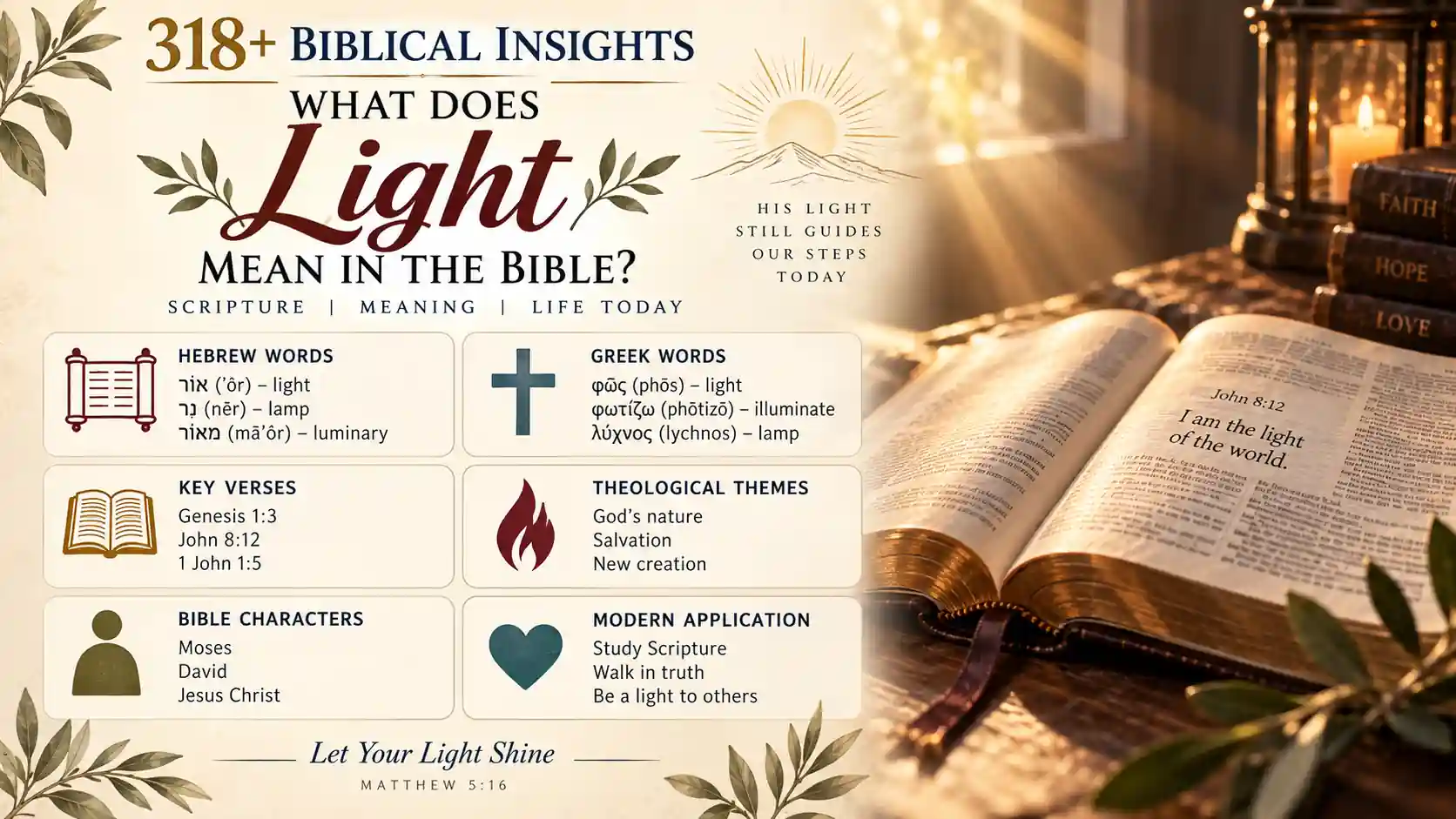
What does light mean in the Bible? Scripture uses light literally for created brightness, lamps, fire, and heavenly bodies, but its deeper significance reaches into revelation, holiness, salvation, wisdom, divine presence, and eternal life. From God’s first command in Genesis to the radiant New Jerusalem in Revelation, light repeatedly reveals what God is doing.
Your study becomes richer when you follow the Hebrew אוֹר (ʾôr) and Greek φῶς (phōs) through Scripture. Light comes from God, exposes darkness, guides His people, describes Christ, and characterizes faithful Christian living.
Key Light Scripture References
| Verse | Passage Snippet | Context |
|---|---|---|
| Genesis 1:3 | “Let there be light” | God introduces light into creation before appointing the heavenly luminaries. |
| Exodus 13:21 | Pillar of fire | God’s presence gives Israel light for wilderness travel. |
| Psalm 27:1 | “The LORD is my light” | David connects divine light with salvation and freedom from fear. |
| Psalm 119:105 | “lamp unto my feet” | God’s word provides moral and practical guidance. |
| Isaiah 9:2 | “a great light” | Hope dawns upon people living in deep darkness. |
| Isaiah 60:1 | “thy light is come” | Zion’s restoration is pictured as the arrival of divine glory. |
| John 1:4-5 | Light shines in darkness | John’s Gospel connects life, revelation, and Christ’s victorious light. |
| John 8:12 | “light of the world” | Jesus presents Himself as the source of life-giving illumination. |
| 1 John 1:5 | “God is light” | Light expresses God’s holy and truthful character. |
| Revelation 21:23 | Glory gives it light | God’s final city needs no sun because divine glory illuminates it. |
Light Bible Translation Comparison
| Verse | KJV | NIV | ESV | NASB |
|---|---|---|---|---|
| Genesis 1:3 | “Let there be light” | “Let there be light” | “Let there be light” | “Let there be light” |
| Psalm 27:1 | “LORD is my light” | “LORD is my light” | “LORD is my light” | “LORD is my light” |
| Isaiah 9:2 | “seen a great light” | “have seen a great light” | “have seen a great light” | “will see a great light” |
| Matthew 5:14 | “light of the world” | “light of the world” | “light of the world” | “light of the world” |
| John 1:5 | “shineth in darkness” | “shines in the darkness” | “shines in the darkness” | “shines in the darkness” |
| John 8:12 | “light of the world” | “light of the world” | “light of the world” | “light of the world” |
| 1 John 1:5 | “God is light” | “God is light” | “God is light” | “God is Light” |
| Revelation 21:23 | “Lamb is the light” | “Lamb is its lamp” | “lamp is the Lamb” | “lamp is the Lamb” |
People and Characters Associated with Light
| Person | Role | Connection |
|---|---|---|
| God | Creator | Commands light into existence and is described as light. |
| Moses | Covenant mediator | Encounters God’s radiant presence and receives divine revelation. |
| David | King and psalmist | Calls the Lord his light and salvation. |
| Isaiah | Prophet | Uses light for messianic salvation, restoration, and God’s glory. |
| John the Baptist | Witness | Bears testimony concerning the true Light rather than being that Light. |
| Jesus Christ | Messiah | Identifies Himself as the Light of the World. |
| Paul | Apostle | Connects creation’s light with God’s illumination of believing hearts. |
| John | Apostle | Develops light as a major theme of Christ, truth, holiness, and fellowship. |
Original Hebrew and Greek Light Words
| Original Word | Transliteration | Strong’s # | Literal Meaning |
|---|---|---|---|
| אוֹר | ʾôr | H216 | Light, illumination |
| נֵר | nēr | H5216 | Lamp, light |
| מָאוֹר | māʾôr | H3974 | Luminary, light-bearer |
| נָגַהּ | nāgah | H5050 | Shine, illuminate |
| φῶς | phōs | G5457 | Light, luminousness |
| φωτίζω | phōtizō | G5461 | Illuminate, enlighten |
| φωστήρ | phōstēr | G5458 | Luminary, light-giver |
| λύχνος | lychnos | G3088 | Lamp |
אוֹר (ʾôr), Strong’s H216, covers ordinary illumination as well as figurative ideas including life, instruction, divine favor, salvation, and God’s guiding presence. The noun מָאוֹר (māʾôr) specifically denotes a luminary or light-bearing source, while נֵר (nēr) commonly refers to a lamp.
In Greek, φῶς (phōs), Strong’s G5457, is the central New Testament noun for light. Related vocabulary includes φωτίζω (phōtizō), “to illuminate,” φωστήρ (phōstēr), a luminary, and λύχνος (lychnos), an oil-fed lamp.
Related Biblical Light Concepts
| Concept | Connection | Supporting Verse |
|---|---|---|
| Creation | Light demonstrates God’s creative authority. | Genesis 1:3 |
| Life | Light becomes an image of life received from God. | John 1:4 |
| Truth | Light reveals reality instead of concealing it. | John 3:20-21 |
| God’s Word | Scripture illuminates the believer’s path. | Psalm 119:105 |
| Righteousness | The righteous path resembles increasing daylight. | Proverbs 4:18 |
| Salvation | God’s saving intervention is pictured as dawning light. | Isaiah 9:2 |
| Witness | Disciples display God’s goodness before others. | Matthew 5:14-16 |
| Fellowship | Walking in light accompanies fellowship and cleansing. | 1 John 1:7 |
| Glory | God’s presence produces overwhelming radiance. | Revelation 21:23 |
Historical and Cultural Context of Light
| Aspect | Detail | Biblical Source |
|---|---|---|
| Household lamps | Small lamps illuminated otherwise dark homes. | Matthew 5:15 |
| Lampstands | Lamps were elevated so their light could spread. | Luke 8:16 |
| Olive oil | Pure beaten olive oil supplied sanctuary lamps. | Exodus 27:20 |
| Tabernacle | Priests maintained lamps before the Lord. | Leviticus 24:2-4 |
| Menorah | Seven lamps illuminated sacred space. | Numbers 8:2 |
| Wilderness | Fire provided Israel with light by night. | Exodus 13:21 |
| Temple worship | Lampstands remained part of Israel’s sanctuary symbolism. | 1 Kings 7:49 |
| Night travel | A lamp naturally pictured guidance along a path. | Psalm 119:105 |
| Messianic age | Prophets portrayed restoration as light replacing darkness. | Isaiah 60:19-20 |
Theological Themes of Light
| Theme | Explanation | Scripture |
|---|---|---|
| Divine nature | God is characterized by absolute light without moral darkness. | 1 John 1:5 |
| Christology | Jesus embodies God’s saving and revealing light. | John 8:12 |
| Revelation | Light makes truth visible and understandable. | John 1:9 |
| Holiness | Light contrasts with sinful works associated with darkness. | Ephesians 5:8-11 |
| Salvation | Redemption transfers people from darkness into light. | 1 Peter 2:9 |
| New creation | Creation’s first light echoes in spiritual illumination. | 2 Corinthians 4:6 |
| Mission | Christ’s followers shine before the surrounding world. | Matthew 5:16 |
| Judgment | Light exposes deeds people would rather conceal. | John 3:19-21 |
| Consummation | God’s glory permanently illuminates the New Jerusalem. | Revelation 21:23 |
Modern Application of Light for Believers
| Area | Practice | Scripture |
|---|---|---|
| Bible study | Let Scripture guide decisions and convictions. | Psalm 119:105 |
| Character | Reject conduct Scripture identifies with darkness. | Ephesians 5:8 |
| Confession | Bring sin openly before God rather than hiding it. | 1 John 1:7-9 |
| Witness | Make good works visible without seeking personal glory. | Matthew 5:16 |
| Discernment | Test what is pleasing to the Lord. | Ephesians 5:10 |
| Relationships | Practice truthful fellowship with other believers. | 1 John 1:7 |
| Suffering | Trust God’s presence when circumstances feel dark. | Micah 7:8 |
| Mission | Proclaim God’s saving work to those called from darkness. | 1 Peter 2:9 |
| Hope | Anticipate the world permanently illuminated by God’s glory. | Revelation 22:5 |
What Does Light Mean in the Bible Through אוֹר And φῶς?
The Hebrew אוֹר (ʾôr) begins with physical light in Genesis 1, but Scripture quickly develops the image. Light can represent life, divine favor, instruction, deliverance, righteousness, and the presence of the Lord. The image works because physical light enables sight. Spiritually, God enables His people to see reality according to His truth.
The Greek φῶς (phōs) carries this biblical imagery into the New Testament. John especially connects light with divine life and revelation. When Jesus declares, “I am the light of the world,” He does more than offer moral instruction. He presents Himself as the One through whom people receive true life and escape spiritual darkness.
From Genesis Light to the Light of the World
Genesis 1 establishes an essential foundation. God does not struggle against darkness as though darkness were an equal power. He speaks, and light appears. The later creation of the sun, moon, and other luminaries in Genesis 1:14-18 reinforces the Creator’s authority over every source of physical illumination.
John’s Gospel intentionally places creation language beside Christ. “In the beginning” recalls Genesis, while life and light identify the Word as the source through whom creation and revelation come. Darkness opposes the light, yet it cannot extinguish the light that shines in Christ.
Isaiah’s Great Light and Messianic Salvation
Isaiah gives light a strong redemptive dimension. People walking in darkness see a great light in Isaiah 9:2, while the Servant is appointed as a light to the nations in Isaiah 42:6 and 49:6. Light therefore becomes more than private spiritual insight. It signals God’s saving purpose extending beyond Israel to the nations.
This prophetic background helps you hear Jesus’ claim in John 8:12 with greater depth. Following Him means possessing “the light of life.” Christian theology therefore does not treat illumination as merely acquiring information. Biblical light leads you toward the person of Christ, in whom God’s character, salvation, and truth are made known.
Walking in the Light from 1 John to Revelation
First John turns the theology of light into a test of lived fellowship. Because “God is light,” claiming fellowship with Him while persistently walking in darkness creates a contradiction. Walking in the light does not mean claiming sinless perfection. The surrounding passage speaks plainly about confession, cleansing, and Christ’s atoning work.
Revelation completes the theme on a cosmic scale. The biblical story begins with God commanding light and ends with a city that no longer depends on ordinary lamps or the sun for its ultimate illumination. God’s glory fills the city, and the Lamb is its lamp. Creation, redemption, holiness, and eternal fellowship finally meet in uninterrupted light.
Frequently Asked Questions About Biblical Light
Is אוֹר (ʾôr) in Genesis 1:3 the same Hebrew word used for spiritual light?
Yes. H216 can describe physical illumination, but biblical writers also use אוֹר for divine guidance, life, salvation, instruction, and God’s favorable presence.
What is the difference between φῶς (phōs) and λύχνος (lychnos)?
φῶς usually means light itself, while λύχνος refers more specifically to a lamp that produces or carries light.
Why does Revelation 21:23 call the Lamb a “light” in the KJV but a “lamp” in many modern translations?
The Greek noun is λύχνος (lychnos), which more specifically means “lamp,” explaining why NIV, ESV, and NASB use that wording.
Does “God is light” in 1 John 1:5 mean God is literally physical light?
No. In context, light expresses God’s perfect holiness, truth, revelation, and complete absence of moral darkness.
How can you practically “walk in the light” according to 1 John 1:7?
You live openly before God in truth, reject hidden sin, confess failure, trust Christ’s cleansing work, and pursue sincere fellowship with His people.