
Death is the one appointment every person keeps, and Scripture treats it with rare honesty. When you ask what does death mean in the Bible, you find more than a biological event. You find an enemy, a consequence, a sleep, and a defeated foe.
From Eden’s warning to Revelation’s promise of no more tears, the Bible traces death’s origin in sin and its destruction in Christ. This study walks you through the verses, the original words, and the hope that changes how you face your final day.
Key Scripture References on Death
| Verse | Passage Snippet | Context |
|---|---|---|
| Genesis 2:17 | “you shall surely die” | God’s warning before the fall |
| Genesis 3:19 | “dust you are, to dust return” | Judgment pronounced on Adam |
| Psalm 23:4 | “valley of the shadow of death” | David’s trust in dark danger |
| Psalm 116:15 | “precious in the sight of the Lord” | Worth of a saint’s homegoing |
| Ecclesiastes 3:2 | “a time to be born, a time to die” | Seasons appointed by God |
| Ecclesiastes 12:7 | “the dust returns to the earth” | The body’s end at death |
| Romans 5:12 | “death through sin spread to all” | Adam’s fall reaching all people |
| Romans 6:23 | “the wages of sin is death” | Sin’s payment versus God’s gift |
| 1 Corinthians 15:26 | “the last enemy to be destroyed” | Death’s final defeat promised |
| Revelation 20:14 | “This is the second death” | Judgment at the great white throne |
Bible Translation Comparison on Death
| Verse | KJV | NIV | ESV | NASB |
|---|---|---|---|---|
| Romans 6:23 | “For the wages of sin is death” | “For the wages of sin is death” | “For the wages of sin is death” | “For the wages of sin is death” |
| 1 Corinthians 15:55 | “O death, where is thy sting” | “Where, O death, is your sting” | “O death, where is your sting” | “Where, O death, is your sting” |
| John 11:25 | “though he were dead, yet shall he live” | “will live, even though they die” | “though he die, yet shall he live” | “will live, even if he dies” |
| Psalm 23:4 | “valley of the shadow of death” | “darkest valley” | “valley of the shadow of death” | “valley of the shadow of death” |
| Genesis 2:17 | “thou shalt surely die” | “you will certainly die” | “you shall surely die” | “you will certainly die” |
| Hebrews 9:27 | “appointed unto men once to die” | “destined to die once” | “appointed for man to die once” | “destined for people to die once” |
| Philippians 1:21 | “to die is gain” | “to die is gain” | “to die is gain” | “to die is gain” |
| Revelation 21:4 | “there shall be no more death” | “no more death” | “death shall be no more” | “no longer be any death” |
People and Characters Associated with Death
| Person | Role | Connection |
|---|---|---|
| Adam | First man | Death entered through his sin |
| Abel | Second son of Adam | First murder victim in Scripture |
| Enoch | Patriarch | Taken by God without dying |
| Moses | Lawgiver | Died on Nebo, buried by God |
| Elijah | Prophet | Carried up without tasting death |
| Lazarus | Friend of Jesus | Raised after four days dead |
| Jesus Christ | Savior | Died and rose, defeating death |
| Stephen | First martyr | Saw Christ as he was stoned |
| Paul | Apostle | Called dying gain for believers |
| Tabitha | Disciple in Joppa | Raised through Peter’s prayer |
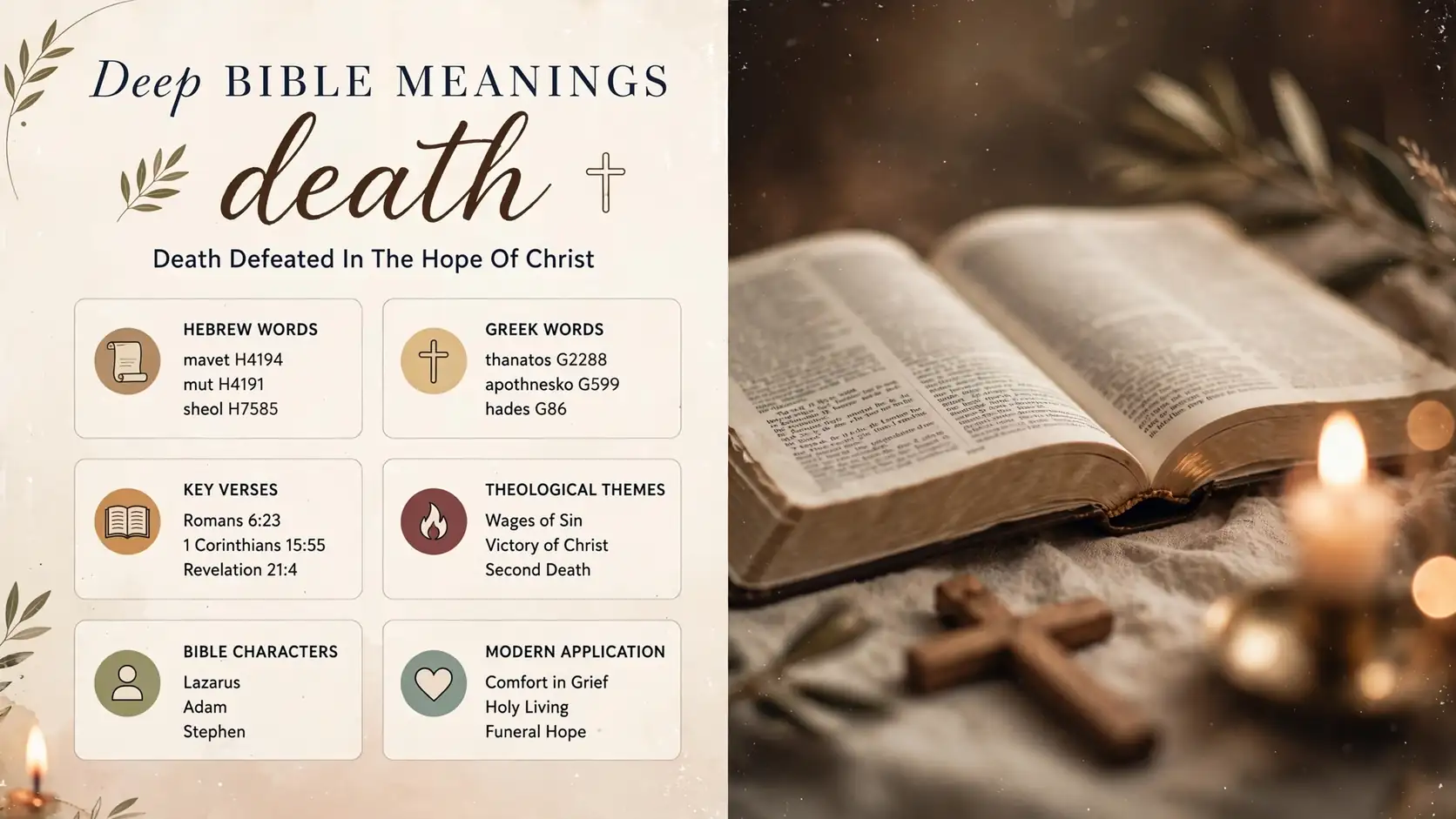
Original Hebrew and Greek Words for Death
| Original Word | Transliteration | Strong’s # | Literal Meaning |
|---|---|---|---|
| מָוֶת | mavet | H4194 | Death, dying, the state of death |
| מוּת | mut | H4191 | To die, to be dead, to kill |
| גָּוַע | gava | H1478 | To expire, breathe out the spirit |
| שְׁאוֹל | she’ol | H7585 | Sheol, the grave, realm of the dead |
| צַלְמָוֶת | tsalmaveth | H6757 | Shadow of death, deep darkness |
| θάνατος | thanatos | G2288 | Death, physical or spiritual |
| θνήσκω | thnesko | G2348 | To die, to be dead |
| ἀποθνήσκω | apothnesko | G599 | To die off, to perish |
| ᾅδης | hades | G86 | Hades, the unseen realm of the dead |
| γέεννα | geenna | G1067 | Gehenna, place of final judgment |
Related Biblical Concepts of Death
| Concept | Connection | Supporting Verse |
|---|---|---|
| Sin | Its earned wage is death | Romans 6:23 |
| The Fall | Death entered through one man | Romans 5:12 |
| Sheol | Old Testament realm of the dead | Psalm 16:10 |
| Hades | New Testament unseen realm | Luke 16:23 |
| Resurrection | Christ reverses death’s grip | John 11:25 |
| Second death | Final separation from God | Revelation 20:14 |
| Sleep | Gentle image for believers’ rest | 1 Thessalonians 4:13 |
| Judgment | Appointed once after dying | Hebrews 9:27 |
| Atonement | Christ died in the sinner’s place | Isaiah 53:5 |
| Eternal life | God’s gift that overcomes death | John 3:16 |
Historical and Cultural Context of Death
| Aspect | Detail | Biblical Source |
|---|---|---|
| Rock tombs | Families buried in carved caves | John 11:38 |
| Same-day burial | Dead buried before sunset | Acts 5:6 |
| Mourning rites | Torn clothes, sackcloth, ashes | Genesis 37:34 |
| Hired mourners | Professional wailers at funerals | Matthew 9:23 |
| Anointing the dead | Spices and linen wrappings | John 19:40 |
| Rare cremation | Burning tied to judgment scenes | Amos 2:1 |
| Levirate duty | Raising heirs for a dead brother | Deuteronomy 25:5 |
| Corinthian doubt | Some denied bodily resurrection | 1 Corinthians 15:12 |
| Sadducee belief | Denied resurrection and angels | Acts 23:8 |
| Garden tombs | Burials in rock gardens near walls | John 19:41 |
Theological Themes of Death
| Theme | Explanation | Scripture |
|---|---|---|
| Wages of Sin | Death is earned by rebellion | Romans 6:23 |
| Death as Enemy | Not natural but hostile to life | 1 Corinthians 15:26 |
| Christ’s Victory | Death swallowed up in triumph | 1 Corinthians 15:54 |
| Two Deaths | Physical death, then final judgment | Revelation 20:14 |
| Sleep of Saints | Believers rest until resurrection | 1 Thessalonians 4:14 |
| Freedom from Fear | Release from lifelong bondage | Hebrews 2:15 |
| Precious Homegoing | God values His saints’ deaths | Psalm 116:15 |
| God of the Living | He is not the God of the dead | Mark 12:27 |
| Swallowed in Victory | Death loses its sting forever | 1 Corinthians 15:55 |
| No More Death | The new creation’s full healing | Revelation 21:4 |
Modern Application of Death for Believers
| Area | Practice | Scripture |
|---|---|---|
| Facing mortality | Number your days with wisdom | Psalm 90:12 |
| Comfort in grief | Grieve with hope beyond the grave | 1 Thessalonians 4:13 |
| Funeral hope | Proclaim resurrection at services | John 14:1-3 |
| Holy living | Live ready for Christ each day | 2 Peter 3:11 |
| Evangelism urgency | Today is the day of salvation | 2 Corinthians 6:2 |
| Caring for the dying | Offer quiet, faithful presence | Job 2:13 |
| Legacy of faith | Teach children God’s mighty works | Psalm 78:4 |
| Eternal perspective | Set your mind on things above | Colossians 3:2 |
| Graveside hope | Speak resurrection, not despair | John 11:25-26 |
| Daily readiness | Keep your lamp burning like a servant | Luke 12:35 |
Mavet and Thanatos: the Words Behind Death in Scripture
In Hebrew the word you meet most is mavet, a noun naming death itself, built on the verb mut, to die. In Greek the New Testament favors thanatos, the same noun Paul uses when he calls death the last enemy. These words are plain and blunt, and Scripture never prettifies them.
The Bible also borrows softer images, like sleep for believers who rest in Christ. Learning the original words helps you hear the Bible’s own tone, sober about sin’s cost yet tender toward the saints. You begin to see why translators chose the English words they did.
What Does Death Mean in the Bible for Your Daily Walk
For your daily walk, death in the Bible is both a warning and a comfort. It warns that sin has real wages, so you take holiness seriously and share the gospel with urgency. It comforts because Christ has already walked through death and out the other side.
This changes how you grieve, how you age, and how you plan your years. You can face a diagnosis, a funeral, or your own final season with steady hope. Death remains an enemy, but it is a defeated one, and you belong to the Victor.
The First Death, the Second Death, and the Sleep of the Saints
Scripture speaks of two deaths. The first is the physical death every descendant of Adam faces, the separation of soul and body. The second death, named in Revelation, is the final separation of the unrepentant from God in the lake of fire.
Believers who die before Christ returns are described as sleeping, not because death is unreal but because waking is certain. Paul tells the Thessalonians not to grieve like those without hope. Your loved ones in Christ are resting, and the trumpet will wake them.
From Eden’s Warning to Revelation’s Promise: Death’s Story Across the Testaments
In Genesis, death arrives as God’s stated consequence for disobedience, and the Old Testament treats it as a shadowed, silent realm. The prophets begin to whisper of victory, as Hosea taunts death with coming destruction. You can trace a growing light across the pages.
In the New Testament the light breaks fully. Jesus weeps at Lazarus’ tomb, then calls him out, and later walks out of His own tomb alive. Revelation closes the story with a world where death is no more. The Bible’s arc bends from warning to triumph.
Frequently Asked Questions About Death in the Bible
Does the Hebrew word mavet always mean physical death?
Not always. It can describe deadly peril or ruin, as in the Psalms, though its core sense is the end of physical life.
Why does Paul call death the last enemy in 1 Corinthians 15:26?
Because death opposes God’s life-giving purpose, and Christ will destroy it last of all His foes at His return.
What is the difference between Hades and the second death?
Hades is the intermediate realm of the dead, while the second death is the final judgment after resurrection in Revelation 20:14.
Why do some translations describe believers’ death as sleep?
The Bible calls it sleep as a picture of rest and certain waking, not as a claim that the soul lies unconscious.
How should the Greek word thanatos shape my view of funerals?
It reminds you that death is real and grievous, yet Christ’s victory turns a believer’s funeral into a hope-filled farewell.