
What does selah mean in the bible is a question that leads you into Israel’s prayer book, temple worship, and the sacred pauses of Scripture. Selah is not a casual filler word. It appears in places where God’s people sing, tremble, confess, remember, and hope.
Most scholars understand Selah as a Hebrew musical or liturgical marker. Its exact force is debated, yet its placement invites the worshiper to stop, weigh the truth just spoken, and let praise or prayer rise before God.
Selah Key Scripture References
| Verse | Passage Snippet | Context |
|---|---|---|
| Psalm 3:2 | Many say, no help in God | David’s danger |
| Psalm 3:4 | He heard from his holy hill | Answered prayer |
| Psalm 3:8 | Salvation belongs to the LORD | Trust in deliverance |
| Psalm 4:2 | How long will you love vanity | Rebuke to rebels |
| Psalm 9:16 | The wicked is snared | Divine justice |
| Psalm 24:6 | This is the generation | True worshipers |
| Psalm 46:3 | Waters roar and mountains shake | God over chaos |
| Psalm 67:1 | God be merciful to us | Priestly blessing |
| Habakkuk 3:3 | God came from Teman | Prophetic hymn |
Selah Bible Translation Comparison
| Verse | KJV | NIV | ESV | NASB |
|---|---|---|---|---|
| Psalm 3:2 | Selah | Selah note | Selah | Selah |
| Psalm 3:4 | Selah | Selah note | Selah | Selah |
| Psalm 3:8 | Selah | Selah note | Selah | Selah |
| Psalm 4:2 | Selah | Selah note | Selah | Selah |
| Psalm 9:16 | Higgaion. Selah | Higgaion note | Higgaion. Selah | Higgaion Selah |
| Psalm 46:7 | Selah | Selah note | Selah | Selah |
| Psalm 49:13 | Selah | Selah note | Selah | Selah |
| Psalm 66:4 | Selah | Selah note | Selah | Selah |
| Habakkuk 3:9 | Selah | Selah note | Selah | Selah |
Selah People & Characters Associated
| Person | Role | Connection |
|---|---|---|
| David | King and psalmist | Many Selah psalms |
| Asaph | Levitical musician | Psalm 50 and 77 |
| Sons of Korah | Temple singers | Psalm 46 and 48 |
| Habakkuk | Prophet | Selah in chapter 3 |
| Jeduthun | Worship leader | Psalm 62 setting |
| Heman | Wise singer | Linked to psalmody |
| Chief Musician | Worship director | Receives Selah psalms |
| Israel | Covenant people | Congregational worship |
| The wicked | Opponents of God | Judged in Selah psalms |
Selah Original Hebrew & Greek Words
| Original Word | Transliteration | Strong’s # | Literal Meaning |
|---|---|---|---|
| סֶלָה | selah | H5542 | pause or suspension |
| סָלַל | salal | H5549 | lift up or cast up |
| סֶלָה | selah | H5542 | musical pause |
| הִגָּיוֹן | higgayon | H1902 | meditation or sound |
| מִזְמוֹר | mizmor | H4210 | psalm or melody |
| שִׁיר | shir | H7892 | song |
| נֶגִינָה | neginah | H5058 | stringed music |
| לַמְנַצֵּחַ | lamnatstseach | H5329 | for the director |
| διάψαλμα | diapsalma | No NT Strong’s # | LXX musical interlude |
Selah Related Biblical Concepts
| Concept | Connection | Supporting Verse |
|---|---|---|
| Prayer | Selah follows cries to God | Psalm 3:4 |
| Trust | Resting in God’s rescue | Psalm 3:8 |
| Worship | Used in sacred song | Psalm 66:4 |
| Judgment | Pause after justice | Psalm 9:16 |
| Meditation | Linked with higgayon | Psalm 9:16 |
| Refuge | God is with his people | Psalm 46:7 |
| Covenant mercy | God blesses his people | Psalm 67:1 |
| Prophetic awe | Habakkuk trembles and sings | Habakkuk 3:3 |
| Holy fear | The earth bows before God | Psalm 66:4 |
Selah Historical & Cultural Context
| Aspect | Detail | Biblical Source |
|---|---|---|
| Canon setting | Psalms and Habakkuk | Psalm 3, Habakkuk 3 |
| Main genre | Hebrew poetry | Psalms |
| Worship setting | Public praise | Psalm titles |
| Music direction | For the chief musician | Psalm 4 title |
| Instrument use | Stringed instruments | Psalm 4 title |
| Temple singers | Sons of Korah and Asaph | Psalm 46, Psalm 50 |
| Covenant memory | Exodus and conquest recalled | Psalm 66 |
| Prophetic song | Prayer of Habakkuk | Habakkuk 3:1 |
| Liturgical silence | Pause after weighty lines | Psalm 46:10 |
Selah Theological Themes
| Theme | Explanation | Scripture |
|---|---|---|
| God hears | Prayer reaches his holy hill | Psalm 3:4 |
| God saves | Salvation belongs to the LORD | Psalm 3:8 |
| God reigns | Nations are under him | Psalm 47:4 |
| God judges | Sinners fall into their snares | Psalm 9:16 |
| God shelters | He is refuge and strength | Psalm 46:1 |
| God blesses | Mercy spreads to nations | Psalm 67:1 |
| God triumphs | Enemies are defeated | Psalm 68:1 |
| God remembers | His covenant people endure | Psalm 89:4 |
| God renews awe | Habakkuk fears and trusts | Habakkuk 3:16 |
Selah Modern Application for Believers
| Area | Practice | Scripture |
|---|---|---|
| Prayer | Pause after petition | Psalm 3:4 |
| Anxiety | Rest under God’s rule | Psalm 46:10 |
| Worship | Let truth shape praise | Psalm 66:4 |
| Bible study | Mark repeated pauses | Psalm 3 |
| Confession | Weigh sin seriously | Psalm 4:2 |
| Suffering | Remember God’s nearness | Psalm 46:7 |
| Justice | Trust God’s judgment | Psalm 9:16 |
| Mission | Pray blessing for nations | Psalm 67:2 |
| Hope | Wait for God’s salvation | Habakkuk 3:18 |
Selah and סֶלָה in the Prayer Songs of Israel
The Hebrew word סֶלָה, transliterated Selah, appears mainly in the Psalms and three times in Habakkuk 3. That distribution matters. Selah belongs to inspired poetry, public worship, lament, thanksgiving, royal praise, and prophetic prayer.
You should not treat it as a magic word or a hidden code. Its most likely function is liturgical. It signals some kind of musical suspension, vocal pause, instrumental lift, or reflective break in the movement of the song.
The Lifted Meaning Behind סָלַל and the Worshiping Assembly
Many connect Selah with the Hebrew root סָלַל, salal, meaning to lift up, cast up, or exalt. This does not prove every use means “lift up,” but it helps explain why Selah often feels like an upward turn in worship.
In your study, notice what stands immediately before Selah. A cry rises, a truth lands, a judgment is declared, or a promise is remembered. The pause gives the congregation time to receive the word before rushing ahead.
What Does Selah Mean in the Bible When David Is Afraid
Psalm 3 is one of the clearest places to learn Selah by watching it work. David is fleeing from Absalom. Enemies say God will not help him, then Selah appears after that painful accusation.
The next Selah follows David’s confidence that the LORD heard him from his holy hill. The final Selah follows, “Salvation belongs to the LORD.” In one psalm, Selah stands beside fear, prayer, assurance, and blessing.
Habakkuk 3 and the Prophetic Selah of Holy Trembling
Habakkuk 3 shows that Selah was not limited to Davidic personal prayer. The prophet uses it in a majestic hymn about God coming from Teman and marching in judgment, mercy, and power.
This matters because Selah is not merely private meditation. It belongs to covenant worship where God’s people remember his mighty acts. Habakkuk trembles, yet he learns to rejoice in the God of his salvation.
Selah as a Reverent Pause for Christian Readers
Since Selah does not appear in the Greek New Testament, Christians should not build doctrine from the word alone. Still, the practice it suggests fits the whole Bible. God’s word should be heard slowly, prayerfully, and obediently.
When you meet Selah in your Bible, pause and ask what truth just demanded attention. Is God judging, rescuing, hearing, ruling, or blessing? Let the pause train your heart to worship with understanding.
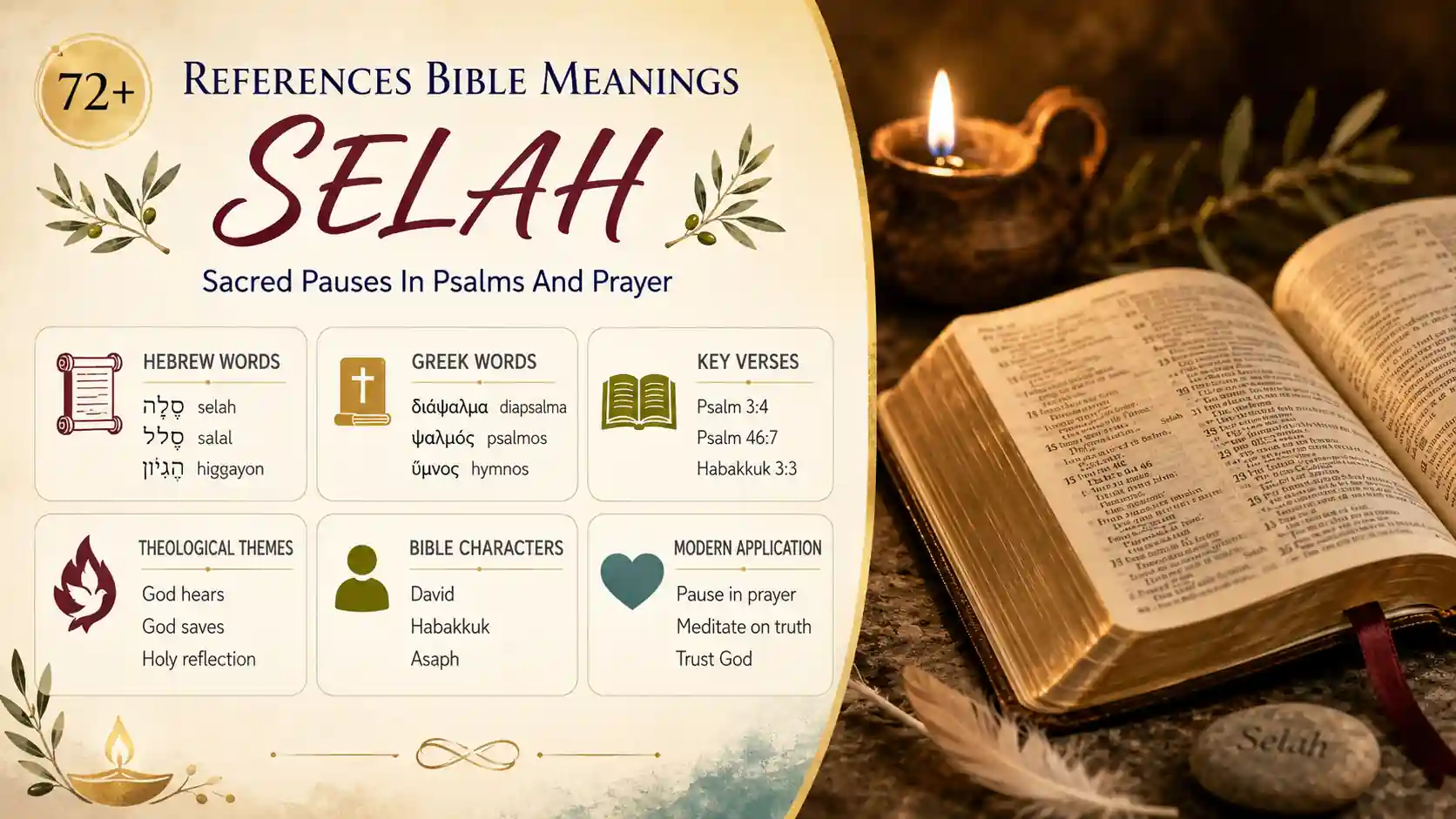
Selah FAQ
Does סֶלָה mean “amen” in the Bible?
Not exactly. Amen affirms truth, while Selah most likely marks a musical or reflective pause.
Why does Psalm 9:16 say “Higgaion. Selah”?
Higgaion suggests meditation or musical sound, so the verse likely calls for solemn reflection after God’s judgment.
Is διάψαλμα the Greek word for Selah?
Yes, the Septuagint often uses διάψαλμα for Selah, meaning a musical interlude or pause.
Why do some translations keep Selah while others footnote it?
Because the Hebrew term is certain in form but debated in exact function, many versions preserve it rather than interpret it.
How should I apply Selah when reading Psalm 46?
Pause after its declarations and let “God is our refuge” shape your fear, prayer, and trust.