
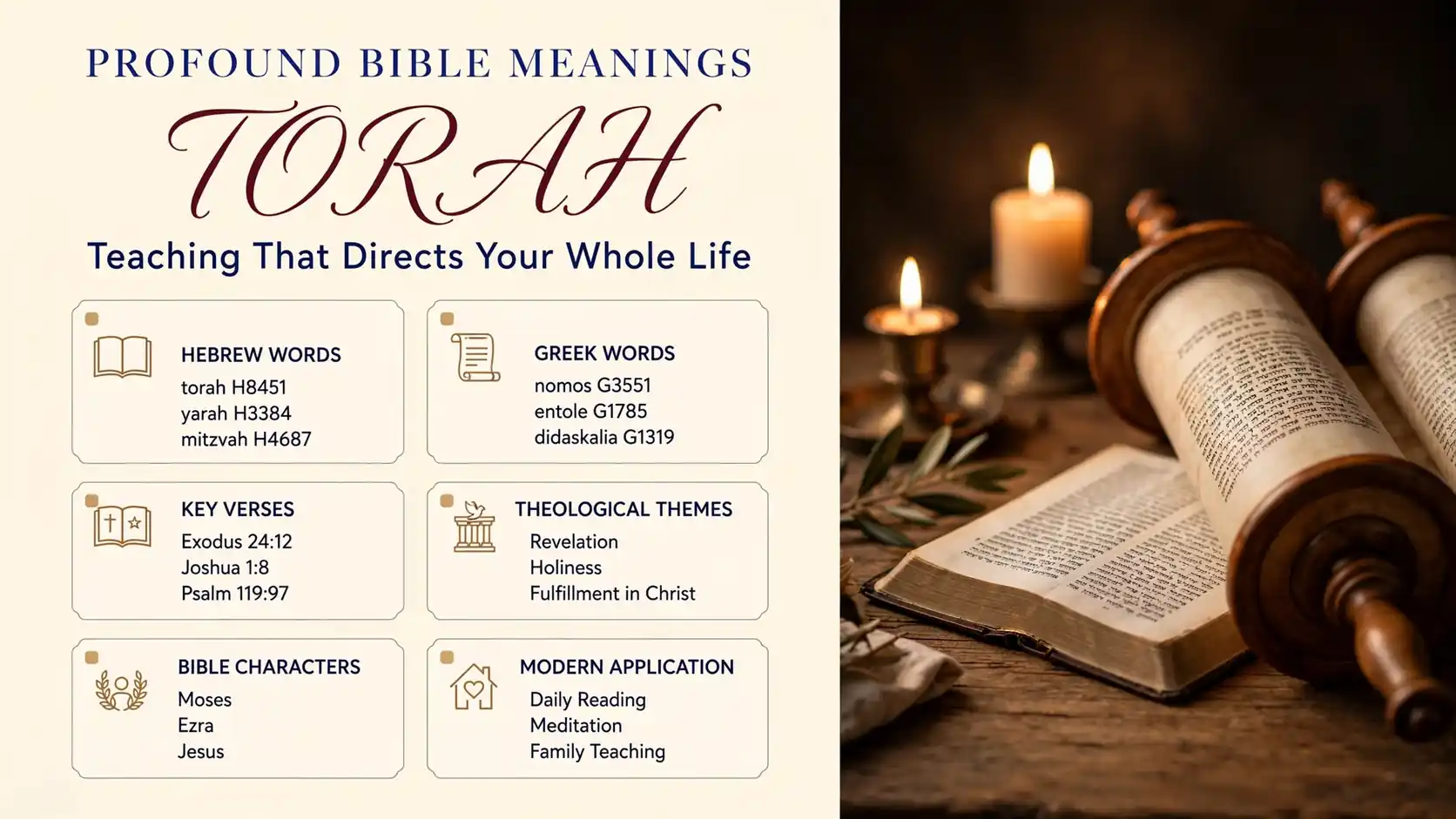
When you ask what does torah mean in the bible, you are asking about far more than a list of rules. Torah is the teaching God gave Israel to shape a whole way of life, and it still anchors your reading of Scripture today.
This guide walks you through its verses, its original words, and its five books with care. You will meet Moses and Ezra, sit with Psalm 119, and hear Jesus in Matthew 5, so your study feels grounded, reverent, and clear from the start.
Key Scripture References for Torah
| Verse | Passage Snippet | Context |
|---|---|---|
| Genesis 26:5 | Abraham obeyed my voice | Abraham kept God’s laws before Sinai |
| Exodus 24:12 | The law I have written | Moses receives teaching on the mountain |
| Deuteronomy 4:44 | This is the law Moses set | Moses presents Torah to a new generation |
| Deuteronomy 31:11 | Read this law before Israel | Public reading for the whole people |
| Joshua 1:8 | Book of the Law, meditate | Joshua told to ponder Torah daily |
| Psalm 1:2 | Delight in the law of the Lord | The blessed person loves Torah |
| Psalm 119:97 | Oh how I love your law | The psalmist meditates all day |
| Proverbs 6:23 | The teaching is a light | Instruction guides a son’s steps |
| Isaiah 2:3 | Law will go out from Zion | Nations come to learn God’s ways |
| Malachi 4:4 | Remember the law of Moses | Final call to recall Torah |
Bible Translation Comparison for Torah
| Verse | KJV | NIV | ESV | NASB |
|---|---|---|---|---|
| Exodus 24:12 | A law and commandments | The law and commands | The law and commandment | The law and commandment |
| Deuteronomy 4:44 | Law Moses set before Israel | Law Moses set out | Law Moses set before them | Law Moses set before them |
| Psalm 1:2 | Delight in law of Lord | Delight in law of Lord | Delight in law of Lord | Delight in Law of Lord |
| Psalm 19:7 | Law of Lord is perfect | Law of Lord is perfect | Law of Lord is perfect | Law of Lord is perfect |
| Psalm 119:97 | O how love I thy law | Oh how I love your law | Oh how I love your law | Oh how I love Your Law |
| Isaiah 2:3 | Law shall go forth | Law will go out | Law shall go forth | Law will go forth |
| Matthew 5:17 | Not come to destroy law | Not come to abolish Law | Not come to abolish Law | Not come to abolish Law |
| Romans 7:22 | Delight in law of God | Delight in God’s law | Delight in law of God | Delight in law of God |
| James 1:25 | Perfect law of liberty | Perfect law giving freedom | Perfect law of liberty | Perfect law of freedom |
People and Characters Associated with Torah
| Person | Role | Connection |
|---|---|---|
| Moses | Mediator and lawgiver | Receives Torah at Sinai, teaches Israel |
| Aaron | First high priest | Follows Torah for worship and sacrifice |
| Levites | Teachers and guardians | Carry the ark, teach the law |
| Joshua | Successor of Moses | Meditates on the Book of the Law |
| David | King and psalmist | Sings delight in Torah |
| Ezra | Scribe and teacher | Reads the law aloud, explains it |
| Nehemiah | Governor | Leads covenant renewal after reading |
| Psalm 119 Poet | Devoted student | Loves Torah through 176 verses |
| Jesus | Teacher and fulfiller | Affirms the Law in Matthew 5 |
| Paul | Apostle, former Pharisee | Wrestles with nomos and grace |
Original Hebrew and Greek Words for Torah
| Original Word | Transliteration | Strong’s # | Literal Meaning |
|---|---|---|---|
| תּוֹרָה | torah | H8451 | Teaching, instruction, direction |
| יָרָה | yarah | H3384 | To direct, point, teach |
| מִצְוָה | mitzvah | H4687 | Commandment from authority |
| חֹק | choq | H2706 | Statute, decree, fixed limit |
| מִשְׁפָּט | mishpat | H4941 | Judgment, ordinance, justice |
| νόμος | nomos | G3551 | Law, custom, Mosaic law |
| ἐντολή | entole | G1785 | Commandment, authoritative order |
| διδασκαλία | didaskalia | G1319 | Teaching, doctrine, instruction |
| παιδεία | paideia | G3809 | Training, discipline, instruction |
Related Biblical Concepts to Torah
| Concept | Connection | Supporting Verse |
|---|---|---|
| Instruction | Torah directs your daily steps | Proverbs 6:23 |
| Covenant | Torah shapes rescued Israel’s life | Exodus 19:5 |
| Commandment | Each mitzvah is one concrete call | Deuteronomy 6:1 |
| Wisdom | Torah is wisdom nations admire | Deuteronomy 4:6 |
| Meditation | Ponder Torah day and night | Joshua 1:8 |
| Obedience | Hearing leads to walking in it | Deuteronomy 28:1 |
| Blessing | Life set before those who keep it | Deuteronomy 30:19 |
| Fulfillment | Jesus fulfills Law and Prophets | Matthew 5:17 |
| Delight | Sweeter than honey, richer than gold | Psalm 19:10 |
Historical and Cultural Context of Torah
| Aspect | Detail | Biblical Source |
|---|---|---|
| Sinai Giving | Teaching given after exodus rescue | Exodus 20:1 |
| Stone Tablets | Core words kept in the ark | Deuteronomy 10:5 |
| Public Reading | Read aloud every seven years | Deuteronomy 31:10 |
| Scribal Copying | Kings write and read their copy | Deuteronomy 17:18 |
| Synagogue Reading | Weekly portions in gathered worship | Acts 15:21 |
| Exile Preservation | Scribes guard scrolls in ruins | Ezra 7:6 |
| Scroll Craft | Handwritten parchment scrolls | Jeremiah 36:2 |
| Feast Cycle | Festivals rehearse Torah story yearly | Leviticus 23:2 |
| Family Teaching | Words spoken at home and road | Deuteronomy 6:7 |
Theological Themes of Torah
| Theme | Explanation | Scripture |
|---|---|---|
| Revelation | God makes His will known clearly | Psalm 19:7 |
| Covenant Faithfulness | Rescued people respond to steadfast love | Exodus 34:6 |
| Holiness | Be holy, for I am holy | Leviticus 19:2 |
| Instruction for Life | Covers worship, justice, family, mercy | Deuteronomy 24:19 |
| Delight and Meditation | Loved and pondered, not just duty | Psalm 119:16 |
| Fulfillment in Christ | Jesus completes and deepens Torah | Matthew 5:17 |
| Obedience From Love | Keeping flows from loving God | Deuteronomy 6:5 |
| Wisdom for Nations | Other peoples recognize its wisdom | Deuteronomy 4:6 |
| Continuity of Scripture | Law, Prophets, Writings, one witness | Luke 24:44 |
Modern Application of Torah for Believers
| Area | Practice | Scripture |
|---|---|---|
| Daily Reading | Read a portion slowly, note instruction | Joshua 1:8 |
| Meditation | Repeat a Psalm 119 verse in prayer | Psalm 119:97 |
| Family Teaching | Talk of it at meals together | Deuteronomy 6:7 |
| Honest Work | Be honest in wages and promises | Leviticus 19:35 |
| Care for Neighbors | Leave margin for people in need | Deuteronomy 24:19 |
| Study in Community | Read aloud together, ask its call | Nehemiah 8:8 |
| Confession | Let Torah expose sin, seek mercy | Psalm 19:12 |
| Teaching Children | Tell the exodus story often | Exodus 12:26 |
| Worship | Praise God for perfect teaching | Psalm 19:7 |
Torah as Instruction, Not Only Law
Your English Bible often renders torah with the single word law, and that word can sound cold or narrow to your ears. The Hebrew root yarah H3384 pictures a finger pointing the way or an archer aiming an arrow, so torah is direction from a teacher who knows the road. It includes commands, yet it also includes story, promise, and guidance for the whole of life.
That wider sense helps you read the five books with fresh patience and warmth. Genesis tells you who God is and who you are before a single statute appears, and Exodus rescues a people before it instructs them. Law in Torah always sits inside a story of grace, rescue, and belonging that came first.
The Five Books and What Does Torah Mean in the Bible
When Jewish and Christian readers speak of the Torah most strictly, they mean the five books of Moses, Genesis, Exodus, Leviticus, Numbers, and Deuteronomy. Together they are also called the Pentateuch, and they form the foundation on which the Prophets and Writings stand. Every later book assumes their story, their covenant, and their teaching.
In a wider sense, torah can mean all of God’s instruction, and Psalm 119 uses it for every word God speaks. Keeping both senses in mind protects your reading, because a verse may point to the five books in one place and to God’s whole teaching in another. Context always tells you which sense fits best.
Psalm 119 and the Heart That Loves Torah
Psalm 119 is the longest chapter in your Bible, and nearly every one of its 176 verses names Torah with a rich synonym such as word, statute, precept, or commandment. The poet does not treat the teaching as a burden to escape. He calls it his delight, his counselors, his song in the house of his pilgrimage, and the light for his path.
Notice also how honest the psalm is about suffering, wandering, and enemies who mock his trust. Love for Torah in this psalm is not a shelter from trouble. It is the steady voice the poet returns to at midnight, at dawn, and in affliction, trusting that God’s instruction will keep his heart alive.
Jesus and the Torah in Matthew 5
In Matthew 5:17 Jesus says plainly that he did not come to abolish the Law or the Prophets but to fulfill them. The Greek word there is nomos G3551, the same term Greek speaking Jews used for Torah. His sermon then deepens familiar commands, tracing anger toward murder and lust toward adultery, so the heart is addressed and not only the hand.
Paul later holds Torah and grace together with similar care, calling the law holy and good while insisting that righteousness comes through faith. Reading both voices fairly keeps you from two errors, treating Torah as worthless or treating it as a ladder you climb to earn God’s love. Both testaments honor it as God’s good teaching.
Frequently Asked Questions About Torah
Does torah H8451 really mean teaching more than law?
Yes, torah H8451 means teaching or instruction first, and law is only one part of its wider meaning in verses like Proverbs 6:23.
What are the five books that make up the Torah?
The Torah is Genesis, Exodus, Leviticus, Numbers, and Deuteronomy, the five books of Moses that open your Bible.
Did Jesus abolish the nomos G3551 in Matthew 5:17?
No, Jesus said he came to fulfill the nomos G3551, not abolish it, and he deepened its commands in the Sermon on the Mount.
How is a mitzvah H4687 different from torah itself?
A mitzvah H4687 is one single commandment, while torah is the whole body of teaching that holds all the commandments together.
Why does Psalm 119 use so many words besides torah?
Psalm 119 rotates synonyms like statute, precept, and word so you see Torah from many angles across its 176 verses.