
When you read what does judge not lest ye be judged mean in the bible, you meet a warning that is gentle and searching. Jesus speaks to listeners who notice faults in others while missing their need for grace. His words invite you to pause before you speak and to examine your heart first.
This study will help you understand the Greek words behind the saying, the setting in the Sermon on the Mount, and the balance between wise discernment and harsh condemnation. You will see how mercy shapes honest speech and how humility opens the way to restoration.
Key Scripture References on Judgment
| Verse | Passage Snippet | Context |
|---|---|---|
| Matthew 7:1 | Judge not, that ye be not judged | Sermon on the Mount opening |
| Matthew 7:2 | With what judgment ye judge | The measure returns to you |
| Matthew 7:3 | The mote in thy brother’s eye | A speck noticed, a beam missed |
| Matthew 7:4 | Let me pull out the mote | Help before self examination |
| Matthew 7:5 | First cast out the beam | Clear sight after humble repentance |
| Luke 6:37 | Judge not, and ye shall not be judged | Mercy beside forgiveness teaching |
| Luke 6:41 | The mote in thy brother’s eye | Judgment beside generous giving |
| John 7:24 | Judge righteous judgment | Discernment without partiality |
| Romans 14:13 | Let us not judge one another | Conscience disputes without condemnation |
Bible Translation Comparison for Judge Not
| Verse | KJV | NIV | ESV | NASB |
|---|---|---|---|---|
| Matthew 7:1 | Judge not, that ye be not judged | Do not judge, or you too will be judged | Judge not, that you be not judged | Do not judge, so you will not be judged |
| Matthew 7:2 | With what judgment ye judge | In the same way you judge others | With the judgment you pronounce | By your standard of measure |
| Matthew 7:3 | The mote in thy brother’s eye | The speck in your brother’s eye | The speck in your brother’s eye | The speck in your brother’s eye |
| Matthew 7:5 | First cast out the beam | First take the plank out | First take the log out | First take the log out |
| Luke 6:37 | Judge not, and ye shall not be judged | Do not judge, and you will not be judged | Judge not, and you will not be judged | Do not judge, and you will not be judged |
| John 7:24 | Judge not according to appearance | Stop judging by mere appearances | Do not judge by appearances | Do not judge according to appearance |
| Romans 14:10 | Why dost thou judge thy brother | Why do you judge your brother | Why do you pass judgment | Why do you judge your brother |
| Romans 14:13 | Let us not judge one another | Let us stop passing judgment | Let us not pass judgment anymore | Let us not judge one another |
People and Characters Associated with Judgment
| Person | Role | Connection |
|---|---|---|
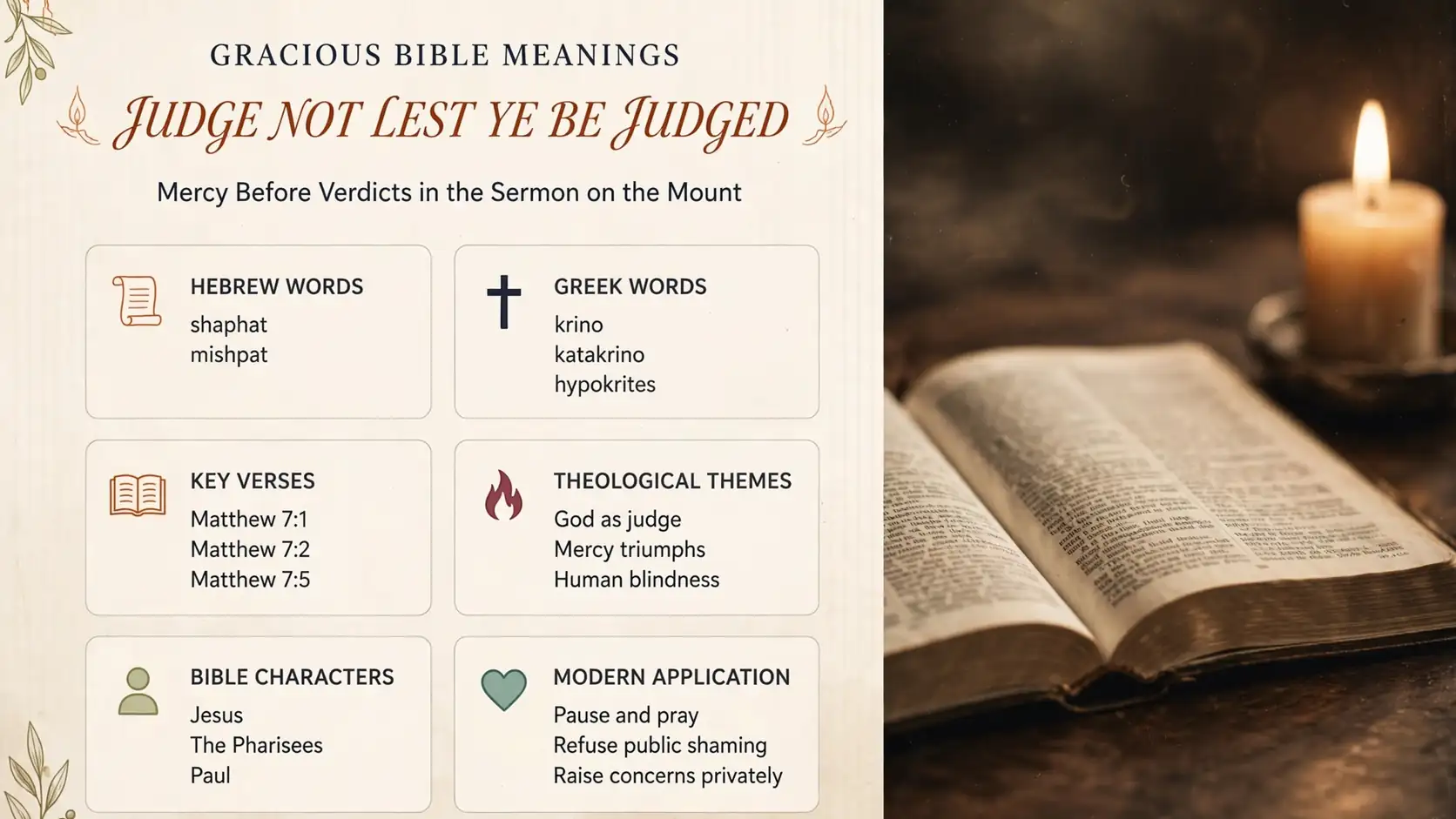
| Jesus | Teacher on the Mount | He gives the command and its spirit |
| The disciples | First hearers | They learn humility before ministry |
| The Pharisees | Religious leaders | Their criticism models harsh judgment |
| The scribes | Teachers of law | They debate purity and public blame |
| The brother | Fellow believer | His small fault draws criticism |
| The hypocrite | Figure in the image | He corrects while ignoring his fault |
| Paul | Apostle to churches | He warns against judging conscience matters |
| James | Writer to believers | He links evil speech with God’s role |
| Peter | Apostle and leader | His story shows restoration after failure |
Original Hebrew and Greek Words for Judgment
| Original Word | Transliteration | Strong’s # | Literal Meaning |
|---|---|---|---|
| שָׁפַט | shaphat | H8199 | To judge, govern, or vindicate |
| מִשְׁפָּט | mishpat | H4941 | Judgment, justice, or right decision |
| κρίνω | krino | G2919 | To judge, decide, or separate |
| κατακρίνω | katakrino | G2632 | To condemn or pass sentence |
| ὑποκριτής | hypokrites | G5271 | Actor, pretender, or hypocrite |
| δοκός | dokos | G2644 | Beam, log, or large plank |
| κάρφος | karphos | G2595 | Speck, mote, or small splinter |
| μέτρον | metron | G3358 | Measure or measuring rod |
| ἔλεος | eleos | G1656 | Mercy or compassion shown |
Related Biblical Concepts Around Judgment
| Concept | Connection | Supporting Verse |
|---|---|---|
| Mercy | Mercy tempers judgment toward forgiveness | Matthew 5:7 |
| Humility | Humility comes before honest correction | Matthew 7:5 |
| Repentance | Repentance clears sight for helping others | Luke 15:18 |
| Discernment | Discernment tests truth without condemning | John 7:24 |
| Forgiveness | Forgiveness breaks harsh blame | Luke 6:37 |
| Grace | Grace reminds you judgment is God’s gift refused | Ephesians 2:8 |
| Restoration | Restoration is the goal of gentle correction | Galatians 6:1 |
| Self examination | Self examination precedes speech about others | 2 Corinthians 13:5 |
| Love of neighbor | Love seeks the good of the corrected person | Matthew 22:39 |
Historical and Cultural Context of Judgment
| Aspect | Detail | Biblical Source |
|---|---|---|
| Sermon setting | Teaching on a hillside to crowds | Matthew 5:1 |
| Honor culture | Public shame carried heavy weight | Matthew 7:3 |
| Purity disputes | Food and washing rules divided groups | Mark 7:1 |
| Roman courts | Roman law shaped trial ideas | John 18:28 |
| Synagogue discipline | Disputes settled before elders | Matthew 18:15 |
| Pharisaic practice | Strict rules became public criticism | Luke 18:11 |
| Household language | Brother language points to close community | Matthew 7:3 |
| Agricultural images | Beams and specks came from carpentry | Matthew 7:4 |
| Measure trade | Market measures were tested for fairness | Leviticus 19:35 |
Theological Themes in Judge Not
| Theme | Explanation | Scripture |
|---|---|---|
| God as judge | Final judgment belongs to God alone | Romans 14:10 |
| Mercy triumphs | Mercy is lifted above strict judgment | James 2:13 |
| Human blindness | Sin clouds our view of others | Matthew 7:5 |
| Gracious speech | Words should build up, not tear down | Ephesians 4:29 |
| Community care | Correction serves healing, not victory | Galatians 6:1 |
| Justice with love | Justice and love belong together | Micah 6:8 |
| Repentance first | Repentance prepares public help | Psalm 51:13 |
| Hope of restoration | Restoration follows honest confession | 1 John 1:9 |
| Imitating Christ | Christ joins truth with compassion | John 8:11 |
Modern Application for Believers on Judgment
| Area | Practice | Scripture |
|---|---|---|
| Family speech | Pause and pray before naming a fault | James 1:19 |
| Social media | Refuse public shaming and hasty replies | Proverbs 18:13 |
| Church life | Raise concerns privately and gently first | Matthew 18:15 |
| Workplace talk | Check facts before repeating criticism | Proverbs 11:13 |
| Parenting | Correct while guarding dignity | Ephesians 6:4 |
| Friendship | Ask questions before drawing conclusions | Proverbs 18:17 |
| Self reflection | Keep a habit of honest confession | Psalm 139:23 |
| Reconciliation | Seek repair after a harsh word | Matthew 5:24 |
| Prayer life | Ask God for clear sight and mercy | Psalm 51:10 |
The Beam and the Speck in Matthew 7
Jesus uses a comic and painful image to expose a common habit. A person with a large beam in the eye tries to remove a tiny speck from a brother’s eye, and the picture makes the audience laugh before it convicts them. The humor is gentle, yet the point is sharp, because the helper cannot see clearly enough to help safely.
The beam stands for a larger fault that has gone unnoticed through pride or habit. The speck stands for a smaller fault that is easy to spot in someone else. When you remove the beam first through confession and change, your sight becomes clear, and your help becomes tender rather than controlling.
What Does Judge Not Lest Ye Be Judged Mean in the Bible for Your Daily Speech
The saying does not forbid all moral judgment, and it does not ask you to pretend that wrong is right. It forbids a condemning spirit that enjoys exposure, assumes the worst motive, and treats another person as beyond grace. That spirit forgets that you also stand in need of mercy each day.
In daily speech, the test is simple and practical. Ask whether your words aim at restoration, whether you know the full story, and whether you would welcome the same tone toward yourself. If your correction is private, patient, and true, it can serve love, and if it is public, hasty, and proud, it fails the test Jesus gives.
Mercy, Discernment, and Restoration in Community Life
Mercy does not cancel truth, and truth does not cancel mercy. A healthy community can name harm clearly while refusing to shame the person who caused it. Leaders can set boundaries for safety, and friends can speak honestly, without turning a mistake into an identity that can never be repaired.
Restoration needs a clear path back into fellowship. That path includes honest confession, changed behavior, patient support, and time for trust to grow again. When a community practices this pattern, correction stops feeling like a courtroom and starts feeling like care from people who want healing.
The Measure You Use in Judgment and Grace
Jesus warns that the measure you use will be measured back to you, and that image comes from market life where grain was weighed fairly. A generous measure gives room for context, weakness, and growth, while a stingy measure counts every fault with no allowance for grace. The measure you choose reveals what you believe about God and about yourself.
Grace does not mean that consequences disappear or that harmful patterns are ignored. It means that judgment is shaped by the mercy you have received, so your verdicts become slower, kinder, and more willing to hope. When you judge with the measure of grace, you leave room for God to work in ways you cannot yet see.
Frequently Asked Questions About Judge Not
Does what does judge not lest ye be judged mean in the bible forbid all judgment?
No, it forbids condemning judgment while still allowing wise discernment guided by mercy and truth.
How does the Greek word krino shape the meaning of Matthew 7:1?
Krino means to judge or decide, and the context shows a final condemning verdict rather than careful discernment.
Why does Jesus use a beam and a speck in this teaching?
The beam image exposes self blindness and shows that humble repentance must come before helping another person.
How can you correct someone without breaking this command?
Speak privately first, check your motives, aim at restoration, and use a tone you would welcome yourself.
What does the measure in Matthew 7:2 teach about grace?
The measure you use returns to you, so generous and merciful judgment reflects the grace you have received.