
What does ad mean in the Bible? In Hebrew, עַד ʿad most often means “until,” “as far as,” “even to,” or “forever,” depending on the context. It can mark a limit in time, a boundary in space, or a lasting reality before God.
In your study, you should not treat ad as the English abbreviation “A.D.” The biblical word points you into Hebrew grammar, covenant language, worship, judgment, kingship, and hope.
Key Scripture References for AD
| Verse | Passage Snippet | Context |
|---|---|---|
| Genesis 13:15 | “forever” | Land promise to Abram |
| Exodus 15:18 | “for ever and ever” | Song after the sea |
| Deuteronomy 23:3 | “even to their tenth generation” | Assembly restriction |
| 1 Chronicles 16:36 | “for ever and ever” | Davidic worship |
| Psalm 9:18 | “not alway be forgotten” | Hope for the needy |
| Psalm 21:4 | “length of days for ever” | Royal blessing |
| Psalm 45:6 | “for ever and ever” | Throne language |
| Isaiah 9:7 | “no end” | Messiah’s kingdom |
| Daniel 6:26 | “for ever” | God’s dominion |
| Micah 4:5 | “for ever and ever” | Faithful walking |
Bible Translation Comparison for AD
| Verse | KJV | NIV | ESV | NASB |
|---|---|---|---|---|
| Exodus 15:18 | “for ever and ever” | “for ever and ever” | “forever and ever” | “forever and ever” |
| Psalm 9:18 | “not alway” | “not always” | “not always” | “not forever” |
| Psalm 21:4 | “for ever and ever” | “for ever and ever” | “forever and ever” | “forever and ever” |
| Psalm 45:6 | “for ever and ever” | “for ever and ever” | “forever and ever” | “forever and ever” |
| Psalm 48:14 | “even unto death” | “to the end” | “forever and ever” | “until death” |
| Psalm 111:8 | “for ever and ever” | “for ever and ever” | “forever and ever” | “forever and ever” |
| Isaiah 9:7 | “no end” | “no end” | “no end” | “no end” |
| Daniel 6:26 | “for ever” | “forever” | “forever” | “forever” |
| Micah 4:5 | “for ever and ever” | “for ever and ever” | “forever and ever” | “forever and ever” |
People and Characters Associated with AD
| Person | Role | Connection |
|---|---|---|
| Abram | Covenant recipient | Promise of land forever |
| Moses | Prophet and singer | Proclaims Yahweh reigns forever |
| David | King and worship leader | Blesses God forever |
| Solomon | Davidic son | Linked to enduring throne hopes |
| Korah’s sons | Psalm singers | Sing of God as guide forever |
| Isaiah | Prophet | Announces endless kingdom |
| Daniel | Exile prophet | Confesses everlasting dominion |
| Darius | Persian ruler | Declares God’s kingdom forever |
| Micah | Prophet | Contrasts idols with lasting faith |
| Messiah | Davidic King | Rules without end |
Original Hebrew and Greek Words for AD
| Original Word | Transliteration | Strong’s # | Literal Meaning |
|---|---|---|---|
| עַד | ʿad | H5704 | Until, as far as |
| עַד | ʿad | H5705 | Aramaic until |
| עוֹלָם | ʿolam | H5769 | Long duration, forever |
| נֶצַח | netsach | H5331 | Enduring, perpetuity |
| תָּמִיד | tamid | H8548 | Continual, regular |
| קֵץ | qets | H7093 | End, limit |
| ἕως | heōs | G2193 | Until, as far as |
| αἰών | aiōn | G165 | Age, eternity |
| αἰώνιος | aiōnios | G166 | Eternal, age-long |
Related Biblical Concepts for AD
| Concept | Connection | Supporting Verse |
|---|---|---|
| Covenant promise | God pledges lasting inheritance | Genesis 13:15 |
| Divine kingship | God reigns beyond all rivals | Exodus 15:18 |
| Davidic throne | Royal rule described as enduring | Psalm 45:6 |
| Messianic hope | Kingdom has no end | Isaiah 9:7 |
| Worship | Praise reaches forever | 1 Chronicles 16:36 |
| Judgment | Exclusion can extend generations | Deuteronomy 23:3 |
| Hope | The needy are not forgotten forever | Psalm 9:18 |
| Guidance | God leads His people continually | Psalm 48:14 |
| Faithfulness | God’s works stand firm | Psalm 111:8 |
Historical and Cultural Context for AD
| Aspect | Detail | Biblical Source |
|---|---|---|
| Hebrew time | עַד can mark a temporal limit | Psalm 9:18 |
| Spatial boundary | It can mean “as far as” | Genesis 13:15 |
| Covenant speech | Promises use lasting language | Genesis 13:15 |
| Royal ideology | Thrones are described by duration | Psalm 45:6 |
| Temple praise | Worship blesses God forever | 1 Chronicles 16:36 |
| Ancient Near East | Kings claimed long rule | Daniel 6:26 |
| Exile setting | Daniel emphasizes God’s dominion | Daniel 6:26 |
| Prophetic hope | Future reign has no limit | Isaiah 9:7 |
| Pilgrim faith | Nations walk after their gods | Micah 4:5 |
Theological Themes for AD
| Theme | Explanation | Scripture |
|---|---|---|
| God’s eternity | His reign does not expire | Exodus 15:18 |
| Covenant loyalty | His promises outlast generations | Genesis 13:15 |
| Messianic rule | The Son’s kingdom has no end | Isaiah 9:7 |
| Human limits | People need divine guidance | Psalm 48:14 |
| Hope for the poor | Their waiting is not endless | Psalm 9:18 |
| Worship without end | Praise fits God’s nature | 1 Chronicles 16:36 |
| Judgment and holiness | Exclusion teaches covenant seriousness | Deuteronomy 23:3 |
| Universal dominion | Nations must honor God | Daniel 6:26 |
| Steadfast obedience | God’s people walk with Him | Micah 4:5 |
Modern Application for Believers with AD
| Area | Practice | Scripture |
|---|---|---|
| Prayer | Trust God beyond delays | Psalm 9:18 |
| Worship | Praise God as everlasting King | Exodus 15:18 |
| Bible study | Watch context before defining “forever” | Psalm 48:14 |
| Hope | Anchor faith in God’s kingdom | Isaiah 9:7 |
| Obedience | Walk in God’s name daily | Micah 4:5 |
| Suffering | Remember need is not forgotten | Psalm 9:18 |
| Leadership | Seek rule under God’s reign | Psalm 45:6 |
| Perseverance | Continue in faithful worship | 1 Chronicles 16:36 |
| Humility | Confess human life has limits | Psalm 21:4 |
עַד ʿAD and the Bible’S Language of Limit, Distance, and Duration
The Hebrew word עַד ʿad is flexible. Sometimes it means “until,” pointing to a limit in time. Sometimes it means “as far as,” pointing to distance. In many worship and covenant texts, it joins larger phrases that English Bibles translate as “forever,” “forever and ever,” or “no end.”
That range matters for your study. A verse may not be teaching abstract eternity every time the word appears. You must ask whether the context is describing a boundary, a duration, a destination, or the enduring reign of God.
What Does AD Mean in the Bible When God’S Reign Is in View?
When Scripture uses עַד ʿad in royal or worship settings, the word often carries great theological weight. Exodus 15:18 declares that the Lord reigns “forever and ever” after He delivers Israel through the sea. The point is not merely long time. It is unrivaled kingship.
This same theme appears in Daniel 6:26, where a Gentile king confesses that the God of Daniel has an enduring kingdom. In a world of collapsing empires, ʿad helps Scripture say that God’s dominion is not fragile, temporary, or dependent on human approval.
עַד ʿAD, עוֹלָם ʿOlam, and the Promise That Outlasts Generations
In covenant passages, עַד ʿad often stands near words like עוֹלָם ʿolam, “long duration” or “forever.” Genesis 13:15 speaks of the land promise to Abram with lasting language. The word is not casual decoration. It signals that God binds Himself by promise.
Yet biblical “forever” language must be read covenantally. It may describe God’s unbreakable purpose, an enduring office, or a promise that moves forward through redemptive history. For Christians, the lasting promises to Abraham and David find their deepest coherence in the Messiah.
From Isaiah’S “No End” to the Messiah’S Everlasting Kingdom
Isaiah 9:7 gives one of the richest theological settings connected to this idea. The promised child will reign on David’s throne, and “of the increase of his government and peace there will be no end.” Here the thought of ad is tied to messianic rule, justice, righteousness, and divine zeal.
This is why the word matters beyond vocabulary. It draws your eyes to the Bible’s storyline. Human rulers rise and fall, but the Lord establishes a kingdom that cannot be measured by ordinary political cycles. The Messiah’s reign fulfills the hope that God’s kingly purpose will endure.
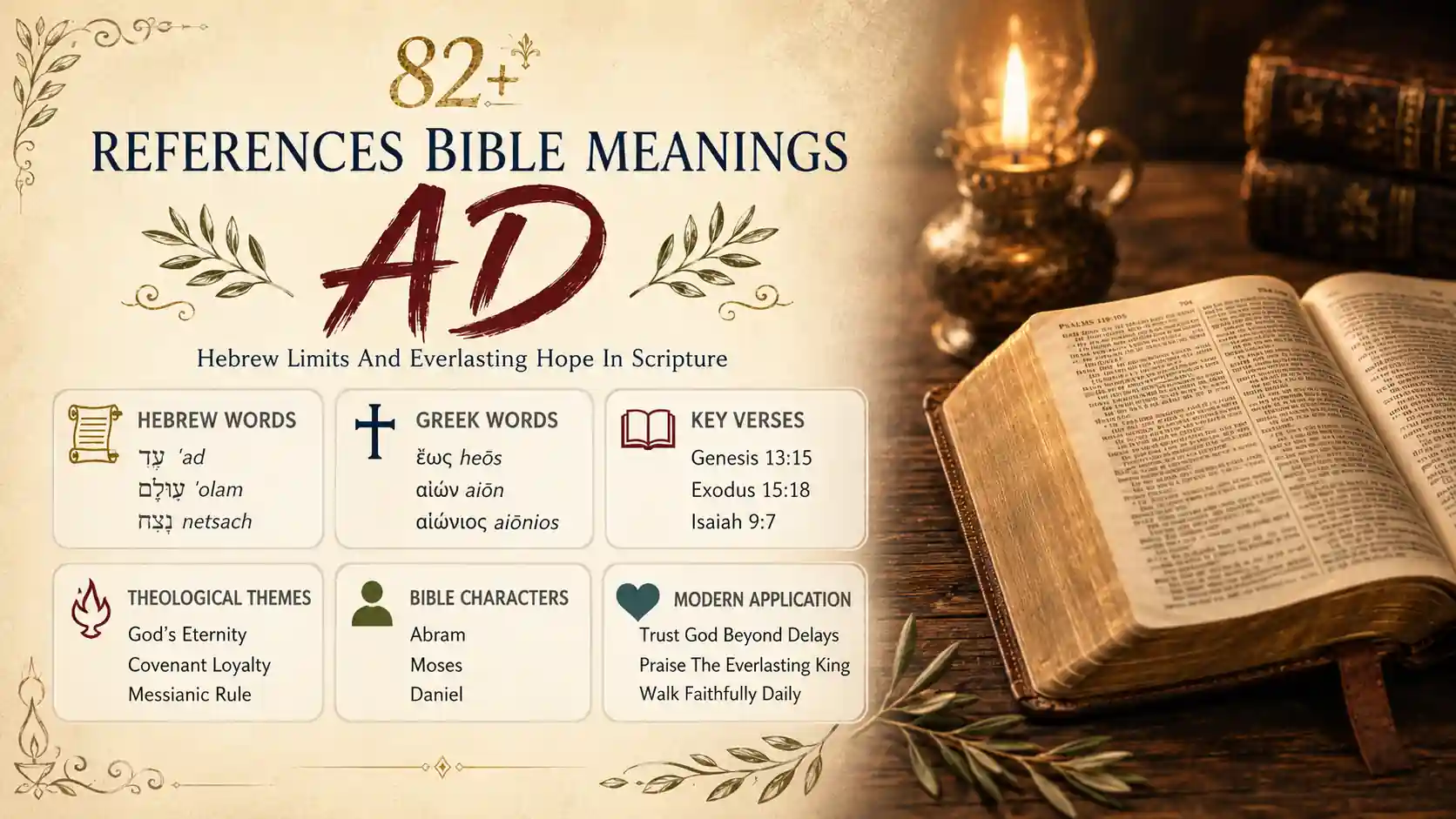
Questions Bible Students Ask About AD
Is ad in the Bible the same as A.D. on a calendar?
No. Biblical עַד ʿad is a Hebrew word meaning “until,” “as far as,” or “forever,” not the Latin calendar phrase Anno Domini.
Why do translations render עַד ʿad as both “until” and “forever”?
Because context decides whether the word marks a limit, a duration, or part of a phrase for lasting time.
Does Psalm 48:14 mean God guides believers “until death” or “forever”?
The Hebrew wording is difficult, so translations differ, but the verse clearly trusts God as His people’s faithful guide.
How does עַד ʿad relate to עוֹלָם ʿolam?
Both can speak of duration, but ʿad often marks extent or limit, while ʿolam more often stresses long, hidden, or everlasting time.
What should I do with “forever” language in hard verses like Deuteronomy 23:3?
Read it in covenant context, where holiness, identity, judgment, and later biblical mercy must be held together carefully.