
What does begotten mean in the Bible? In its ordinary biblical use, “begotten” describes the fathering, bearing, or bringing forth of a child. Scripture also uses birth language figuratively for spiritual renewal, covenant identity, royal appointment, and resurrection life.
When applied to Jesus as God’s “only begotten Son,” the word does not mean that Christ was created or began to exist. It identifies him as the Father’s unique, one-of-a-kind Son, eternally sharing the divine nature and perfectly revealing the Father. Your study must therefore consider each passage, language, and context carefully.
Key Begotten Scripture References
| Verse | Passage Snippet | Context |
|---|---|---|
| Genesis 5:3 | Adam begot Seth | Human descent and likeness |
| Psalm 2:7 | “Today I have begotten you” | Enthronement of God’s King |
| Proverbs 8:24 | “I was brought forth” | Wisdom poetry and personification |
| John 1:14 | Glory of the only begotten | The Word becomes flesh |
| John 1:18 | The unique Son reveals God | Jesus explains the unseen Father |
| John 3:16 | God gave his only begotten Son | Divine love and saving faith |
| John 3:18 | Belief in God’s unique Son | Judgment rests on response to Christ |
| Hebrews 1:5 | “Today I have begotten you” | Christ’s royal superiority |
| Hebrews 11:17 | Isaac called Abraham’s only son | Unique covenant relationship |
| 1 John 4:9 | God sent his only begotten Son | God’s love brings life |
Begotten in Major Bible Translations
| Verse | KJV | NIV | ESV | NASB |
|---|---|---|---|---|
| Psalm 2:7 | begotten thee | become your father | begotten you | begotten You |
| John 1:14 | only begotten | one and only | only Son | only begotten |
| John 1:18 | only begotten Son | one and only Son | only God | only begotten God |
| John 3:16 | only begotten Son | one and only Son | only Son | only Son |
| John 3:18 | only begotten Son | one and only Son | only Son | only Son |
| Hebrews 1:5 | begotten thee | become your Father | begotten you | begotten You |
| Hebrews 5:5 | begotten thee | become your Father | begotten you | begotten You |
| Hebrews 11:17 | only begotten son | one and only son | only son | only son |
| 1 Peter 1:3 | begotten us again | new birth | born again | born again |
| 1 John 4:9 | only begotten Son | one and only Son | only Son | only Son |
The translation differences reflect how interpreters understand Greek μονογενής, monogenēs. Older English versions often use “only begotten,” while many modern versions emphasize uniqueness with “only,” “one and only,” or “unique Son.” The Greek term appears for Jesus and for an only child, including Isaac in his special covenant position.
People and Characters Associated with Begotten
| Person | Role | Connection |
|---|---|---|
| God the Father | Eternal Father | Gives and declares the Son |
| Jesus Christ | Unique divine Son | Called μονογενής of the Father |
| Adam | First man | Begot Seth in his likeness |
| Seth | Son of Adam | Continues the appointed family line |
| Abraham | Covenant patriarch | Father of Isaac |
| Isaac | Promised son | Unique heir of the covenant promise |
| David | Anointed king | Royal background of Psalm 2 |
| Solomon | Royal son | Illustrates Davidic succession |
| Mary | Mother of Jesus | Conceives by the Holy Spirit |
| Believers | God’s children | Begotten again through resurrection hope |
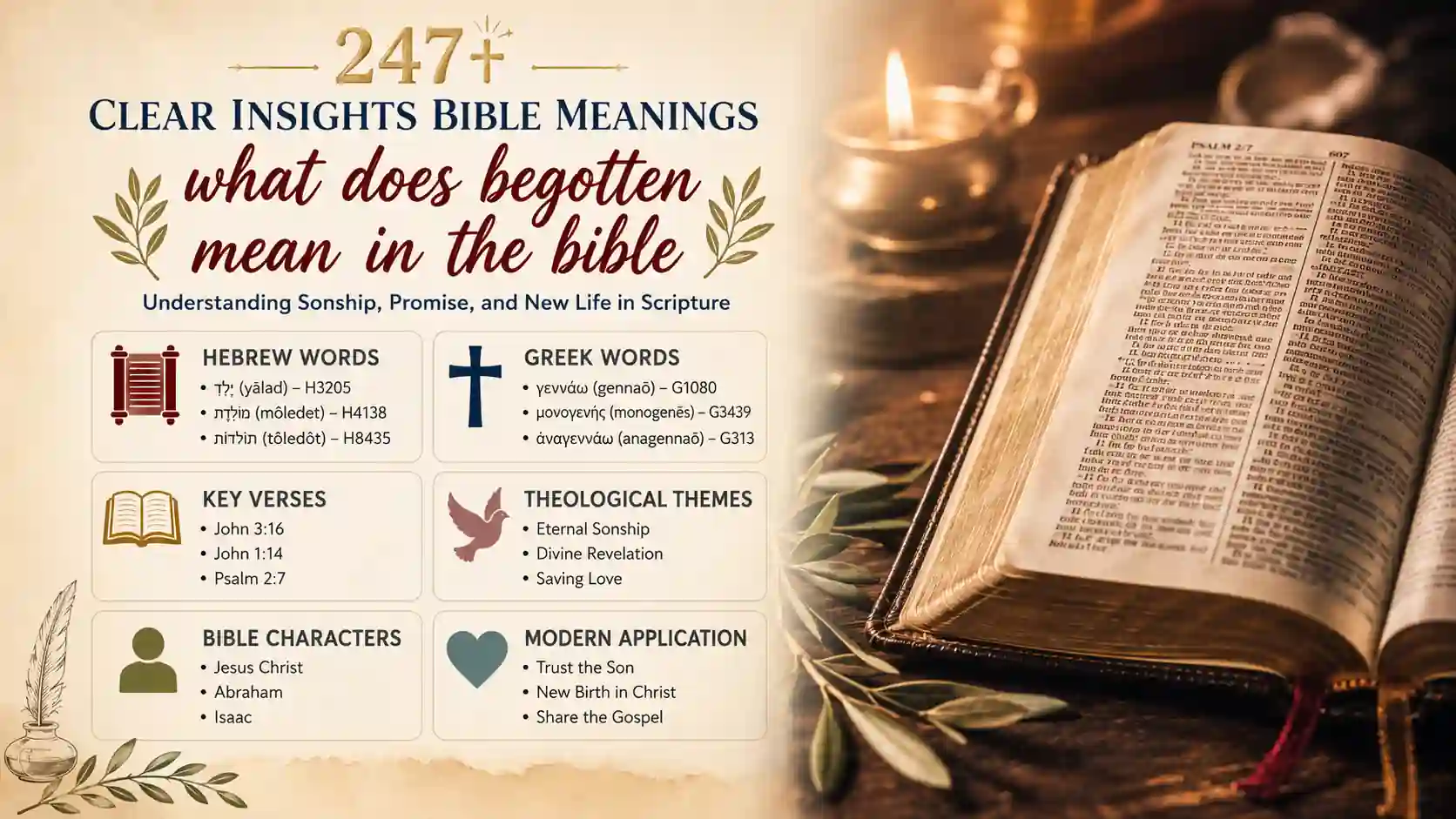
Original Hebrew and Greek Words for Begotten
| Original Word | Transliteration | Strong’s # | Literal Meaning |
|---|---|---|---|
| יָלַד | yālad | H3205 | Bear, beget, bring forth |
| מוֹלֶדֶת | môledet | H4138 | Birth, kindred, native land |
| תּוֹלְדוֹת | tôledôt | H8435 | Generations, family history |
| בֵּן | bēn | H1121 | Son, descendant |
| בְּכוֹר | bekhôr | H1060 | Firstborn |
| γεννάω | gennaō | G1080 | Beget, give birth, generate |
| μονογενής | monogenēs | G3439 | Only, unique, one of a kind |
| ἀναγεννάω | anagennaō | G313 | Beget again, give new birth |
| γένος | genos | G1085 | Family, offspring, kind |
| πρωτότοκος | prōtotokos | G4416 | Firstborn, highest-ranking heir |
Hebrew יָלַד, yālad, is the common Old Testament verb for bearing or fathering children. Depending on its grammatical form and subject, it may describe a mother giving birth, a father begetting, or a genealogy establishing descent. Strong’s identifies it as H3205.
Greek γεννάω, gennaō, G1080, likewise covers fathering, giving birth, and figurative regeneration. Greek μονογενής, monogenēs, G3439, stresses an only or uniquely related child. Therefore, “begotten” does not represent the same Greek word in every New Testament passage.
Biblical Concepts Related to Begotten
| Concept | Connection | Supporting Verse |
|---|---|---|
| Sonship | Begotten language identifies relationship | John 1:14 |
| Incarnation | The eternal Son becomes flesh | John 1:14 |
| Uniqueness | Jesus is the Father’s incomparable Son | John 3:16 |
| Kingship | The Davidic king is publicly installed | Psalm 2:6-7 |
| Covenant promise | Isaac is Abraham’s unique promised heir | Hebrews 11:17 |
| New birth | God brings believers into spiritual life | 1 Peter 1:3 |
| Resurrection | Christ’s rising inaugurates new creation | Acts 13:33 |
| Adoption | Believers receive filial standing by grace | Romans 8:15 |
| Firstborn status | Rank and inheritance are emphasized | Colossians 1:15 |
| Revelation | The Son makes the Father known | John 1:18 |
Historical and Cultural Context of Begotten
| Aspect | Detail | Biblical Source |
|---|---|---|
| Ancient genealogies | “Begot” traces family descent | Genesis 5 |
| Patriarchal households | The father publicly recognized heirs | Genesis 21:9-12 |
| Covenant inheritance | Isaac carried the promised lineage | Genesis 17:19 |
| Firstborn customs | The firstborn held special status | Deuteronomy 21:17 |
| Davidic monarchy | A king could be called God’s son | 2 Samuel 7:14 |
| Royal enthronement | “Today” marked public installation | Psalm 2:6-7 |
| Jewish birth imagery | Birth could picture spiritual origin | John 3:3-8 |
| Greco-Roman usage | An only child was uniquely cherished | Luke 7:12 |
| Apostolic preaching | Psalm 2 was applied to Christ | Acts 13:32-33 |
| Early church confession | Sonship guarded Christ’s full deity | John 1:1, 18 |
In Israel’s royal setting, calling the king God’s “son” did not mean that the ruler became divine by physical generation. It expressed covenant appointment. God established the Davidic ruler as his representative, and Psalm 2 ultimately reaches beyond ordinary kings to the Messiah.
John’s Gospel uses a different setting. Its description of Christ as μονογενής presents the Son who eternally belongs with the Father, enters human history, displays divine glory, and makes the invisible God known.
Theological Themes within Begotten Language
| Theme | Explanation | Scripture |
|---|---|---|
| Eternal Sonship | Christ is Son before his incarnation | John 17:5 |
| Full deity | The Word is God, not a creature | John 1:1 |
| Personal distinction | Father and Son relate personally | John 5:19-23 |
| Unique relationship | No other son shares Christ’s identity | John 3:18 |
| Divine revelation | Jesus perfectly reveals the Father | John 1:18 |
| Saving love | The Father gives his unique Son | John 3:16 |
| Messianic kingship | The Son reigns over the nations | Psalm 2:7-8 |
| Resurrection victory | The royal Son is publicly vindicated | Acts 13:33 |
| Covenant fulfillment | Jesus fulfills promises to David | Romans 1:3-4 |
| Regenerated life | God begets believers into living hope | 1 Peter 1:3 |
Modern Application of Begotten Truth
| Area | Practice | Scripture |
|---|---|---|
| Bible reading | Examine the word’s immediate context | Nehemiah 8:8 |
| Christology | Confess Jesus as eternal Son and Lord | John 20:28 |
| Worship | Honor the Son as you honor the Father | John 5:23 |
| Faith | Trust the Son whom God gave | John 3:16 |
| Assurance | Rest in God’s fatherly love | 1 John 3:1 |
| New birth | Depend on God’s regenerating mercy | 1 Peter 1:3 |
| Witness | Present Christ as God’s unique Son | 1 John 4:14 |
| Obedience | Listen to the beloved Son | Matthew 17:5 |
| Hope | Live in light of resurrection life | 1 Peter 1:3-5 |
| Fellowship | Love others born of God | 1 John 5:1 |
What Does Begotten Mean in the Bible’S Genealogies?
In genealogical passages, “begotten” usually carries its natural family meaning. A father begets a child, while a mother bears or gives birth to a child. Genesis 5 repeatedly uses יָלַד, yālad, to connect generations from Adam onward.
These records are theological as well as historical. They preserve family identity, trace covenant promises, and show how God works through successive generations. Matthew’s genealogy similarly uses γεννάω, gennaō, to trace Jesus’ legal and royal descent through Abraham and David.
MonogenēS and the Father’S Unique Son
The expression μονογενής, monogenēs, does not teach that the Father created Jesus. John has already declared that the Word existed “in the beginning,” was with God, was God, and participated in the creation of everything that came into existence.
In John 3:16, the emphasis rests on the immeasurable cost and wonder of divine love. God gave not one son among many equivalent sons, but his unique Son. Jesus possesses a relationship with the Father that no angel, king, prophet, or adopted child shares in the same way.
The description “only begotten” historically helped Christians confess that the Son truly shares the Father’s divine nature. Modern translations often express the immediate lexical sense as “only Son” or “one and only Son.” These renderings need not oppose one another when they preserve Christ’s eternal, unique sonship.
Psalm 2 and the Royal Meaning of “Today I Have Begotten You”
Psalm 2:7 records God’s declaration to the anointed king, “You are my Son; today I have begotten you.” In its royal context, “today” points to enthronement or public installation rather than the beginning of the king’s biological existence.
The New Testament applies this royal declaration to Jesus in Acts 13:33, Hebrews 1:5, and Hebrews 5:5. His resurrection, exaltation, and heavenly priesthood publicly demonstrate his identity and authority as the promised Davidic Son.
This does not imply that Jesus became the Son only at his resurrection. The Gospels identify him as God’s Son before the cross. Resurrection reveals, vindicates, and enthrones the Son who already possessed that identity.
Begotten Again Through the Resurrection of Jesus
First Peter 1:3 says that God has “begotten us again,” using ἀναγεννάω, anagennaō. Here the subject is not Christ’s eternal sonship but the believer’s regeneration. God mercifully grants new spiritual life.
Your new birth rests on Jesus’ resurrection. As Christ rose into indestructible life, those united to him receive living hope, a new identity, and an incorruptible inheritance. You do not become divine or share Christ’s unique sonship, but you truly enter God’s family by grace.
This distinction protects both truths. Jesus is the unique Son by nature, while believers become God’s children through new birth and adoption. His sonship is the foundation of yours, not an identical form of sonship.
Questions About Begotten in the Bible
Does μονογενής, monogenēs, mean “only begotten” or “one and only”?
It identifies an only or uniquely related child, so both renderings seek to express aspects of Christ’s incomparable sonship.
Does Psalm 2:7 teach that Jesus began to exist when God begot him?
No, its royal context concerns messianic installation and public vindication, not the creation of the eternal Son.
Why is Isaac called Abraham’s “only begotten” son in Hebrews 11:17?
Isaac was Abraham’s unique promised and covenant-bearing son, although Abraham also fathered Ishmael and other children.
Is “firstborn” in Colossians 1:15 the same as “begotten”?
No, πρωτότοκος, prōtotokos, emphasizes Christ’s supremacy and inheritance rights, while μονογενής emphasizes his unique relationship with the Father.
How does ἀναγεννάω, anagennaō, apply to your Christian life?
It teaches that God has given you new spiritual life and a living hope through the resurrection of Jesus Christ.