
What does oppressed mean in the Bible? Scripture uses the idea of oppression for suffering caused by cruel power, injustice, exploitation, violence, bondage, or overwhelming affliction. An oppressed person is pressed down by someone stronger, deprived of rightful protection, or burdened beyond ordinary hardship.
The biblical writers treat oppression as a moral and spiritual matter. God hears the oppressed, judges oppressors, commands his people to practice justice, and reveals Jesus as the Messiah who brings freedom, healing, and hope. Your study therefore leads from human suffering to God’s righteous intervention.
Key Oppressed Scripture References
| Verse | Passage Snippet | Context |
|---|---|---|
| Exodus 3:9 | Israel’s oppression has reached God | Egyptian slavery |
| Exodus 22:21 | Do not oppress a foreigner | Covenant law |
| Deuteronomy 24:14 | Do not oppress hired workers | Economic justice |
| Psalm 9:9 | The Lord is a refuge | Protection for sufferers |
| Psalm 10:17–18 | God defends the oppressed | Judgment of violent people |
| Psalm 103:6 | God works righteousness and justice | Divine character |
| Isaiah 1:17 | Correct oppression | Prophetic call to repentance |
| Isaiah 58:6 | Let the oppressed go free | True fasting |
| Luke 4:18 | Set the oppressed free | Jesus’ Nazareth proclamation |
| Acts 10:38 | Jesus healed those oppressed | Apostolic summary |
Oppressed Bible Translation Comparison
| Verse | KJV | NIV | ESV | NASB |
|---|---|---|---|---|
| Exodus 3:9 | oppression | oppressed | oppression | oppression |
| Exodus 22:21 | oppress him | oppress a foreigner | oppress him | oppress him |
| Deuteronomy 24:14 | oppress an hired servant | take advantage of a hired worker | oppress a hired worker | oppress a hired person |
| Psalm 9:9 | refuge for the oppressed | refuge for the oppressed | stronghold for the oppressed | stronghold for the oppressed |
| Psalm 10:18 | oppressed | afflicted | oppressed | oppressed |
| Isaiah 1:17 | relieve the oppressed | defend the oppressed | correct oppression | rebuke the oppressor |
| Isaiah 58:6 | let the oppressed go free | set the oppressed free | let the oppressed go free | let the oppressed go free |
| Luke 4:18 | set at liberty them that are bruised | set the oppressed free | set at liberty those oppressed | set free those who are oppressed |
| Acts 10:38 | oppressed of the devil | under the power of the devil | oppressed by the devil | oppressed by the devil |
People and Characters Associated with the Oppressed
| Person | Role | Connection |
|---|---|---|
| Moses | Deliverer of Israel | Sent to confront Egyptian oppression |
| Pharaoh | King of Egypt | Enslaved and exploited Israel |
| Israelites | Covenant people | Cried to God under forced labor |
| Ruth | Foreign widow | Protected by Israel’s covenant laws |
| David | Psalmist and king | Described God as the oppressed person’s refuge |
| Amos | Prophet | Condemned economic exploitation |
| Isaiah | Prophet | Called Judah to defend vulnerable people |
| Jeremiah | Prophet | Rebuked royal injustice and oppression |
| Jesus | Messiah | Proclaimed liberty and healed the oppressed |
| James | Apostolic teacher | Condemned rich people who oppressed the poor |
Original Hebrew and Greek Words for Oppressed
| Original Word | Transliteration | Strong’s # | Literal Meaning |
|---|---|---|---|
| עָשַׁק | ʿāshaq | H6231 | Oppress, exploit, defraud |
| עֹשֶׁק | ʿōsheq | H6233 | Oppression, extortion |
| לָחַץ | lāḥats | H3905 | Press, squeeze, oppress |
| לַחַץ | laḥats | H3906 | Pressure, distress, oppression |
| עָנָה | ʿānâ | H6031 | Afflict, humble, mistreat |
| דַּךְ | dakh | H1790 | Crushed, oppressed |
| רָצַץ | rātsats | H7533 | Crush, shatter, oppress |
| יָנָה | yānâ | H3238 | Wrong, suppress, mistreat |
| καταδυναστεύω | katadynasteuō | G2616 | Dominate, exploit, oppress |
| θραύω | thrauō | G2352 | Break, crush, shatter |
Related Biblical Concepts of Oppression
| Concept | Connection | Supporting Verse |
|---|---|---|
| Affliction | Pain imposed through hardship | Exodus 1:11–12 |
| Injustice | Rights denied by corrupt power | Isaiah 10:1–2 |
| Slavery | People controlled for another’s gain | Exodus 3:7–9 |
| Exploitation | Labor or property taken unfairly | Deuteronomy 24:14 |
| Violence | Force used against vulnerable people | Psalm 10:7–10 |
| Poverty | Oppression often produces deprivation | Proverbs 14:31 |
| False judgment | Courts favor the powerful | Amos 5:12 |
| Deliverance | God acts to release sufferers | Psalm 72:12–14 |
| Compassion | God’s people share another’s burden | Zechariah 7:9–10 |
| Righteousness | Justice expressed through covenant faithfulness | Psalm 103:6 |
Historical and Cultural Context of the Oppressed
| Aspect | Detail | Biblical Source |
|---|---|---|
| Egyptian labor | Israel built cities through forced service | Exodus 1:11–14 |
| Foreign residents | Immigrants lacked land and family protection | Exodus 22:21 |
| Day laborers | Workers depended on daily wages | Deuteronomy 24:14–15 |
| Debt slavery | Poor people could lose freedom through debt | 2 Kings 4:1 |
| Land seizure | Powerful families accumulated ancestral property | Micah 2:1–2 |
| Corrupt courts | Bribes deprived poor people of justice | Amos 5:12 |
| Royal abuse | Kings could misuse authority and property | 1 Kings 21:1–16 |
| Widows and orphans | Households without male protectors were vulnerable | Isaiah 1:17 |
| Roman rule | Heavy taxation burdened Judean communities | Luke 3:12–14 |
| Patronage systems | Wealthy people could dominate poor believers | James 2:5–6 |
Theological Themes within Biblical Oppression
| Theme | Explanation | Scripture |
|---|---|---|
| God hears cries | Suffering does not escape his attention | Exodus 3:7 |
| God judges power | Authority remains accountable to him | Ecclesiastes 5:8 |
| God defends the weak | He acts for those lacking protection | Psalm 146:7–9 |
| Sin becomes structural | Evil can shape laws, courts, and economies | Isaiah 10:1–2 |
| Memory guides ethics | Israel must remember its former slavery | Deuteronomy 24:17–18 |
| Worship requires justice | Religious activity cannot excuse exploitation | Isaiah 58:3–7 |
| Messiah brings liberty | Jesus fulfills the promise of release | Luke 4:18–21 |
| Spiritual tyranny is real | The devil exercises destructive domination | Acts 10:38 |
| Disciples practice mercy | Faith must change treatment of the poor | James 2:1–9 |
| Final justice is certain | God will end violence and oppression | Psalm 10:17–18 |
Modern Application for Believers Facing Oppression
| Area | Practice | Scripture |
|---|---|---|
| Prayer | Bring suffering honestly before God | Psalm 10:17 |
| Advocacy | Speak for people denied justice | Proverbs 31:8–9 |
| Employment | Pay workers fairly and promptly | Deuteronomy 24:15 |
| Hospitality | Protect immigrants and outsiders | Leviticus 19:33–34 |
| Church life | Reject favoritism toward wealth | James 2:1–4 |
| Generosity | Share resources without manipulation | Deuteronomy 15:7–11 |
| Leadership | Use authority to serve rather than control | Mark 10:42–45 |
| Discernment | Recognize spiritual bondage and seek Christ | Acts 10:38 |
| Repentance | Repair harm caused by exploitation | Luke 19:8 |
| Hope | Trust God’s promised judgment and restoration | Psalm 72:12–14 |
What Does Oppressed Mean in the Bible’S Hebrew Vocabulary?
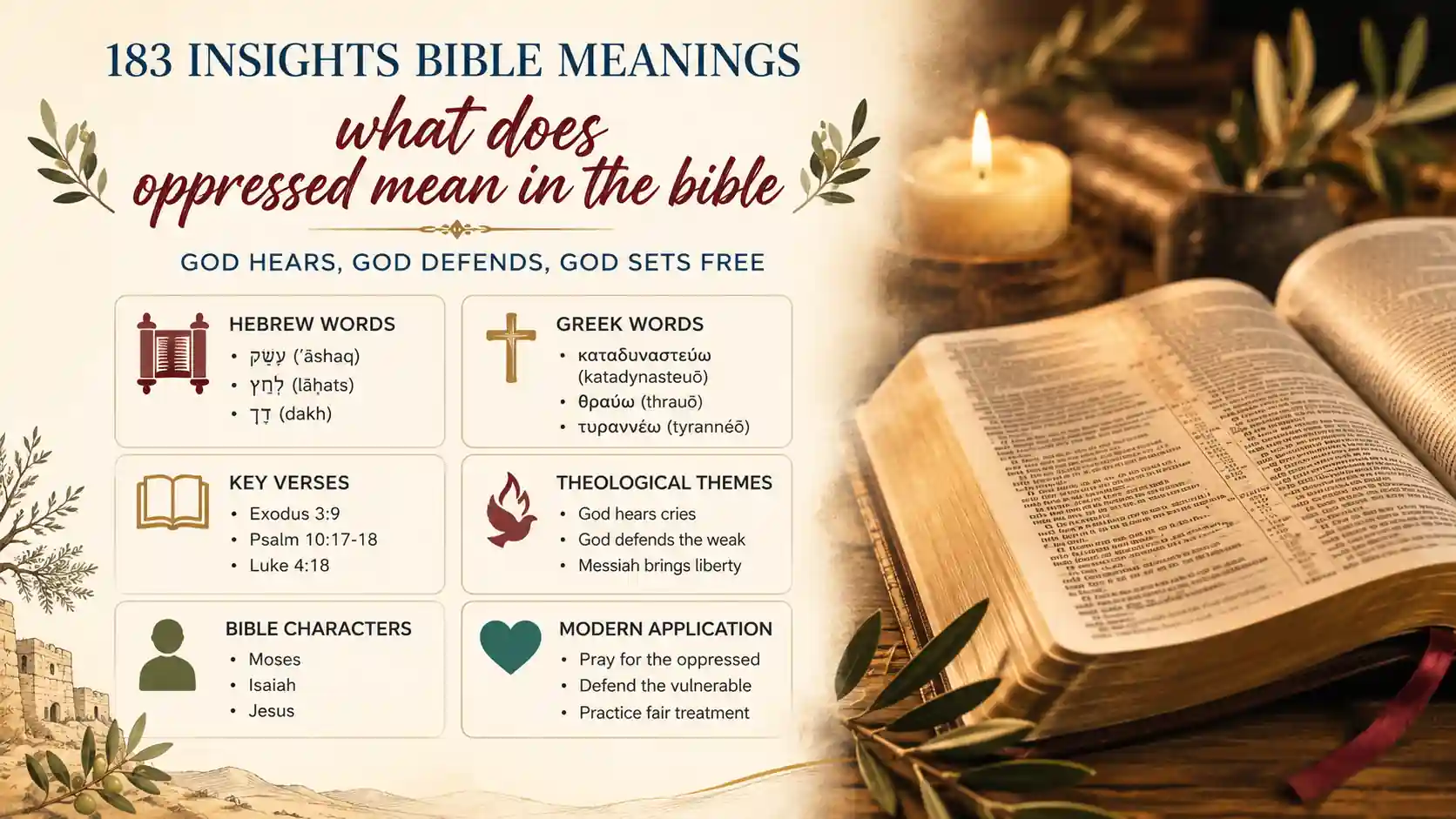
The Hebrew Bible does not rely on one word for oppression. עָשַׁק, ʿāshaq, emphasizes exploitation, fraud, or the misuse of strength. It appears when employers withhold wages, rulers abuse subjects, or wealthy people take advantage of those with fewer resources. The word identifies more than sadness. It describes a wrong committed against another person.
לָחַץ, lāḥats, pictures pressure applied to someone. It can describe the crushing conditions Israel endured in Egypt or the distress produced by hostile nations. דַּךְ, dakh, describes someone crushed or brought low. Together, these terms show oppression as an experience involving an oppressor, a victim, and power used contrary to God’s righteousness.
Egypt and the Covenant Memory of Oppression
Egypt provides the foundational biblical picture of oppression. Pharaoh feared Israel’s growth, imposed forced labor, ordered violence against children, and treated human beings as tools of imperial security. The Israelites cried out, and God declared that he had seen their affliction, heard their cry, and knew their suffering.
Israel’s later laws repeatedly appeal to this memory. The people must not oppress foreigners because they once lived as foreigners in Egypt. Redemption creates responsibility. When God releases people from bondage, he calls them to build communities where workers, immigrants, widows, orphans, and poor families receive justice rather than renewed exploitation.
Jesus, καταδυναστεύω, and Freedom for the Oppressed
In Acts 10:38, Peter says that Jesus healed those who were καταδυναστευομένους, katadynasteuomenous, oppressed by the devil. The verb καταδυναστεύω, katadynasteuō, describes hostile domination or the abusive exercise of power. Here oppression includes spiritual tyranny manifested through suffering from which Jesus brings release.
Luke 4:18 uses different language when Jesus announces liberty for those who have been crushed. His proclamation draws from Isaiah and presents him as the Spirit-anointed Messiah. Jesus addresses sin, demonic bondage, bodily misery, exclusion, and injustice without reducing every form of suffering to the same cause. His kingdom confronts every power that degrades God’s image-bearers.
God’S Justice and Your Response to the Oppressed
Scripture never treats concern for oppressed people as an optional interest for unusually compassionate believers. God identifies righteous conduct with defending the poor, paying fair wages, welcoming strangers, correcting injustice, and refusing favoritism. Isaiah warns that fasting and worship become hollow when people continue exploiting workers or ignoring those in need.
Your response begins with seeing people truthfully rather than blaming them automatically for their suffering. You can listen, pray, give, advocate, practice fair employment, resist manipulative leadership, and support lawful protection for vulnerable people. Biblical justice does not replace the gospel. It displays the character of the God whose gospel rescues sinners and forms a merciful people.
Frequently Asked Questions About the Oppressed in Scripture
Does עָשַׁק, ʿāshaq, refer only to physical violence?
No. It can include fraud, withheld wages, extortion, economic exploitation, and other abuses of power.
Why does Isaiah 1:17 differ between “relieve the oppressed,” “defend the oppressed,” and “correct oppression”?
The Hebrew wording permits interpretations involving setting injustice right, restraining an oppressor, or bringing relief to the oppressed.
Is Luke 4:18 primarily about political oppression or spiritual salvation?
Its messianic promise embraces God’s saving reign, including spiritual liberation and compassionate restoration for people who are crushed.
Does Acts 10:38 teach that every oppressed person is demon-possessed?
No. It identifies the devil’s tyrannical activity but does not equate every social, emotional, economic, or physical hardship with possession.
How can you help oppressed people without acting self-righteous?
Serve humbly, listen carefully, seek truth, protect dignity, practice justice, and remember that you also depend completely on God’s mercy.