
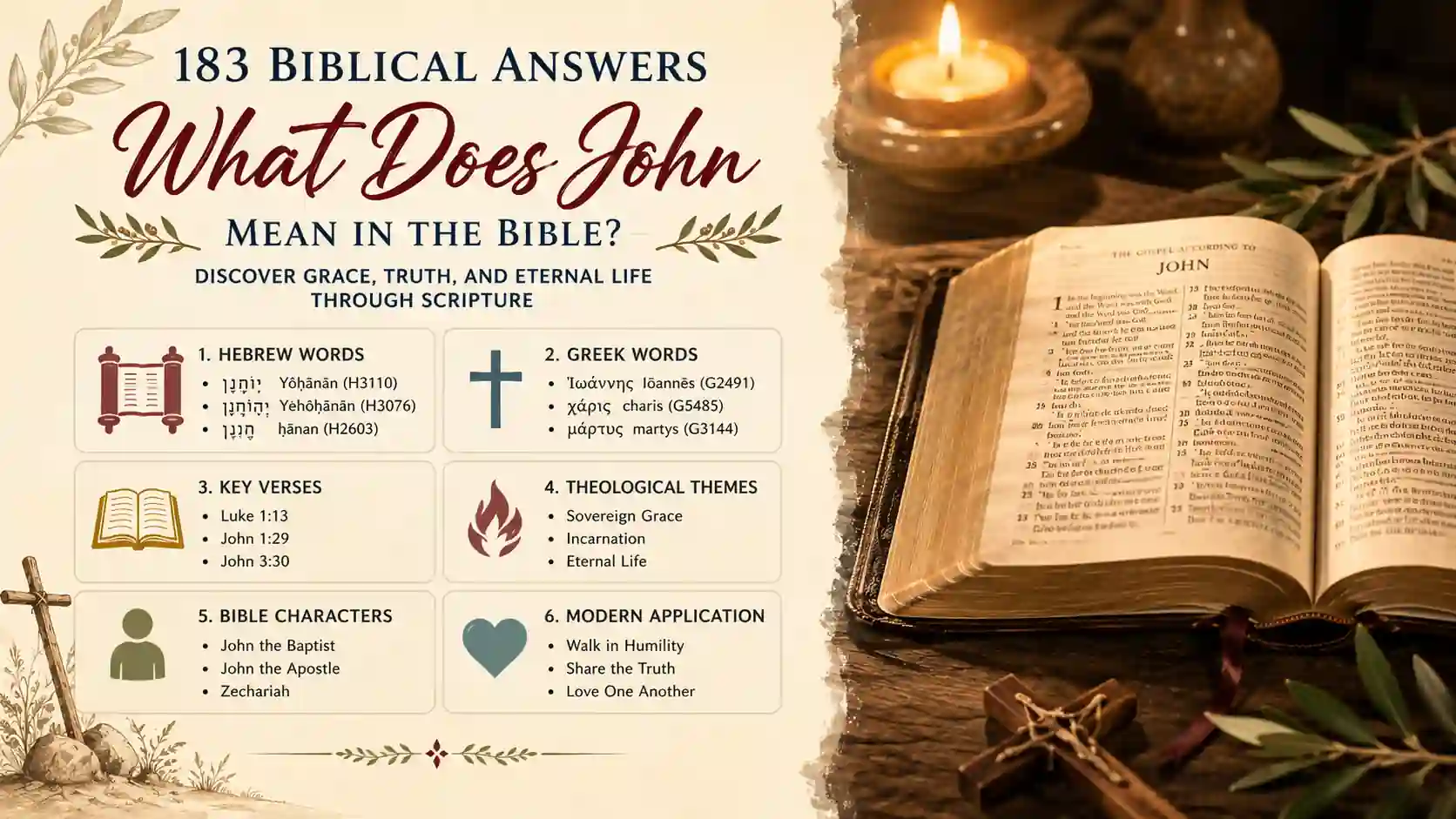
What does John mean in the Bible? The name John comes through the Greek Ἰωάννης, Iōannēs, from the Hebrew יוֹחָנָן, Yôḥānān, meaning “Yahweh has been gracious” or “the Lord has shown favor.” This meaning fits the biblical story of John the Baptist, whose unexpected birth displayed God’s mercy to his parents and announced the arrival of Israel’s Messiah.
John is also the name traditionally associated with an apostle, a Gospel, three New Testament letters, and Revelation. As you study the name, you encounter grace, witness, repentance, love, truth, and faithful testimony.
John in Key Scripture References
| Verse | Passage Snippet | Context |
|---|---|---|
| Luke 1:13 | “Call his name John” | Gabriel names Elizabeth’s son |
| Luke 1:60 | “He shall be called John” | Elizabeth obeys God’s command |
| Luke 1:63 | “His name is John” | Zechariah confirms the name |
| Luke 1:76 | “Prophet of the Highest” | John’s prophetic calling |
| Matthew 3:1 | “John the Baptist” | Ministry begins in Judea |
| John 1:6 | “A man sent from God” | John bears witness to Christ |
| John 1:29 | “Behold the Lamb of God” | John identifies Jesus |
| Mark 1:9 | “Baptized of John” | John baptizes Jesus |
| Acts 4:13 | “Peter and John” | The apostle testifies boldly |
| Revelation 1:9 | “I John” | John receives the Revelation |
John in Bible Translation Comparison
| Verse | KJV | NIV | ESV | NASB |
|---|---|---|---|---|
| Luke 1:13 | “name John” | “call him John” | “call his name John” | “give him the name John” |
| Luke 1:60 | “called John” | “called John” | “called John” | “called John” |
| Luke 1:63 | “His name is John” | “His name is John” | “His name is John” | “John is his name” |
| Matthew 3:1 | “John the Baptist” | “John the Baptist” | “John the Baptist” | “John the Baptist” |
| Mark 1:4 | “baptize in the wilderness” | “appeared in the wilderness” | “appeared, baptizing” | “appeared in the wilderness” |
| John 1:6 | “sent from God” | “sent from God” | “sent from God” | “sent from God” |
| John 1:23 | “voice of one crying” | “voice of one calling” | “voice of one crying out” | “voice of one calling out” |
| John 1:29 | “Lamb of God” | “Lamb of God” | “Lamb of God” | “Lamb of God” |
| Acts 3:1 | “Peter and John” | “Peter and John” | “Peter and John” | “Peter and John” |
| Revelation 1:9 | “I John” | “I, John” | “I, John” | “I, John” |
John and the People Associated with the Name
| Person | Role | Connection |
|---|---|---|
| John the Baptist | Prophet and forerunner | Prepared Israel for Jesus |
| John son of Zebedee | Apostle | Followed Jesus from Galilee |
| Zechariah | Priest | Father of John the Baptist |
| Elizabeth | Mother of John | Received God’s gracious gift |
| Gabriel | Angelic messenger | Announced John’s birth and name |
| Jesus Christ | Messiah | John’s ministry pointed to him |
| James | Apostle | Brother of John son of Zebedee |
| Peter | Apostle | Frequent ministry partner of John |
| Herod Antipas | Galilean ruler | Imprisoned John the Baptist |
| Herodias | Herod’s wife | Opposed John’s rebuke |
John in the Original Hebrew and Greek Words
| Original Word | Transliteration | Strong’s # | Literal Meaning |
|---|---|---|---|
| יוֹחָנָן | Yôḥānān | H3110 | Yahweh has been gracious |
| יְהוֹחָנָן | Yəhôḥānān | H3076 | Yahweh has shown favor |
| Ἰωάννης | Iōannēs | G2491 | John |
| יהוה | YHWH | H3068 | The covenant name of God |
| חָנַן | ḥānan | H2603 | To show favor or mercy |
| חֵן | ḥēn | H2580 | Favor or grace |
| χάρις | charis | G5485 | Grace or gracious favor |
| μάρτυς | martys | G3144 | Witness |
| μαρτυρία | martyria | G3141 | Testimony |
| βαπτιστής | baptistēs | G910 | Baptizer |
John and Related Biblical Concepts
| Concept | Connection | Supporting Verse |
|---|---|---|
| Divine grace | John’s name declares God’s favor | Luke 1:13 |
| Answered prayer | His birth answered long prayer | Luke 1:13 |
| Prophetic calling | Set apart before birth | Luke 1:15 |
| Repentance | Central message of John the Baptist | Matthew 3:2 |
| Preparation | Prepared the Lord’s way | Luke 3:4 |
| Witness | Testified concerning the Light | John 1:7 |
| Humility | Christ must increase | John 3:30 |
| Sacrificial love | Strong theme in John’s writings | 1 John 3:16 |
| Truth | Truth shapes Christian discipleship | 3 John 4 |
| Eternal life | Life is found in the Son | John 20:31 |
John in Historical and Cultural Context
| Aspect | Detail | Biblical Source |
|---|---|---|
| Priestly family | John descended from Aaron | Luke 1:5 |
| Elderly parents | His birth appeared impossible | Luke 1:7 |
| Naming custom | Families often used ancestral names | Luke 1:59-61 |
| Divine naming | God selected John’s name | Luke 1:13 |
| Wilderness ministry | Prophets often emerged from solitude | Matthew 3:1 |
| Baptism | Sign of repentance and cleansing | Mark 1:4 |
| Jordan River | Public setting for John’s ministry | Matthew 3:5-6 |
| Camel-hair clothing | Echoed Elijah’s prophetic image | 2 Kings 1:8 |
| Herodian rule | John confronted royal immorality | Mark 6:17-18 |
| Roman exile | John suffered on Patmos | Revelation 1:9 |
John and Major Theological Themes
| Theme | Explanation | Scripture |
|---|---|---|
| Sovereign grace | God graciously initiates salvation | Luke 1:13-17 |
| Fulfilled prophecy | John fulfills the forerunner promise | Malachi 3:1 |
| Incarnation | The eternal Word became flesh | John 1:14 |
| Christ’s deity | The Word was God | John 1:1 |
| Lamb of God | Jesus bears away sin | John 1:29 |
| New birth | Entrance into God’s kingdom | John 3:3 |
| Atoning love | God gave his only Son | John 3:16 |
| True discipleship | Obedience reveals genuine love | John 14:15 |
| Christian fellowship | Believers share life in Christ | 1 John 1:3 |
| Final victory | Christ reigns over evil | Revelation 19:16 |
John in Modern Application for Believers
| Area | Practice | Scripture |
|---|---|---|
| Identity | Receive your calling from God | Luke 1:13 |
| Humility | Direct attention toward Christ | John 3:30 |
| Repentance | Turn from known sin | Matthew 3:8 |
| Witness | Speak truthfully about Jesus | John 1:7 |
| Courage | Confront wrongdoing wisely | Mark 6:18 |
| Love | Serve fellow believers sacrificially | 1 John 3:18 |
| Discernment | Test spiritual claims | 1 John 4:1 |
| Assurance | Trust the testimony about the Son | 1 John 5:11-13 |
| Fellowship | Walk openly in God’s light | 1 John 1:7 |
| Perseverance | Remain faithful through suffering | Revelation 1:9 |
What Does John Mean in the Bible and Why Was the Name Chosen?
The Hebrew name יוֹחָנָן, Yôḥānān, combines a shortened form of the divine name יהוה, YHWH, with the verb חָנַן, ḥānan, meaning to show favor, mercy, or gracious kindness. John therefore means “Yahweh has been gracious.” It is a confession about God’s character, not merely an attractive personal name.
That meaning is especially fitting in Luke 1. Zechariah and Elizabeth were righteous but childless, and both were advanced in age. John’s birth was not presented as ordinary family good fortune. It was God’s gracious intervention, answering prayer and advancing his covenant purpose for Israel.
Ἰωάννης And the God-Given Name in Luke 1
The Greek New Testament writes John as Ἰωάννης, Iōannēs, Strong’s G2491. Luke emphasizes that the name did not arise from family preference. Gabriel commanded Zechariah to use it, Elizabeth defended it, and Zechariah publicly confirmed it by writing, “His name is John.”
The neighbors objected because no close relative carried that name. Their reaction reveals the cultural weight of family naming customs. God’s command, however, showed that this child’s identity and mission came from divine initiative. John belonged to a family, but his calling served God’s larger redemptive plan.
His name also anticipates his message. John announced that God was graciously visiting his people, yet he called them to repentance. Biblical grace never makes sin insignificant. God’s favor creates the opportunity to turn, receive forgiveness, and prepare for the coming King.
John the Baptist as Witness to the Lamb of God
John the Baptist is the first major John encountered in the New Testament. He is described as a prophet, a voice in the wilderness, a baptizer, and a witness. His purpose was not to establish his own movement but to prepare people for Jesus Christ.
The Fourth Gospel is careful to distinguish John from the Light. John “was not that Light,” but he came to testify about it. When priests and Levites questioned him, he refused titles that would misdirect attention. He identified himself as the prophetic voice preparing the Lord’s way.
His greatest declaration appears in John 1:29, when he calls Jesus “the Lamb of God.” This title connects Christ with sacrifice, deliverance, and the removal of sin. John’s name proclaimed divine grace, and his ministry identified the One through whom that grace would reach its saving fulfillment.
John’s humility completes the picture. When Jesus’ ministry began attracting more disciples, John answered, “He must increase, but I must decrease.” Your own witness is faithful when it makes Christ clearer rather than making you more prominent.
John the Apostle and the Theology of Love, Truth, and Life
The New Testament also presents John the son of Zebedee, brother of James and one of Jesus’ twelve apostles. He belonged to Jesus’ closest circle with Peter and James. The Gospels portray him as passionate and sometimes severe, yet the writings associated with John repeatedly emphasize love, truth, fellowship, and eternal life.
The Gospel of John announces that Jesus is the eternal Word who became flesh. Its stated purpose is that readers may believe Jesus is the Christ, the Son of God, and receive life in his name. Grace is therefore not treated as a vague feeling. It is revealed personally and decisively in Jesus.
First John joins doctrinal truth with moral transformation. Those who know God confess the true Christ, practice righteousness, and love fellow believers. Second John warns that love must remain governed by truth, while Third John praises hospitality and faithfulness.
Revelation presents John as a suffering witness exiled on Patmos. He receives visions of Christ’s authority, the church’s perseverance, divine judgment, and final renewal. Across these writings, the meaning of John finds a broad theological echo. The gracious God reveals his Son, preserves his people, defeats evil, and promises life in his presence.
Questions About John in the Bible
Is יוֹחָנָן, Yôḥānān, the exact Hebrew source of the name John?
Yes. Greek Ἰωάννης, Iōannēs, reflects the Hebrew names יוֹחָנָן and יְהוֹחָנָן, both expressing that Yahweh is gracious.
Why does Luke 1 make such a major issue of John’s name?
The repeated naming scene shows that John’s identity, birth, and prophetic mission were determined by God rather than family custom.
Does “Yahweh has been gracious” describe John or God?
It primarily describes God, confessing that John’s life and calling were gifts of divine favor.
Are John the Baptist and John the apostle the same person?
No. John the Baptist was Jesus’ prophetic forerunner, while John son of Zebedee was one of Jesus’ twelve apostles.
How should John 3:30 shape your Christian life?
It calls you to welcome Christ’s increasing influence while surrendering pride, personal recognition, and self-centered ambition.