
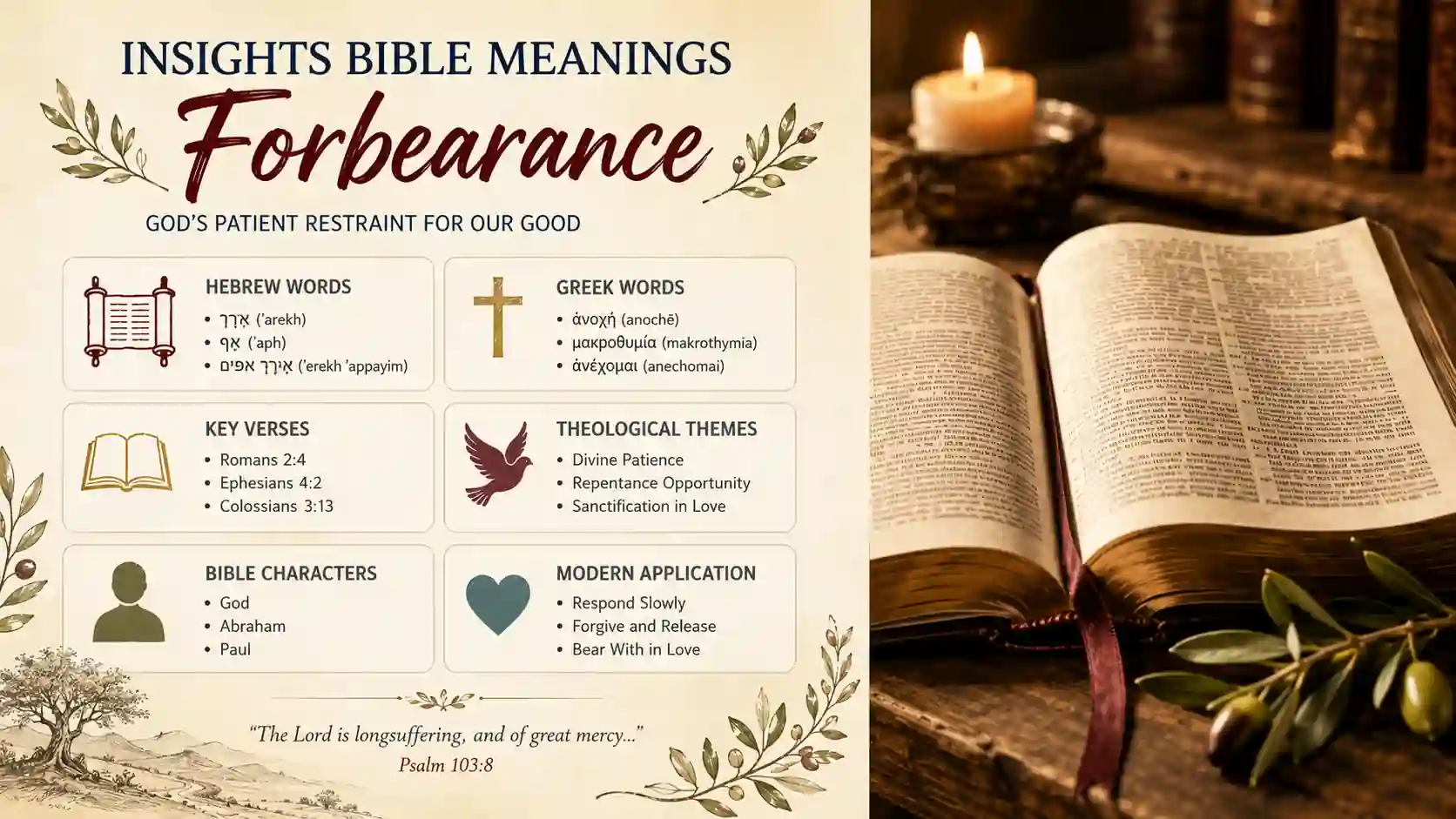
What does forbearance mean in the Bible? Scripture presents forbearance as patient restraint toward people who provoke, disappoint, or wrong you. It is the deliberate refusal to answer sin with immediate anger or retaliation. Biblical forbearance reflects God’s own character, especially His patience with sinners and His willingness to delay judgment while calling them to repentance.
Forbearance does not excuse evil or erase justice. Instead, it governs how you respond while trusting God to judge rightly, extend mercy, and accomplish His redemptive purposes.
Key Scripture References for Forbearance
| Verse | Passage Snippet | Context |
|---|---|---|
| Romans 2:4 | “riches of his goodness and forbearance” | God’s patience should lead sinners to repentance |
| Romans 3:25 | “through the forbearance of God” | God passed over former sins before Christ’s sacrifice |
| Ephesians 4:2 | “forbearing one another in love” | Believers preserve unity through humility and patience |
| Colossians 3:13 | “forbearing one another, and forgiving” | Christian community requires endurance and forgiveness |
| 2 Corinthians 6:6 | “by longsuffering, by kindness” | Paul describes conduct fitting God’s servants |
| Galatians 5:22 | “the fruit of the Spirit is…longsuffering” | The Spirit produces patient restraint in believers |
| 1 Timothy 1:16 | “all longsuffering” | Christ’s patience with Paul becomes an example |
| 2 Peter 3:9 | “is longsuffering to us-ward” | God delays judgment because He desires repentance |
| Proverbs 19:11 | “his glory to pass over a transgression” | Wisdom slows anger and refuses needless retaliation |
| Exodus 34:6 | “longsuffering, and abundant in goodness” | God reveals His covenant name and merciful character |
Bible Translation Comparison for Forbearance
| Verse | KJV | NIV | ESV | NASB |
|---|---|---|---|---|
| Romans 2:4 | “forbearance and longsuffering” | “forbearance and patience” | “forbearance and patience” | “tolerance and patience” |
| Romans 3:25 | “forbearance of God” | “in his forbearance” | “divine forbearance” | “forbearance of God” |
| Ephesians 4:2 | “forbearing one another” | “bearing with one another” | “bearing with one another” | “showing tolerance” |
| Colossians 3:13 | “forbearing one another” | “bear with each other” | “bearing with one another” | “bearing with one another” |
| Galatians 5:22 | “longsuffering” | “forbearance” | “patience” | “patience” |
| Colossians 1:11 | “longsuffering with joyfulness” | “patience and endurance” | “patience with joy” | “patience and joyously” |
| 1 Timothy 1:16 | “all longsuffering” | “immense patience” | “perfect patience” | “perfect patience” |
| 2 Peter 3:9 | “longsuffering to us-ward” | “patient with you” | “patient toward you” | “patient toward you” |
The comparison shows that English translations distribute the idea among several terms. “Forbearance,” “tolerance,” “bearing with,” “patience,” and “longsuffering” may represent related Greek expressions, but they are not always interchangeable in every context.
The KJV often preserves the older English words “forbear” and “longsuffering.” Modern translations commonly use “bear with,” “patience,” or “tolerance” to express the same underlying ideas more naturally.
People and Characters Associated with Forbearance
| Person | Role | Connection |
|---|---|---|
| God | Covenant Lord and righteous Judge | Delays judgment and gives sinners opportunity to repent |
| Jesus Christ | Savior and perfect revelation of God | Displays complete patience toward Paul and other sinners |
| Paul | Apostle to the Gentiles | Receives Christ’s patience and teaches churches to practice it |
| Moses | Mediator of the Sinai covenant | Hears God proclaimed as slow to anger |
| David | King of Israel | Spares Saul instead of taking personal vengeance |
| Joseph | Son of Jacob and Egyptian ruler | Provides for brothers who had betrayed him |
| Stephen | First Christian martyr | Prays for his killers rather than cursing them |
| Abraham | Patriarch and recipient of promise | Waits patiently for God’s promised inheritance |
| Nehemiah | Governor of Judah | Recalls God’s long patience with rebellious Israel |
| Peter | Apostle and church leader | Explains God’s patience before final judgment |
Original Hebrew and Greek Words for Forbearance
| Original Word | Transliteration | Strong’s # | Literal Meaning |
|---|---|---|---|
| ἀνοχή | anochē | G463 | Restraint, tolerance, holding back |
| ἀνέχομαι | anechomai | G430 | To bear with, endure, put up with |
| μακροθυμία | makrothymia | G3115 | Patience, longsuffering, delayed anger |
| μακροθυμέω | makrothymeō | G3114 | To remain patient, delay wrath |
| μακρόθυμος | makrothymos | G3116 | Long-tempered, slow to anger |
| ἐπιείκεια | epieikeia | G1932 | Gentleness, clemency, gracious restraint |
| אָרֵךְ | ʾarekh | H750 | Long, especially long of anger |
| אַף | ʾaph | H639 | Nose, anger, wrath |
| אֶרֶךְ אַפַּיִם | ʾerekh ʾappayim | H750, H639 | Long of nostrils, slow to anger |
| חָדַל | chadal | H2308 | To cease, refrain, forbear |
The noun ἀνοχή, anochē, is the most direct New Testament term translated “forbearance.” It occurs in Romans 2:4 and Romans 3:25. The word pictures restraint, particularly the temporary holding back of deserved judgment.
The verb ἀνέχομαι, anechomai, describes bearing with another person. Paul uses it when instructing believers to endure one another’s weaknesses in love. Μακροθυμία, makrothymia, emphasizes a long delay before anger, especially when facing provocation.
Related Biblical Concepts of Forbearance
| Concept | Connection | Supporting Verse |
|---|---|---|
| Patience | Endures provocation without sinful reaction | Colossians 1:11 |
| Mercy | Withholds consequences that are deserved | Micah 7:18 |
| Forgiveness | Releases personal claims for repayment | Colossians 3:13 |
| Repentance | God’s patience creates opportunity to turn | Romans 2:4 |
| Longsuffering | Remains steady under repeated offense | Galatians 5:22 |
| Gentleness | Corrects others without harshness | 2 Timothy 2:25 |
| Self-control | Restrains impulses toward anger or revenge | Galatians 5:23 |
| Love | Bears weaknesses and seeks another’s good | Ephesians 4:2 |
| Justice | Leaves final judgment in God’s hands | Romans 12:19 |
| Unity | Protects fellowship from needless division | Ephesians 4:3 |
Forbearance is closely joined to forgiveness, but the two concepts are distinguishable. You may bear with a person’s immaturity, irritating habits, or weaknesses even when no specific sin requires a formal request for forgiveness.
When genuine sin occurs, forbearance restrains immediate retaliation and creates room for truthful confrontation, repentance, and forgiveness. It does not forbid correction. It shapes correction with patience, humility, and love.
Historical and Cultural Context of Forbearance
| Aspect | Detail | Biblical Source |
|---|---|---|
| Covenant revelation | God identifies Himself as slow to anger | Exodus 34:6 |
| Sinai rebellion | God repeatedly bears with Israel’s disobedience | Numbers 14:18 |
| Monarchy | David refuses to kill Saul, the Lord’s anointed | 1 Samuel 24:6 |
| Wisdom tradition | Slow anger marks prudence and honor | Proverbs 19:11 |
| Prophetic warning | Delayed judgment does not cancel accountability | Nahum 1:3 |
| Second Temple hope | Jews awaited God’s final judgment and restoration | Romans 2:5 |
| Roman social order | Churches united people divided by status and ethnicity | Colossians 3:11-13 |
| Household churches | Close fellowship made mutual patience necessary | Ephesians 4:1-3 |
| Apostolic mission | Persecuted servants answered hostility with endurance | 2 Corinthians 6:4-6 |
| Final judgment | God’s delay allows time for repentance | 2 Peter 3:9 |
In Hebrew thought, anger was often pictured through the nose or nostrils. The expression אֶרֶךְ אַפַּיִם, ʾerekh ʾappayim, literally suggests being “long of nostrils.” The image describes anger that rises slowly rather than flaring immediately.
This language appears in God’s self-revelation at Sinai and echoes throughout Israel’s Scriptures. God’s covenant patience explains why rebellious people were not instantly destroyed, though His holiness also meant that persistent rebellion would eventually face judgment.
Theological Themes within Forbearance
| Theme | Explanation | Scripture |
|---|---|---|
| Divine patience | God restrains deserved wrath for a redemptive purpose | Romans 2:4 |
| Righteous judgment | Delayed punishment remains certain and just | Romans 2:5 |
| Atonement | Christ publicly demonstrates God’s righteousness | Romans 3:25-26 |
| Repentance | Mercy grants time for sinners to turn | 2 Peter 3:9 |
| Sanctification | The Spirit forms patience in Christ’s people | Galatians 5:22 |
| Union with Christ | The forgiven learn to forgive and bear with others | Colossians 3:12-13 |
| Church unity | Patient love protects the bond of peace | Ephesians 4:2-3 |
| Providence | Believers entrust wrongs to God’s government | Romans 12:19 |
| Christian witness | Patient endurance commends gospel ministry | 2 Corinthians 6:4-6 |
| Final accountability | Forbearance must not be mistaken for approval | Ecclesiastes 8:11-13 |
Modern Application of Forbearance for Believers
| Area | Practice | Scripture |
|---|---|---|
| Marriage | Respond slowly and refuse contempt | Colossians 3:13 |
| Family | Correct children without provoking them | Ephesians 6:4 |
| Church | Bear with differences that do not violate Scripture | Ephesians 4:2 |
| Conflict | Listen before speaking or becoming angry | James 1:19 |
| Workplace | Answer unfair treatment without revenge | 1 Peter 2:20 |
| Leadership | Correct opponents with gentleness | 2 Timothy 2:24-25 |
| Online speech | Refuse impulsive and hostile replies | Proverbs 15:1 |
| Personal offense | Overlook minor wrongs when love permits | Proverbs 19:11 |
| Reconciliation | Combine patience with honest forgiveness | Colossians 3:13 |
| Evangelism | Remember that God patiently pursued you | 1 Timothy 1:16 |
What Does Forbearance Mean in the Bible’S Teaching on God?
Romans 2:4 places God’s χρηστότης, chrēstotēs, or kindness, beside His ἀνοχή, anochē, and μακροθυμία, makrothymia. God does not delay judgment because sin is harmless. His restraint has a moral purpose, leading sinners toward repentance.
This means divine forbearance should never make you careless. Paul warns that a stubborn heart can misuse God’s patience and store up wrath. The proper response to delayed judgment is gratitude, confession, and a changed life.
Romans 3:25 addresses a related question. Before the cross, God had “passed over” sins previously committed. This does not mean He ignored evil. In His forbearance, He delayed its full public reckoning until Christ’s atoning death displayed both divine justice and mercy.
At the cross, God’s patience is shown to be righteous rather than indifferent. Christ bears sin’s judgment, allowing God to remain just while justifying those who trust in Jesus. Forbearance therefore belongs within the Bible’s larger account of redemption.
Ἀνοχή And Μακροθυμία Reveal Two Sides of Forbearance
Ἀνοχή, anochē, stresses restraint. It portrays God holding back immediate punishment. Μακροθυμία, makrothymia, stresses the disposition behind that restraint, a settled patience that is slow to become angry under repeated provocation.
Together, the terms show that forbearance is not weakness or indecision. It is strength governed by holy purpose. God possesses the authority to judge, yet He patiently delays because His redemptive plan is unfolding.
When the New Testament applies this quality to believers, it uses language such as ἀνέχομαι, anechomai. You are called to “bear with” fellow Christians, not because every action is acceptable, but because every believer is still being sanctified.
Such patience requires humility. Ephesians 4 connects bearing with one another to lowliness, gentleness, love, and eagerness for unity. You practice forbearance when you refuse to treat every irritation as a crisis or every disagreement as rebellion.
אֶרֶךְ אַפַּיִם And the Covenant God Who Is Slow to Anger
The Old Testament foundation appears in Exodus 34:6, where the Lord declares Himself אֶרֶךְ אַפַּיִם, ʾerekh ʾappayim, “slow to anger.” This revelation comes after Israel’s worship of the golden calf, making the setting essential to its meaning.
God renews covenant fellowship with a people who have already broken His commands. His patience does not deny their guilt. It demonstrates His abundant mercy, faithfulness, and commitment to His covenant purposes.
This description becomes a confession repeated throughout the Old Testament. Moses appeals to it after Israel’s rebellion. Nehemiah remembers it while recounting national sin. Joel uses it when calling Judah to return to the Lord.
Yet the same passages refuse to separate patience from justice. The Lord is slow to anger, but He does not declare persistent wickedness innocent. Biblical forbearance holds mercy and holiness together without weakening either one.
Forbearance in Your Relationships and Spiritual Formation
Colossians 3:12-13 places forbearance among the garments of God’s chosen people. Compassion, kindness, humility, gentleness, and patience create the character from which believers bear with and forgive one another.
Your model is not merely a naturally calm personality. Paul writes, “as the Lord forgave you.” Christian forbearance grows as you remember how patiently Christ has treated you and how completely He has forgiven your sins.
Forbearance may mean overlooking a minor offense. It may mean giving someone time to mature, listening carefully before judging motives, or correcting error without humiliation. It may also mean setting wise boundaries while refusing hatred and revenge.
It never requires you to conceal abuse, protect dangerous behavior, or call evil good. Biblical patience can coexist with truth, discipline, lawful protection, and accountability. Its defining feature is that your response remains governed by love rather than vengeance.
Questions About Biblical Forbearance
Does ἀνοχή, anochē, mean that God excuses sin?
No. It means God temporarily restrains judgment, giving space for repentance while preserving final accountability.
Why does the KJV say “forbearance” where the NASB says “tolerance” in Romans 2:4?
Both translate ἀνοχή, anochē, which describes restraint or the holding back of deserved judgment.
Is μακροθυμία, makrothymia, different from ordinary patience?
It especially emphasizes being slow to anger when people provoke, oppose, or repeatedly disappoint you.
Does “bearing with one another” in Colossians 3:13 require ignoring serious sin?
No. It requires patient, forgiving love while allowing truthful correction, accountability, and protection from harm.
How can you develop biblical forbearance toward difficult people?
Depend on the Holy Spirit, remember Christ’s patience with you, slow your anger, and entrust final justice to God.