
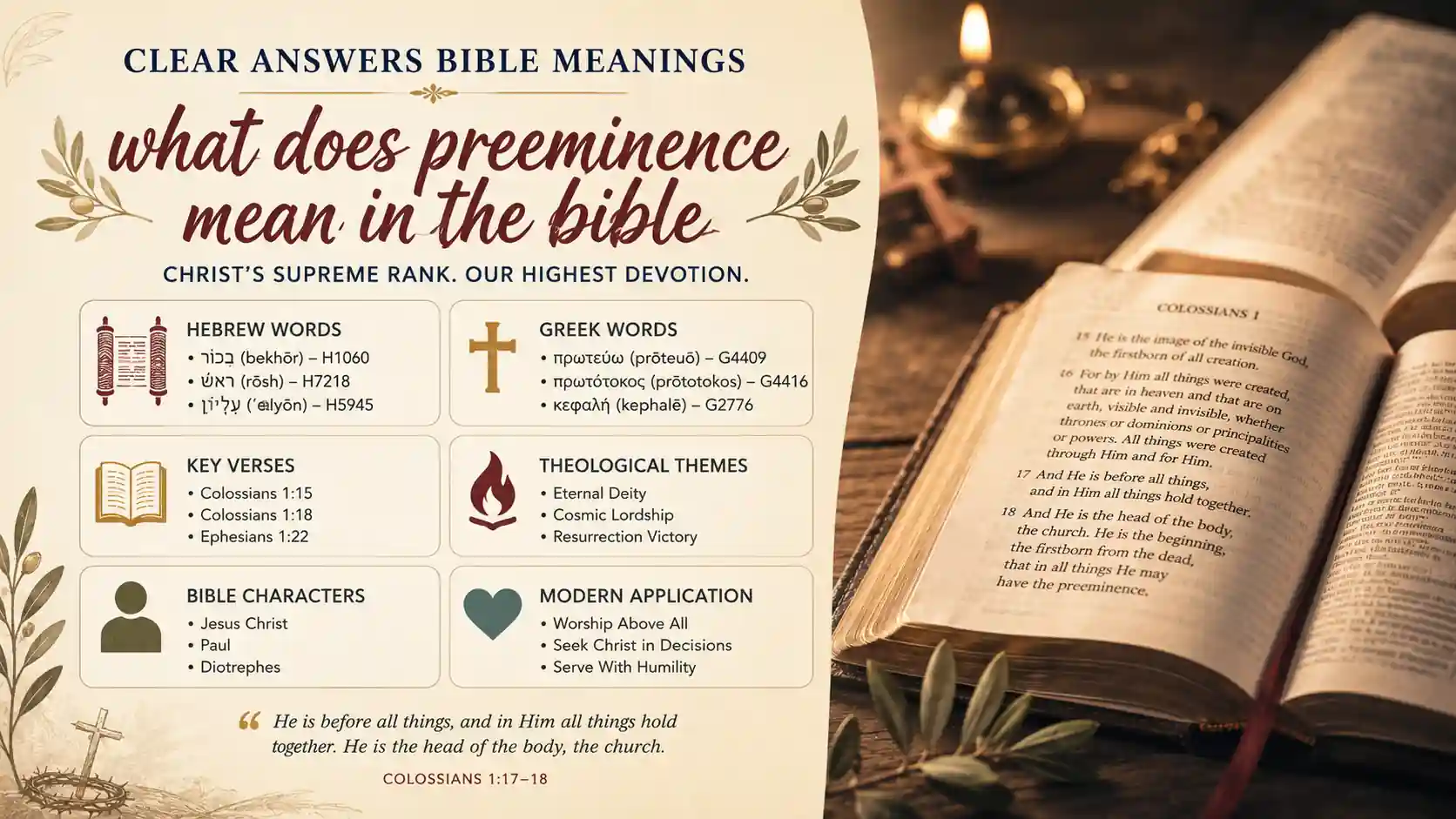
What does preeminence mean in the Bible? Preeminence describes the highest rank, supreme dignity, and rightful priority belonging above all others. Scripture applies this truth most directly to Jesus Christ, who must “have the preeminence” in everything according to Colossians 1:18.
The biblical idea reaches beyond prominence or popularity. Christ is preeminent because of who He eternally is and what He has accomplished in creation, redemption, resurrection, and the church. Your study of preeminence therefore leads you toward worship, submission, and a Christ-centered understanding of all Scripture.
Key Scripture References for Preeminence
| Verse | Passage Snippet | Context |
|---|---|---|
| Colossians 1:15 | “Firstborn of every creature” | Christ ranks over creation |
| Colossians 1:16 | “By him were all things created” | Christ is creation’s agent |
| Colossians 1:17 | “He is before all things” | Christ precedes and sustains creation |
| Colossians 1:18 | “Have the preeminence” | Christ is first in everything |
| Colossians 1:19 | “All fulness dwell” | Divine fullness resides in Christ |
| Psalm 89:27 | “Higher than the kings” | Davidic kingship anticipates Christ |
| John 1:1-3 | “All things were made by him” | The eternal Word is Creator |
| Ephesians 1:22 | “Head over all things” | Christ rules for His church |
| Philippians 2:9 | “Highly exalted him” | The humbled Son is publicly exalted |
| Revelation 1:5 | “Prince of the kings” | The risen Christ rules earthly kings |
Bible Translation Comparison for Preeminence
| Verse | KJV | NIV | ESV | NASB |
|---|---|---|---|---|
| Colossians 1:18 | “the preeminence” | “the supremacy” | “preeminent” | “first place” |
| Colossians 1:15 | “firstborn of every creature” | “firstborn over all creation” | “firstborn of all creation” | “firstborn of all creation” |
| Colossians 1:17 | “before all things” | “before all things” | “before all things” | “before all things” |
| Ephesians 1:21 | “far above” | “far above” | “far above” | “far above” |
| Ephesians 1:22 | “head over all things” | “head over everything” | “head over all things” | “head over all things” |
| Philippians 2:9 | “highly exalted” | “exalted” | “highly exalted” | “highly exalted” |
| Revelation 1:5 | “prince of the kings” | “ruler of the kings” | “ruler of kings” | “ruler of kings” |
| 3 John 9 | “loveth to have preeminence” | “loves to be first” | “likes to put himself first” | “loves to be first” |
People and Characters Associated with Preeminence
| Person | Role | Connection |
|---|---|---|
| Jesus Christ | Eternal Son and risen Lord | Possesses universal preeminence |
| God the Father | Source of the redemptive mission | Exalts the Son openly |
| Paul | Apostle to the Gentiles | Proclaims Christ’s supremacy in Colossians |
| Timothy | Paul’s ministry companion | Joins the Colossian greeting |
| Epaphras | Minister from Colossae | Taught the church about Christ |
| David | King of Israel | Made “firstborn” in royal rank |
| John the Baptist | Forerunner of Christ | Confesses Christ existed before him |
| Peter | Apostle and witness | Preaches Christ’s exaltation |
| John | Apostle and elder | Contrasts Christlike service with Diotrephes |
| Diotrephes | Self-promoting church leader | Sinfully loves personal preeminence |
Original Hebrew and Greek Words for Preeminence
| Original Word | Transliteration | Strong’s # | Literal Meaning |
|---|---|---|---|
| πρωτεύω | prōteuō | G4409 | To be first |
| φιλοπρωτεύω | philoprōteuō | G5383 | To love being first |
| πρῶτος | prōtos | G4413 | First or foremost |
| πρωτότοκος | prōtotokos | G4416 | Firstborn |
| κεφαλή | kephalē | G2776 | Head |
| ὑπερέχω | hyperechō | G5242 | To surpass or excel |
| בְּכוֹר | bekhōr | H1060 | Firstborn |
| רֹאשׁ | rōsh | H7218 | Head, chief, top |
| עֶלְיוֹן | ʿelyōn | H5945 | Most High |
| נָשָׂא | nāśāʾ | H5375 | To lift or exalt |
Related Biblical Concepts of Preeminence
| Concept | Connection | Supporting Verse |
|---|---|---|
| Firstborn | Expresses rank and inheritance | Colossians 1:15 |
| Headship | Christ governs His body | Colossians 1:18 |
| Creation | All things exist through Christ | Colossians 1:16 |
| Sustaining power | All things hold together in Him | Colossians 1:17 |
| Resurrection | Christ begins the new creation | Colossians 1:18 |
| Divine fullness | God’s fullness dwells in Christ | Colossians 1:19 |
| Reconciliation | Christ makes peace through His blood | Colossians 1:20 |
| Exaltation | Christ receives the highest name | Philippians 2:9 |
| Kingdom | Christ rules above every authority | Ephesians 1:21 |
| Worship | Every creature honors the Lamb | Revelation 5:13 |
Historical and Cultural Context of Preeminence
| Aspect | Detail | Biblical Source |
|---|---|---|
| Colossae | A city in the Lycus Valley | Colossians 1:2 |
| Roman province | Colossae belonged to Asia Minor | Colossians 2:1 |
| Mixed population | Jewish and Gentile ideas interacted | Colossians 3:11 |
| Household rank | Status shaped ancient social life | Colossians 3:18-4:1 |
| Firstborn rights | The firstborn held rank and inheritance | Deuteronomy 21:17 |
| Royal firstborn | The title could denote supremacy | Psalm 89:27 |
| Spiritual powers | People feared invisible authorities | Colossians 1:16 |
| False humility | Ascetic religion claimed spiritual value | Colossians 2:18-23 |
| Emperor culture | Roman rulers claimed exceptional honor | Revelation 1:5 |
| Church conflict | Diotrephes pursued controlling status | 3 John 9-10 |
Theological Themes of Preeminence
| Theme | Explanation | Scripture |
|---|---|---|
| Eternal deity | Christ exists before creation | John 1:1 |
| Divine revelation | Christ makes the invisible God known | Colossians 1:15 |
| Cosmic lordship | Every created realm belongs to Christ | Colossians 1:16 |
| Providence | Christ continually sustains creation | Colossians 1:17 |
| Ecclesial headship | Christ directs and nourishes the church | Colossians 1:18 |
| Resurrection victory | Christ leads redeemed humanity from death | Colossians 1:18 |
| Incarnation | Divine fullness dwells bodily in Christ | Colossians 2:9 |
| Atonement | Christ reconciles through the cross | Colossians 1:20 |
| Final judgment | Every knee will acknowledge Christ | Philippians 2:10 |
| New creation | The risen Christ begins restored creation | Revelation 1:5 |
Modern Application of Preeminence for Believers
| Area | Practice | Scripture |
|---|---|---|
| Worship | Honor Christ above every created thing | Revelation 5:13 |
| Bible study | Read Scripture with Christ at the center | Luke 24:27 |
| Decisions | Seek the Lord’s rule over your choices | Colossians 3:17 |
| Church life | Submit ministry to Christ’s headship | Ephesians 1:22 |
| Leadership | Serve rather than seek personal rank | Mark 10:43 |
| Work | Labor as service rendered to Christ | Colossians 3:23 |
| Thought life | Resist philosophies that diminish Christ | Colossians 2:8 |
| Suffering | Remember the risen Lord rules history | Revelation 1:17-18 |
| Relationships | Practice Christlike humility | Philippians 2:3-5 |
| Witness | Proclaim Christ rather than yourself | 2 Corinthians 4:5 |
What Does Preeminence Mean in the Bible According To πρωτεύω?
The clearest biblical answer appears in Colossians 1:18. Paul says that Christ is the beginning and the firstborn from the dead so that He might be preeminent in everything. The Greek verb πρωτεύω, transliterated prōteuō, means to be first, hold first place, or occupy the highest rank.
This is the only New Testament occurrence of this particular verb. Its placement at the conclusion of Paul’s majestic description of Christ gives it unusual weight. Preeminence summarizes Christ’s priority over creation, His authority over the church, and His victory as the firstborn from the dead.
Paul does not say merely that Christ should become important within your existing priorities. Christ already possesses first place by divine right. Your responsibility is to recognize, confess, and live under the supremacy that is eternally His.
πρωτότοκος And Christ’S Rank Over All Creation
The title πρωτότοκος, or prōtotokos, means “firstborn.” In ordinary family life, it could describe the first child born. Yet Scripture also uses firstborn language for dignity, inheritance, authority, and royal rank. Psalm 89:27 calls David God’s firstborn and the highest of earthly kings, although David was Jesse’s youngest son.
This royal background helps you interpret Colossians 1:15. Paul is not placing Jesus inside the created order as its earliest member. The following verse says that all things were created through Him and for Him, including visible and invisible powers. The Creator of all cannot be one item within the totality He created.
Christ is firstborn “of” or “over” creation because He possesses the rights of the supreme heir and sovereign Lord. Everything came into existence through Him, depends upon Him, and moves toward His purposes. His preeminence rests on His identity, not on recognition granted by creatures.
The Firstborn from the Dead and the New Creation
Colossians 1:18 applies “firstborn” to Christ’s resurrection as well as His relation to creation. Other people were restored to mortal life before Jesus rose, but they eventually died again. Christ rose in an immortal, glorified life that death can never overcome.
He is therefore the beginning of the renewed creation and the representative head of all who will be raised in Him. His resurrection establishes His priority in the coming age. The church’s hope does not rest in an abstract idea of survival, but in union with the living, preeminent Christ.
Your future is secure because the One who leads His people through death has already conquered it. His preeminence is not cold domination. It is the supremacy of the crucified and risen Savior who brings His people into the life He possesses.
Christ’S Preeminence and the Warning of Diotrephes
The New Testament presents a sharp contrast between Christ’s rightful preeminence and human self-exaltation. Third John 9 describes Diotrephes with the verb φιλοπρωτεύω, or philoprōteuō. The term means to love being first or to crave the leading position.
Diotrephes rejected apostolic instruction, spread malicious accusations, refused faithful believers, and attempted to expel those who welcomed them. His conduct shows that the desire for preeminence becomes destructive when a servant claims the place belonging to Christ.
Healthy Christian leadership directs attention toward Jesus rather than gathering control around the leader. When Christ has first place, authority becomes service, giftedness produces gratitude, and influence is exercised for another person’s good. You guard your heart by asking whether your actions magnify Christ or protect your status.
Questions About Biblical Preeminence
Does πρωτεύω mean that Jesus earned preeminence only after His resurrection?
No. The resurrection publicly displays His supremacy, but Colossians also presents Him as the eternal Creator who existed before all things.
Why does the KJV say “preeminence” while the NIV says “supremacy” in Colossians 1:18?
Both render πρωτεύω by expressing Christ’s unmatched right to first place, though “preeminence” follows the idea of rank more directly.
Does πρωτότοκος in Colossians 1:15 teach that Christ was created?
No. Colossians 1:16 identifies Christ as the agent and goal of all creation, while “firstborn” emphasizes His sovereign rank and inheritance.
How is Christ’s preeminence different from Diotrephes loving to be first?
Christ possesses first place by divine identity and saving work, while Diotrephes selfishly sought authority that did not belong to him.
What changes when you give Christ practical preeminence?
Your worship, decisions, relationships, work, and church service increasingly come under His authority and aim at His glory.