
When you ask what does bread mean in the bible, you meet a word at the center of daily life and worship. Bread feeds hungry families, welcomes guests, and carries prayers and promises through both testaments of Scripture.
You will follow bread from the fields near Bethlehem to manna in the wilderness and onward to Jesus calling Himself the Bread of Life. Along the way, bread teaches you about honest work, daily trust, covenant fellowship, and the generous provision of God today.
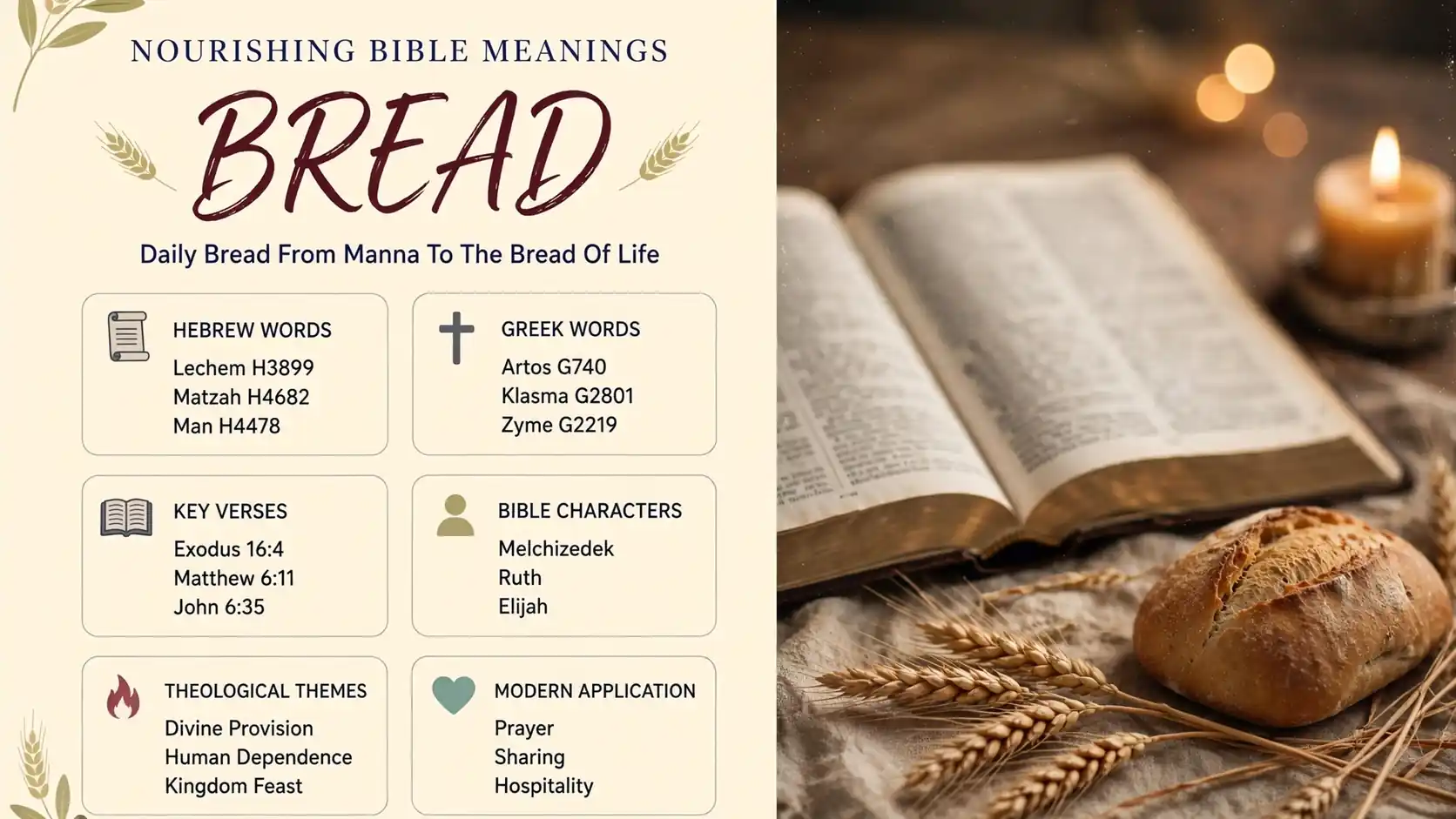
Key Scripture References for Bread
| Verse | Passage Snippet | Context |
|---|---|---|
| Genesis 14:18 | Melchizedek brought out bread and wine | Blessing after Abram rescue |
| Genesis 3:19 | By sweat of your face eat bread | Labor after the fall |
| Exodus 16:4 | I will rain bread from heaven | Manna in the wilderness |
| Leviticus 24:8 | Bread set before the Lord | Showbread in the tabernacle |
| Deuteronomy 8:3 | Man does not live by bread alone | Israel learns dependence |
| Ruth 2:14 | Dip your bread in the wine | Boaz kindness to Ruth |
| Psalm 104:15 | Bread strengthens mans heart | Praise for Gods provision |
| Matthew 6:11 | Give us this day our daily bread | Jesus teaches prayer |
| John 6:35 | I am the bread of life | Jesus teaches the crowd |
| Luke 24:30 | He took bread and broke it | Risen Jesus at Emmaus |
Bible Translation Comparison for Bread
| Verse | KJV | NIV | ESV | NASB |
|---|---|---|---|---|
| Genesis 3:19 | By sweat eat bread | By sweat eat food | By sweat eat bread | By sweat eat bread |
| Deuteronomy 8:3 | Not by bread only | Not on bread alone | Not by bread alone | Not by bread alone |
| Matthew 4:4 | Not live by bread alone | Not live on bread alone | Not live by bread alone | Not live on bread alone |
| Matthew 6:11 | Give us this day our daily bread | Give us today our daily bread | Give us this day our daily bread | Give us this day our daily bread |
| John 6:35 | I am the bread of life | I am the bread of life | I am the bread of life | I am the bread of life |
| John 6:48 | I am that bread of life | I am the bread of life | I am the bread of life | I am the bread of life |
| John 6:51 | Bread is my flesh | Bread is my flesh | Bread is my flesh | Bread is My flesh |
| Luke 22:19 | This is my body given | This is my body given | This is my body given | This is My body given |
| 1 Corinthians 11:26 | As ye eat this bread | When you eat this bread | As you eat this bread | As you eat this bread |
People and Characters Associated with Bread
| Person | Role | Connection |
|---|---|---|
| Melchizedek | King of Salem and priest | Brought bread and wine to Abram |
| Joseph | Governor in Egypt | Stored grain, fed nations in famine |
| Moses | Prophet and leader | Announced manna from heaven |
| Aaron | High priest | Placed the showbread before the Lord |
| David | King of Israel | Ate the showbread while fleeing Saul |
| Ruth | Moabite widow | Gleaned grain, shared bread with Naomi |
| Elijah | Prophet | Fed by ravens and a widow |
| Jesus | Son of God and teacher | Fed crowds, called Himself living bread |
| Cleopas | Disciple at Emmaus | Knew the risen Lord in broken bread |
| Paul | Apostle | Broke bread with believers at Troas |
Original Hebrew and Greek Words for Bread
| Original Word | Transliteration | Strong’s # | Literal Meaning |
|---|---|---|---|
| לֶחֶם | lechem | H3899 | Bread, food, grain provision |
| מַצָּה | matzah | H4682 | Unleavened bread or cake |
| מָן | man | H4478 | Manna, bread from heaven |
| מִנְחָה | minchah | H4503 | Grain offering, gift, tribute |
| אָכַל | akal | H398 | To eat, consume, devour |
| ἄρτος | artos | G740 | Bread, loaf, food |
| κλάσμα | klasma | G2801 | Fragment, broken piece of bread |
| ζύμη | zyme | G2219 | Leaven, yeast in dough |
| σῖτος | sitos | G4621 | Grain, wheat, corn for food |
| ἄζυμος | azymos | G106 | Unleavened bread, without yeast |
Related Biblical Concepts to Bread
| Concept | Connection | Supporting Verse |
|---|---|---|
| Manna | Heavenly bread teaching trust | Exodus 16:4 |
| Daily provision | God supplies His peoples needs | Matthew 6:11 |
| Bread of Life | Jesus satisfies spiritual hunger | John 6:35 |
| Showbread | Bread of the Presence in worship | Leviticus 24:8 |
| Unleavened bread | Purity and haste at Passover | Exodus 12:17 |
| Breaking bread | Shared fellowship around a table | Acts 2:46 |
| Hospitality | Bread offered to guests and strangers | Genesis 18:5 |
| Lords Supper | Bread recalling the body of Christ | 1 Corinthians 11:24 |
| Firstfruits | Grain and loaves offered to God | Leviticus 23:17 |
| Harvest | Grain gathered before baking | Ruth 2:23 |
Historical and Cultural Context of Bread
| Aspect | Detail | Biblical Source |
|---|---|---|
| Wheat and barley fields | Grain framed the farming year | Ruth 1:22 |
| Grinding grain | Women ground flour at home | Matthew 24:41 |
| Clay ovens | Loaves baked on hot stones | Leviticus 2:4 |
| Sweat and labor | Bread pictured hard human work | Genesis 3:19 |
| Passover haste | Unleavened loaves marked the exodus | Exodus 12:39 |
| Guest welcome | Bread signaled honor and peace | Genesis 14:18 |
| Temple service | Priests replaced showbread weekly | 1 Chronicles 9:32 |
| Shared meals | Breaking loaves opened fellowship | Luke 24:30 |
| Famine relief | Stored grain saved regions | Genesis 41:56 |
| Market bread | Loaves for crowds cost wages | John 6:7 |
Theological Themes of Bread
| Theme | Explanation | Scripture |
|---|---|---|
| Divine provision | God feeds His people in deserts | Exodus 16:4 |
| Human dependence | Life rests on Gods word | Deuteronomy 8:3 |
| Christ our sustenance | Jesus gives unfading life | John 6:51 |
| Covenant fellowship | Shared bread marks belonging | Acts 2:46 |
| Sacrifice and body | Broken bread points to cross | Luke 22:19 |
| Prayer and trust | Daily bread shapes daily prayer | Matthew 6:11 |
| Purity of heart | Leaven pictures corruption | 1 Corinthians 5:7 |
| Resurrection recognition | Eyes opened at broken bread | Luke 24:31 |
| Kingdom feast | Bread awaits the coming banquet | Luke 14:15 |
| Gratitude | Received bread calls for praise | Psalm 104:15 |
Modern Application of Bread for Believers
| Area | Practice | Scripture |
|---|---|---|
| Prayer | Ask God for todays needs | Matthew 6:11 |
| Gratitude | Thank God before every meal | 1 Timothy 4:4 |
| Sharing | Feed hungry neighbors freely | Isaiah 58:7 |
| Hospitality | Open your table to strangers | Hebrews 13:2 |
| Communion | Receive bread with gratitude | 1 Corinthians 11:28 |
| Work | Labor honestly, trust Gods provision | Genesis 3:19 |
| Worry | Rest in Gods daily care | Matthew 6:31 |
| Scripture hunger | Feed on Gods word daily | Matthew 4:4 |
| Generosity | Share like the early church | Acts 2:46 |
| Family table | Teach children Gods goodness | Deuteronomy 8:10 |
Lechem and the House of Bread at Bethlehem
The Hebrew word לֶחֶם, lechem, H3899, covers bread itself and food in general, showing how central the loaf was to Hebrew thought. Eating lechem often means sharing a full meal rather than one item on a plate.
Bethlehem carries this word inside its name, since Beth Lechem means house of bread in Hebrew. Ruth found grain in its fields, and Jesus, the Bread of Life, was later born in that same small town.
Bread also marks honest labor and shared blessing among patriarchs and kings. Abraham received bread from Melchizedek, Joseph stored grain for nations, and Boaz fed a foreign widow with kindness.
Each scene invites you to see your kitchen as a place where God works quietly. The loaf on your table is never merely yours, because Scripture ties bread to blessing received and blessing passed along.
Manna and Artos in the Wilderness and the Gospels
In Exodus 16, God rained manna each morning, and Israel gathered only enough for the day ahead. Hoarded manna spoiled, teaching a nation that trust in God is renewed daily and cannot be stored like wealth.
Jesus reaches back to that lesson when He teaches you to pray for daily bread in Matthew 6:11. Your prayer admits need without shame and rests on a Father who knows what you need today.
The Greek word ἄρτος, artos, G740, is the ordinary word for a loaf in the Gospels. Jesus used it when He fed crowds and when He spoke of children asking a father for bread.
Ordinary artos becomes holy ground when thankful hands bless it and share it. God delights to multiply small gifts placed willingly in the hands of Christ for hungry people nearby.
What Does Bread Mean in the Bible at Your Table
When Jesus says He is the bread of life in John 6:35, He moves bread from your pantry into the deepest hunger of your soul. People who ate manna still died, yet those who come to Christ receive life death cannot take.
John sets the feeding of the five thousand before this teaching at Capernaum for good reason. Full stomachs were never the goal, since Jesus came to give Himself as true food for a starving world.
At the Last Supper, Jesus took bread, gave thanks, broke it, and called it His body given for His disciples. The church has kept that table ever since, tasting in a simple loaf the love that carried Christ to the cross.
Your table at home can echo that greater table in faithful ways. Grateful prayer, open seats, and food shared without grudging preach the gospel quietly to everyone who sits with you.
Breaking Bread from Emmaus to the Early Church
On the road to Emmaus, two sad disciples urged a stranger to stay and eat as evening fell. Only when He took bread, blessed it, and broke it were their eyes opened to the risen Jesus beside them.
Luke wants you to feel the weight of that quiet moment at an ordinary table. The Lord who broke bread at supper still makes Himself known to hearts that welcome Him gladly.
The first believers devoted themselves to teaching, fellowship, the breaking of bread, and prayers in Acts 2. Their shared loaves and homes turned private faith into a visible family that amazed the watching city.
Your church lives from that same pattern whenever believers gather around ordinary tables with sincere hearts. A shared loaf can carry comfort to the grieving, friendship to the lonely, and steady hope to trusting hearts.
Frequently Asked Questions About Bread
What does lechem H3899 mean beyond a simple loaf?
Lechem means bread and food in general, so eating lechem often describes sharing a complete meal.
Why does Jesus call Himself the bread of life in John 6?
Jesus means that He alone satisfies lasting spiritual hunger, giving eternal life to everyone who comes to Him in trust.
What is special about the word epiousios in Matthew 6:11?
Epiousios is the rare Greek word rendered daily, pointing to bread sufficient for today from Gods hand.
Why was the showbread kept in the tabernacle and temple?
The twelve loaves stood before the Lord as a sign of His provision for the twelve tribes.
How is the bread of the Lords Supper different from daily bread?
Daily bread meets bodily need through prayer, while supper bread proclaims the body of Christ given for His people.