
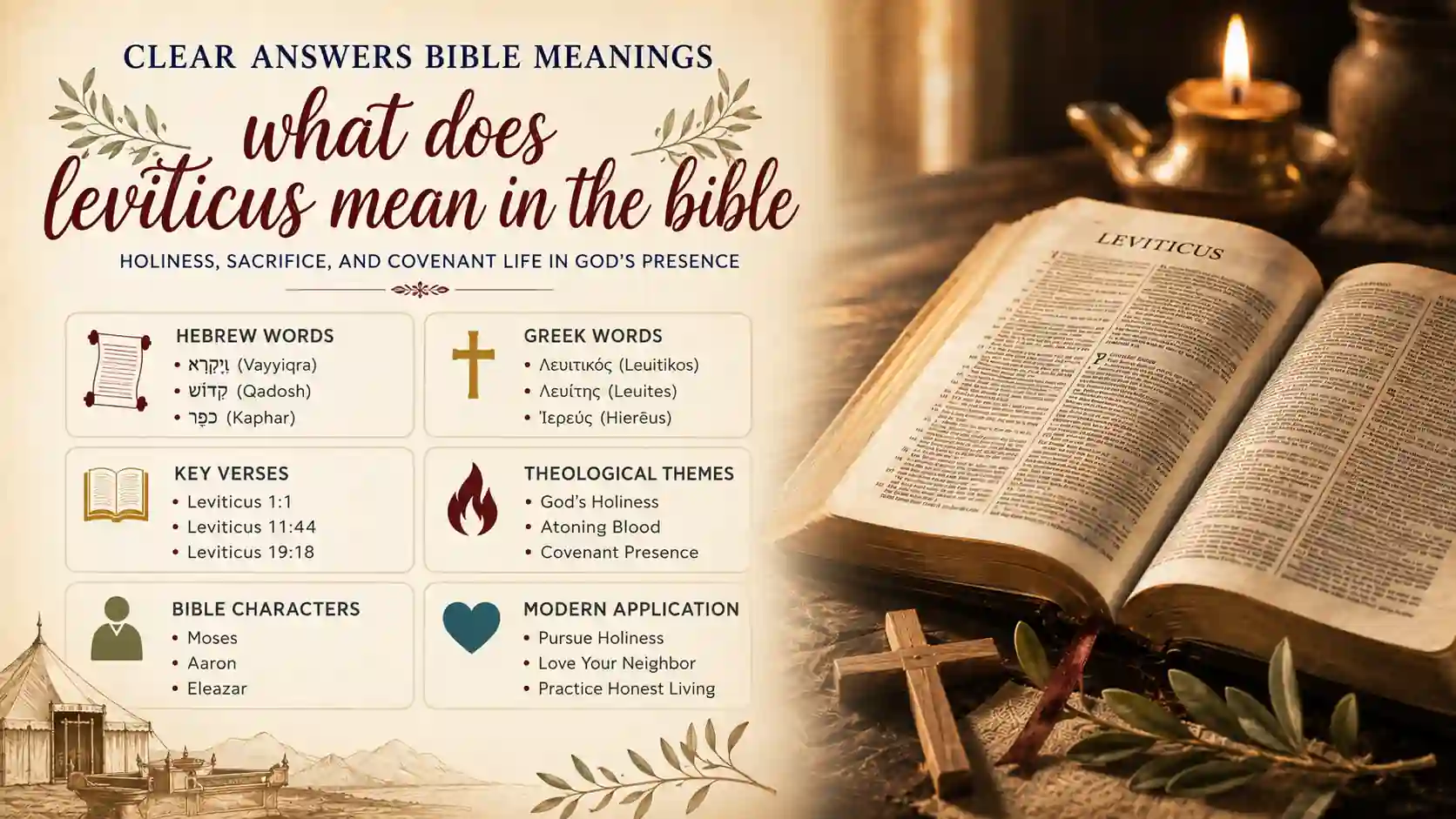
What does Leviticus mean in the Bible? The English title refers to matters “belonging to the Levites,” especially Israel’s priestly worship. It comes through the Latin Leviticus from the Greek title Λευιτικόν, Leuitikon. The Hebrew title, וַיִּקְרָא, Vayyiqra, means “And He called,” taken from the book’s opening words.
Leviticus teaches how the holy God could dwell among a covenant people marked by sin and impurity. Through sacrifices, priests, purity laws, sacred times, and commands of love and justice, you see worship shaping every part of life.
Key Leviticus Scripture References
| Verse | Passage Snippet | Context |
|---|---|---|
| Leviticus 1:1 | “The LORD called unto Moses” | God speaks from the tabernacle |
| Leviticus 1:4 | “Make atonement for him” | Acceptance through a burnt offering |
| Leviticus 10:3 | “I will be sanctified” | Nadab and Abihu judged |
| Leviticus 11:44 | “Be ye holy” | Holiness reflected in daily conduct |
| Leviticus 16:30 | “Clean from all your sins” | Day of Atonement purification |
| Leviticus 17:11 | “The life of the flesh” | Blood given for atonement |
| Leviticus 19:2 | “Ye shall be holy” | Covenant holiness commanded |
| Leviticus 19:18 | “Love thy neighbour” | Love governs community ethics |
| Leviticus 23:2 | “Feasts of the LORD” | Israel’s sacred calendar |
| Leviticus 25:10 | “Proclaim liberty” | Jubilee restoration and release |
Leviticus Bible Translation Comparison
| Verse | KJV | NIV | ESV | NASB |
|---|---|---|---|---|
| Leviticus 1:1 | “LORD called unto Moses” | “LORD called to Moses” | “LORD called Moses” | “LORD called to Moses” |
| Leviticus 1:4 | “Atonement for him” | “Atonement for you” | “Atonement for him” | “Atonement on his behalf” |
| Leviticus 10:3 | “I will be sanctified” | “I will be proved holy” | “I will be sanctified” | “I will be treated as holy” |
| Leviticus 11:44 | “Sanctify yourselves” | “Consecrate yourselves” | “Consecrate yourselves” | “Consecrate yourselves” |
| Leviticus 16:30 | “Clean from all your sins” | “Clean from all your sins” | “Clean before the LORD” | “Clean from all your sins” |
| Leviticus 17:11 | “Life of the flesh” | “Life of a creature” | “Life of the flesh” | “Life of the flesh” |
| Leviticus 19:18 | “Love thy neighbour” | “Love your neighbor” | “Love your neighbor” | “Love your neighbor” |
| Leviticus 25:10 | “Proclaim liberty” | “Proclaim liberty” | “Proclaim liberty” | “Proclaim a release” |
People and Characters Associated with Leviticus
| Person | Role | Connection |
|---|---|---|
| The LORD | Covenant God | Gives the laws and dwells among Israel |
| Moses | Mediator and prophet | Receives instructions at the tabernacle |
| Aaron | First high priest | Leads Israel’s sacrificial worship |
| Nadab | Son of Aaron | Dies after offering unauthorized fire |
| Abihu | Son of Aaron | Shares Nadab’s act and judgment |
| Eleazar | Priest and Aaron’s son | Continues authorized priestly service |
| Ithamar | Priest and Aaron’s son | Assists with sanctuary responsibilities |
| Aaron’s sons | Priestly family | Handle sacrifices and distinguish holiness |
| The anointed priest | Covenant representative | Offers sacrifices for priestly sin |
| The blasphemer | Unnamed offender | His case illustrates covenant justice |
Original Hebrew and Greek Words in Leviticus
| Original Word | Transliteration | Strong’s # | Literal Meaning |
|---|---|---|---|
| וַיִּקְרָא | Vayyiqra | H7121 | And he called |
| לֵוִי | Levi | H3878 | Levi, joined |
| כֹּהֵן | kohen | H3548 | Priest |
| קָרְבָּן | qorban | H7133 | Offering brought near |
| קָדוֹשׁ | qadosh | H6918 | Holy, set apart |
| כָּפַר | kaphar | H3722 | Atone, purge, cover |
| טָהוֹר | tahor | H2889 | Clean, pure |
| טָמֵא | tame | H2931 | Unclean, impure |
| Λευιτικός | Leuitikos | G3020 | Levitical |
| Λευίτης | Leuites | G3019 | Levite |
Related Leviticus Biblical Concepts
| Concept | Connection | Supporting Verse |
|---|---|---|
| Holiness | God’s people must reflect his character | Leviticus 19:2 |
| Sacrifice | Worshipers approach God through offerings | Leviticus 1:2 |
| Atonement | Sin and impurity require cleansing | Leviticus 16:30 |
| Priesthood | Priests mediate sanctuary worship | Leviticus 8:1-13 |
| Purity | Clean and unclean conditions are distinguished | Leviticus 11:47 |
| Covenant | Obedience expresses loyalty to the LORD | Leviticus 26:9 |
| Sabbath | Sacred rest belongs to God | Leviticus 23:3 |
| Jubilee | Land and liberty are restored | Leviticus 25:10 |
| Neighbor love | Holiness includes interpersonal mercy | Leviticus 19:18 |
| Divine presence | God dwells among his people | Leviticus 26:11-12 |
Historical and Cultural Context of Leviticus
| Aspect | Detail | Biblical Source |
|---|---|---|
| Location | Israel remains near Mount Sinai | Exodus 19:1 |
| Sanctuary | God speaks from the tent of meeting | Leviticus 1:1 |
| Time period | After the tabernacle is erected | Exodus 40:17 |
| Audience | Priests and the whole congregation | Leviticus 1:2 |
| Priesthood | Aaron’s family serves at the altar | Leviticus 8:1-36 |
| Sacrifices | Animals and grain are presented | Leviticus 1:2; 2:1 |
| Agriculture | Firstfruits acknowledge God’s provision | Leviticus 23:10 |
| Community | The poor receive gleaning rights | Leviticus 19:9-10 |
| Land tenure | Israel’s land ultimately belongs to God | Leviticus 25:23 |
| Covenant setting | Blessings and judgments govern national life | Leviticus 26:3-39 |
Theological Themes of Leviticus
| Theme | Explanation | Scripture |
|---|---|---|
| God’s holiness | The LORD is morally and ritually distinct | Leviticus 11:44 |
| Human approach | God determines how worshipers draw near | Leviticus 1:1-4 |
| Substitution | An offering is accepted for the worshiper | Leviticus 1:4 |
| Atoning blood | Life is given upon the altar | Leviticus 17:11 |
| Priestly mediation | Consecrated priests serve between altar and people | Leviticus 9:7 |
| Cleansing | Defilement must not pollute God’s dwelling | Leviticus 15:31 |
| Ethical holiness | Worship includes honesty, mercy, and justice | Leviticus 19:11-18 |
| Sacred time | Feasts rehearse God’s covenant provision | Leviticus 23:1-44 |
| Restoration | Jubilee protects families and inheritance | Leviticus 25:8-24 |
| Covenant presence | God promises to walk among his people | Leviticus 26:12 |
Modern Application from Leviticus for Believers
| Area | Practice | Scripture |
|---|---|---|
| Worship | Approach God with reverence | Leviticus 10:3 |
| Character | Pursue holiness in ordinary choices | Leviticus 19:2 |
| Relationships | Love your neighbor without vengeance | Leviticus 19:18 |
| Honesty | Use truthful measures and dealings | Leviticus 19:35-36 |
| Compassion | Leave provision for the vulnerable | Leviticus 19:9-10 |
| Family | Honor parents and household responsibilities | Leviticus 19:3 |
| Work | Practice regular rhythms of rest | Leviticus 23:3 |
| Stewardship | Remember that possessions belong to God | Leviticus 25:23 |
| Repentance | Confess sin rather than conceal it | Leviticus 5:5 |
| Fellowship | Welcome the foreigner with neighborly love | Leviticus 19:33-34 |
What Does Leviticus Mean in the Bible and Why Is It Named for Levi?
The English name “Leviticus” means “Levitical” or “pertaining to the Levites.” It comes from the Greek adjective Λευιτικός, Leuitikos, which describes something associated with Levi, the tribe set apart for Israel’s sanctuary service. The Latin Bible carried this title into the form familiar to English readers.
The title can be slightly misleading because Leviticus speaks chiefly about Aaron, his sons, sacrifices, holiness, and Israel as a whole. Ordinary Levites are not its central characters. The Greek title emphasizes the book’s priestly subject matter rather than naming every group discussed within it.
וַיִּקְרָא Vayyiqra Begins with God’S Gracious Call
The Jewish title is וַיִּקְרָא, Vayyiqra, meaning “And He called.” It comes from the verb קָרָא, qara, “to call, proclaim, or summon.” This title draws your attention away from an impersonal legal code and toward the personal God who calls Moses from the newly completed tent of meeting.
Exodus ends with divine glory filling the tabernacle so fully that Moses cannot enter. Leviticus begins with God calling to him from within that holy dwelling. The laws that follow answer a vital covenant question. How can a sinful and mortal people live near the consuming holiness of God?
קָרְבָּן Qorban and the Meaning of Drawing Near
Leviticus 1:2 introduces קָרְבָּן, qorban, an offering presented to God. The word is related to the Hebrew root קָרַב, qarav, meaning “to come near” or “bring near.” A sacrifice was not merely a religious payment. It belonged to the God-given means by which an Israelite approached the sanctuary.
The offerings served different purposes. The burnt offering expressed complete surrender, the grain offering honored God’s provision, and the peace offering celebrated fellowship. Purification and reparation offerings addressed sin, defilement, desecration, and damaged relationships. Each ritual taught that access to God must occur on his terms.
כָּפַר Kaphar, Holy Blood, and Covenant Atonement
The verb כָּפַר, kaphar, commonly translated “make atonement,” is essential to the book. Depending on the passage, it conveys purging, cleansing, or removing an offense that obstructs communion with God. Atonement in Leviticus concerns both guilty people and a sanctuary polluted by Israel’s sins and impurities.
Leviticus 17:11 explains that the life of the flesh is in the blood and that God gave blood upon the altar to make atonement. The annual rites of Leviticus 16 cleanse the sanctuary, priests, and congregation. Christian readers later recognize these institutions as preparing biblical language for understanding the sacrificial work of Christ.
Frequently Asked Questions About Leviticus
Does וַיִּקְרָא, Vayyiqra, mean the same thing as Leviticus?
No. Vayyiqra means “And He called,” while Leviticus means “Levitical” or “related to the Levites.”
Why is Leviticus named for the Levites when it mainly discusses priests?
The Greek title broadly associates Israel’s priestly worship with Levi’s tribe, though the book concentrates on Aaron’s priestly line.
Does כָּפַר, kaphar, simply mean that sin is hidden or covered?
Its use in Leviticus includes making atonement through cleansing, purging, or removing what disrupts fellowship with the holy God.
What is the difference between קָדוֹשׁ, qadosh, and טָהוֹר, tahor?
Qadosh means holy or set apart, while tahor describes a clean condition suitable for participation in Israel’s sacred life.
How should you apply Leviticus when animal sacrifices are no longer offered?
You should receive its enduring revelation about holiness, worship, repentance, justice, neighbor love, and reverence for God’s presence.