
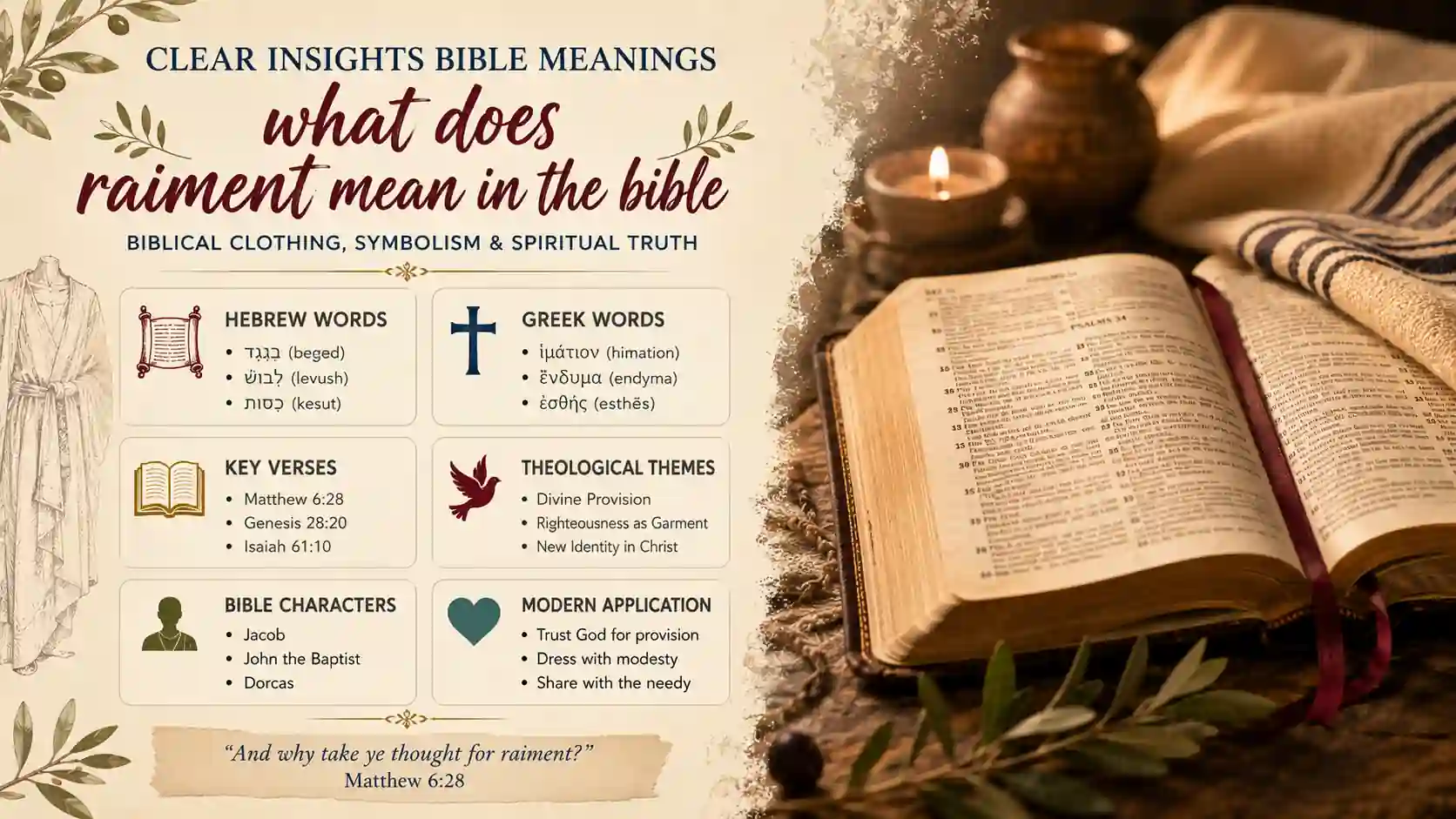
What does raiment mean in the Bible? In its simplest sense, raiment means clothing, garments, apparel, or robes. The older English word appears frequently in the King James Version, translating several Hebrew and Greek terms rather than one single biblical word.
As you study raiment throughout Scripture, you discover that clothing does more than cover the body. It may reveal poverty or wealth, identify priests and kings, express mourning, symbolize righteousness, expose hypocrisy, or picture the glory believers receive through Christ.
Key Raiment Scripture References
| Verse | Passage Snippet | Context |
|---|---|---|
| Genesis 28:20 | “raiment to put on” | Jacob asks God for basic provision |
| Deuteronomy 8:4 | Raiment did not grow old | God preserved Israel in the wilderness |
| 1 Samuel 28:8 | Saul changed his raiment | Saul disguised himself at Endor |
| 2 Kings 5:5 | Ten changes of raiment | Naaman carried costly diplomatic gifts |
| Ezra 9:3 | Rent garment and mantle | Ezra expressed grief over Israel’s sin |
| Isaiah 61:10 | Garments of salvation | Zion rejoices in God’s saving righteousness |
| Matthew 6:28 | “Why take ye thought for raiment?” | Jesus teaches trust in the Father |
| Matthew 17:2 | Raiment white as light | Christ’s glory appears at the transfiguration |
| Luke 24:4 | Shining garments | Angels announce the resurrection |
| James 2:2 | Goodly apparel | The church is warned against favoritism |
Raiment Bible Translation Comparison
| Verse | KJV | NIV | ESV | NASB |
|---|---|---|---|---|
| Genesis 28:20 | raiment | clothes | clothing | garments |
| Deuteronomy 8:4 | raiment | clothes | clothing | clothing |
| Isaiah 63:3 | raiment | garments | garments | garments |
| Matthew 3:4 | raiment | clothes | clothing | garment |
| Matthew 6:28 | raiment | clothes | clothing | clothing |
| Matthew 17:2 | raiment | clothes | clothes | garments |
| Luke 9:29 | raiment | clothes | clothing | clothing |
| Luke 24:4 | shining garments | clothes gleamed | dazzling apparel | dazzling clothing |
| James 2:2 | goodly apparel | fine clothes | fine clothing | fine clothes |
| Revelation 3:5 | white raiment | dressed in white | white garments | white garments |
The comparison shows why modern readers encounter “raiment” less often. Contemporary translations generally use clothing, clothes, garments, or apparel, depending on the underlying word and context.
People and Characters Associated with Raiment
| Person | Role | Connection |
|---|---|---|
| Jacob | Patriarch | Prayed for food and raiment |
| Joseph | Son of Jacob | Received and distributed changes of raiment |
| Moses | Covenant mediator | Taught that Israel’s raiment endured |
| Aaron | High priest | Wore holy garments for priestly service |
| Saul | Israel’s first king | Changed raiment to conceal his identity |
| Naaman | Syrian commander | Offered valuable changes of raiment |
| Ezra | Priest and scribe | Tore his raiment in grief |
| John the Baptist | Prophet | Wore camel-hair raiment |
| Jesus Christ | Messiah | Taught about raiment and appeared in glory |
| Dorcas | Christian disciple | Made coats and garments for widows |
Original Hebrew and Greek Words for Raiment
| Original Word | Transliteration | Strong’s # | Literal Meaning |
|---|---|---|---|
| בֶּגֶד | beged | H899 | garment, clothing |
| שִׂמְלָה | simlah | H8071 | wrapper, mantle, clothing |
| לְבוּשׁ | levush | H3830 | clothing, dress, apparel |
| מַלְבּוּשׁ | malbush | H4403 | garment, vestment |
| כְּסוּת | kesut | H3682 | covering, clothing |
| מַד | mad | H4055 | garment, measure, attire |
| ἱμάτιον | himation | G2440 | garment, cloak, outer robe |
| ἱματισμός | himatismos | G2441 | clothing, apparel |
| ἔνδυμα | endyma | G1742 | garment, clothing |
| ἐσθής | esthēs | G2066 | dress, apparel, robe |
The Hebrew vocabulary is broad. בֶּגֶד, beged, can refer to an ordinary garment, priestly clothing, or a symbolic covering. לְבוּשׁ, levush, emphasizes clothing or dress, while כְּסוּת, kesut, highlights something that covers. In Greek, ἱμάτιον, himation, frequently denotes a garment or outer cloak, and ἔνδυμα, endyma, refers more generally to something worn.
Related Biblical Concepts of Raiment
| Concept | Connection | Supporting Verse |
|---|---|---|
| Divine provision | God supplies necessary clothing | Matthew 6:30 |
| Human dignity | Clothing covers bodily shame | Genesis 3:21 |
| Priestly holiness | Sacred garments mark consecrated service | Exodus 28:2 |
| Mourning | Torn clothing expresses grief | Job 1:20 |
| Repentance | Changed garments may accompany cleansing | Genesis 35:2 |
| Social status | Fine raiment can signal wealth | James 2:2 |
| Righteousness | Salvation is pictured as a garment | Isaiah 61:10 |
| Spiritual renewal | Believers put on the new self | Ephesians 4:24 |
| Heavenly glory | The redeemed wear white garments | Revelation 7:9 |
| Judgment | Defiled garments symbolize sin | Zechariah 3:3 |
Historical and Cultural Context of Raiment
| Aspect | Detail | Biblical Source |
|---|---|---|
| Basic clothing | Most people wore a tunic and outer covering | Matthew 5:40 |
| Outer cloak | The cloak also served as nighttime covering | Exodus 22:26–27 |
| Materials | Wool and linen were common fabrics | Leviticus 19:19 |
| Priesthood | Priestly garments used linen, colors, and embroidery | Exodus 28:4–8 |
| Wealth | Multiple garments represented substantial value | 2 Kings 5:5 |
| Hospitality | Hosts could provide festive clothing | Genesis 45:22 |
| Mourning | People tore garments after tragedy or blasphemy | 2 Kings 18:37 |
| Disguise | Changing clothing could hide identity | 1 Samuel 28:8 |
| Washing | Clean garments accompanied preparation and worship | Exodus 19:10 |
| Seizure | Garments could be taken as a loan pledge | Deuteronomy 24:12–13 |
In biblical society, clothing was labor-intensive and valuable. A “change of raiment” was not a trivial gift. It represented portable wealth, social honor, and generosity. This explains why garments appear among royal gifts, military spoil, inheritance goods, and diplomatic offerings.
An outer garment also protected its wearer from cold. The law therefore commanded a lender to return a poor person’s pledged cloak before nightfall. God’s concern for raiment was not merely ceremonial. It included compassion for physical need and protection of human dignity.
Theological Themes Expressed Through Raiment
| Theme | Explanation | Scripture |
|---|---|---|
| God’s providence | The Father knows the body needs clothing | Matthew 6:31–32 |
| Sin and shame | Fallen humanity seeks a covering | Genesis 3:7 |
| Gracious covering | God clothes Adam and Eve | Genesis 3:21 |
| Imputed righteousness | Salvation is portrayed as divine clothing | Isaiah 61:10 |
| Cleansing | Filthy garments are removed from Joshua | Zechariah 3:4 |
| Christ’s glory | Jesus’ clothing becomes dazzling | Matthew 17:2 |
| False appearance | Outward dress can conceal inward corruption | Matthew 7:15 |
| New identity | Christians put on Christ | Galatians 3:27 |
| Sanctification | Believers put on compassion and love | Colossians 3:12–14 |
| Final victory | The faithful receive white garments | Revelation 3:5 |
Modern Application of Biblical Raiment
| Area | Practice | Scripture |
|---|---|---|
| Anxiety | Trust God for material necessities | Matthew 6:28–33 |
| Contentment | Value food and clothing without greed | 1 Timothy 6:8 |
| Generosity | Share clothing with those lacking it | Luke 3:11 |
| Impartiality | Do not honor people merely for fine clothes | James 2:1–4 |
| Modesty | Dress with self-control and good works | 1 Timothy 2:9–10 |
| Compassion | Provide practical help to the poorly clothed | James 2:15–16 |
| Integrity | Let character matter more than appearance | 1 Samuel 16:7 |
| Holiness | Put on virtues fitting God’s people | Colossians 3:12 |
| Identity | Remember that you have put on Christ | Galatians 3:27 |
| Hope | Anticipate the purity of the redeemed | Revelation 7:13–14 |
What Does Raiment Mean in the Bible’S Older English?
“Raiment” belongs to the vocabulary of early modern English. In the King James Bible, it functions as a collective word for what a person wears. Depending on the passage, it may indicate ordinary clothes, an outer cloak, ceremonial robes, costly apparel, or supernatural garments.
You should therefore resist assigning one precise garment to every occurrence. The meaning comes from the original Hebrew or Greek term, the social setting, and the author’s purpose. Modern translations often clarify the reference by choosing “cloak,” “clothing,” “robe,” or “garments.”
בֶּגֶד And ἱμάτιον Show That Raiment Has Many Forms
The common Hebrew noun בֶּגֶד, beged, Strong’s H899, is used for garments worn in daily life, royal settings, priestly ministry, mourning, and prophetic symbolism. A garment may be clean or defiled, torn or preserved, ordinary or sacred. The object remains physical, but its narrative meaning changes.
The Greek ἱμάτιον, himation, Strong’s G2440, similarly ranges from clothing in general to an outer garment or cloak. It is used for the garment touched by the suffering woman, the clothing divided at Christ’s crucifixion, and the robes made white in Revelation.
What Does Raiment Mean in the Bible’S Teaching About Providence?
In Matthew 6, Jesus asks why His hearers worry about raiment. His point is not that clothing is unnecessary. The Father already knows it is necessary. Christ directs your attention to the lilies, whose beauty exceeds Solomon’s royal splendor without anxious labor.
This teaching calls you away from fearful preoccupation, not responsible work. You may plan, sew, purchase, repair, and provide while still trusting God. Raiment becomes an everyday reminder that your heavenly Father cares for embodied human life.
From Filthy Raiment to Garments of Salvation
Some of Scripture’s richest clothing imagery concerns sin and righteousness. In Zechariah 3, the high priest Joshua stands in filthy garments, representing guilt. God orders those garments removed and declares that Joshua’s iniquity has been taken away.
Isaiah 61 presents the opposite picture. God clothes His people with garments of salvation and a robe of righteousness. The symbolism reaches its Christian fullness in putting on Christ and appearing before God cleansed, accepted, and prepared for eternal worship.
Questions About Raiment in Scripture
Does the Hebrew word בֶּגֶד, beged, always mean ordinary clothing?
No. It may describe common garments, priestly vestments, royal clothing, or symbolic garments depending on context.
Why does the KJV say “raiment” when modern translations say “clothes”?
“Raiment” was familiar English in 1611, while modern translations use words more natural to present-day readers.
What kind of raiment did John the Baptist wear in Matthew 3:4?
He wore a garment made from camel hair with a leather belt, reflecting his prophetic simplicity and recalling Elijah.
Does Matthew 6:28 forbid believers from planning what to wear?
No. Jesus condemns anxious preoccupation and calls you to trust the Father while seeking His kingdom first.
What is the difference between filthy raiment in Zechariah 3 and white raiment in Revelation?
Filthy garments represent guilt and defilement, while white garments signify cleansing, faithfulness, victory, and acceptance before God.