
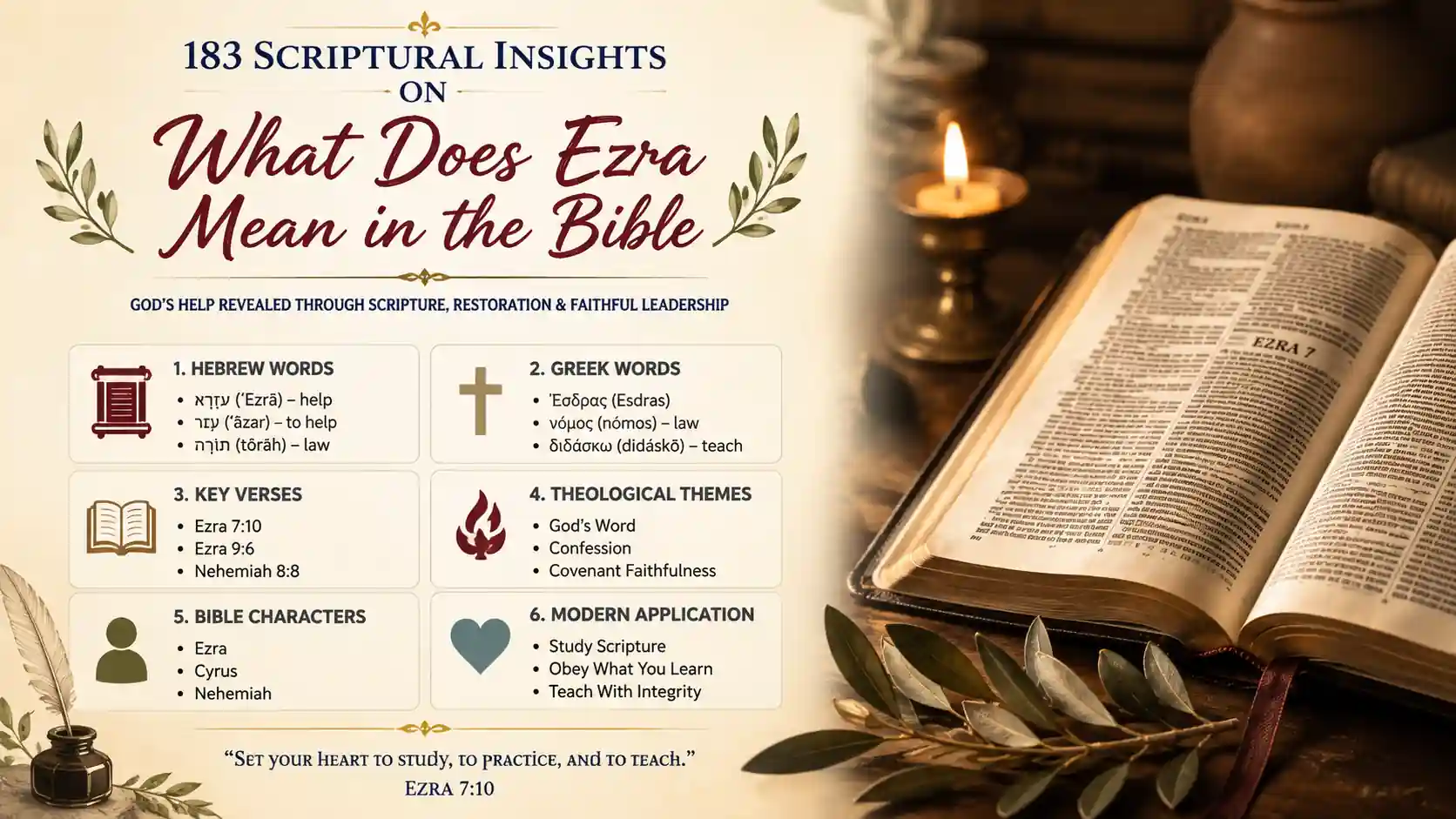
What does Ezra mean in the Bible? The name Ezra comes from the Hebrew עֶזְרָא, transliterated ʿEzrā, and carries the sense of “help” or “helper.” It is closely connected with the Hebrew verb עָזַר, ʿāzar, meaning “to help” or “support.”
Ezra’s name beautifully reflects his calling. As a priest, skilled scribe, teacher, intercessor, and reformer, he became God’s instrument of help during Judah’s restoration after the Babylonian exile. His story shows you how divine help often arrives through faithful people who study Scripture, obey it, teach it, and humbly lead others back to covenant faithfulness.
Key Ezra Scripture References
| Verse | Passage Snippet | Context |
|---|---|---|
| Ezra 1:1 | The Lord stirred Cyrus | Persia authorizes Judah’s return |
| Ezra 3:11 | His steadfast love endures | Worship resumes at the altar |
| Ezra 6:15 | The house was finished | The second temple is completed |
| Ezra 7:6 | A skilled scribe | Ezra’s knowledge of Moses’ Law |
| Ezra 7:9 | God’s good hand | Ezra reaches Jerusalem safely |
| Ezra 7:10 | Study, practice, and teach | Ezra’s pattern of spiritual leadership |
| Ezra 8:21 | We humbled ourselves | The travelers fast for protection |
| Ezra 9:6 | I am ashamed | Ezra confesses Israel’s unfaithfulness |
| Ezra 10:1 | Praying and confessing | The people gather in repentance |
| Nehemiah 8:8 | They gave the meaning | Scripture is read and explained |
These passages present Ezra as a priestly teacher whose ministry joined biblical understanding, obedient action, public instruction, prayer, and communal repentance.
Ezra Bible Translation Comparison
| Verse | KJV | NIV | ESV | NASB |
|---|---|---|---|---|
| Ezra 7:6 | ready scribe | teacher well versed | scribe skilled | scribe skilled |
| Ezra 7:9 | good hand | gracious hand | good hand | good hand |
| Ezra 7:10 | prepared his heart | devoted himself | set his heart | set his heart |
| Ezra 7:10 | seek the law | study the Law | study the Law | study the law |
| Ezra 7:10 | do it | observance | do it | practice it |
| Ezra 7:10 | teach statutes | teaching decrees | teach statutes | teach statutes |
| Ezra 8:21 | afflict ourselves | humble ourselves | humble ourselves | humble ourselves |
| Ezra 9:5 | heaviness | self-abasement | fasting | humiliation |
| Nehemiah 8:2 | congregation | assembly | assembly | assembly |
| Nehemiah 8:8 | gave the sense | made it clear | gave the sense | gave the meaning |
The translations differ slightly in wording, but they consistently portray Ezra as a disciplined interpreter whose devotion included learning God’s instruction, living under its authority, and teaching it clearly.
People and Characters Associated with Ezra
| Person | Role | Connection |
|---|---|---|
| Ezra | Priest and scribe | Leads restoration through God’s Law |
| Seraiah | Priestly ancestor | Named as Ezra’s father or forefather |
| Aaron | First high priest | Head of Ezra’s priestly lineage |
| Cyrus | Persian king | Authorizes the first return |
| Darius | Persian king | Confirms temple rebuilding |
| Artaxerxes | Persian king | Commissions and supports Ezra |
| Zerubbabel | Governor | Leads the earlier return from exile |
| Jeshua | High priest | Restores altar and temple worship |
| Nehemiah | Governor | Serves during Jerusalem’s renewal |
| Levites | Temple servants | Explain Scripture with Ezra |
Ezra 7 traces Ezra’s priestly ancestry back to Aaron, while the wider narrative places his ministry within several generations of restoration under Persian rule.
Original Ezra Hebrew and Greek Words
| Original Word | Transliteration | Strong’s # | Literal Meaning |
|---|---|---|---|
| עֶזְרָא | ʿEzrā | H5830 | Ezra, help |
| עֶזְרָא | ʿEzrā | H5831 | Aramaic form of Ezra |
| עָזַר | ʿāzar | H5826 | To help or support |
| עֵזֶר | ʿēzer | H5828 | Help or assistance |
| עֶזְרָה | ʿezrāh | H5833 | Help or aid |
| עֲזַרְיָה | ʿAzaryāh | H5838 | Yah has helped |
| תּוֹרָה | tôrāh | H8451 | Instruction or law |
| סֹפֵר | sōphēr | H5608 | Scribe or recorder |
| כֹּהֵן | kōhēn | H3548 | Priest |
| Ἔσδρας | Esdras | No NT Strong’s # | Greek form of Ezra |
The Hebrew form is indexed differently according to language and passage. H5830 represents the Hebrew proper name, while H5831 identifies its Aramaic form in Ezra’s Aramaic material. The Greek Ἔσδρας, Esdras, appears in the Septuagint tradition, but it has no standard New Testament Strong’s number because Ezra is not named in the Greek New Testament.
Related Ezra Biblical Concepts
| Concept | Connection | Supporting Verse |
|---|---|---|
| Divine help | Ezra’s name echoes God-given aid | Ezra 7:9 |
| Scripture study | Ezra applies himself to Torah | Ezra 7:10 |
| Obedience | Knowledge leads to practice | Ezra 7:10 |
| Teaching | Ezra instructs restored Israel | Ezra 7:10 |
| Providence | God works through Persian rulers | Ezra 1:1 |
| Restoration | Temple and worship are renewed | Ezra 6:15–18 |
| Fasting | The returnees seek protection | Ezra 8:21–23 |
| Confession | Ezra identifies with national sin | Ezra 9:5–15 |
| Repentance | The community responds to conviction | Ezra 10:1–4 |
| Understanding | Levites explain the reading | Nehemiah 8:7–8 |
Ezra’s meaning should not be separated from Ezra’s ministry. God’s help appears through providence, Scripture, worship, prayer, repentance, wise leadership, and the patient rebuilding of covenant life.
Ezra Historical and Cultural Context
| Aspect | Detail | Biblical Source |
|---|---|---|
| Babylonian exile | Jerusalem had fallen to Babylon | Ezra 5:12 |
| Persian rule | Persia replaced Babylon as empire | Ezra 1:1 |
| Cyrus’s decree | Exiles may return and rebuild | Ezra 1:2–4 |
| First return | Zerubbabel leads returning families | Ezra 2:1–2 |
| Second temple | Rebuilding finishes under Darius | Ezra 6:14–15 |
| Ezra’s return | Ezra travels from Babylon | Ezra 7:6–9 |
| Royal commission | Artaxerxes grants authority | Ezra 7:11–26 |
| Imperial Aramaic | Official correspondence uses Aramaic | Ezra 4:8–6:18 |
| Temple economy | Gifts and vessels support worship | Ezra 7:15–20 |
| Public Torah reading | The people gather at the Water Gate | Nehemiah 8:1–3 |
Ezra ministered during the early Second Temple era under Persian authority. The book alternates between Hebrew and Aramaic, with much of the official correspondence in Ezra 4:8 through 6:18 written in Aramaic.
Ezra Theological Themes
| Theme | Explanation | Scripture |
|---|---|---|
| Covenant faithfulness | God preserves His promises | Ezra 1:1 |
| Sovereignty | God directs kings and nations | Ezra 6:22 |
| Holy worship | The temple is restored for worship | Ezra 3:10–11 |
| God’s Word | Torah shapes the renewed community | Ezra 7:10 |
| Grace | God leaves a surviving remnant | Ezra 9:8 |
| Holiness | Israel must remain devoted to God | Ezra 9:1–2 |
| Confession | Sin is acknowledged without excuse | Ezra 9:6–15 |
| Spiritual leadership | Ezra practices before teaching | Ezra 7:10 |
| Corporate identity | The people respond together | Ezra 10:1 |
| Joyful understanding | God’s Word produces holy joy | Nehemiah 8:12 |
The book does not describe restoration merely as returning to a location. True restoration requires renewed worship, submission to God’s revelation, moral seriousness, dependence on grace, and a restored identity as God’s covenant people.
Modern Ezra Application for Believers
| Area | Practice | Scripture |
|---|---|---|
| Bible study | Study the text carefully | Ezra 7:10 |
| Personal conduct | Practice what you learn | Ezra 7:10 |
| Teaching | Explain Scripture accurately | Nehemiah 8:8 |
| Prayer | Confess sin honestly | Ezra 9:5–6 |
| Dependence | Seek God before acting | Ezra 8:21 |
| Leadership | Prepare your heart first | Ezra 7:10 |
| Community | Pursue renewal together | Ezra 10:1 |
| Stewardship | Handle sacred resources faithfully | Ezra 8:33–34 |
| Courage | Continue despite opposition | Ezra 5:1–5 |
| Worship | Rejoice in God’s enduring love | Ezra 3:11 |
Ezra’s example challenges you to reject a merely informational approach to Scripture. Biblical knowledge reaches its intended purpose when truth reshapes your conduct, strengthens worship, produces repentance, and equips you to serve others.
עֶזְרָא And the Biblical Meaning of Help
The name עֶזְרָא, ʿEzrā, is related to the Hebrew word family built on עָזַר, ʿāzar, “to help.” The simplest meaning is “help,” although “helper” is also commonly used. Some scholars understand Ezra as an abbreviated form related to עֲזַרְיָה, ʿAzaryāh, “Yah has helped.”
That fuller idea fits the narrative, but you should distinguish etymology from interpretation. Ezra does not directly spell out the entire sentence “God is my helper.” Still, his life demonstrates that Israel’s true help came from the Lord, whose good hand moved rulers, protected travelers, restored worship, and revived His people.
What Does Ezra Mean in the Bible and in Ezra 7:10?
Ezra 7:10 provides the clearest portrait of the man behind the name. Ezra set his heart to study the Torah of the Lord, to practice it, and to teach its statutes in Israel. The order is spiritually significant because study comes before instruction, and personal obedience stands between them.
You can therefore see Ezra as a helper who first allowed God’s Word to govern his own heart. His authority did not rest solely on royal permission, priestly ancestry, or academic skill. His ministry gained integrity because the truth he taught was the truth he had resolved to obey.
Ezra the Scribe in the Persian Restoration Era
Ezra entered a restoration already in progress. Cyrus had permitted an earlier group to return, Zerubbabel and Jeshua had restored the altar, and the second temple had been completed before Ezra arrived. Ezra’s particular assignment centered on teaching, administration, covenant order, and spiritual reform.
Artaxerxes authorized Ezra to travel from Babylon to Jerusalem with priests, Levites, offerings, and royal support. Yet Ezra repeatedly attributes success to “the good hand” of God. Imperial policy formed part of the historical setting, but divine providence remains the narrative’s deepest explanation.
Torah, Repentance, and the Cost of Covenant Renewal
Ezra’s ministry reveals that restoration can be both joyful and painful. The rebuilt temple represented grace, but the community still needed correction. Ezra’s grief in chapters 9 and 10 arose from his conviction that restored people must not repeat the covenant unfaithfulness that had contributed to exile.
The marriage crisis in these chapters requires careful reading. The primary concern is not modern racial prejudice but covenant disloyalty and participation in practices condemned by the Torah. The account is emotionally difficult, reminding you that sin damages families and that communal reform can involve severe consequences.
Questions About Ezra’S Meaning
Does Ezra mean “help” or “God is my helper”?
Ezra most directly means “help,” while “Yah has helped” reflects the related longer name עֲזַרְיָה, ʿAzaryāh.
Why does Ezra have both H5830 and H5831 in Strong’s Concordance?
H5830 identifies the Hebrew form of Ezra’s name, while H5831 identifies the corresponding Aramaic form.
Is Ἔσδρας, Esdras, a Greek translation of Ezra’s name?
Yes, Ἔσδρας is the traditional Greek form found in the Septuagint and later Greek biblical literature.
Why is Ezra 7:10 considered central to understanding Ezra?
It summarizes his calling through a threefold commitment to study God’s Law, practice it, and teach it.
How can you follow Ezra’s example in your own Bible study?
Prepare your heart, examine Scripture carefully, obey what you understand, pray humbly, and teach only with integrity.