
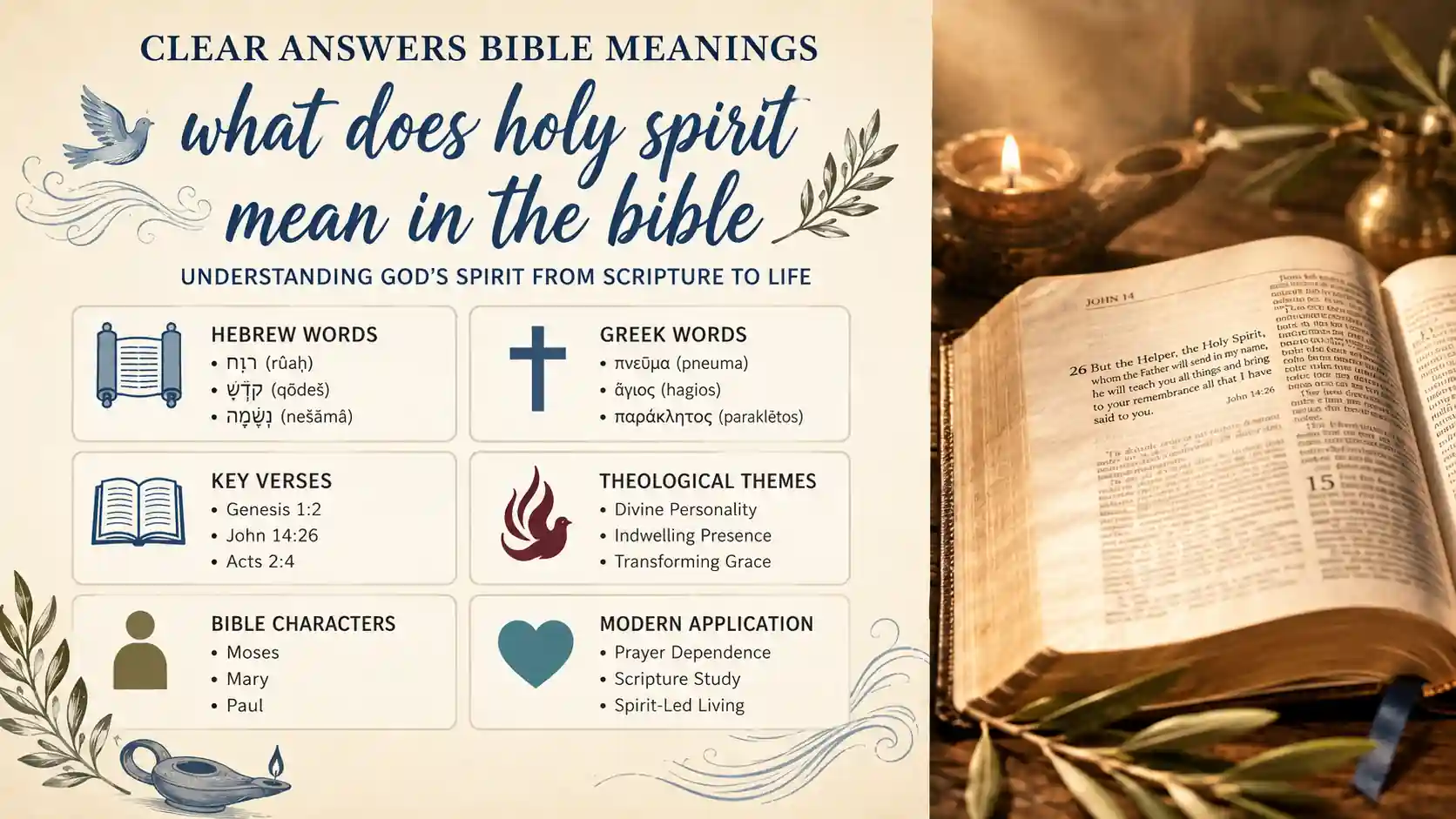
What does holy spirit mean in the bible? The phrase refers to God’s own Spirit, personally present and actively working in creation, revelation, redemption, and the lives of his people. Scripture presents the Holy Spirit not merely as an influence, emotion, or religious atmosphere, but as the divine Spirit who speaks, teaches, guides, empowers, and gives life.
The biblical words for “spirit” also mean wind or breath. This imagery helps your study because the Spirit is invisible yet known by his powerful effects. From Genesis to Revelation, the Holy Spirit reveals God’s presence and accomplishes God’s purposes.
Holy Spirit Key Scripture References
| Verse | Passage Snippet | Context |
|---|---|---|
| Genesis 1:2 | God’s Spirit hovered over the waters | Creation begins under divine presence |
| Psalm 51:11 | “Take not thy holy spirit” | David pleads after grievous sin |
| Isaiah 63:10 | They grieved his Holy Spirit | Israel rebelled against God’s presence |
| Ezekiel 36:27 | “I will put my spirit within you” | New-covenant obedience is promised |
| Joel 2:28 | “I will pour out my spirit” | God promises widespread prophetic empowerment |
| Luke 1:35 | The Holy Spirit comes upon Mary | Jesus’ conception is divinely accomplished |
| John 14:26 | The Holy Spirit will teach | Jesus promises another divine Helper |
| Acts 2:4 | All were filled with the Spirit | Pentecost inaugurates global witness |
| Romans 8:11 | The Spirit gives life | Resurrection power dwells in believers |
| Ephesians 1:13 | Sealed with the promised Spirit | Believers receive God’s covenant pledge |
Holy Spirit Bible Translation Comparison
| Verse | KJV | NIV | ESV | NASB |
|---|---|---|---|---|
| Psalm 51:11 | “holy spirit” | “Holy Spirit” | “Holy Spirit” | “Holy Spirit” |
| Matthew 1:18 | “Holy Ghost” | “Holy Spirit” | “Holy Spirit” | “Holy Spirit” |
| Luke 1:35 | “Holy Ghost” | “Holy Spirit” | “Holy Spirit” | “Holy Spirit” |
| John 14:16 | “Comforter” | “advocate” | “Helper” | “Helper” |
| John 14:26 | “Comforter” | “Advocate” | “Helper” | “Helper” |
| Acts 1:8 | “Holy Ghost” | “Holy Spirit” | “Holy Spirit” | “Holy Spirit” |
| Acts 2:4 | “Holy Ghost” | “Holy Spirit” | “Holy Spirit” | “Holy Spirit” |
| Ephesians 1:13 | “holy Spirit of promise” | “promised Holy Spirit” | “promised Holy Spirit” | “Holy Spirit of promise” |
Holy Spirit People and Characters Associated
| Person | Role | Connection |
|---|---|---|
| Moses | Covenant mediator | God’s Spirit rested on shared leaders |
| Bezalel | Tabernacle craftsman | Filled with God’s Spirit for skilled work |
| David | King and psalmist | Anointed by the Spirit for kingship |
| Isaiah | Prophet | Foretold the Spirit-anointed Messiah |
| Ezekiel | Exilic prophet | Promised inward renewal by the Spirit |
| John the Baptist | Prophetic forerunner | Filled with the Spirit before birth |
| Mary | Mother of Jesus | Conceived through the Spirit’s power |
| Jesus | Messiah and Son | Anointed and empowered by the Spirit |
| Peter | Apostle and witness | Preached boldly after Pentecost |
| Paul | Apostle to the nations | Taught extensively about life in the Spirit |
Holy Spirit Original Hebrew and Greek Words
| Original Word | Transliteration | Strong’s # | Literal Meaning |
|---|---|---|---|
| רוּחַ | rûaḥ | H7307 | Wind, breath, spirit |
| קֹדֶשׁ | qōdeš | H6944 | Holiness, sacredness |
| קָדוֹשׁ | qādôš | H6918 | Holy, set apart |
| נְשָׁמָה | nešāmâ | H5397 | Breath, life-breath |
| πνεῦμα | pneuma | G4151 | Wind, breath, spirit |
| ἅγιος | hagios | G40 | Holy, consecrated |
| παράκλητος | paraklētos | G3875 | Helper, advocate |
| ἀλήθεια | alētheia | G225 | Truth, reality |
| σφραγίζω | sphragizō | G4972 | Seal, authenticate |
| πληρόω | plēroō | G4137 | Fill, make complete |
Holy Spirit Related Biblical Concepts
| Concept | Connection | Supporting Verse |
|---|---|---|
| Creation | The Spirit brings order and life | Genesis 1:2 |
| Revelation | The Spirit speaks through Scripture | 2 Peter 1:21 |
| Anointing | The Spirit equips God’s appointed servant | Isaiah 61:1 |
| New birth | Spiritual life comes from the Spirit | John 3:5 |
| Adoption | The Spirit confirms believers as God’s children | Romans 8:15 |
| Sanctification | The Spirit forms holy character | 2 Thessalonians 2:13 |
| Spiritual gifts | The Spirit distributes gifts for service | 1 Corinthians 12:11 |
| Witness | The Spirit empowers gospel testimony | Acts 1:8 |
| Unity | Believers share one Spirit | Ephesians 4:3 |
| Resurrection | The Spirit gives life to mortal bodies | Romans 8:11 |
Holy Spirit Historical and Cultural Context
| Aspect | Detail | Biblical Source |
|---|---|---|
| Ancient wind imagery | Wind pictured invisible divine power | Ezekiel 37:9 |
| Breath and life | Breath signified life received from God | Genesis 2:7 |
| Tabernacle craftsmanship | Spiritual filling included artistic wisdom | Exodus 31:2–5 |
| Tribal leadership | The Spirit equipped judges to deliver Israel | Judges 3:10 |
| Royal anointing | Kings received divine authorization | 1 Samuel 16:13 |
| Prophetic speech | Prophets spoke under God’s Spirit | Micah 3:8 |
| Exilic hope | The Spirit promised national and inward renewal | Ezekiel 36:26–27 |
| Second Temple expectation | Israel awaited the promised outpouring | Joel 2:28–29 |
| Pentecost | Jewish pilgrims witnessed Spirit-given languages | Acts 2:5–11 |
| Roman sealing | A seal marked ownership and authenticity | Ephesians 1:13 |
Holy Spirit Theological Themes
| Theme | Explanation | Scripture |
|---|---|---|
| Divine personality | The Spirit speaks, wills, and teaches | Acts 13:2 |
| Divine holiness | He communicates God’s holy presence | Romans 1:4 |
| Trinitarian fellowship | Father, Son, and Spirit share the divine name | Matthew 28:19 |
| Christ’s mission | Jesus ministers in the Spirit’s power | Luke 4:18 |
| Covenant renewal | The Spirit enables obedience from within | Ezekiel 36:27 |
| Indwelling presence | God dwells in believers through the Spirit | 1 Corinthians 6:19 |
| Transforming grace | The Spirit produces Christlike fruit | Galatians 5:22–23 |
| Assurance | The Spirit bears witness to adoption | Romans 8:16 |
| Mission | The Spirit sends and empowers witnesses | Acts 13:2–4 |
| Future inheritance | The Spirit guarantees final redemption | Ephesians 1:14 |
Holy Spirit Modern Application for Believers
| Area | Practice | Scripture |
|---|---|---|
| Prayer | Depend on the Spirit’s help in weakness | Romans 8:26 |
| Scripture study | Seek illumination with careful interpretation | 1 Corinthians 2:12 |
| Character | Cultivate the fruit of the Spirit | Galatians 5:22–23 |
| Decision-making | Follow biblical truth rather than impulse | John 16:13 |
| Worship | Worship through the Spirit in truth | Philippians 3:3 |
| Service | Use spiritual gifts for the common good | 1 Corinthians 12:7 |
| Witness | Rely on divine power, not confidence alone | Acts 1:8 |
| Community | Preserve Spirit-created unity | Ephesians 4:3 |
| Purity | Honor God with your embodied life | 1 Corinthians 6:19–20 |
| Hope | Trust the Spirit’s pledge of resurrection | Romans 8:23 |
What Does Holy Spirit Mean in the Bible Through רוּחַ RûAḥ?
The Hebrew noun רוּחַ, rûaḥ, can describe wind, breath, a person’s inner disposition, or the Spirit of God. Context determines its sense. In Genesis 1:2, “the Spirit of God” hovers over the waters, showing divine presence and power at the beginning of creation.
The Old Testament also connects the Spirit with life, wisdom, leadership, craftsmanship, prophecy, and moral renewal. God fills Bezalel for sacred craftsmanship, empowers judges for deliverance, rests upon prophets, and anoints David as king. These works are diverse, but their source is always God.
The word “holy” identifies this Spirit as belonging uniquely to the holy God. David’s plea in Psalm 51:11 does not treat the Spirit as an impersonal force. David fears losing the gracious divine presence and royal empowerment he had received, especially after witnessing Saul’s tragic decline.
Isaiah 63:10–14 gives the phrase a covenant setting. Israel grieved God’s Holy Spirit, the same Spirit associated with God’s saving guidance during the exodus. The passage joins divine holiness with personal action, since the Spirit can be resisted and grieved.
From Joel’S Promise to the Πνεῦμα Pneuma of Pentecost
The Greek noun πνεῦμα, pneuma, carries the same broad range as rûaḥ, including wind, breath, and spirit. The adjective ἅγιος, hagios, means holy or set apart. Together, πνεῦμα ἅγιον, pneuma hagion, identifies the Holy Spirit as God’s sacred and active presence.
Joel had promised that God would pour out his Spirit upon sons, daughters, old, young, and servants. The promise anticipated an expansion of prophetic participation. At Pentecost, Peter explains the disciples’ Spirit-given speech by quoting Joel and declaring that the promised days have begun.
Pentecost does not mark the Spirit’s first appearance in Scripture. It marks a decisive new-covenant outpouring connected with Jesus’ death, resurrection, exaltation, and worldwide mission. The risen Christ receives the promised Spirit from the Father and pours out what the crowd sees and hears.
The Spirit’s arrival also reverses barriers that might have confined the gospel to one ethnicity or language. People from many regions hear God’s mighty works. The miracle signals that the good news of Jesus is intended for every nation under heaven.
The Παράκλητος ParaklēTos Reveals a Personal Divine Helper
In John 14–16, Jesus calls the promised Helper παράκλητος, paraklētos. The word may be rendered Helper, Advocate, Counselor, or Comforter. Each translation highlights part of its meaning, but no single English term captures every aspect of the Spirit’s ministry.
Jesus says the Spirit teaches, reminds, testifies, guides, hears, speaks, and glorifies Christ. These actions exceed what Scripture normally attributes to an impersonal power. The apostles also describe the Spirit as willing, interceding, forbidding, appointing overseers, and directing mission.
The Holy Spirit never competes with Jesus for attention. He glorifies the Son by making Christ’s words known and applying Christ’s saving work. A genuinely Spirit-directed life therefore grows in love for Jesus, faithfulness to Scripture, obedience, humility, and truthful witness.
The Spirit is also named with the Father and the Son in baptism and blessing. This pattern helped Christians confess that the Spirit is personally distinct yet fully divine. Scripture presents one God whose saving presence is known as Father, Son, and Holy Spirit.
The Spirit’S Seal, Indwelling, and Transforming Fruit
The new covenant promised more than occasional empowerment. God pledged to place his Spirit within his people and cause them to walk in his ways. In the New Testament, everyone who belongs to Christ has the Spirit, and lacking the Spirit means not belonging to Christ.
Paul describes believers as temples because the Spirit dwells within them. This indwelling is both comfort and calling. God is truly present with you, yet his presence also summons you to flee sin, honor your body, love fellow believers, and pursue holiness.
The Spirit’s “seal” marks believers as God’s own and authenticates their place among his covenant people. He is also the “guarantee” or first installment of the promised inheritance. Present fellowship with God anticipates bodily resurrection and the completed renewal of creation.
You recognize the Spirit’s transforming work through fruit rather than spectacle alone. Love, joy, peace, patience, kindness, goodness, faithfulness, gentleness, and self-control reveal his holy influence. Gifts may differ among believers, but Christlike character remains essential for all.
Holy Spirit Questions Bible Students Often Ask
Why does the KJV say “Holy Ghost” while newer translations say “Holy Spirit”?
“Ghost” once commonly meant spirit, so both expressions translate πνεῦμα, pneuma, but “Holy Spirit” is clearer in modern English.
Does רוּחַ, rûaḥ, always refer to the Holy Spirit?
No, rûaḥ can mean wind, breath, human spirit, or God’s Spirit, so you must determine its meaning from context.
What does it mean to grieve the Holy Spirit in Ephesians 4:30?
It means that sinful conduct, especially corrupt speech and hostility, personally opposes the Spirit who seals and sanctifies believers.
Was the Holy Spirit active before Pentecost in Acts 2?
Yes, the Spirit created, revealed truth, empowered leaders, and inspired prophets, while Pentecost began the promised new-covenant outpouring.
How can you know whether you are being led by the Holy Spirit?
Test your direction by Scripture, Christlike character, wise Christian counsel, prayer, and the Spirit’s fruit rather than feelings alone.