
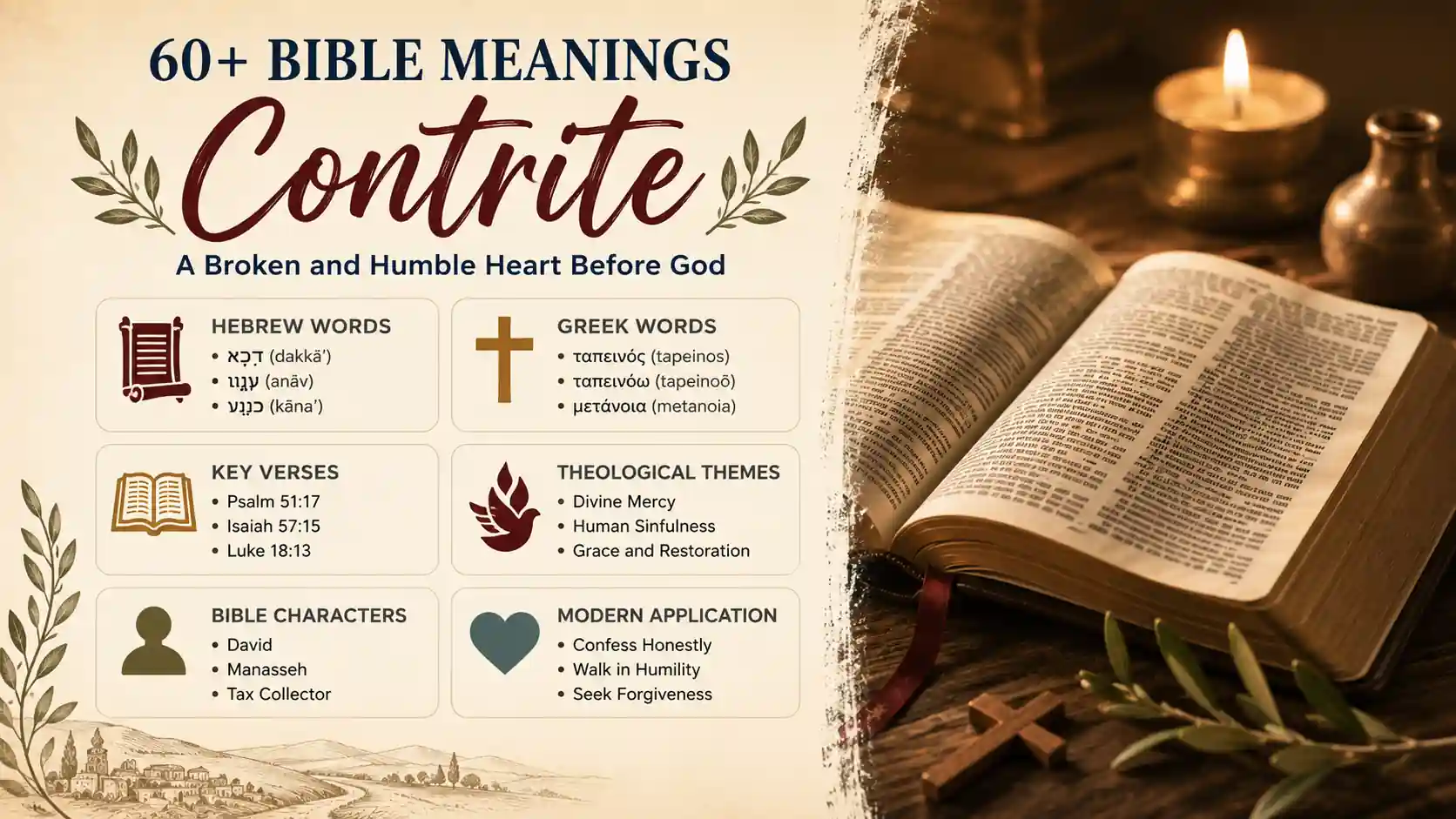
If you have ever wondered what does contrite mean in the Bible, you are asking about one of Scripture’s richest descriptions of true repentance and humble faith. A contrite heart is not simply emotional sadness or regret. It is the inward posture of a person who recognizes God’s holiness, admits personal sin, and turns to the Lord with sincere humility.
Throughout both the Old and New Testaments, God consistently honors those whose hearts are broken over sin while resisting those who trust in pride and self righteousness.
Key Scripture References for Contrite
| Verse | Passage Snippet | Context |
|---|---|---|
| Psalm 34:18 | The Lord is near the brokenhearted | God’s comfort for humble sufferers |
| Psalm 51:17 | A broken and contrite heart | David’s repentance after sin |
| Isaiah 57:15 | I dwell with the contrite | God’s presence with the humble |
| Isaiah 66:2 | One who is humble and contrite | True worship over ritual |
| Proverbs 28:13 | Confess and forsake sins | Mercy follows repentance |
| Joel 2:13 | Rend your heart | Genuine repentance |
| Luke 18:13 | God be merciful to me | Tax collector’s humble prayer |
| Matthew 5:3 | Poor in spirit | Beginning of kingdom blessings |
| James 4:10 | Humble yourselves before the Lord | God exalts the humble |
Bible Translation Comparison for Contrite
| Verse | KJV | NIV | ESV | NASB |
|---|---|---|---|---|
| Psalm 51:17 | Contrite heart | Contrite heart | Contrite heart | Contrite heart |
| Isaiah 57:15 | Contrite and humble | Contrite and lowly | Contrite and lowly | Contrite and lowly |
| Isaiah 66:2 | Contrite spirit | Contrite in spirit | Contrite in spirit | Contrite of spirit |
| Psalm 34:18 | Broken in heart | Brokenhearted | Brokenhearted | Brokenhearted |
| Joel 2:13 | Rend your heart | Rend your heart | Rend your hearts | Tear your heart |
| Matthew 5:3 | Poor in spirit | Poor in spirit | Poor in spirit | Poor in spirit |
| Luke 18:13 | Merciful to me | Mercy on me | Merciful to me | Be merciful to me |
| James 4:10 | Humble yourselves | Humble yourselves | Humble yourselves | Humble yourselves |
People and Characters Associated with Contrite
| Person | Role | Connection |
|---|---|---|
| David | King | Repented after Bathsheba |
| Manasseh | King | Humbled himself before God |
| Josiah | King | Tender heart before God’s Word |
| Ezra | Priest | Led national confession |
| Daniel | Prophet | Confessed Israel’s sins |
| Tax Collector | Worshiper | Humble prayer in the temple |
| Peter | Apostle | Wept after denying Jesus |
| Paul | Apostle | Counted himself chief of sinners |
| Prodigal Son | Jesus’ parable | Returned with repentance |
Original Hebrew and Greek Words for Contrite
| Original Word | Transliteration | Strong’s # | Literal Meaning |
|---|---|---|---|
| דַּכָּא | dakkā’ | H1792 | Crushed, broken |
| דָּכָא | dākā’ | H1794 | To crush, break |
| שָׁפָל | shāphāl | H8217 | Low, humble |
| עָנָו | anāv | H6035 | Humble, meek |
| כָּנַע | kānaʿ | H3665 | To humble oneself |
| συντρίβω | syntribō | G4937 | To crush completely |
| ταπεινός | tapeinos | G5011 | Humble, lowly |
| ταπεινόω | tapeinoō | G5013 | To humble |
| μετάνοια | metanoia | G3341 | Repentance, change of mind |
Related Biblical Concepts for Contrite
| Concept | Connection | Supporting Verse |
|---|---|---|
| Repentance | Genuine turning to God | Acts 3:19 |
| Humility | Opposite of pride | James 4:6 |
| Confession | Honest admission of sin | 1 John 1:9 |
| Mercy | God forgives the humble | Psalm 103:11 |
| Brokenness | Heart softened by God | Psalm 51:17 |
| Forgiveness | Result of repentance | Isaiah 1:18 |
| Grace | Given to the humble | 1 Peter 5:5 |
| Holiness | God’s standard reveals sin | Isaiah 6:5 |
| Restoration | God rebuilds the repentant | Joel 2:25 |
Historical and Cultural Context for Contrite
| Aspect | Detail | Biblical Source |
|---|---|---|
| Covenant Worship | Heart mattered more than sacrifice | Psalm 51 |
| Temple Prayer | Humility expected before God | Luke 18 |
| Royal Repentance | Kings publicly confessed | 2 Chronicles 33 |
| Prophetic Ministry | Called Israel to heartfelt repentance | Joel 2 |
| Sacrificial System | Symbol without obedience was empty | Isaiah 1 |
| Exile | National sorrow for covenant failure | Daniel 9 |
| Wisdom Literature | Pride contrasted with humility | Proverbs |
| Messianic Hope | Humble people awaited redemption | Isaiah 61 |
| Early Church | Repentance preached with faith | Acts 2 |
Theological Themes for Contrite
| Theme | Explanation | Scripture |
|---|---|---|
| God’s Holiness | Reveals human sin | Isaiah 6:5 |
| Human Sinfulness | Every heart needs grace | Romans 3:23 |
| Divine Mercy | God welcomes repentant sinners | Luke 15 |
| Covenant Faithfulness | God keeps promises to the humble | Isaiah 57:15 |
| Grace | Salvation is undeserved | Ephesians 2:8 |
| Sanctification | Humility continues after conversion | Philippians 2 |
| Restoration | God heals broken hearts | Psalm 147:3 |
| Worship | Inner sincerity matters most | John 4:24 |
| Kingdom Values | Humility marks disciples | Matthew 5:3 |
Modern Application for Believers About Contrite
| Area | Practice | Scripture |
|---|---|---|
| Prayer | Confess honestly | 1 John 1:9 |
| Worship | Come with humility | Psalm 51:17 |
| Relationships | Admit wrong quickly | James 5:16 |
| Bible Study | Receive correction gladly | 2 Timothy 3:16 |
| Leadership | Serve without pride | Mark 10:45 |
| Family | Seek forgiveness often | Ephesians 4:32 |
| Church | Restore gently | Galatians 6:1 |
| Evangelism | Share grace with compassion | Titus 3:5 |
| Daily Life | Walk humbly before God | Micah 6:8 |
The Hebrew Root Dakkā’ and What Does Contrite Mean in the Bible
When you ask what does contrite mean in the Bible, the Old Testament points you first to the Hebrew word דַּכָּא (dakkā’) and the related verb דָּכָא (dākā’). These words describe something crushed, broken, or humbled. They often refer to a person whose pride has been shattered before God’s holiness rather than someone who is merely discouraged.
Psalm 51 gives the clearest picture. After David confessed his sin, he declared that “a broken and contrite heart” was the sacrifice God truly desired. David understood that ritual offerings could never replace genuine repentance. God was looking for inward transformation before outward obedience.
The prophets continued this message. Isaiah 57:15 reveals the astonishing truth that the high and holy God dwells with those who are contrite and lowly in spirit. The Creator who inhabits eternity chooses to comfort humble sinners instead of the self confident.
Isaiah 66:2 strengthens the same idea. God says His attention rests upon the one who is humble, contrite in spirit, and who trembles at His Word. Reverence for Scripture naturally grows from a heart that knows its need for God’s mercy.
Contrition in the Covenant Life of Israel
Throughout Israel’s history, contrition marked the faithful response whenever God’s people recognized covenant failure. Whether under judges, kings, or prophets, true repentance involved confession, renewed obedience, and trust in God’s compassion.
Joel urged the nation, “Rend your heart and not your garments.” Public signs of mourning had value only when they reflected genuine inward sorrow. External religion without inward repentance never satisfied God because He always examines the heart before the hands.
King Manasseh provides a remarkable example. After years of rebellion and idolatry, he humbled himself greatly before the Lord. His story demonstrates that no sinner is beyond God’s mercy when repentance is sincere. Likewise, King Josiah responded with a tender heart when the Book of the Law was rediscovered, leading Judah into spiritual renewal.
Daniel and Ezra also modeled corporate contrition. Although personally faithful, both men confessed the sins of the nation as their own. Their prayers reveal that biblical humility is not about protecting personal reputation but about honoring God’s covenant faithfulness.
Tapeinos in the New Testament and the Example of Christ
The New Testament often uses the Greek adjective ταπεινός (tapeinos) and the verb ταπεινόω (tapeinoō) to describe humility before God. While the exact Hebrew expression for contrite is less common, the same spiritual reality appears throughout the teachings of Jesus and the apostles.
Jesus illustrated this perfectly through the parable of the Pharisee and the tax collector. The Pharisee trusted his own righteousness, while the tax collector cried, “God, be merciful to me, a sinner.” Christ declared that the humble worshiper went home justified because he depended entirely upon God’s mercy.
The Beatitudes begin with “Blessed are the poor in spirit.” Spiritual poverty recognizes complete dependence upon God. A contrite heart does not bargain with the Lord or boast in personal achievements. It receives grace with gratitude.
Jesus Himself displayed perfect humility. Philippians 2 describes how He willingly humbled Himself in obedience to the Father, even to death on a cross. His humility was not repentance, since He was without sin, but it became the supreme example of self giving obedience for every believer.
The apostles continued this emphasis. James commands believers to humble themselves before the Lord, promising that God will lift them up. Peter likewise teaches that God opposes the proud but gives grace to the humble, echoing the wisdom found throughout the Old Testament.
Contrite Hearts and Daily Christian Living
A contrite heart should not be confused with constant shame or hopelessness. Biblical contrition leads to restoration rather than despair. After genuine confession comes forgiveness, renewed fellowship, and joyful obedience.
First John 1:9 assures believers that if you confess your sins, God is faithful and just to forgive and cleanse you. Contrition therefore becomes the doorway to spiritual freedom rather than a permanent state of sorrow. God’s purpose is always restoration.
A contrite believer also becomes teachable. Pride resists correction, but humility welcomes God’s Word even when it exposes hidden sin. Regular Scripture reading, prayer, and honest self examination help cultivate this attitude throughout your walk with Christ.
Contrition also transforms relationships. When you admit mistakes quickly, forgive others generously, and seek reconciliation instead of defending yourself, you reflect God’s own mercy. Humility creates unity in families, churches, and friendships because it values grace above personal pride.
Finally, a contrite heart produces joyful worship. The believer who remembers God’s forgiveness sings with deeper gratitude, serves with greater compassion, and trusts God’s promises with renewed confidence. Biblical contrition is never an end in itself. It leads you back into the joy of fellowship with the Lord who delights in showing mercy.
FAQs
Does the Hebrew word dakkā’ always refer to emotional sadness?
No, dakkā’ primarily describes a humbled or crushed heart before God, not merely feelings of sadness.
Why does Psalm 51:17 emphasize a broken and contrite heart instead of sacrifices?
Because God values sincere repentance above empty religious rituals.
Is being poor in spirit the same as being contrite?
Yes, both describe humble dependence upon God and recognition of your spiritual need.
Does the Greek word tapeinos mean weakness or humility?
It refers to humble lowliness before God, not personal worthlessness or lack of value.
Can a Christian remain contrite after receiving forgiveness?
Yes, a believer continues walking in humility while rejoicing in God’s complete forgiveness and grace.