
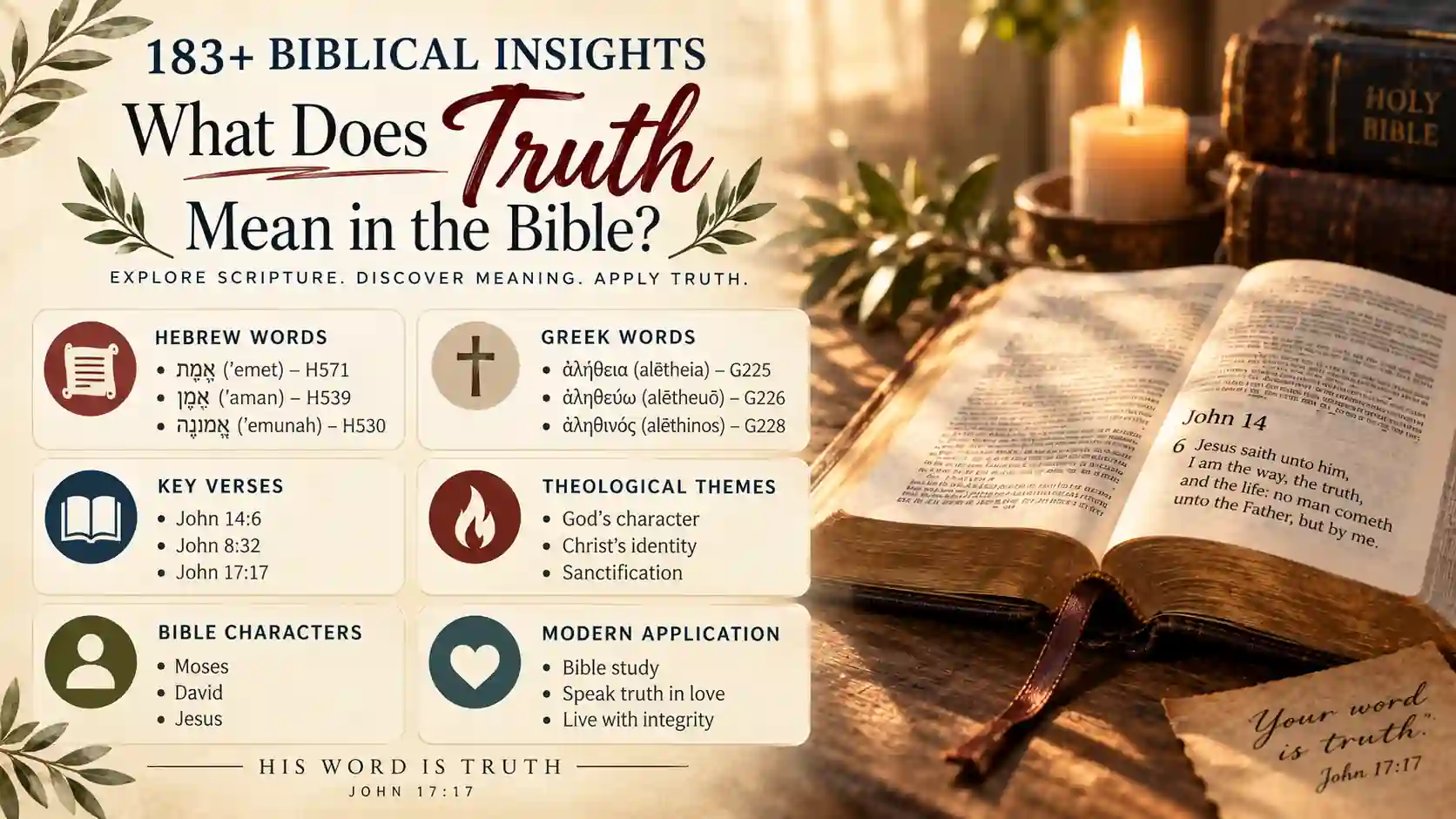
When you ask what does truth mean in the Bible, Scripture gives a richer answer than simple factual accuracy. Biblical truth includes what is real and dependable, but it is also bound to God’s faithfulness, His revealed word, His covenant character, and ultimately Jesus Christ. In Hebrew, אֱמֶת (ʾemet) carries ideas of firmness, reliability, faithfulness, and truth.
In the New Testament, ἀλήθεια (alētheia) describes truth and reality rather than falsehood or deception. Most importantly, biblical truth is something you believe, speak, obey, and live.
Key Truth Scripture References
| Verse | Passage Snippet | Context |
|---|---|---|
| Exodus 34:6 | “abundant in goodness and truth” | God reveals His covenant character to Moses |
| Psalm 25:5 | “Lead me in thy truth” | David asks God for guidance |
| Psalm 119:160 | “Thy word is true” | God’s revelation is dependable |
| Proverbs 12:19 | “lip of truth” | Truthful speech endures |
| John 1:14 | “grace and truth” | Jesus reveals divine glory |
| John 8:32 | “truth shall make you free” | Jesus links truth with discipleship |
| John 14:6 | “I am…the truth” | Jesus identifies truth with Himself |
| John 17:17 | “thy word is truth” | Jesus prays for His disciples |
Bible Translation Comparison of Truth
| Verse | KJV | NIV | ESV | NASB |
|---|---|---|---|---|
| Exodus 34:6 | goodness and truth | love and faithfulness | steadfast love and faithfulness | lovingkindness and truth |
| Psalm 25:5 | thy truth | your truth | your truth | Your truth |
| Psalm 119:160 | word is true | words are true | sum…is truth | sum…is truth |
| John 1:14 | grace and truth | grace and truth | grace and truth | grace and truth |
| John 8:32 | make you free | set you free | set you free | set you free |
| John 14:6 | the truth | the truth | the truth | the truth |
| John 17:17 | word is truth | word is truth | word is truth | word is truth |
| Ephesians 4:15 | speaking the truth | speaking the truth | speaking the truth | speaking the truth |
The translation difference in Exodus 34:6 is especially instructive. Hebrew אֱמֶת (ʾemet) can communicate both truth and faithfulness, so English versions legitimately emphasize different dimensions of the same Hebrew idea.
People and Characters Associated with Truth
| Person | Role | Connection |
|---|---|---|
| Moses | Lawgiver | Receives God’s revelation of His faithful character |
| David | King and psalmist | Prays to walk in God’s truth |
| Solomon | Wisdom teacher | Contrasts truthful and lying speech |
| Isaiah | Prophet | Calls God’s people back to faithful righteousness |
| Jeremiah | Prophet | Condemns deception and false prophecy |
| Jesus | Messiah | Declares Himself “the truth” |
| Pilate | Roman governor | Asks Jesus, “What is truth?” |
| Paul | Apostle | Commands believers to speak truth in love |
Original Hebrew and Greek Words for Truth
| Original Word | Transliteration | Strong’s # | Literal Meaning |
|---|---|---|---|
| אֱמֶת | ʾemet | H571 | truth, firmness, faithfulness |
| אָמַן | ʾaman | H539 | confirm, support, believe |
| אֱמוּנָה | ʾemunah | H530 | firmness, faithfulness |
| ἀλήθεια | alētheia | G225 | truth, reality |
| ἀληθεύω | alētheuō | G226 | speak or practice truth |
| ἀληθής | alēthēs | G227 | true, truthful |
| ἀληθινός | alēthinos | G228 | true, genuine, real |
| ψεῦδος | pseudos | G5579 | falsehood, lie |
The principal Old Testament noun is אֱמֶת (ʾemet), Strong’s H571. It is related to the Hebrew root אָמַן (ʾaman), associated with firmness and reliability. Scripture therefore presents truth not merely as correct information but as something stable enough to trust.
The central New Testament noun is ἀλήθεια (alētheia), Strong’s G225, meaning truth or reality. Its related verb ἀληθεύω (alētheuō), G226, appears in passages about telling or practicing truth, while ἀληθινός (alēthinos), G228, can emphasize what is genuine or truly corresponds to reality.
Related Biblical Concepts of Truth
| Concept | Connection | Supporting Verse |
|---|---|---|
| Faithfulness | Truth describes God’s reliability | Exodus 34:6 |
| Revelation | God’s word communicates truth | John 17:17 |
| Freedom | Truth releases disciples from bondage | John 8:32 |
| Holiness | Truth sanctifies God’s people | John 17:17 |
| Grace | Grace and truth meet in Christ | John 1:14 |
| Love | Truth must be expressed lovingly | Ephesians 4:15 |
| Worship | True worship accords with God | John 4:23 |
| Integrity | Believers reject falsehood | Ephesians 4:25 |
Historical and Cultural Context of Truth
| Aspect | Detail | Biblical Source |
|---|---|---|
| Sinai covenant | God’s truth reflects His dependable character | Exodus 34:6 |
| Hebrew wisdom | Truthful speech preserves community life | Proverbs 12:19 |
| Israelite worship | Worshipers seek God’s truthful guidance | Psalm 25:5 |
| Prophetic ministry | False prophecy opposes divine truth | Jeremiah 23 |
| Second Temple Judaism | Scripture shapes Jewish understanding of revelation | John 5:39 |
| Roman rule | Pilate questions Jesus about truth | John 18:37-38 |
| Johannine theology | Truth centers strongly on Christ | John 1:14 |
| Early churches | Truth governs doctrine and relationships | Ephesians 4:15 |
Theological Themes of Truth
| Theme | Explanation | Scripture |
|---|---|---|
| God’s character | God is completely trustworthy | Exodus 34:6 |
| God’s word | Divine revelation is true | John 17:17 |
| Christ’s identity | Jesus personally embodies truth | John 14:6 |
| Gospel revelation | Truth concerns God’s saving work | Ephesians 1:13 |
| Sanctification | God forms believers through truth | John 17:17 |
| Liberation | Knowing truth brings genuine freedom | John 8:32 |
| Spirit’s ministry | The Spirit guides disciples into truth | John 16:13 |
| Christian ethics | Truth shapes speech and conduct | Ephesians 4:25 |
Modern Application of Biblical Truth for Believers
| Area | Practice | Scripture |
|---|---|---|
| Bible study | Receive Scripture as God’s truthful word | John 17:17 |
| Discipleship | Continue in Jesus’ teaching | John 8:31-32 |
| Speech | Reject lying and speak honestly | Ephesians 4:25 |
| Relationships | Join truth with love | Ephesians 4:15 |
| Worship | Worship in spirit and truth | John 4:24 |
| Discernment | Test claims against God’s revelation | 1 John 4:1 |
| Character | Practice sincerity rather than deception | 1 John 3:18 |
| Witness | Testify faithfully about Christ | John 18:37 |
אֱמֶת ʾEmet Shows Why Biblical Truth Means More than Correct Facts
When Exodus 34:6 describes the Lord as abounding in אֱמֶת (ʾemet), truth appears within God’s own self-revelation to Moses. The setting follows Israel’s sin with the golden calf. God’s truthfulness therefore concerns His dependable character, including His faithfulness to what He has revealed and promised.
That background helps you understand why ʾemet can be translated “truth” in one passage and “faithfulness” in another. The word carries the sense of solidity and trustworthiness. Biblical truth is true because it corresponds to reality, but divine truth is also reliable because God Himself does not deceive or prove unfaithful.
What Does Truth Mean in the Bible According to Jesus?
John’s Gospel brings the theme to its clearest personal focus. Jesus does not merely say that He teaches truth. In John 14:6, He says, “I am the way, the truth, and the life.” Christian truth therefore cannot be separated from the identity, revelation, and saving mission of Christ.
This explains the force of John 8:31-32. The famous promise that truth makes people free occurs in a discussion of continuing in Jesus’ word and becoming genuine disciples. The freedom described there is not simply intellectual independence. In the surrounding verses, Jesus speaks about liberation from slavery to sin.
ἀλήθεια AlēTheia Connects God’s Reality with Christian Life
The Greek noun ἀλήθεια (alētheia) is Strong’s G225 and commonly carries the sense of truth or reality as opposed to what is false. John’s Gospel uses the term extensively in connection with Jesus, God’s revelation, faithful testimony, worship, and the Holy Spirit.
Paul shows that truth also has an ethical dimension. The rare verb ἀληθεύω (alētheuō) appears in Galatians 4:16 and Ephesians 4:15. In Ephesians, believers are called to be “speaking the truth in love.” Truth is not permission for harshness. Christian maturity joins truthful confession with Christlike love.
From Moses to Pilate, Scripture Makes Truth a Question of Whom You Trust
The contrast between Moses and Pilate is striking. Moses encounters the God whose character is marked by אֱמֶת (ʾemet). Centuries later, Pilate stands before Jesus and asks, “What is truth?” while questioning the One who has already testified that He came into the world to bear witness to truth.
For your study, this biblical sweep matters. Scripture treats truth as factual and doctrinal, but never merely theoretical. Truth originates in God’s trustworthy character, is communicated through His word, reaches its fullest revelation in Christ, is illuminated by the Spirit, and reshapes the believer’s speech, worship, obedience, and relationships.
Frequently Asked Questions About Biblical Truth
Why can אֱמֶת ʾemet mean both “truth” and “faithfulness”?
Because the Hebrew word includes ideas of reliability, firmness, trustworthiness, and truth, making faithfulness a natural expression of what is genuinely true.
Does John 14:6 mean Jesus teaches truth or that He is truth?
Jesus says, “I am…the truth,” presenting truth as inseparable from His own person as well as from what He teaches.
What does ἀλήθεια alētheia mean in the New Testament?
ἀλήθεια (alētheia), Strong’s G225, refers to truth or reality and frequently describes God’s revelation, the gospel, and what stands opposed to falsehood.
Why do translations render Exodus 34:6 as either “truth” or “faithfulness”?
Hebrew אֱמֶת (ʾemet) contains both ideas, so the translations emphasize complementary aspects of God’s trustworthy covenant character.
How should you practice biblical truth without becoming harsh toward others?
Ephesians 4:15 joins truth with love, calling you to communicate what is true in a manner shaped by the character and maturity of Christ.