
If you are asking what does halloween mean in the bible, the first fact to establish is simple. Scripture never mentions Halloween by name, nor does it describe October 31 as a biblical holy day. The word itself developed centuries after the biblical period from “All Hallows’ Eve.”
Your Bible study therefore needs to distinguish Halloween itself from practices Scripture does address. The Bible speaks directly about divination, sorcery, consulting the dead, idolatry, spiritual darkness, conscience, holiness, and Christian freedom. Those teachings provide the proper framework for evaluating modern Halloween customs.
Halloween Key Scripture References
| Verse | Passage Snippet | Context |
|---|---|---|
| Deuteronomy 18:9-12 | Avoid divination and sorcery | Israel entering Canaan |
| Leviticus 19:31 | Do not seek mediums | Covenant holiness |
| Isaiah 8:19 | Should people not consult God? | Warning against necromancy |
| 1 Samuel 28:7 | Saul seeks a medium | Saul at Endor |
| 2 Kings 21:6 | Manasseh practices sorcery | Judah’s apostasy |
| Acts 19:18-19 | Converts abandon magic | Gospel reaches Ephesus |
| Galatians 5:19-21 | Sorcery among fleshly works | Life outside the Spirit |
| Ephesians 5:8-11 | Walk as children of light | Christian holiness |
| 1 Corinthians 10:20-21 | Reject demonic participation | Pagan sacrificial meals |
| Romans 14:5-6 | Act unto the Lord | Disputable observances |
Deuteronomy places occult practices within Israel’s confrontation with Canaanite religion, not within a discussion of costumes, candy, autumn festivals, or October 31. Isaiah likewise directs God’s people away from mediums and toward divine revelation.
Halloween Bible Translation Comparison
| Verse | KJV | NIV | ESV | NASB |
|---|---|---|---|---|
| Deut. 18:10 | witch | engages in witchcraft | sorcerer | witchcraft |
| Deut. 18:11 | familiar spirits | medium | medium | medium |
| Lev. 19:31 | familiar spirits | mediums | mediums | mediums |
| 1 Sam. 28:3 | wizards | spiritists | necromancers | spiritists |
| Isa. 8:19 | wizards | spiritists | necromancers | spiritists |
| Gal. 5:20 | witchcraft | witchcraft | sorcery | sorcery |
| Rev. 21:8 | sorcerers | magic arts | sorcerers | sorcerers |
| Eph. 5:8 | children of light | children of light | children of light | children of Light |
The differences matter because older English vocabulary can suggest categories different from modern usage. For example, Hebrew יִדְּעֹנִי (yiddeoni) may appear as “wizard” in older translation tradition but as “spiritist” in modern English.
Halloween People and Characters Associated with Biblical Principles
| Person | Role | Connection |
|---|---|---|
| Moses | Covenant mediator | Gives Israel occult prohibitions |
| Saul | King of Israel | Consults the medium at Endor |
| Medium of Endor | Spirit practitioner | Consulted by Saul |
| Samuel | Prophet | Appears in 1 Samuel 28 |
| Manasseh | King of Judah | Practices sorcery and divination |
| Josiah | Reforming king | Removes occult practices |
| Isaiah | Prophet | Condemns consulting the dead |
| Paul | Apostle | Teaches against sorcery and idolatry |
| Ephesian converts | New believers | Burn magical books |
| Corinthian believers | Gentile Christians | Warned about pagan worship |
Saul’s story is especially significant. He had previously removed mediums and spiritists from Israel, yet in desperation he sought precisely the guidance God had forbidden. His story connects occult consultation with rebellion against God’s revealed direction, rather than merely with frightening imagery.
Josiah provides the opposite pattern. His reforms included removing mediums, spiritists, household gods, and other practices associated with Judah’s religious corruption.
Halloween Original Hebrew and Greek Words
| Original Word | Transliteration | Strong’s # | Literal Meaning |
|---|---|---|---|
| קֶסֶם | qesem | H7081 | divination |
| אוֹב | ‘ob | H178 | medium, spirit |
| יִדְּעֹנִי | yiddeoni | H3049 | spiritist, knowing one |
| כָּשַׁף | kashaph | H3784 | practice sorcery |
| חָבַר | chabar | H2266 | bind, charm |
| φαρμακεία | pharmakeia | G5331 | sorcery, magic |
| μαγεία | mageia | G3095 | magic |
| εἴδωλον | eidolon | G1497 | idol, image |
| σκότος | skotos | G4655 | darkness |
| φῶς | phos | G5457 | light |
These words show why saying “Halloween means witchcraft in Hebrew” would be inaccurate. There is no biblical Hebrew or Greek word for Halloween. Instead, Scripture contains distinct vocabulary describing actual forbidden practices such as sorcery, divination, and consultation with spirits.
The Hebrew כָּשַׁף (kashaph, H3784) refers to practicing sorcery, while יִדְּעֹנִי (yiddeoni, H3049) concerns a spiritist or one associated with occult knowledge. The Greek φαρμακεία (pharmakeia, G5331) can designate sorcery or magical practice.
Halloween Related Biblical Concepts
| Concept | Connection | Supporting Verse |
|---|---|---|
| Divination | Seeking forbidden supernatural knowledge | Deut. 18:10 |
| Necromancy | Consulting the dead | Deut. 18:11 |
| Sorcery | Magical practice condemned | Gal. 5:20 |
| Idolatry | Rival spiritual allegiance | 1 Cor. 10:14 |
| Darkness | Moral and spiritual imagery | Eph. 5:8 |
| Light | Identity of believers | Eph. 5:8 |
| Holiness | Separation unto God | 1 Pet. 1:15-16 |
| Conscience | Personal accountability | Rom. 14:22-23 |
| Discernment | Testing what pleases God | Eph. 5:10 |
| Witness | Doing all for God’s glory | 1 Cor. 10:31 |
Biblical darkness does not automatically mean nighttime, black clothing, or frightening decoration is sinful. Greek σκότος (skotos, G4655) can describe literal darkness, but New Testament writers also use it metaphorically for spiritual ignorance and evil.
That distinction prevents superficial interpretation. Scripture’s concern is spiritual allegiance and conduct, not merely visual symbolism.
Halloween Historical and Cultural Context
| Aspect | Detail | Biblical Source |
|---|---|---|
| Biblical era | Halloween did not exist | No direct biblical reference |
| All Hallows | Means All Saints | Postbiblical development |
| All Hallows’ Eve | Evening before All Saints | Postbiblical development |
| October 31 | Traditional Halloween date | Not a biblical date |
| Samhain | Ancient Celtic seasonal festival | Not named in Scripture |
| Canaan | Israel faced occult religion | Deut. 18:9-14 |
| Endor | Saul sought a medium | 1 Sam. 28 |
| Ephesus | Magic practiced widely | Acts 19:18-19 |
| Corinth | Idol worship challenged | 1 Cor. 10:14-22 |
| Rome | Conscience issues discussed | Rom. 14 |
The English name Halloween developed from “All Hallows’ Eve,” the vigil associated with All Saints’ Day. The November 1 observance of All Saints became established in Western Christianity long after the New Testament period.
Claims that Halloween is simply Samhain under another name require caution. Celtic customs contributed to later Halloween traditions, but historians discuss a more complicated development involving Christian observances, regional folklore, and later popular customs.
Halloween Theological Themes
| Theme | Explanation | Scripture |
|---|---|---|
| God’s revelation | Seek God rather than spirits | Isa. 8:19-20 |
| Exclusive worship | God tolerates no rivals | Exod. 20:3 |
| Holiness | God’s people live distinctly | Lev. 19:2 |
| Spiritual discernment | Examine what pleases Christ | Eph. 5:10 |
| Light and darkness | Believers belong to light | Eph. 5:8 |
| Repentance | Renounce former occult practice | Acts 19:18-19 |
| Christian freedom | Conscience matters | Rom. 14:5 |
| Love | Freedom must consider others | Rom. 14:15 |
| God’s glory | Ordinary actions honor God | 1 Cor. 10:31 |
| Spiritual allegiance | Reject demonic fellowship | 1 Cor. 10:20-21 |
Acts 19 gives one of Scripture’s clearest pictures of conversion affecting magical practices. Ephesian believers openly abandoned practices associated with magic rather than attempting to combine them with devotion to Christ.
Romans 14 addresses a different category. Paul recognizes that believers can evaluate certain disputable matters differently while remaining responsible to the Lord. Applying that chapter to Halloween requires care because Paul never discusses Halloween itself.
Halloween Modern Application for Believers
| Area | Practice | Scripture |
|---|---|---|
| Occult activity | Avoid genuine spirit consultation | Deut. 18:10-12 |
| Fortune telling | Refuse divination | Deut. 18:10 |
| Séances | Do not seek the dead | Isa. 8:19 |
| Entertainment | Test what you celebrate | Eph. 5:10 |
| Costumes | Evaluate meaning and conscience | Rom. 14:22 |
| Parties | Conduct yourself honorably | 1 Cor. 10:31 |
| Children | Teach biblical discernment | Deut. 6:6-7 |
| Neighbors | Show genuine love | Mark 12:31 |
| Conscience | Do not act against faith | Rom. 14:23 |
| Witness | Reflect Christ openly | Matt. 5:16 |
The Bible does not give a command saying, “Do not participate in Halloween,” because the observance did not exist in biblical times. It does give commands against actual occult practices, idolatry, and participation in worship contrary to God.
That distinction allows you to ask better questions. A neighborhood gathering, a child’s costume, consulting a medium, and performing an occult ritual are not automatically the same moral act simply because all might occur on October 31.
What Does Halloween Mean in the Bible When Scripture Never Names It?
When you ask what does halloween mean in the bible, the most textually accurate answer is that Halloween has no direct biblical meaning. Neither the Hebrew Bible nor the Greek New Testament contains a word referring to the holiday.
The biblical question is therefore not “Where is Halloween condemned or commanded?” but “Which scriptural principles govern the practices associated with my observance?” That approach respects both Scripture’s authority and its historical setting.
You should distinguish a cultural symbol from the spiritual practice it may sometimes represent. Scripture unequivocally rejects divination and attempts to seek supernatural guidance from forbidden spiritual sources, but it never creates a general rule that everything frightening, imaginary, nocturnal, or associated with death is inherently occult.
קֶסֶם Qesem and the Covenant Warning of Deuteronomy 18
Deuteronomy 18:9-14 is central because Israel was about to inhabit a land where surrounding peoples practiced forms of divination. קֶסֶם (qesem) belongs to this world of seeking supernatural knowledge through practices God had prohibited.
The passage’s central contrast is theological. Israel must not copy the nations’ methods for obtaining hidden knowledge. God’s people receive direction from God himself, which leads immediately into Moses’ promise concerning a prophet whom the Lord would raise up.
Reading this passage carefully keeps your application grounded. A costume depicting a fictional character is not qesem. Asking spirits to reveal hidden knowledge is much closer to precisely what Deuteronomy prohibits.
Saul at Endor Shows Why אוֹב and Necromancy Matter
First Samuel 28 offers the Bible’s most memorable narrative involving a medium. Saul, frightened by the Philistine army and no longer receiving the divine guidance he desired, disguises himself and seeks a woman associated with an אוֹב (‘ob).
The tragedy is not that Saul encounters spooky surroundings. His deeper problem is covenant rebellion. Rather than responding faithfully to God’s revealed word, he seeks prohibited supernatural guidance. The chapter therefore warns you against substituting occult consultation for trust and obedience.
Isaiah 8:19 makes the same point with unusual clarity. When people recommend mediums and spiritists, Isaiah asks why a people would not inquire of their God. The issue is fundamentally one of whom God’s people trust for truth and direction.
Φαρμακεία Pharmakeia, Ephesus, and Walking as Children of Light
The New Testament continues the rejection of magical practice. Paul places φαρμακεία (pharmakeia) among the works of the flesh in Galatians 5:20. The word refers in this context to sorcery or magical practice, not to ordinary modern medicine.
Acts 19 supplies a striking historical example. After the gospel spread in Ephesus, people formerly involved in magical practices confessed what they had done and publicly destroyed valuable magical texts. Their repentance changed both allegiance and behavior.
Yet Paul’s imagery of light and darkness must also be interpreted responsibly. In Ephesians 5, believers were once darkness but are now “light in the Lord.” The emphasis rests on moral transformation, goodness, righteousness, truth, and discerning what pleases God, not on fear of ordinary nighttime imagery.
For your own Halloween decisions, Scripture therefore provides both firm boundaries and room for conscience. Genuine occult participation conflicts with biblical teaching. Cultural activities not involving such practices require discernment about motive, meaning, conscience, influence on others, and whether your conduct can genuinely honor Christ.
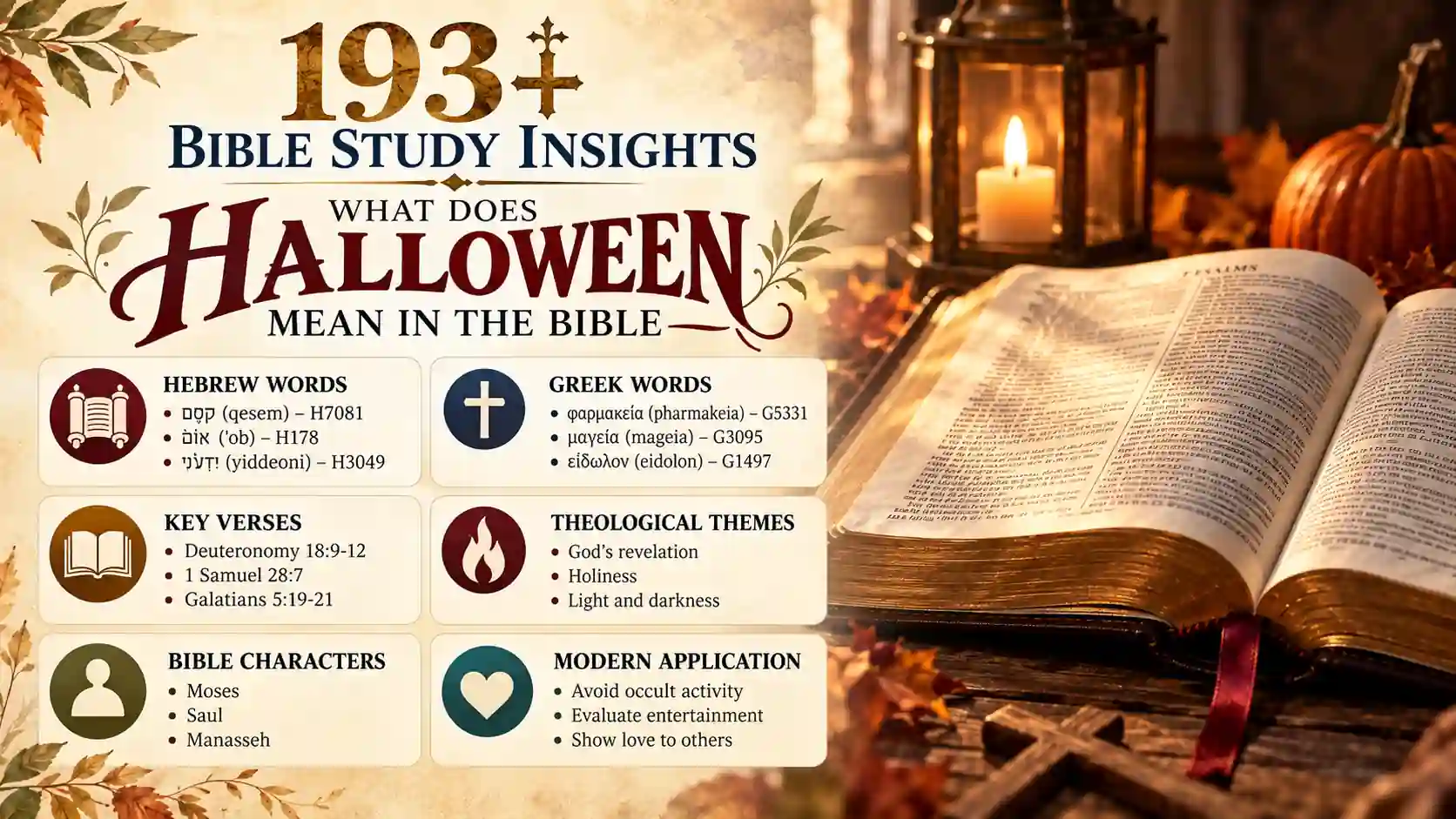
Halloween Bible Study Questions
Does the Hebrew word קֶסֶם (qesem) actually mean Halloween?
No. Qesem means divination and describes a forbidden practice, while Halloween has no Hebrew biblical equivalent.
Does φαρμακεία (pharmakeia) in Galatians 5:20 mean modern medicine or Halloween?
Neither. In its Galatians context, pharmakeia refers to sorcery or magical practice.
Why do KJV passages say “wizard” where modern translations may say “spiritist”?
The underlying יִדְּעֹנִי (yiddeoni, H3049) concerns a person associated with occult or spirit consultation, while English terminology has changed over time.
Does 1 Samuel 28 prove that every Halloween activity involves communicating with spirits?
No. The passage specifically describes Saul deliberately consulting a medium and cannot automatically be applied to unrelated cultural activities.
How should you decide whether to participate in Halloween activities?
Reject practices Scripture clearly condemns, then apply holiness, conscience, love, discernment, and God’s glory to activities Scripture does not directly address.