
What does 8 mean in the Bible? Scripture never gives one universal definition stating that the number eight always symbolizes a single spiritual truth. Yet eight and the eighth day repeatedly appear at significant moments involving covenant, consecration, worship, judgment, and fresh beginnings.
As you study these passages, the strongest approach is to begin with what each text actually says. Biblical patterns can deepen your understanding, but they should arise from Scripture itself rather than later systems of number symbolism. The clearest examples center on circumcision, priestly ministry, Noah’s family, and events following a completed seven-day period.
Key Scripture References for 8
| Verse | Passage Snippet | Context |
|---|---|---|
| Genesis 17:12 | Circumcision on the eighth day | Abrahamic covenant sign |
| Leviticus 9:1 | On the eighth day | Aaron begins priestly ministry |
| Leviticus 12:3 | Eighth-day circumcision | Israel’s covenant law |
| Leviticus 23:36 | Eighth-day holy assembly | Feast of Booths |
| 1 Samuel 17:12 | Jesse had eight sons | David’s family background |
| Luke 2:21 | Eight days completed | Jesus is circumcised and named |
| John 20:26 | Eight days later | Jesus appears to Thomas |
| Philippians 3:5 | Circumcised the eighth day | Paul’s Jewish credentials |
| 1 Peter 3:20 | Eight persons saved | Noah’s household in the ark |
| Revelation 17:11 | The beast is an eighth | Apocalyptic symbolism |
These passages show why no single formula should control your interpretation. Eight appears in legal, historical, Gospel, epistolary, and apocalyptic contexts, and each setting contributes something different.
Bible Translation Comparison for 8
| Verse | KJV | NIV | ESV | NASB |
|---|---|---|---|---|
| Genesis 17:12 | eight days old | eight days old | eight days old | eight days old |
| Leviticus 9:1 | eighth day | eighth day | eighth day | eighth day |
| Leviticus 12:3 | eighth day | eighth day | eighth day | eighth day |
| Leviticus 23:36 | eighth day | eighth day | eighth day | eighth day |
| Luke 2:21 | eight days | eighth day | eight days | eight days |
| John 20:26 | eight days | week later | eight days | eight days |
| Philippians 3:5 | eighth day | eighth day | eighth day | eighth day |
| 1 Peter 3:20 | eight souls | eight in all | eight persons | eight persons |
| 2 Peter 2:5 | Noah the eighth person | Noah and seven others | Noah with seven others | Noah with seven others |
John 20:26 especially shows how translation philosophy affects wording. Greek uses ὀκτώ, oktō, literally “eight,” while some translations communicate the idiom as approximately a week later. Likewise, 2 Peter 2:5 shows that the older expression “eighth person” means Noah together with seven others, not that Noah occupied a mysterious numerical rank.
People and Characters Associated with 8
| Person | Role | Connection |
|---|---|---|
| Abraham | Covenant patriarch | Receives eighth-day circumcision command |
| Isaac | Promised son | Circumcised at eight days old |
| Moses | Covenant mediator | Oversees Aaron’s eighth-day inauguration |
| Aaron | High priest | Begins public ministry on eighth day |
| David | Israel’s king | Youngest among Jesse’s eight sons |
| Jesus | Messiah | Circumcised when eight days were completed |
| Thomas | Apostle | Encounters risen Christ eight days later |
| Paul | Apostle | Cites eighth-day circumcision |
| Noah | Ark builder | One of eight persons preserved |
| Peter | Apostle | Uses Noah’s eight-person household in teaching |
These individuals connect eight with several major biblical eras. The pattern stretches from the patriarchs through Israel’s priesthood and monarchy into the life of Christ and apostolic teaching.
Original Hebrew and Greek Words Behind 8
| Original Word | Transliteration | Strong’s # | Literal Meaning |
|---|---|---|---|
| שְׁמֹנֶה | shemoneh | H8083 | eight |
| שְׁמֹנָה | shemonah | H8083 | eight, feminine form |
| שְׁמִינִי | shemini | H8066 | eighth |
| שְׁמִינִית | sheminith | H8067 | eighth, musical term |
| בְּרִית | berit | H1285 | covenant |
| ὀκτώ | oktō | G3638 | eight |
| ὄγδοος | ogdoos | G3590 | eighth |
| ὀκταήμερος | oktaēmeros | G3637 | eight days old |
| περιτομή | peritomē | G4061 | circumcision |
| διαθήκη | diathēkē | G1242 | covenant, testament |
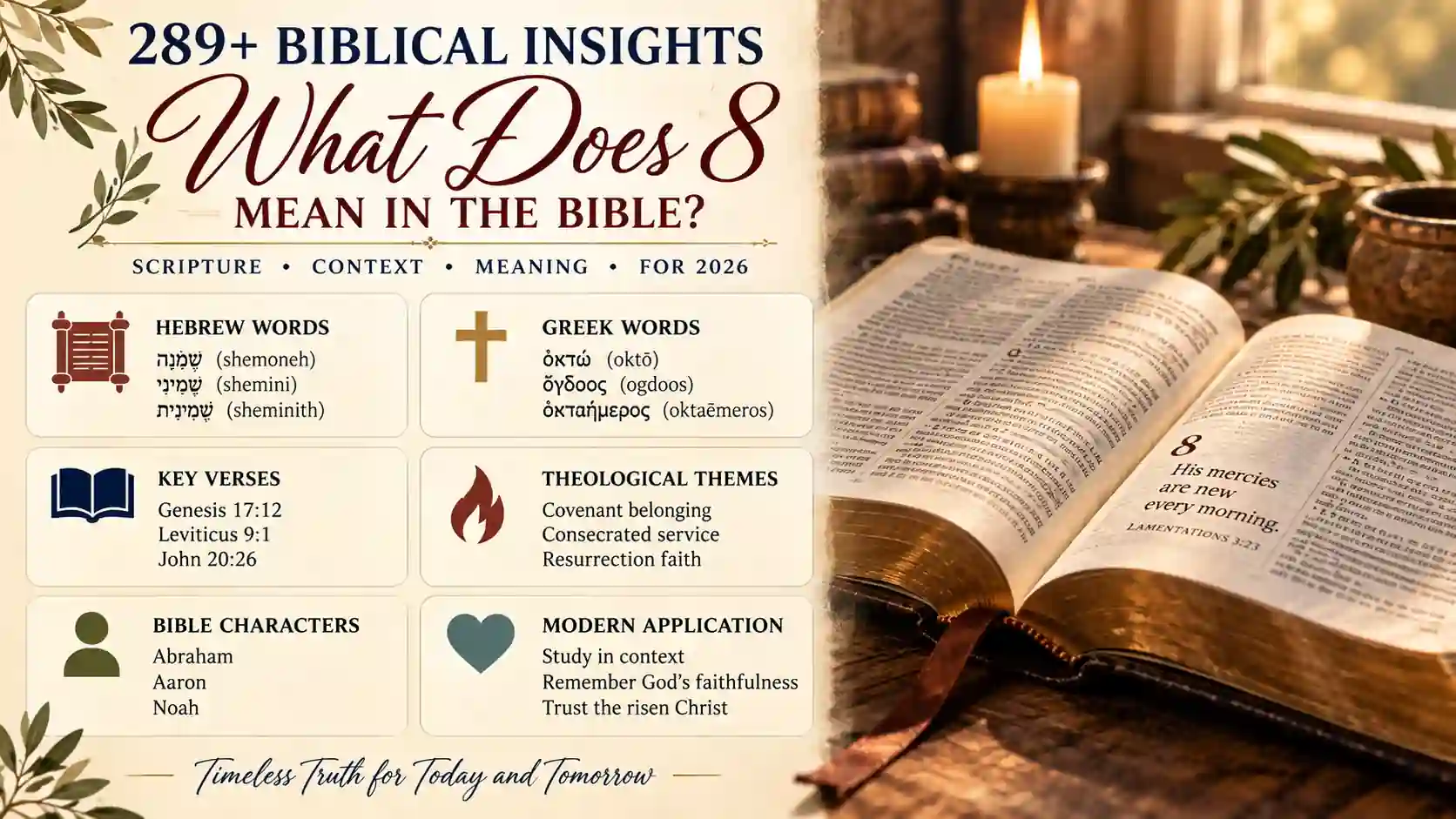
The basic Hebrew cardinal number is שְׁמֹנֶה, shemoneh, Strong’s H8083, while שְׁמִינִי, shemini, H8066, is the ordinary ordinal meaning “eighth.” The related שְׁמִינִית, sheminith, H8067, appears in musical settings such as 1 Chronicles 15:21 and the headings of Psalms 6 and 12.
In Greek, ὀκτώ, oktō, G3638, means “eight,” and ὄγδοος, ogdoos, G3590, means “eighth.” Philippians 3:5 contains the specialized adjective ὀκταήμερος, oktaēmeros, G3637, describing someone connected with the eighth day, specifically Paul’s circumcision.
Related Biblical Concepts Connected with 8
| Concept | Connection | Supporting Verse |
|---|---|---|
| Covenant | Circumcision performed on eighth day | Genesis 17:12 |
| Consecration | Priestly service begins after seven days | Leviticus 9:1 |
| Purification | Circumcision follows birth period | Leviticus 12:3 |
| Holy assembly | Festival includes an eighth-day gathering | Leviticus 23:36 |
| Worship | Sheminith appears in musical directions | Psalm 6 title |
| Preservation | Eight survive the flood | 1 Peter 3:20 |
| Resurrection | Christ appears after another week | John 20:26 |
| Jewish identity | Paul cites eighth-day circumcision | Philippians 3:5 |
| Judgment | Eight are preserved amid flood judgment | Genesis 7:13 |
| Apocalyptic rule | An “eighth” appears in John’s vision | Revelation 17:11 |
The most defensible connections are those Scripture explicitly makes. Covenant, circumcision, priestly inauguration, festival worship, and Noah’s household all involve eight directly rather than through speculative arithmetic.
Historical and Cultural Context of 8
| Aspect | Detail | Biblical Source |
|---|---|---|
| Patriarchal covenant | Boys circumcised at eight days | Genesis 17:12 |
| Isaac’s infancy | Abraham obeys the covenant command | Genesis 21:4 |
| Priestly consecration | Aaron completes seven-day preparation | Leviticus 8:33 |
| Priestly inauguration | Service begins on day eight | Leviticus 9:1 |
| Israelite purification | Circumcision follows childbirth | Leviticus 12:3 |
| Festival calendar | Eighth day closes sacred observance | Leviticus 23:36 |
| Temple music | Sheminith directs musicians | 1 Chronicles 15:21 |
| Jewish family practice | Jesus receives covenant circumcision | Luke 2:21 |
| Apostolic Judaism | Paul recalls eighth-day circumcision | Philippians 3:5 |
| Flood tradition | Eight survivors remembered | 1 Peter 3:20 |
Eighth-day circumcision was rooted in God’s covenant with Abraham and later incorporated into Israel’s law. Acts 7:8 even describes God’s arrangement with Abraham as the “covenant of circumcision,” linking the rite to covenant identity rather than to an independent mystical property of the number itself. The Greek terms διαθήκη, diathēkē, and περιτομή, peritomē, carry those ideas into New Testament discussion.
Theological Themes Associated with 8
| Theme | Explanation | Scripture |
|---|---|---|
| Covenant belonging | Eighth-day circumcision marks covenant membership | Genesis 17:12 |
| Obedience | Abraham performs the rite as commanded | Genesis 21:4 |
| Consecrated service | Aaron moves from preparation to ministry | Leviticus 9:1 |
| Sacred worship | An eighth-day assembly concludes the feast | Leviticus 23:36 |
| Divine preservation | God preserves eight through the flood | 1 Peter 3:20 |
| Grace over pedigree | Paul refuses confidence in religious credentials | Philippians 3:5-9 |
| Resurrection faith | Thomas meets the risen Jesus | John 20:26-29 |
| Fulfillment | Jesus enters Israel’s covenant life | Luke 2:21 |
| Judgment and mystery | Revelation uses “eighth” apocalyptically | Revelation 17:11 |
| Careful interpretation | Context governs numerical meaning | 2 Peter 2:5 |
A recurring transition from seven days to an eighth can naturally suggest movement beyond a completed period. That observation helps explain why later Christian theology often associated an “eighth day” with resurrection and new creation, but the Bible itself never gives a rule saying, “Eight means new beginnings.”
That distinction matters. A theological pattern can be meaningful without becoming a secret code through which every occurrence of eight must be interpreted.
Modern Application for Believers Studying 8
| Area | Practice | Scripture |
|---|---|---|
| Bible study | Read each occurrence in context | Nehemiah 8:8 |
| Covenant | Remember God’s faithfulness | Genesis 17:7 |
| Obedience | Respond carefully to God’s commands | Genesis 21:4 |
| Worship | Approach service with reverence | Leviticus 9:1-6 |
| Identity | Do not trust religious pedigree | Philippians 3:5-9 |
| Salvation | Remember God’s preservation of Noah | 1 Peter 3:20 |
| Baptism | Study Peter’s flood comparison carefully | 1 Peter 3:20-21 |
| Resurrection | Trust the risen Christ | John 20:26-29 |
| Discernment | Avoid superstitious number systems | Deuteronomy 18:10-12 |
| Hope | Look toward God’s final renewal | Revelation 21:1-5 |
Your application should grow from the theological message of each passage rather than from treating eight as a formula. Genesis 17 calls you toward covenant faithfulness, Leviticus emphasizes holy service, 1 Peter magnifies God’s saving action, and John 20 directs your faith toward the risen Christ.
שְׁמִינִי Shemini and the Eighth Day in Israel’s Covenant Life
The Hebrew שְׁמִינִי, shemini, simply means “eighth.” Yet several important Torah passages place major acts on an eighth day. Genesis 17:12 requires circumcision at eight days, and Leviticus 12:3 repeats that requirement. Circumcision therefore gives eight its strongest explicit covenant association in Scripture.
Leviticus 9 provides another striking example. Aaron and his sons had undergone seven days of consecration, and “on the eighth day” Aaron entered a new stage of public priestly service. The text presents a movement from preparation into ministry, which explains why interpreters often associate the eighth day with transition or inauguration.
What Does 8 Mean in the Bible When Seven Days Have Been Completed?
Several biblical occurrences of eight follow a completed seven-day period. Priestly consecration lasted seven days before Aaron’s eighth-day ministry. The Feast of Booths also involved seven days followed by a sacred gathering on the eighth day. These structures make transition after completion a reasonable biblical observation.
Still, you should distinguish observation from definition. Scripture never teaches that seven invariably means completion and therefore eight invariably means new beginnings. The safest conclusion is narrower. In several significant texts, the eighth day marks what follows a completed period and introduces another covenantal, liturgical, or ministerial stage.
ὀκτώ Oktō from Noah’s Eight Survivors to the Risen Christ
First Peter 3:20 uses the Greek ὀκτώ, oktō, when Peter says that eight persons were preserved through the flood. Those eight were Noah, his wife, their three sons, and their wives. Peter’s point is not numerological speculation. He is developing a theological comparison involving judgment, salvation, water, and baptism.
John 20:26 also uses ὀκτώ in describing Jesus’ later appearance to the disciples when Thomas was present. Christians have historically connected resurrection with the concept of an eighth day because Jesus rose on the first day of the week, the day after the Sabbath. Yet John 20:26 itself emphasizes the risen Christ and Thomas’s movement from doubt to confession.
Why Eight Should Point You Toward Scripture Rather than Numerology
Biblical numbers can participate in literary patterns, but Scripture does not invite you to turn them into a hidden dictionary. Revelation 17:11 provides a useful warning. Its mysterious “eighth” belongs to an apocalyptic vision involving seven kings, the beast, and judgment. That usage cannot simply be replaced with the idea of “new beginnings.”
Paul offers another safeguard in Philippians 3:5. His ὀκταήμερος, oktaēmeros, eighth-day circumcision was a genuine covenant credential, yet he refused to place saving confidence in that religious status. Your study of eight should ultimately lead beyond fascination with numbers toward God’s covenant faithfulness, Christ’s resurrection, obedient worship, and grace.
Frequently Asked Questions About 8 in the Bible
Does the Hebrew word שְׁמִינִי, shemini, mean “new beginning”?
No. שְׁמִינִי, shemini, Strong’s H8066, literally means “eighth,” while ideas such as transition or fresh beginning come from particular biblical contexts rather than the dictionary meaning.
Why did God command circumcision on the eighth day in Genesis 17:12?
Genesis connects the eighth-day rite with God’s covenant with Abraham, but Scripture does not explicitly explain why God selected that particular day.
Does 1 Peter 3:20 teach that eight is automatically the number of salvation?
No. Peter states that eight persons survived the flood and uses the event in his teaching about salvation and baptism, without establishing eight as a universal numerical code.
Why does 2 Peter 2:5 call Noah “the eighth person” in the KJV?
The Greek ὄγδοος, ogdoos, can describe Noah as one of eight, so modern translations commonly clarify the sense as Noah together with seven others.
Can you biblically say that 8 represents resurrection and new creation?
You can describe that as a theological pattern associated with the first day after the seven-day week, but Scripture never directly defines the number eight itself as meaning resurrection or new creation.