
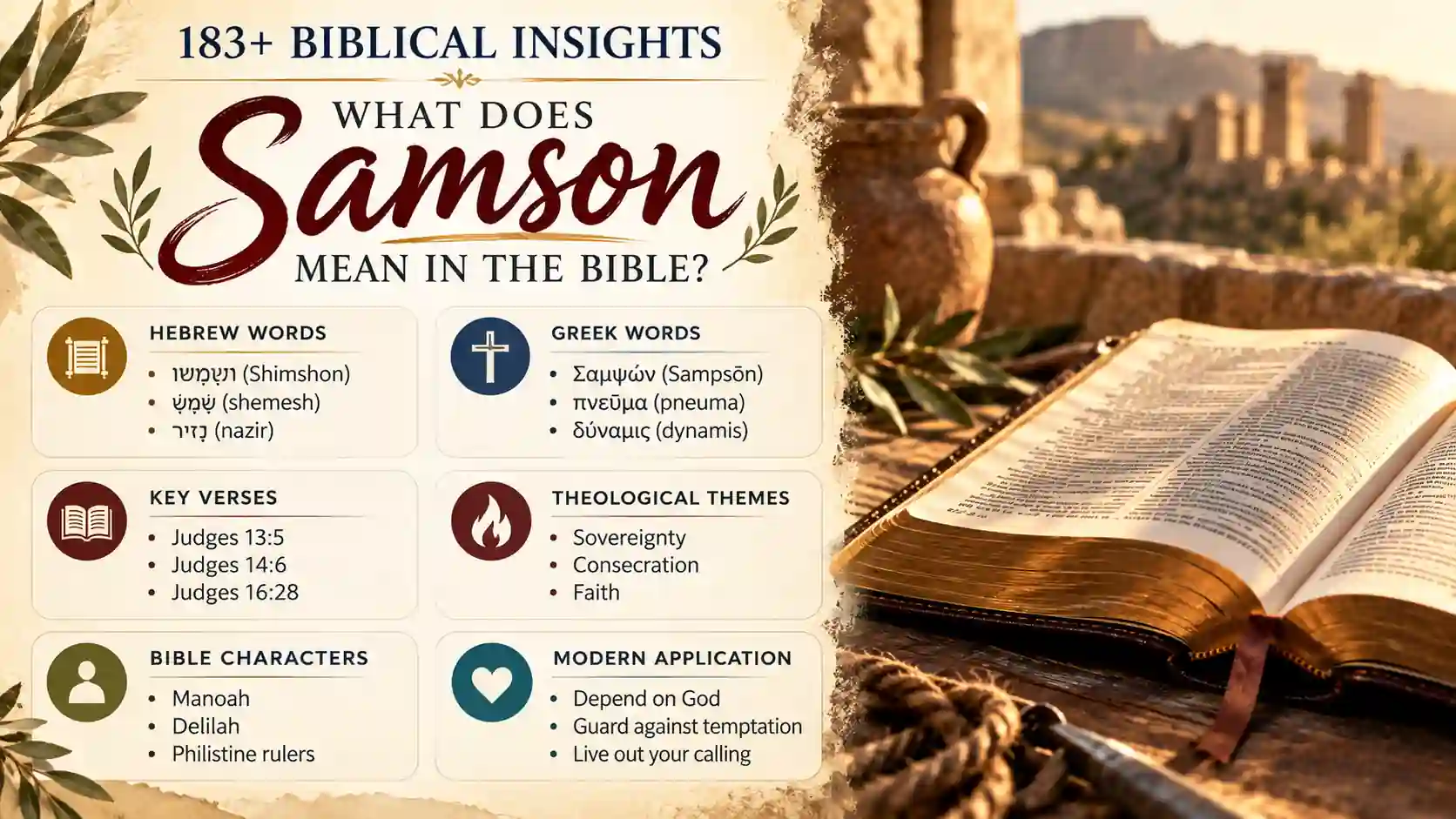
What does Samson mean in the Bible? Samson is the famous judge of Israel whose extraordinary strength, Nazirite calling, personal failures, and final act of faith are recorded primarily in Judges 13 through 16. His Hebrew name, שִׁמְשׁוֹן, Shimshon, is Strong’s H8123 and is commonly connected with שֶׁמֶשׁ, shemesh, meaning “sun.”
Yet Scripture presents Samson as far more than a strong man. His story reveals God’s sovereign purpose, the seriousness of consecration, the danger of uncontrolled desire, and the surprising way divine mercy can work through deeply imperfect servants.
Key Scripture References for Samson
| Verse | Passage Snippet | Context |
|---|---|---|
| Judges 13:1 | Israel given to Philistines | Samson enters an age of oppression |
| Judges 13:5 | “Nazirite unto God” | His consecration begins before birth |
| Judges 13:24 | His name was Samson | Samson is born to Manoah’s wife |
| Judges 13:25 | Spirit begins stirring him | God prepares him for his calling |
| Judges 14:6 | Spirit comes mightily | Samson kills a lion |
| Judges 15:14 | Cords fall from his arms | Divine strength empowers deliverance |
| Judges 16:20 | LORD departed from him | His presumption reaches a crisis |
| Judges 16:28 | Samson calls to the LORD | He prays before his final act |
| Hebrews 11:32 | Samson named among faithful | New Testament remembers his faith |
Bible Translation Comparison for Samson
| Verse | KJV | NIV | ESV | NASB |
|---|---|---|---|---|
| Judges 13:5 | “Nazirite unto God” | “Nazirite, dedicated to God” | “Nazirite to God” | “Nazirite to God” |
| Judges 13:24 | “called his name Samson” | “named him Samson” | “called his name Samson” | “named him Samson” |
| Judges 13:25 | Spirit “move him” | Spirit “stir in him” | Spirit “stir him” | Spirit “stir him” |
| Judges 14:6 | Spirit came “mightily” | Spirit came “powerfully” | Spirit “rushed upon him” | Spirit came “upon him mightily” |
| Judges 15:14 | bonds “loosed” | bindings “dropped” | bonds “melted” | bonds “dropped” |
| Judges 16:20 | LORD “departed” | LORD “left” | LORD “left” | LORD “departed” |
| Judges 16:28 | “strengthen me” | “strengthen me” | “strengthen me” | “strengthen me” |
| Hebrews 11:32 | “Samson” | “Samson” | “Samson” | “Samson” |
People and Characters Associated with Samson
| Person | Role | Connection |
|---|---|---|
| Manoah | Samson’s father | Danite from Zorah |
| Manoah’s wife | Samson’s mother | Receives angelic birth announcement |
| Angel of the LORD | Divine messenger | Announces Samson’s calling |
| Philistine woman of Timnah | Samson’s wife | Marriage sparks conflict |
| Timnite companion | Wedding associate | Receives Samson’s wife |
| Delilah | Woman of Sorek | Pressures Samson for his secret |
| Philistine rulers | Israel’s oppressors | Pay Delilah to betray Samson |
| Judahite men | Fellow Israelites | Bind Samson for the Philistines |
| Dagon worshipers | Philistine assembly | Present at Samson’s death |
Original Hebrew and Greek Words Connected with Samson
| Original Word | Transliteration | Strong’s # | Literal Meaning |
|---|---|---|---|
| שִׁמְשׁוֹן | Shimshon | H8123 | Samson, personal name |
| שֶׁמֶשׁ | shemesh | H8121 | Sun |
| נָזִיר | nazir | H5139 | Consecrated, separated one |
| רוּחַ | ruach | H7307 | Spirit, wind, breath |
| כֹּחַ | koach | H3581 | Strength, power |
| יְהוָה | YHWH | H3068 | The LORD |
| פְּלִשְׁתִּי | Pelishti | H6430 | Philistine |
| שָׁפַט | shaphat | H8199 | Judge, govern |
| Σαμψών | Sampsōn | G4546 | Samson |
The precise etymology of שִׁמְשׁוֹן, Shimshon, is not explicitly explained by the biblical narrator. Its traditional association with שֶׁמֶשׁ, shemesh, “sun,” has led to suggested senses such as “sunlike” or “little sun,” but these should be treated as etymological proposals rather than an inspired definition supplied by Judges.
Related Biblical Concepts in Samson’S Story
| Concept | Connection | Supporting Verse |
|---|---|---|
| Nazirite consecration | Samson is set apart before birth | Judges 13:5 |
| Divine calling | God appoints his purpose early | Judges 13:5 |
| Spirit empowerment | Strength accompanies God’s Spirit | Judges 14:6 |
| Deliverance | He begins rescuing Israel | Judges 13:5 |
| Human weakness | Desire repeatedly compromises him | Judges 14:1-3 |
| Prayer | Samson eventually appeals to God | Judges 16:28 |
| Judgment | Philistine oppression reflects Israel’s sin | Judges 13:1 |
| Faith | Hebrews remembers Samson among believers | Hebrews 11:32 |
| Sovereignty | God works amid human disorder | Judges 14:4 |
Historical and Cultural Context of Samson
| Aspect | Detail | Biblical Source |
|---|---|---|
| Era | Period of Israel’s judges | Judges 13-16 |
| Tribe | Samson belongs to Dan | Judges 13:2 |
| Home | Zorah in Danite territory | Judges 13:2 |
| Nearby town | Eshtaol | Judges 13:25 |
| Oppressors | Philistines dominate Israel | Judges 13:1 |
| Duration | Oppression lasts forty years | Judges 13:1 |
| Nazirite sign | Hair must remain uncut | Judges 13:5 |
| Marriage custom | Wedding feast lasts several days | Judges 14:10-17 |
| Philistine religion | Dagon honored as their god | Judges 16:23 |
Theological Themes Revealed Through Samson
| Theme | Explanation | Scripture |
|---|---|---|
| Sovereignty | God advances his purpose through flawed people | Judges 14:4 |
| Grace | Samson’s calling begins with God | Judges 13:3-5 |
| Consecration | His life is claimed for divine service | Judges 13:5 |
| Holy Spirit | True power ultimately comes from God | Judges 14:6 |
| Human sin | Giftedness does not remove moral danger | Judges 16:1 |
| Discipline | Persistent compromise brings consequences | Judges 16:20-21 |
| Prayer | Samson returns to dependence on God | Judges 16:28 |
| Deliverance | His mission concerns Israel’s oppression | Judges 13:5 |
| Faith | His imperfect life still contains genuine faith | Hebrews 11:32 |
Modern Application for Believers from Samson
| Area | Practice | Scripture |
|---|---|---|
| Calling | Treat God’s gifts as stewardship | Judges 13:5 |
| Dependence | Look to God rather than natural ability | Judges 14:6 |
| Temptation | Do not repeatedly entertain compromise | Judges 16:6-17 |
| Relationships | Let covenant faithfulness guide desire | Judges 14:3 |
| Humility | Never confuse gifting with invulnerability | Judges 16:20 |
| Prayer | Call upon God in weakness | Judges 16:28 |
| Repentance | Return to God after failure | Judges 16:28 |
| Service | Use strength for God’s purposes | Judges 15:14-15 |
| Faith | Trust God despite personal weakness | Hebrews 11:32-34 |
What Does Samson Mean in the Bible Through שִׁמְשׁוֹן, Shimshon?
The biblical name Samson is שִׁמְשׁוֹן, Shimshon, Strong’s H8123. Scholars commonly associate it with שֶׁמֶשׁ, shemesh, Strong’s H8121, the ordinary Hebrew word for “sun.” This association explains why meanings such as “sunlike,” “little sun,” or a name related to sunlight often appear in biblical reference works.
You should distinguish that possible word origin from the theological meaning of Samson’s life. Judges 13:24 simply tells you that his mother gave birth and named him Samson. The text does not pause to interpret his name in the way Scripture explicitly explains names such as Isaac or Samuel.
Samson’S Nazirite Calling and Israel’S Philistine Crisis
Samson’s significance becomes clearer when you begin with Judges 13 rather than his famous feats of strength. Israel has again done evil, and the LORD gives them into Philistine hands for forty years. Into this situation, God promises a child to the previously childless wife of Manoah.
The angel declares that the child will be a נָזִיר, nazir, “one separated” or “consecrated” to God. Numbers 6 provides the broader Nazirite background, while Samson’s calling is unusual because it begins before his birth. Judges 13:5 also states his mission carefully. He will “begin” to deliver Israel from the Philistines, not complete that deliverance by himself.
רוּחַ יהוה, The Spirit of the Lord, Explains Samson’S Strength
Popular retellings can make Samson’s hair sound like a magical source of physical power. Judges gives a deeper explanation. Again and again, Samson performs extraordinary acts when רוּחַ יְהוָה, ruach YHWH, the Spirit of the LORD, comes powerfully upon him.
Judges 14:6 connects the Spirit with the killing of the lion. Judges 14:19 and 15:14 likewise connect extraordinary strength with divine empowerment. His uncut hair mattered because it represented his Nazirite consecration. The tragedy of Judges 16 is therefore not merely that his hair was cut, but that Samson treated his sacred calling with increasing presumption.
Weakness, Prayer, and Samson in Hebrews 11
Samson is one of Scripture’s deliberately uncomfortable heroes. He is genuinely called by God and genuinely empowered, yet he is impulsive, sexually vulnerable, vengeful, and frequently driven by personal desire. His story prevents you from equating spiritual gifting with mature character.
His final scene also prevents you from reducing his life to failure. Blinded and imprisoned, Samson finally prays, “O Lord GOD, remember me” in Judges 16:28. Hebrews 11:32 later includes Σαμψών, Sampsōn, Strong’s G4546, among people remembered in a chapter devoted to faith. Scripture neither conceals his sins nor denies that God worked through his faith.
Frequently Asked Questions About Samson
Does שִׁמְשׁוֹן, Shimshon, literally mean “sunshine” in Hebrew?
It is commonly associated with שֶׁמֶשׁ, shemesh, “sun,” but Scripture itself does not provide an explicit etymological definition of Samson’s name.
Was Samson’s strength actually stored in his hair according to Judges 16?
No. His hair represented his Nazirite consecration, while Judges repeatedly identifies the Spirit of the LORD as the source of his extraordinary empowerment.
Why does Judges 13:5 say Samson would only “begin” to deliver Israel?
His victories weakened Philistine domination, but Israel’s struggle with the Philistines continued beyond Samson into the days of Samuel, Saul, and David.
How can Hebrews 11:32 mention Samson after the serious sins recorded in Judges?
Hebrews recognizes genuine faith in Samson without presenting every action of his life as righteous or worthy of imitation.
What should you learn from Samson’s prayer in Judges 16:28?
His final dependence on God shows that human strength is insufficient and that even a severely compromised servant must ultimately appeal to the LORD for power.