
When Scripture calls something profane, it is not talking about bad manners or rough language alone. The phrase what does profane mean in the bible opens a much older and weightier idea, the treating of what is holy as if it were ordinary.
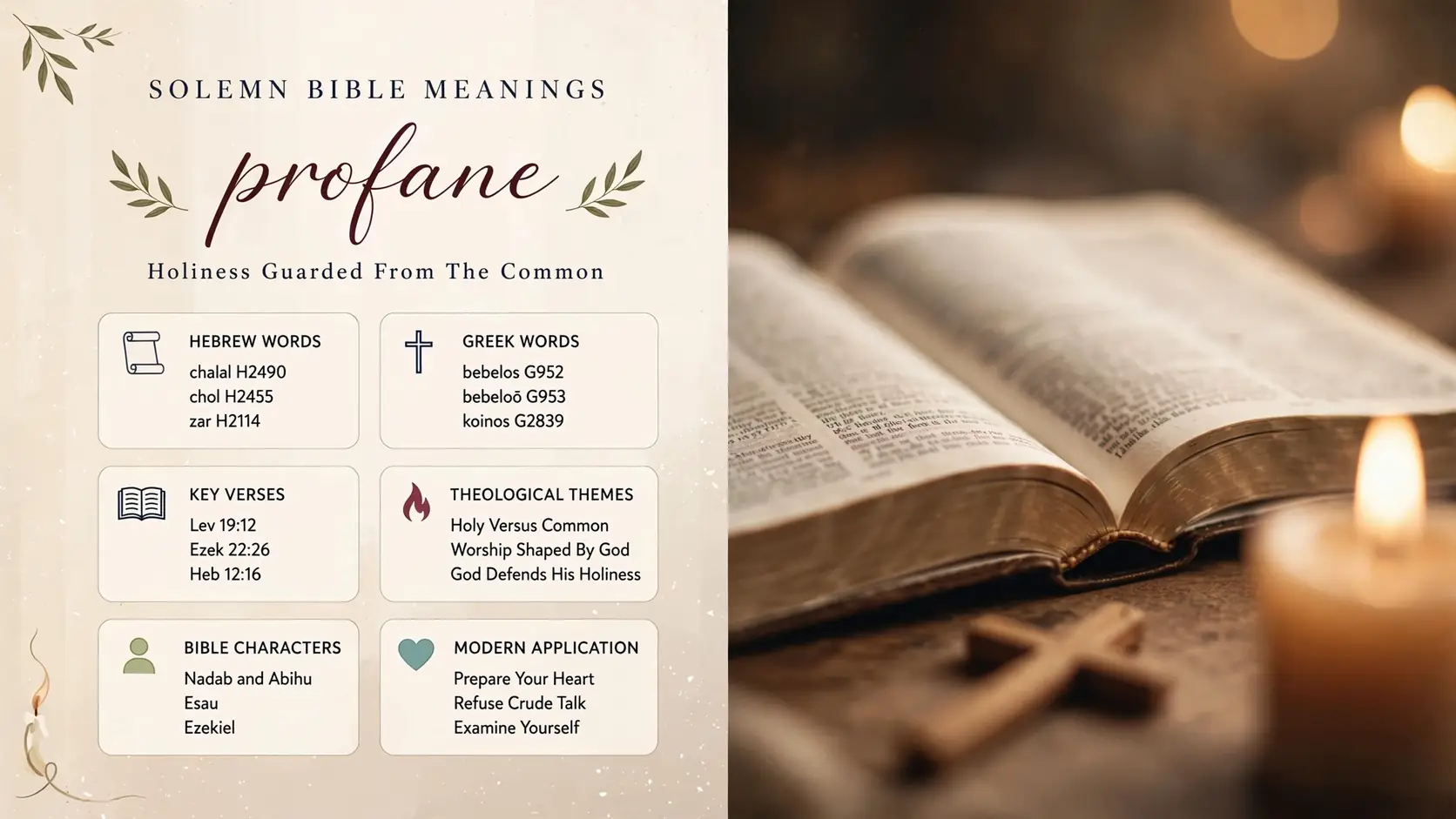
In the Old Testament the Hebrew root chalal pictures a sacred thing being pierced or emptied of its set apart status. In the New Testament the Greek word bebelos describes ground anyone can walk on, ground no longer fenced off for God.
Key Scripture References on Profane in the Bible
| Verse | Passage Snippet | Context |
|---|---|---|
| Lev 10:1 | Nadab and Abihu offered unauthorized fire | God consumed them for profaning His presence |
| Lev 19:12 | You shall not profane the name of your God | False oaths drag God’s holy name into lies |
| Lev 21:6 | Priests must not profane God’s holy name | Purity laws guard those who serve at the altar |
| Ezek 22:26 | Her priests have profaned My holy things | They erased the line between holy and common |
| Ezek 44:23 | Teach the difference between holy and profane | Restored priests must recover the lost distinction |
| Matt 12:5 | Priests in the temple profane the Sabbath | Temple service frees them from any guilt |
| 1 Tim 4:7 | Refuse profane and old wives’ fables | Train yourself instead for true godliness |
| Heb 12:16 | Esau, a profane person, sold his birthright | He traded eternal blessing for a single meal |
Bible Translation Comparison of Profane
| Verse | KJV | NIV | ESV | NASB |
|---|---|---|---|---|
| Lev 19:12 | Neither shalt thou profane the name of thy God | Do not profane the name of your God | You shall not profane the name of your God | You shall not profane the name of your God |
| Ezek 22:26 | Have profaned mine holy things | Desecrate my holy things | Have profaned my holy things | Have profaned My holy things |
| Ezek 44:23 | Difference between the holy and profane | Difference between the holy and the common | Distinction between the holy and the common | Distinction between the holy and the profane |
| Matt 12:5 | Profane the sabbath, and are blameless | Desecrate the Sabbath yet are innocent | Profane the Sabbath and are guiltless | Profane the Sabbath and are innocent |
| 1 Tim 4:7 | Refuse profane and old wives’ fables | Have nothing to do with godless myths | Have nothing to do with irreverent, silly myths | Have nothing to do with worldly fables fit only for old women |
| 2 Tim 2:16 | Shun profane and vain babblings | Avoid godless chatter | Avoid irreverent babble | Avoid worldly and empty chatter |
| 1 Tim 1:9 | For the unholy and profane | For the irreligious and for sinners | For the ungodly and sinners | For the unholy and profane |
| Heb 12:16 | Lest there be any fornicator, or profane person, as Esau | No one is sexually immoral, or is godless like Esau | No one is sexually immoral or unholy like Esau | No sexually immoral or godless person like Esau |
People and Characters Associated with Profane
| Person | Role | Connection |
|---|---|---|
| Nadab | Aaron’s eldest son | Offered unauthorized fire before the Lord |
| Abihu | Aaron’s second son | Shared his brother’s fatal profaning act |
| Hophni | Priest, Eli’s son | Treated the Lord’s offerings with open contempt |
| Esau | Son of Isaac | Called profane for selling his birthright |
| Belshazzar | King of Babylon | Drank wine from the temple’s holy vessels |
| Antiochus Epiphanes | Seleucid king | Set a desolating sacrilege upon the altar |
| Ezekiel | Priest and prophet | Denounced priests who blurred holy and common |
| Paul | Apostle to the Gentiles | Warned Timothy to reject profane empty talk |
Original Hebrew and Greek Words for Profane
| Original Word | Transliteration | Strong’s # | Literal Meaning |
|---|---|---|---|
| חָלַל | chalal | H2490 | To pierce, pollute, make common |
| חֹל | chol | H2455 | Common, profane, open to all |
| זָר | zar | H2114 | Strange, foreign, unauthorized |
| טָמֵא | tame | H2930 | Unclean, defiled, impure |
| בָּזָה | bazah | H959 | To despise, hold in contempt |
| βέβηλος | bebelos | G952 | Trodden ground, unhallowed, common |
| βεβηλόω | bebeloō | G953 | To profane, desecrate, treat as common |
| κοινός | koinos | G2839 | Common, shared, ceremonially unclean |
| μιαίνω | miainō | G3392 | To stain, defile, pollute morally |
Related Biblical Concepts to Profane
| Concept | Connection | Supporting Verse |
|---|---|---|
| Holiness | The exact opposite of the profane | Lev 11:44 |
| Holy versus common | The core divide that profaning erases | Ezek 44:23 |
| Defilement | The stain that profaning leaves behind | Lev 21:6 |
| Taking God’s name in vain | Profaning God with our own words | Exod 20:7 |
| Desecration | Profaning holy objects and holy places | Dan 5:3 |
| Irreverent talk | The New Testament form of profaning | 1 Tim 4:7 |
| Sanctification | God reversing what we have profaned | 1 Thess 4:3 |
| Reverence | The guard that keeps holy things holy | Heb 12:28 |
| ## Historical and Cultural Context of Profane |
| Aspect | Detail | Biblical Source |
|---|---|---|
| Tabernacle zones | Curtains divided the holy from the most holy | Exod 26:33 |
| Aaronic priesthood | Only Aaron’s sons were allowed to serve | Lev 8:2 |
| Holy offerings | Sacred portions were eaten only by priests | Lev 6:26 |
| Sabbath keeping | Gathering sticks on Sabbath brought death | Num 15:35 |
| Temple courts | Gentiles were barred from the inner courts | Acts 21:28 |
| Antiochus desecration | A pagan altar was set up in 167 BC | Dan 11:31 |
| Synagogue reading | The people stood to honor the Scripture | Neh 8:5 |
| Corinthian communion | Unworthy eating brought God’s judgment | 1 Cor 11:30 |
Theological Themes of Profane
| Theme | Explanation | Scripture |
|---|---|---|
| God’s jealousy for His name | He will not share His glory with another | Ezek 39:7 |
| Holy versus common | Priests must teach the clear distinction | Ezek 22:26 |
| Worship shaped by God | Nadab’s fire was invented by man | Lev 10:3 |
| Sin spreads like gangrene | Profane talk corrupts whole churches | 2 Tim 2:17 |
| Birthrights have weight | Esau traded eternity for one meal | Heb 12:16 |
| Speech reveals the heart | Empty chatter leads to deeper ungodliness | 1 Tim 6:20 |
| God defends His holiness | Uzzah died for touching the ark | 2 Sam 6:7 |
| Repentance restores | God re consecrates the humble heart | Joel 2:13 |
Modern Application for Believers on Profane
| Area | Practice | Scripture |
|---|---|---|
| Worship | Prepare your heart before the service begins | Ps 96:9 |
| Speech | Refuse crude jokes and godless talk | Eph 5:4 |
| Media | Turn from entertainment that mocks the holy | Phil 4:8 |
| Work | Do every task as direct service to Christ | Col 3:23 |
| Body | Honor God with your physical life | 1 Cor 6:20 |
| Rest | Keep one day set apart for the Lord | Exod 20:8 |
| Communion | Examine yourself before touching the bread | 1 Cor 11:28 |
| Family | Teach your children to revere God’s name | Deut 6:7 |
חָלַל Chalal: the Hebrew Root Behind Profane in the Old Testament
The Hebrew verb chalal, Strong’s H2490, paints a startling picture. At its root it means to pierce or to bore through, like a wound that lets the life drain out. When Moses warns Israel not to profane God’s name, he pictures holiness as something precious that careless hands can puncture and empty.
Its cousin chol, Strong’s H2455, names the sad result. Chol is ground anyone may walk on, food anyone may eat, a day like any other day. Ezekiel’s great charge against the priests is that they stopped teaching the difference between the holy and the chol, until the sanctuary looked no different from the marketplace.
What Does Profane Mean in the Bible for Your Daily Worship
For your worship, the word means treating God’s things as common things. Singing the hymns while your mind shops for groceries profanes the hour. Praying with flippant words profanes the Name you claim to honor. The question is never whether God dislikes your style, but whether your heart still registers the weight of His glory.
Leviticus shows that profaning is rarely dramatic. It happens in small surrenders, a vow quietly broken, an offering given grudgingly, a Sabbath edged with errands. Each one teaches your soul that the holy is negotiable. Guarding against it is simply the daily choice to keep first things first.
βέβηλος Bebelos: Why Paul Warns Timothy About Profane Talk
Paul’s favorite Greek word for profane is bebelos, Strong’s G952. It describes the ground outside the temple, the public square where anyone’s foot may tread. A bebelos person is one whose inner life has no fenced off holy ground left, no thought or appetite reserved for God alone.
That is why Paul pairs profane with empty talk in both letters to Timothy. Godless chatter seems harmless, but it trains the tongue to handle sacred truth like common gossip. Timothy’s defense was not louder argument but disciplined devotion, refusing the conversation that makes holy things cheap.
From Ezekiel’s Temple to Esau’s Birthright: the Covenant Cost of Profaning
Ezekiel watched priests who could no longer tell holy from common, and he named their failure as covenant breaking. When leaders treat God’s ordinances casually, the whole nation follows them into confusion. The prophet’s rebuke lands on every generation that edits worship to fit its mood.
Esau shows the personal cost in one sharp portrait. Hebrews calls him profane not for cursing God but for trading his birthright for a single meal. He weighed the eternal against the immediate and chose the bowl. Your birthright in Christ is heavier still, and the world is always offering a bowl.
Frequently Asked Questions About Profane in the Bible
What Hebrew word stands behind the Bible’s use of profane?
The root is chalal (H2490), to pierce or pollute, joined with chol (H2455), the common thing set against the holy.
Why did Nadab and Abihu die for offering strange fire?
They carried unauthorized fire into God’s presence, treating His holiness as something they could approach on their own terms.
How do Bible translations differ on the word profane?
The KJV keeps “profane” while the NIV often uses “desecrate,” “common,” or “godless,” as seen in Ezekiel 44:23 and 1 Timothy 4:7.
What does bebelos mean when Paul uses it in 1 Timothy 4:7?
It pictures public ground open to every foot, so Paul tells Timothy to refuse talk that handles holy truth like cheap gossip.
Can a believer today still profane God’s name?
Yes, through false oaths, flippant worship, and careless speech, which is why Jesus taught us to pray “hallowed be your name.”