
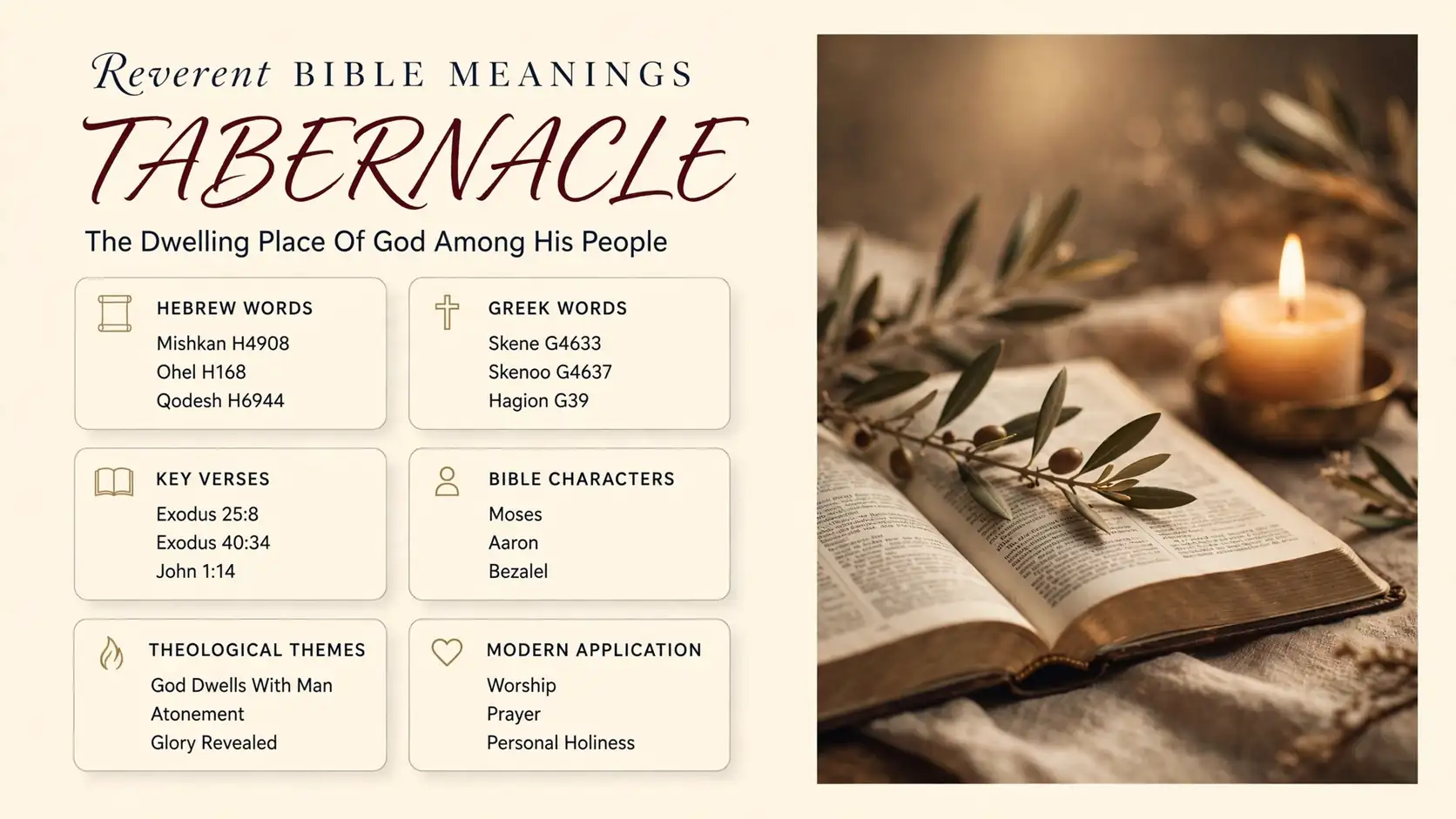
When you first ask what does tabernacle mean in the bible, you meet a God who chooses to dwell close to His people rather than remain distant. The tabernacle was the portable tent sanctuary where Israel worshiped in the wilderness, carrying the ark, the altars, and the visible sign of His holy presence.
Your study grows richer as you trace its Hebrew words, its careful design, and its path toward Christ, who is pictured as God dwelling among us in flesh. Every curtain, lamp, and offering pointed forward with quiet purpose and lasting hope for believers today in their walk.
Key Scripture References for Tabernacle
| Verse | Passage Snippet | Context |
|---|---|---|
| Exodus 25:8 | Let them make me a sanctuary that I may dwell among them | God commands the dwelling place |
| Exodus 25:9 | According to all that I show you make it | Pattern given on the mountain |
| Exodus 26:1 | Make the tabernacle with ten curtains of fine linen | Detailed construction begins here |
| Exodus 29:45 | I will dwell among the children of Israel | Covenant presence is promised |
| Exodus 40:34 | The glory of the Lord filled the tabernacle | Glory descends at its completion |
| Leviticus 26:11 | I will set my tabernacle among you | Blessing promised for obedience |
| Numbers 1:50 | Appoint the Levites over the tabernacle | Levites guard and carry it |
| Joshua 18:1 | They set up the tabernacle at Shiloh | Settlement in the promised land |
| John 1:14 | The Word became flesh and dwelt among us | Christ fulfills the old pattern |
Bible Translation Comparison for Tabernacle
| Verse | KJV | NIV | ESV | NASB |
|---|---|---|---|---|
| Exodus 25:8 | sanctuary that I may dwell | sanctuary so he can dwell | sanctuary that I may dwell | sanctuary that I may dwell |
| Exodus 29:45 | I will dwell among Israel | I will live among Israel | I will dwell among Israel | I will dwell among Israel |
| Exodus 40:34 | glory filled the tabernacle | glory filled the tabernacle | glory filled the tabernacle | glory filled the tabernacle |
| Leviticus 26:11 | I will set my tabernacle | I will put my dwelling place | I will make my dwelling | I will make my dwelling |
| Numbers 9:15 | cloud covered the tabernacle | cloud covered the tabernacle | cloud covered the tabernacle | cloud covered the tabernacle |
| Psalm 78:60 | forsook tabernacle of Shiloh | abandoned the tabernacle | he forsook his dwelling | he abandoned the tabernacle |
| Hebrews 9:2 | a tabernacle was prepared | a tabernacle was set up | a tent was prepared | a tabernacle was prepared |
| Revelation 21:3 | tabernacle of God is with men | dwelling place of God is with man | dwelling place of God is with man | tabernacle of God is among men |
People and Characters Associated with Tabernacle
| Person | Role | Connection |
|---|---|---|
| Moses | Leader and mediator | Received the pattern on Mount Sinai |
| Aaron | First high priest | Offered sacrifices and entered yearly |
| Bezalel | Chief craftsman | Filled with wisdom to build it |
| Oholiab | Assistant craftsman | Helped shape wood metal and cloth |
| The Levites | Porters and guards | Carried and guarded every holy part |
| Eleazar | Son of Aaron | Oversaw the oil lamps and vessels |
| Joshua | Successor to Moses | Present when it stood at Shiloh |
| Samuel | Young temple servant | Served before the ark at Shiloh |
| Jesus Christ | Son of God | True dwelling of God among men |
Original Hebrew and Greek Words for Tabernacle
| Original Word | Transliteration | Strong’s # | Literal Meaning |
|---|---|---|---|
| מִשְׁכָּן | mishkan | H4908 | dwelling place or abode |
| אֹהֶל | ohel | H168 | tent or covering |
| אֹהֶל מוֹעֵד | ohel moed | H168 and H4150 | tent of meeting |
| קֹדֶשׁ | qodesh | H6944 | holy place or sacred thing |
| כַּפֹּרֶת | kapporeth | H3727 | mercy seat or atonement cover |
| פָּרֹכֶת | paroketh | H6532 | veil or curtain of separation |
| מִזְבֵּחַ | mizbeach | H4196 | altar or place of slaughter |
| מְנֹרָה | menorah | H4501 | lampstand giving light |
| σκηνή | skene | G4633 | tent or tabernacle dwelling |
| σκηνόω | skenoo | G4637 | to pitch a tent or dwell |
Related Biblical Concepts for Tabernacle
| Concept | Connection | Supporting Verse |
|---|---|---|
| Divine Presence | God dwells in the midst of Israel | Exodus 29:45 |
| Glory of God | Cloud and glory fill the tent | Exodus 40:34 |
| Atonement | Blood is offered for the sins of people | Leviticus 16:15 |
| Priesthood | Priests mediate between God and Israel | Exodus 28:1 |
| Covenant | The ark holds the tablets of law | Deuteronomy 10:5 |
| Holiness | Sacred space is set apart from common use | Leviticus 10:10 |
| Sacrifice | Offerings are made at the bronze altar | Leviticus 1:9 |
| Heavenly Pattern | Earthly tent copies a heavenly reality | Hebrews 8:5 |
Historical and Cultural Context for Tabernacle
| Aspect | Detail | Biblical Source |
|---|---|---|
| Portable Design | Tent could be taken down and carried | Numbers 4:25 |
| Freewill Offerings | Israel gave gold cloth and skins willingly | Exodus 35:21 |
| Outer Court | Fence of linen surrounded the sacred area | Exodus 27:9 |
| Holy Place | Lamp table and altar of incense inside | Exodus 30:6 |
| Most Holy Place | Ark stood alone behind the thick veil | Exodus 26:33 |
| Cloud Guidance | Cloud lifted when Israel should journey | Numbers 9:17 |
| Sinai Origin | Pattern was shown during wilderness wandering | Exodus 25:9 |
| Shiloh Period | Tent rested at Shiloh for many years | Joshua 18:1 |
Theological Themes in Tabernacle
| Theme | Explanation | Scripture |
|---|---|---|
| God Dwells With Man | Heavenly God chooses nearness with His people | Exodus 25:8 |
| Holiness of God | Sinful people need a holy approach to God | Leviticus 19:2 |
| Mediation | Priests stand between God and the nation | Hebrews 5:1 |
| Atonement for Sin | Blood on the mercy seat covers guilt | Leviticus 16:15 |
| Covenant Presence | God walks with the people He redeemed | Leviticus 26:12 |
| Glory Revealed | His glory is seen in cloud and fire | Exodus 40:38 |
| Shadow of Christ | Tent points forward to a greater reality | Colossians 2:17 |
| Heavenly Reality | Earthly copy serves a heavenly pattern | Hebrews 9:23 |
Modern Application for Tabernacle Believers
| Area | Practice | Scripture |
|---|---|---|
| Worship | Approach God with reverence and gratitude daily | Hebrews 12:28 |
| Prayer | Come boldly through Christ your high priest | Hebrews 4:16 |
| Personal Holiness | Keep your life set apart for God | 1 Peter 1:16 |
| Church Community | Value the gathering of Gods people together | Hebrews 10:25 |
| Scripture Study | Trace old patterns toward Christ with care | Luke 24:27 |
| Daily Presence | Remember God dwells with you by His Spirit | 1 Corinthians 3:16 |
| Obedience | Follow Gods pattern rather than your preference | Exodus 39:43 |
| Hope | Look toward Gods final dwelling with man | Revelation 21:3 |
Mishkan and the God Who Draws Near in the Wilderness
The Hebrew word mishkan comes from a root that speaks of dwelling and resting, and that simple fact shapes your whole reading of Exodus. God was not asking for a monument to His distance. He was preparing a home in the middle of the camp, where every tribe faced the same holy center. That nearness is the heartbeat of the whole account.
Think of the camp arranged around that tent in Numbers chapter two, with families ordered by tribe and banner. Your life is pictured there, ordered around a presence rather than around fear. When the cloud lifted, the people moved. When it settled, they rested, learning trust by watching and waiting.
What Does Tabernacle Mean in the Bible for Priesthood and Atonement
The priesthood shows you why the tent needed both beauty and blood. Aaron and his sons washed, dressed in holy garments, and offered sacrifices so that a sinful nation could draw near to a holy God. Their work was daily and never finally complete.
On the Day of Atonement the high priest alone passed the veil with blood and sprinkled the mercy seat. That solemn scene in Leviticus chapter sixteen teaches you the cost of sin and the mercy of God. It prepares your heart to see Christ, who entered once for all with His own blood.
Skene and the Dwelling of Christ Among Us
When John wrote that the Word became flesh, he chose the Greek verb skenoo, which means to pitch a tent or dwell. Your mind is meant to travel back to the wilderness tent and see a greater glory walking in human flesh. In Jesus, God did not merely visit His people. He lived among them.
Hebrews presses that picture further by calling the old tent a copy and shadow of heavenly things. The true priest, the true sacrifice, and the true holy place have now been revealed in Christ. So you read the furniture and altars as signposts pointing your faith homeward.
Tabernacle Hope from Shiloh to the New Creation
The story does not end when the tent rests at Shiloh or when Solomon builds the temple in Jerusalem. Prophets and psalmists kept looking back to that dwelling as a sign of Gods faithfulness, even when Israel failed and the glory departed. Loss made the promise shine brighter rather than weaker.
Revelation closes the arc with a loud voice declaring that the dwelling of God is with man forever. What began as a tent in sand ends as a renewed creation with no veil, no distance, and no night. Your hope rests in a God who chooses to dwell with His redeemed people. That final promise gathers every earlier shadow into lasting light for your faith and worship today and always.
Frequently Asked Questions About Tabernacle
What does mishkan H4908 tell you about the tabernacle?
Mishkan means dwelling place, showing that the tabernacle was Gods chosen home among Israel rather than a distant shrine.
Why does John use skenoo G4637 in John 1:14 about Jesus?
Skenoo means to pitch a tent, so John pictures Jesus as God dwelling among His people just as the tent once did.
What was inside the Most Holy Place of the tabernacle?
Only the ark of the covenant stood there, holding the tablets, with the mercy seat and cherubim above its cover.
Why do translations differ between tabernacle and dwelling place in Leviticus 26:11?
Some versions keep the traditional word tabernacle while others render mishkan by its plain sense of dwelling place for clarity.
How does the tabernacle veil in Exodus 26:33 point to Christ?
The veil barred access to Gods presence, and its tearing at the cross shows the open way Christ made for believers.