
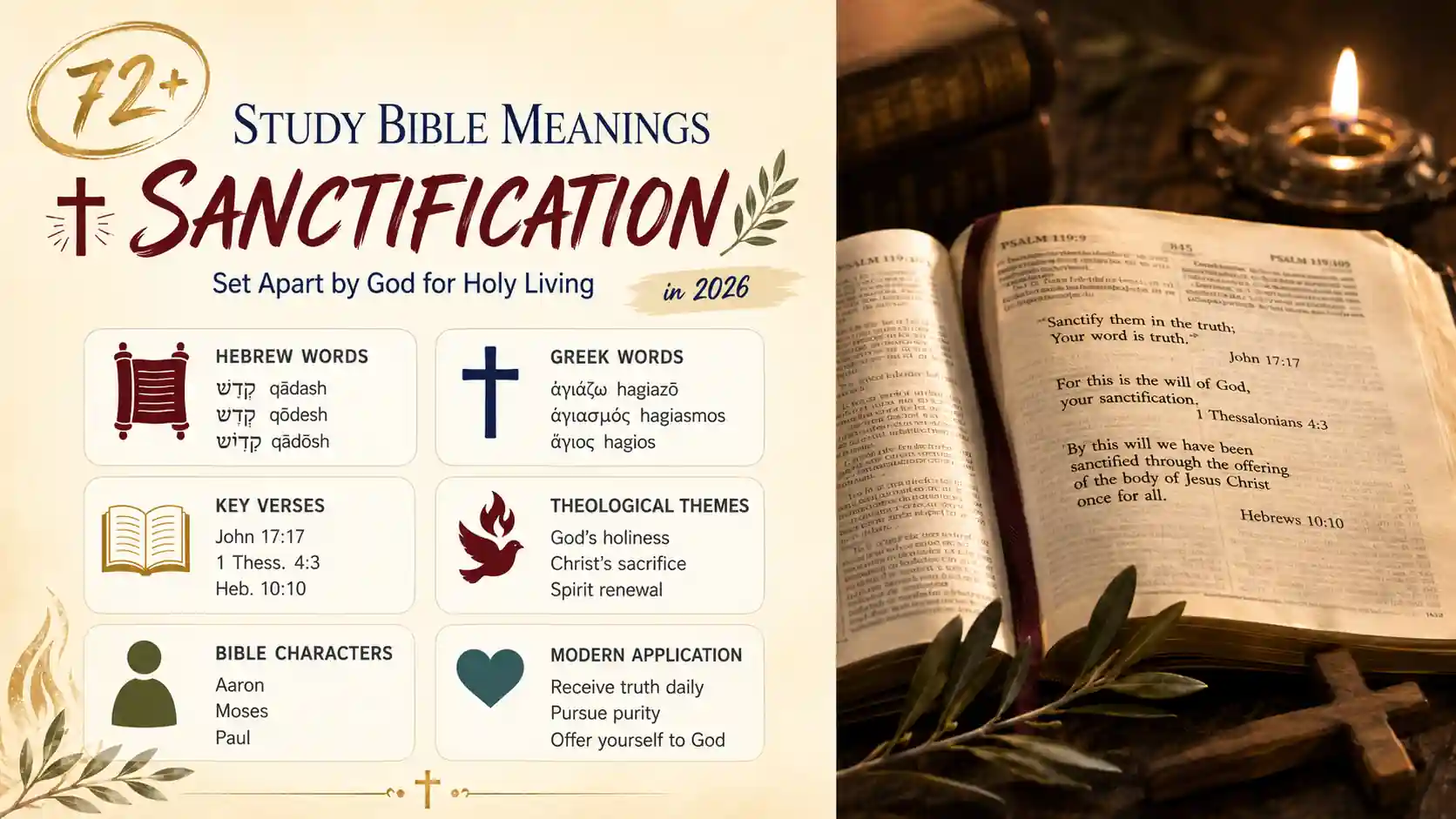
What does sanctification mean in the Bible? Sanctification is God’s work of setting people, places, days, and lives apart as holy for Himself. It is not merely moral improvement. It is consecration to the Lord, cleansing from sin, and growth into the likeness of Christ.
In your study, you will see sanctification in Israel’s priesthood, temple worship, prophetic hope, Jesus’ prayer, and the Spirit’s work in believers.
Sanctification Key Scripture References
| Verse | Passage Snippet | Context |
|---|---|---|
| Exodus 19:6 | “kingdom of priests” | Israel set apart |
| Exodus 31:13 | “I sanctify you” | Sabbath sign |
| Leviticus 20:7 | “Sanctify yourselves” | Covenant holiness |
| John 17:17 | “Sanctify them” | Jesus’ prayer |
| Acts 20:32 | “all them which are sanctified” | Paul’s farewell |
| Romans 6:22 | “fruit unto holiness” | Freedom from sin |
| 1 Corinthians 1:30 | “sanctification” | Christ as source |
| 1 Thessalonians 4:3 | “your sanctification” | Sexual purity |
| Hebrews 10:10 | “sanctified” | Christ’s offering |
Sanctification Bible Translation Comparison
| Verse | KJV | NIV | ESV | NASB |
|---|---|---|---|---|
| John 17:17 | “Sanctify them” | “Sanctify them” | “Sanctify them” | “Sanctify them” |
| 1 Thessalonians 4:3 | “your sanctification” | “be sanctified” | “your sanctification” | “your sanctification” |
| Hebrews 10:10 | “we are sanctified” | “we have been made holy” | “we have been sanctified” | “we have been sanctified” |
| Romans 6:22 | “unto holiness” | “leads to holiness” | “leads to sanctification” | “resulting in sanctification” |
| 1 Peter 1:2 | “sanctification” | “sanctifying work” | “sanctification” | “sanctifying work” |
| Jude 1:1 | “sanctified by God” | “loved in God” | “beloved in God” | “beloved in God” |
| Exodus 31:13 | “doth sanctify you” | “makes you holy” | “sanctifies you” | “sanctifies you” |
| Leviticus 20:8 | “sanctify you” | “make you holy” | “sanctify you” | “sanctifies you” |
| 2 Timothy 2:21 | “sanctified” | “made holy” | “set apart as holy” | “sanctified” |
Sanctification People and Characters Associated
| Person | Role | Connection |
|---|---|---|
| Aaron | High priest | Consecrated for service |
| Moses | Covenant mediator | Sanctified tabernacle items |
| Israel | Covenant nation | Called holy to Yahweh |
| Isaiah | Prophet | Purified for mission |
| Jeremiah | Prophet | Set apart before birth |
| Jesus | Messiah | Sanctifies His people |
| Paul | Apostle | Teaches Spirit holiness |
| Thessalonians | Church | Called to purity |
| Timothy | Minister | Vessel for honorable use |
Sanctification Original Hebrew and Greek Words
| Original Word | Transliteration | Strong’s # | Literal Meaning |
|---|---|---|---|
| קָדַשׁ | qādash | H6942 | to be holy, consecrate |
| קֹדֶשׁ | qōdesh | H6944 | holiness, sacredness |
| קָדוֹשׁ | qādōsh | H6918 | holy, sacred |
| מִקְדָּשׁ | miqdāsh | H4720 | sanctuary, holy place |
| קִדֵּשׁ | qiddēsh | H6942 | to sanctify, dedicate |
| ἁγιάζω | hagiazō | G37 | to make holy |
| ἁγιασμός | hagiasmos | G38 | sanctification, holiness |
| ἅγιος | hagios | G40 | holy, set apart |
| ἁγιωσύνη | hagiōsynē | G42 | holiness, sacred character |
Sanctification Related Biblical Concepts
| Concept | Connection | Supporting Verse |
|---|---|---|
| Holiness | Root meaning | Leviticus 19:2 |
| Consecration | Set apart for God | Exodus 28:41 |
| Purification | Cleansing from defilement | Numbers 8:7 |
| Priesthood | Holy service | Exodus 29:44 |
| Sabbath | Sign of sanctifying God | Exodus 31:13 |
| Union with Christ | Source of holiness | 1 Corinthians 1:30 |
| Spirit’s work | Inner transformation | 1 Peter 1:2 |
| Obedience | Fruit of holiness | Romans 6:19 |
| Glory | Final completion | 1 Thessalonians 5:23 |
Sanctification Historical and Cultural Context
| Aspect | Detail | Biblical Source |
|---|---|---|
| Sinai covenant | Nation consecrated | Exodus 19:5-6 |
| Tabernacle worship | Holy space guarded | Exodus 40:9 |
| Priestly ordination | Blood and oil used | Exodus 29:21 |
| Clean and unclean | Daily holiness taught | Leviticus 11:44 |
| Sabbath rhythm | Time made holy | Exodus 20:8 |
| Temple dedication | Sacred dwelling | 1 Kings 8:10 |
| Exile warning | Holiness profaned | Ezekiel 36:20 |
| New covenant | Heart cleansing promised | Ezekiel 36:25-27 |
| Early church | Gentiles sanctified | Acts 26:18 |
Sanctification Theological Themes
| Theme | Explanation | Scripture |
|---|---|---|
| God’s holiness | God defines holiness | Isaiah 6:3 |
| Divine ownership | Believers belong to God | 1 Corinthians 6:19 |
| Christ’s sacrifice | Once for all cleansing | Hebrews 10:10 |
| Spirit renewal | Holiness applied within | 2 Thessalonians 2:13 |
| Word and truth | Scripture sanctifies | John 17:17 |
| Moral purity | Body offered to God | 1 Thessalonians 4:3 |
| Perseverance | Growth continues | Hebrews 12:14 |
| Worship | Holy lives please God | Romans 12:1 |
| Final blamelessness | God completes the work | 1 Thessalonians 5:23 |
Sanctification Modern Application for Believers
| Area | Practice | Scripture |
|---|---|---|
| Scripture | Receive truth daily | John 17:17 |
| Body | Flee sexual immorality | 1 Thessalonians 4:3 |
| Speech | Use words for grace | Ephesians 4:29 |
| Work | Serve as unto Christ | Colossians 3:23 |
| Worship | Offer yourself to God | Romans 12:1 |
| Community | Pursue peace and holiness | Hebrews 12:14 |
| Suffering | Trust refining discipline | Hebrews 12:10 |
| Mission | Live as holy witness | 1 Peter 2:9 |
| Hope | Await full renewal | 1 John 3:3 |
What Does Sanctification Mean in the Bible Through קָדַשׁ And ἁγιάζω
The Hebrew root קָדַשׁ, qādash, carries the idea of being holy, consecrated, or set apart. In the Old Testament, this word can describe the Sabbath, the priests, the altar, the tabernacle, and the people of Israel. Sanctification begins with God’s claim. What belongs to Him must not be treated as common.
The Greek verb ἁγιάζω, hagiazō, continues this pattern in the New Testament. Jesus prays, “Sanctify them in the truth,” and Hebrews says believers have been sanctified through His offering. Sanctification is both a status given by grace and a life shaped by grace.
Sinai, Priesthood, and the Holy People of Yahweh
At Sinai, sanctification was covenantal. Israel was not chosen because it was morally impressive, but because the Lord loved, redeemed, and claimed them. Their holiness was visible in worship, food laws, purity boundaries, Sabbath keeping, and priestly service.
This historical setting protects your study from making sanctification sound vague. In Scripture, holiness always has direction. Israel was sanctified from the nations and for the Lord. The church receives the same calling in Christ, as a people set apart to proclaim God’s excellencies.
The Cross Makes Holy What Human Effort Cannot Cleanse
The New Testament deepens sanctification by grounding it in Christ’s finished work. Hebrews 10:10 says believers have been sanctified through the offering of Jesus Christ once for all. That means sanctification is not your attempt to become acceptable apart from grace.
Yet grace does not leave you unchanged. Romans 6 teaches that freedom from sin produces fruit leading to sanctification. The believer does not pursue holiness to earn redemption, but because redemption has transferred ownership from sin to God.
The Spirit’S Ongoing Work in a Believer’S Body and Desires
Paul’s command in 1 Thessalonians 4:3 is intensely practical. “This is the will of God, your sanctification,” especially in sexual purity. Sanctification reaches the body, desires, habits, relationships, and private choices. No part of life is outside God’s holy claim.
The Spirit applies what Christ accomplished. Peter speaks of “sanctification of the Spirit,” showing that holiness is not self-improvement with religious language. The Spirit forms obedience, repentance, endurance, and love in those whom God has set apart.
Sanctification FAQ
Does ἁγιασμός mean holiness or sanctification?
It can carry both senses, describing the state and process of being made holy before God.
Why does Hebrews 10:10 say believers have already been sanctified?
It speaks of the decisive holiness secured by Christ’s once for all sacrifice.
How is קָדַשׁ different from ordinary moral improvement?
קָדַשׁ means being set apart to God, so morality flows from consecration, not mere self-discipline.
Why do some translations say “holiness” in Romans 6:22 instead of “sanctification”?
The Greek ἁγιασμός can emphasize either the process of sanctification or the holy result it produces.
Can a believer be sanctified and still need growth?
Yes. Scripture presents believers as already set apart in Christ and still being transformed by the Spirit.