
When you ask what does demon mean in the bible, you are asking about a real spiritual enemy that Scripture treats with sober seriousness and clear hope. The word points to unseen beings who oppose God, mislead people, and bring harm, yet it never leaves you without the stronger story of Jesus and his authority. Your study will move from ancient words to Gospel encounters and finally to daily wisdom.
You will find demons named in songs of warning, in synagogue confrontations, and in letters that test true faith. This guide gathers those passages in order, explains the Hebrew and Greek words behind them, and shows how each text fits the larger Bible story of deliverance and judgment.
Demon Encounters in Key Scripture References
| Verse | Passage Snippet | Context |
|---|---|---|
| Deuteronomy 32:17 | They sacrificed to demons | Moses warns Israel about idolatry |
| Psalm 106:37 | They sacrificed sons to demons | Psalm recalls idol worship in Canaan |
| Matthew 8:28 | Two demon possessed men met him | Jesus arrives in the Gadarenes region |
| Mark 5:2 | A man with an unclean spirit | Gerasene man lives among the tombs |
| Luke 8:27 | A man possessed for a long time | Luke tells the Gerasene healing story |
| Mark 1:23 | A man in the synagogue | Unclean spirit speaks in Capernaum worship |
| Acts 16:16 | A spirit of divination in a girl | Paul meets her at Philippi in mission |
| James 2:19 | Demons believe and shudder | James tests faith that lacks good works |
| Revelation 12:9 | The great dragon was thrown down | Vision of Satan cast from heaven |
Demon Words in Bible Translation Comparison
| Verse | KJV | NIV | ESV | NASB |
|---|---|---|---|---|
| Deuteronomy 32:17 | devils | demons | demons | demons |
| Psalm 106:37 | devils | demons | demons | demons |
| Matthew 8:28 | possessed with devils | demon possessed | demon possessed | demon possessed |
| Mark 5:2 | an unclean spirit | an impure spirit | an unclean spirit | an unclean spirit |
| Luke 8:27 | possessed with devils | demon possessed | demon possessed | demon possessed |
| Mark 1:23 | an unclean spirit | an impure spirit | an unclean spirit | an unclean spirit |
| Acts 16:16 | a spirit of divination | a spirit of prediction | a spirit of divination | a spirit of divination |
| 1 Corinthians 10:20 | devils | demons | demons | demons |
| James 2:19 | devils | demons | demons | demons |
Demon Stories in People and Characters Associated
| Person | Role | Connection |
|---|---|---|
| Jesus | Healer and Lord | Commands demons and they obey him |
| Gerasene man | Possessed man | Healed and sent to tell his region |
| Mary Magdalene | Faithful follower | Seven demons had left her life |
| Paul | Apostle in mission | Casts out a divining spirit at Philippi |
| Legion | Many demons together | Name shows many spirits in one man |
| Satan | Chief adversary | Linked to the ruler of evil spirits |
| Beelzebul | Ruler name used | Called prince of demons by critics |
| Disciples | Learners sent out | Report demons subject to Jesus name |
| Boy with mute spirit | Possessed boy | Jesus heals him after disciples fail |
Demon Language in Original Hebrew and Greek Words
| Original Word | Transliteration | Strong’s # | Literal Meaning |
|---|---|---|---|
| שֵׁד | shed | H7700 | demon |
| שָׂעִיר | sa’ir | H8163 | goat demon |
| רוּחַ | ruach | H7307 | spirit |
| שָׂטָן | satan | H7854 | adversary |
| δαιμόνιον | daimonion | G1140 | demon |
| δαίμων | daimon | G1142 | demon |
| πνεῦμα | pneuma | G4151 | spirit |
| διάβολος | diabolos | G1228 | devil |
| πονηρός | poneros | G4190 | evil |
Demon Themes in Related Biblical Concepts
| Concept | Connection | Supporting Verse |
|---|---|---|
| Unclean spirit | Name for a demon in Gospels | Mark 1:23 |
| Satan | Chief foe behind evil spirits | Matthew 12:26 |
| Idolatry | Worship given to false gods | Deuteronomy 32:17 |
| Possession | Demon control of a person | Luke 8:27 |
| Exorcism | Casting out by command | Mark 5:8 |
| Kingdom of God | Power breaking evil rule | Luke 11:20 |
| Spiritual warfare | Conflict beyond human sight | Ephesians 6:12 |
| False gods | Idols linked to demons | 1 Corinthians 10:20 |
| Deliverance | Freedom from demon control | Mark 5:15 |
Demon Background in Historical and Cultural Context
| Aspect | Detail | Biblical Source |
|---|---|---|
| Wilderness song | Israel warned against demon worship | Deuteronomy 32:17 |
| Canaanite idols | Child sacrifice linked to demons | Psalm 106:37 |
| First century synagogue | Spirits confronted in public worship | Mark 1:23 |
| Tombs and Gentile land | Gerasene story in Gentile territory | Mark 5:1 |
| Roman Philippi | Divination used for profit there | Acts 16:16 |
| Corinthian meals | Meat linked to idol feasts | 1 Corinthians 10:20 |
| Early church mission | Evil spirits named in mission reports | Acts 19:12 |
| Apocalyptic vision | Demons gather kings for battle | Revelation 16:14 |
| Angelic conflict | Prince of Persia opposed the messenger | Daniel 10:13 |
Demon Truth in Theological Themes
| Theme | Explanation | Scripture |
|---|---|---|
| Authority of Jesus | His word alone drives demons out | Mark 1:27 |
| Reality of evil | Evil is personal, not only abstract | Ephesians 6:12 |
| Kingdom conflict | Jesus kingdom confronts dark rule | Luke 11:20 |
| Idolatry as betrayal | False worship breaks covenant loyalty | Deuteronomy 32:17 |
| Human brokenness | Possession pictures deep human damage | Mark 5:5 |
| Deliverance and restoration | Healing returns people to community | Mark 5:15 |
| Judgment and final defeat | Evil faces a fixed end | Revelation 20:10 |
| Faith and fear | Right belief must lead to trust | James 2:19 |
| Final victory | God will crush Satan soon | Romans 16:20 |
Demon Wisdom in Modern Application for Believers
| Area | Practice | Scripture |
|---|---|---|
| Discernment | Test claims by Scripture and fruit | 1 John 4:1 |
| Prayer | Pray in the name of Jesus | Luke 10:17 |
| Scripture reading | Learn Gospel authority from Mark | Mark 1:27 |
| Community support | Stay close to trusted believers | Hebrews 10:25 |
| Rejecting idolatry | Turn from modern false gods | 1 Corinthians 10:14 |
| Compassion | Treat suffering people with kindness | Mark 5:19 |
| Resisting fear | Trust Christ over dark threats | 1 John 4:4 |
| Witness | Tell how Jesus changed your life | Mark 5:19 |
| Spiritual discipline | Fast and pray for hard cases | Mark 9:29 |
Shedim and the Old Testament World of Unseen Powers
The Hebrew word shed appears only twice, yet both places carry weight for your reading. Deuteronomy links demon worship to covenant failure, while Psalm 106 links it to the terrible cost of copying Canaanite religion. These texts do not give you a demon bestiary, but they do teach you that idolatry is never a harmless cultural choice.
You should read sa’ir in the same sober light, since Leviticus forbids sacrifice to goat demons. The Old Testament keeps the focus on loyalty to God, not on curiosity about dark powers. When you study these words, you learn to name evil clearly without giving it more attention than Scripture gives it.
Daimonion in the Gospels and the Authority of Jesus
In the Gospels, daimonion names the spirits Jesus meets in synagogues, tombs, and Gentile towns. The stories are brief and direct, and the spirits often know who Jesus is before the crowds do. That pattern matters for your study, because it shows authority rather than debate at the center of each encounter.
You will notice that Jesus never bargains with these spirits and never treats them as equals. He commands, they leave, and the healed person is restored to home and community. That restoration is the Gospel point, since deliverance is always tied to a life made whole again.
What Does Demon Mean in the Bible When Mark Tells the Story
Mark gives you the fullest picture, from the Capernaum synagogue to the Gerasene tombs and the mission of the disciples. His fast paced narrative keeps returning to one question, which is who has true authority over broken lives. The demons answer that question by their own submission, even when human leaders resist Jesus.
You can follow that thread into Luke and Acts, where the same authority travels with the church in mission. The story does not end with fear, because the risen Jesus sends ordinary followers into places where dark powers once held sway. Your reading should leave you watchful, steady, and confident in Christ rather than fascinated by evil itself.
Beelzebul Satan and the Divided Kingdom in Matthew
Matthew records critics who claim Jesus casts out demons by Beelzebul, the prince of demons. Jesus answers with plain logic, since a kingdom divided against itself cannot stand, and he points to the Spirit of God at work in his healings. This exchange matters for your study, because it ties demon language directly to the question of where true power comes from.
You should also note that Matthew never lets the debate stay abstract, because the healed lives in the story speak louder than the charge. The same chapter warns about a house swept clean and then refilled, which teaches you that deliverance must be followed by a life filled with God. That warning keeps your application grounded in daily obedience rather than mere relief.
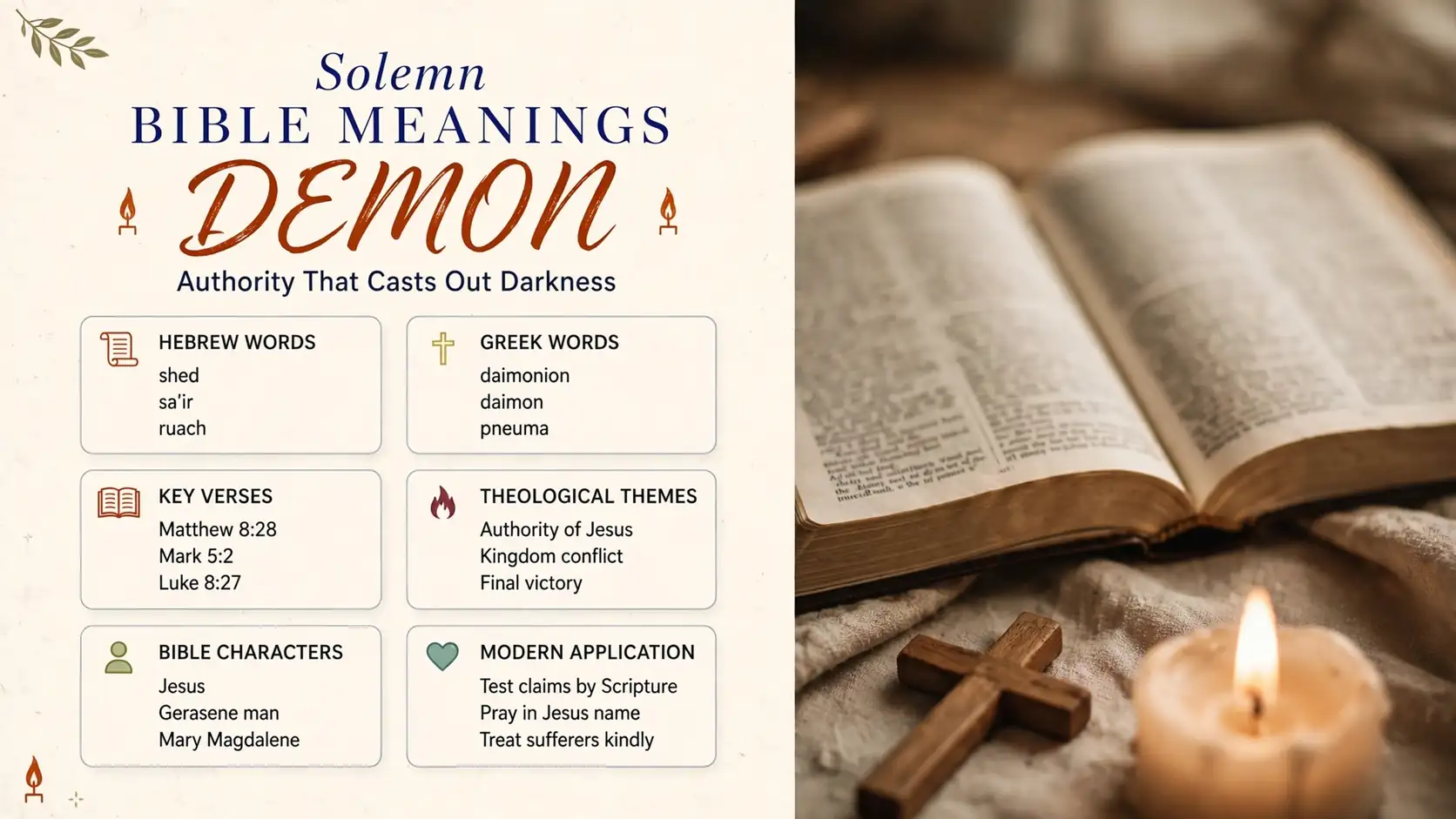
Questions Readers Ask About Demons in Scripture
Does shed in Deuteronomy 32:17 mean the same as daimonion in the Gospels?
No, shed is a rare Hebrew word for a demon linked to idolatry, while daimonion is the common Greek word for the spirits Jesus cast out.
Why does Mark 5:2 call the Gerasene spirit unclean instead of naming it a demon?
Mark uses unclean spirit as a Gospel synonym for a demon, and the story later names the many spirits Legion.
How can James 2:19 say demons believe and shudder without saving faith?
James shows that bare belief in God is not saving trust, since even demons know God is one and fear judgment.
Do different translations change the meaning when KJV says devils and NIV says demons?
No, both render the same Greek word daimonion, but modern versions use demons to avoid confusion with the devil as a single figure.
Should a believer today seek out stories about demons for spiritual growth?
No, Scripture points you to prayer, sound teaching, wise community, and the authority of Jesus rather than curiosity about dark powers.