
You may have heard the phrase seven deadly sins in sermons, books, and films, yet the Bible itself never prints that exact list in one place. The Bible instead gives many verses, stories, and wisdom sayings that later teachers gathered into a memorable summary of destructive desires.
In the pages ahead you will meet pride, greed, lust, envy, gluttony, wrath, and sloth through Scripture, language, history, and daily practice. You will also see how grace answers each sin without softening its danger or denying its power in ordinary life.
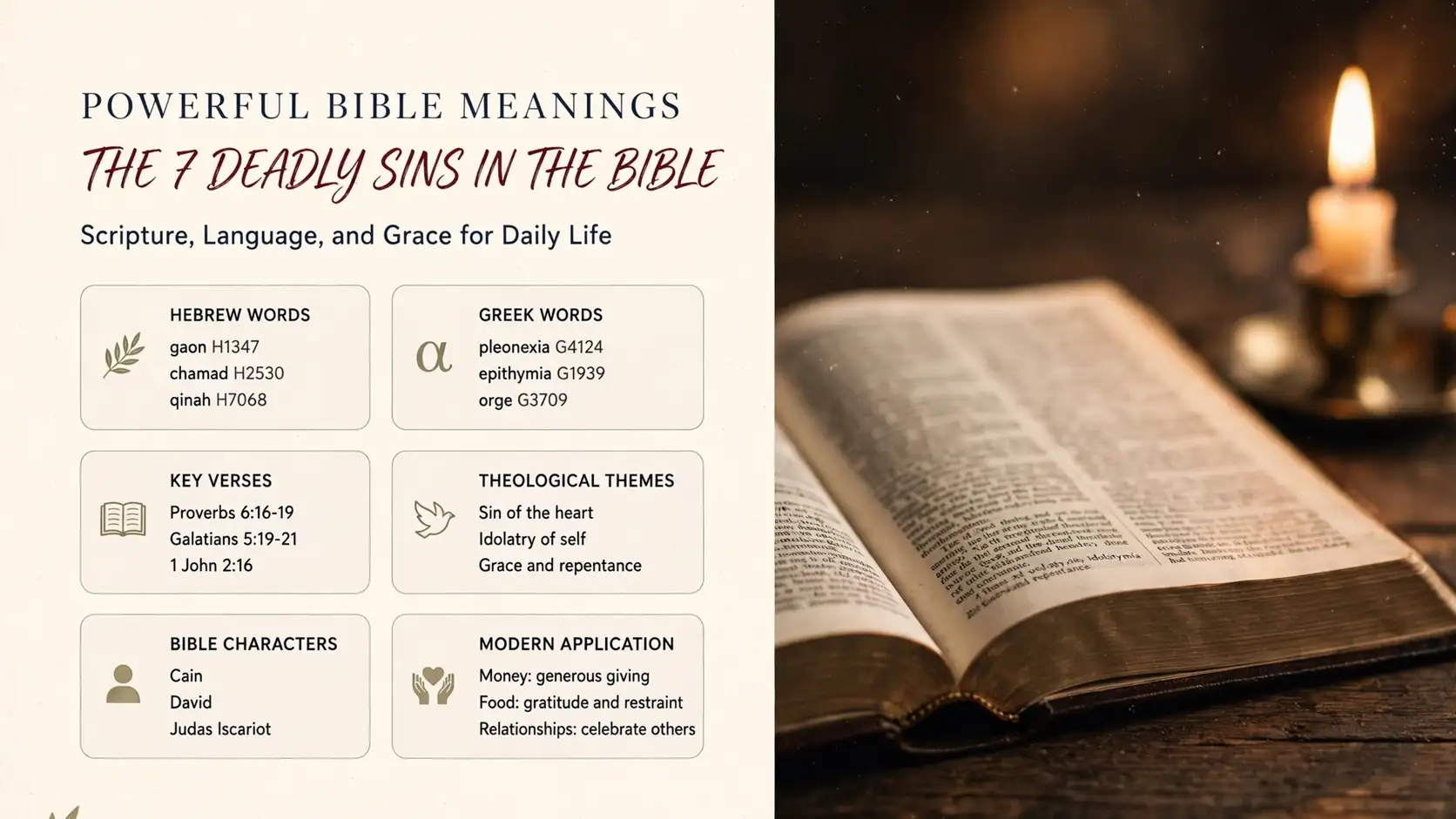
Seven Deadly Sins in Key Scripture References
| Verse | Passage Snippet | Context |
|---|---|---|
| Proverbs 6:16-19 | Seven abominations the Lord hates | Wisdom warning against proud eyes and false witness |
| Galatians 5:19-21 | Works of the flesh are evident | Paul lists envy, wrath, and excess as fleshly patterns |
| 1 John 2:16 | Lust of flesh and pride of life | John traces worldly desire to a heart turned from the Father |
| James 1:14-15 | Desire gives birth to sin | James explains how inward craving grows toward death |
| Proverbs 16:18 | Pride goes before destruction | Wisdom links a haughty spirit with a coming fall |
| Exodus 20:17 | You shall not covet | The tenth command guards the heart against greedy wanting |
| Matthew 5:28 | Lustful looking breaks the heart | Jesus moves adultery from act alone to inward desire |
| Proverbs 6:6-11 | Go to the ant, sluggard | Wisdom contrasts diligence with sleep and poverty |
Seven Deadly Sins Across Bible Translations
| Verse | KJV | NIV | ESV | NASB |
|---|---|---|---|---|
| Proverbs 6:16 | Seven are an abomination | Seven detestable to him | Seven an abomination to him | Seven an abomination to Him |
| Proverbs 16:18 | Pride goeth before destruction | Pride goes before destruction | Pride goes before destruction | Pride goes before destruction |
| Exodus 20:17 | Thou shalt not covet | You shall not covet | You shall not covet | You shall not covet |
| Matthew 5:28 | Looks to lust | Looks at a woman lustfully | Looks with lustful intent | Looks with lust for her |
| Galatians 5:21 | Envyings, murders, drunkenness | Envy, drunkenness, orgies | Envy, drunkenness, orgies | Envying, drunkenness, carousing |
| 1 John 2:16 | Lust of the flesh | Lust of the flesh | Desires of the flesh | Lust of the flesh |
| Ephesians 4:31 | All bitterness and wrath | Rid of bitterness, rage | Let all bitterness and wrath | All bitterness and wrath |
| Proverbs 6:9 | How long sleep, O sluggard | How long lie there, sluggard | How long lie there, sluggard | How long lie down, sluggard |
People and Characters Linked to the Seven Deadly Sins
| Person | Role | Connection |
|---|---|---|
| Cain | Brother and first murderer | Envy of Abel led to anger and murder |
| David | King of Israel | Lust for Bathsheba led to adultery and murder |
| Judas Iscariot | Disciple and treasurer | Greed for silver led to betrayal of Jesus |
| Nebuchadnezzar | King of Babylon | Pride in his kingdom led to humbling madness |
| Esau | Son of Isaac | Appetite for stew traded away his birthright |
| Jonah | Prophet to Nineveh | Wrath at mercy shown to enemies exposed his anger |
| Achan | Soldier under Joshua | Covetous taking of spoil brought judgment on Israel |
| Pharaoh | Ruler of Egypt | Hardened pride refused release of Israel |
Hebrew and Greek Words Behind the Seven Deadly Sins
| Original Word | Transliteration | Strong’s # | Literal Meaning |
|---|---|---|---|
| גָּאוֹן | gaon | H1347 | Pride or swelling majesty |
| חָמַד | chamad | H2530 | To desire or covet strongly |
| πλεονεξία | pleonexia | G4124 | Greed or covetous desire |
| ἐπιθυμία | epithymia | G1939 | Strong desire or lust |
| קִנְאָה | qinah | H7068 | Jealousy or envy burning within |
| זָלַל | zalal | H2151 | To be a glutton or squanderer |
| ὀργή | orgē | G3709 | Wrath or settled anger |
| עָצֵל | atsel | H6102 | Slothful or lazy person |
Related Biblical Concepts Around the Seven Deadly Sins
| Concept | Connection | Supporting Verse |
|---|---|---|
| Repentance | Turning from sin toward God | Acts 3:19 |
| Temptation | Testing that appeals to desire | James 1:14 |
| Idolatry | Putting a created good first | Colossians 3:5 |
| Humility | Lowly trust before God | James 4:6 |
| Self-control | Spirit led restraint of appetite | Galatians 5:23 |
| Grace | Undeserved favor that trains holiness | Titus 2:11-12 |
| Fruit of the Spirit | Love, joy, and peace replacing flesh | Galatians 5:22-23 |
| Contentment | Satisfaction in God over gain | Hebrews 13:5 |
Historical and Cultural Context of the Seven Deadly Sins
| Aspect | Detail | Biblical Source |
|---|---|---|
| Ancient Israel wisdom | Proverbs groups pride, greed, and laziness as moral dangers | Proverbs 6 |
| Torah covenant | The tenth command names coveting as heart sin | Exodus 20 |
| Prophetic warning | Prophets link pride and greed to national judgment | Isaiah 2 |
| Jesus teaching | The Sermon on the Mount traces sin to the heart | Matthew 5 |
| Apostolic churches | Letters warn new believers against fleshly patterns | Galatians 5 |
| Early church lists | Later teachers gathered seven from biblical patterns, not a single list | Galatians 5 |
| Medieval teaching | Preachers used seven as a pastoral diagnostic tool | Proverbs 6 |
| Reformation emphasis | Reformers stressed grace over merit in fighting sin | Romans 3 |
Theological Themes in the Seven Deadly Sins
| Theme | Explanation | Scripture |
|---|---|---|
| Sin of the heart | Sin begins inside before it acts outside | Matthew 15:19 |
| Idolatry of self | Each sin puts self above God | Colossians 3:5 |
| Grace and repentance | God forgives and restores the repentant | 1 John 1:9 |
| Sanctification | Believers grow by the Spirit over time | Galatians 5:16 |
| Judgment and mercy | God judges sin yet offers mercy in Christ | Romans 6:23 |
| Humility as antidote | Humble dependence counters pride and greed | Philippians 2:3 |
| Hope of renewal | New creation reshapes desire and habit | 2 Corinthians 5:17 |
| Contentment in Christ | Christ satisfies deeper than appetite or status | Philippians 4:11 |
Modern Application of the Seven Deadly Sins for Believers
| Area | Practice | Scripture |
|---|---|---|
| Money | Practice generous giving and honest budgeting | 2 Corinthians 9:7 |
| Food | Eat with gratitude and measured restraint | Proverbs 23:20-21 |
| Work | Work diligently and rest without laziness | Proverbs 6:6 |
| Relationships | Replace envy with celebration of others | Romans 12:15 |
| Speech | Speak slowly and refuse bitter anger | James 1:19-20 |
| Desire | Guard eyes and heart with wise boundaries | Matthew 5:28 |
| Status | Seek service instead of praise and position | Mark 10:43-44 |
| Digital life | Limit comparison feeds that feed envy and lust | Psalm 101:3 |
What Are the 7 Deadly Sins in the Bible and Why Seven
The number seven in Scripture often signals completeness, so teachers used seven to cover the full range of human craving. Pride stands at the head because it turns worship inward, while greed, lust, envy, gluttony, wrath, and sloth show how that inward turn spreads. Together they form a map, not a new law, and the map helps you name what you might otherwise excuse.
You should read the list as a diagnostic, not a ranking of unforgivable sins. Scripture treats every sin seriously, yet it also shows different sins bearing different fruit in a life, a family, and a community. When you name the pattern honestly, you can bring that exact pattern to God in prayer.
Pride, Greed, and the Hebrew Roots of Desire
Hebrew words for pride picture a swelling heart that rises above its proper place, while chamad pictures a desire that reaches for what belongs to another. Those images matter because they show sin as misdirected worship, not only broken rules. Your study grows sharper when you ask what good gift you are asking to carry more weight than God.
Greed often hides behind careful planning, and pride often hides behind strong leadership, so both sins need honest friends and clear Scripture. A simple practice helps here, namely asking whether a choice serves God and neighbour or only protects your image and comfort. That question brings hidden motives into the light without harsh self attack.
Envy, Lust, and Gluttony in the Wisdom Books
Wisdom books return again and again to envy, lust, and appetite because those sins promise quick satisfaction and deliver slow damage. Proverbs pictures the sluggard, the glutton, and the covetous neighbour with plain images that a reader can test in daily life. Those images invite you to notice small choices, such as a lingering look, a second helping, or a bitter comparison.
The wisdom answer is not mere restraint, but a reordered love that finds joy in God, gratitude for daily bread, and delight in a neighbour’s good. When contentment grows, envy loses its sting, appetite loses its rule, and desire finds its proper place. That reordering takes time, and it grows through prayer, Scripture, and ordinary faithfulness.
From Wrath and Sloth to Grace in Christ
Wrath and sloth look opposite, yet both refuse the patient work of love, one by force and the other by neglect. Greek words for wrath picture a settled anger, while Hebrew words for sloth picture hands that will not move toward duty. Both patterns can grow quietly, which is why daily repentance and small faithful steps matter so much.
Grace does not leave you where it finds you, and it does not demand that you defeat sin by willpower alone. The Spirit gives new desires, the church gives wise counsel, and Scripture gives words for confession and fresh obedience. You can therefore face the seven sins with hope, not shame driven hiding, and with steady practice rather than sudden perfection.
Frequently Asked Questions About the Seven Deadly Sins
Are the seven deadly sins named together in a single Bible verse?
No, the seven form a later pastoral summary drawn from many passages, while Proverbs 6 names seven things God hates in a related wisdom list.
What does the Greek word epithymia add to our understanding of lust?
It names strong desire itself, so context decides whether a desire is good or disordered.
Why do translations differ on Proverbs 6:16 between abomination and detestable?
Hebrew toebah covers what God detests, so translators choose abomination or detestable for the same strong rejection.
If all sins separate us from God, why single out seven as deadly?
Deadly here means deeply destructive patterns, not a separate class of unforgivable sins, since Scripture offers forgiveness through Christ.
How can I fight envy or gluttony in daily life without legalism?
Practice gratitude, honest limits, prayer, and accountability, letting grace shape habits rather than shame alone.