
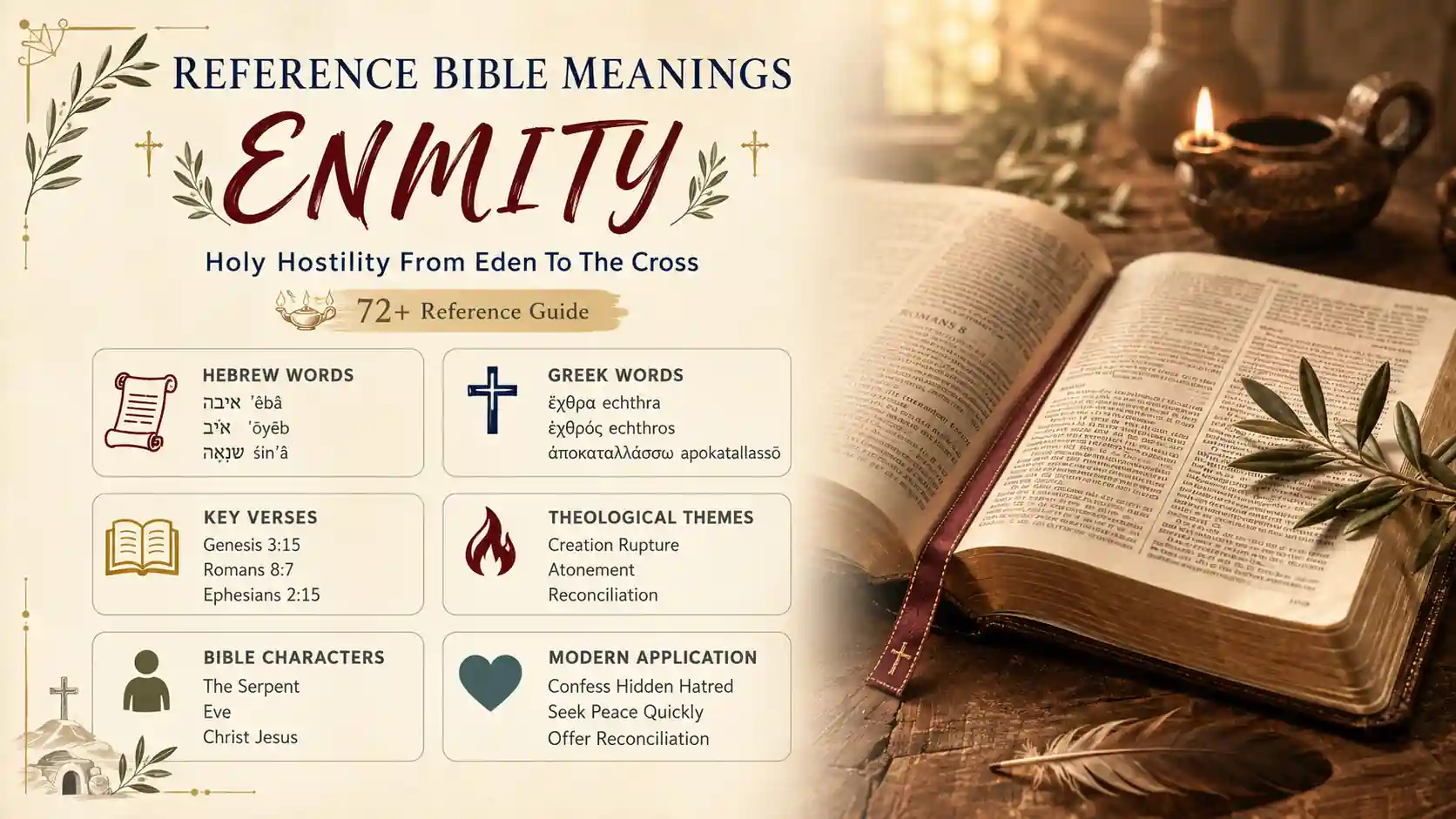
What does enmity mean in the Bible? It means settled hostility, opposition, alienation, or covenantal conflict between persons, peoples, or powers. Scripture uses enmity for human hatred, blood vengeance, spiritual rebellion, and the deep divide sin creates between God and humanity.
In your study, the word reaches from Eden to the cross. Genesis 3:15 announces enmity between the serpent and the woman’s seed, while Ephesians 2 proclaims that Christ has slain the enmity and made peace.
Enmity Key Scripture References
| Verse | Passage Snippet | Context |
|---|---|---|
| Genesis 3:15 | “I will put enmity” | Edenic judgment |
| Numbers 35:21 | “in enmity” | Murder law |
| Numbers 35:22 | “without enmity” | Manslaughter case |
| Deuteronomy 4:42 | “hated him not” | Refuge cities |
| Deuteronomy 19:4 | “not hated him” | Accidental death |
| Deuteronomy 19:11 | “hate his neighbor” | Premeditated murder |
| Joshua 20:5 | “hated him not” | Refuge protection |
| Romans 8:7 | “enmity against God” | Fleshly mind |
| Ephesians 2:15 | “abolished…enmity” | Jew and Gentile |
| James 4:4 | “enmity with God” | Worldly friendship |
Enmity Bible Translation Comparison
| Verse | KJV | NIV | ESV | NASB |
|---|---|---|---|---|
| Genesis 3:15 | enmity | hostility | enmity | enmity |
| Numbers 35:21 | enmity | malice aforethought | hostility | enmity |
| Numbers 35:22 | without enmity | without hostility | without enmity | without enmity |
| Deuteronomy 4:42 | hated | without malice | had no hatred | without hating |
| Deuteronomy 19:4 | hated | without malice | had no hatred | without hating |
| Deuteronomy 19:11 | hate | hates | hates | hates |
| Romans 8:7 | enmity | hostile | hostile | hostile |
| Ephesians 2:15 | enmity | barrier | hostility | enmity |
| James 4:4 | enmity | enemy | enmity | hostility |
Enmity People & Characters Associated
| Person | Role | Connection |
|---|---|---|
| The serpent | Tempter | Receives judgment |
| Eve | Woman | Her seed opposed |
| Cain | First murderer | Hatred becomes violence |
| Esau | Brother of Jacob | Hatred after blessing |
| Joseph’s brothers | Sons of Jacob | Hostility toward Joseph |
| Pharaoh | Oppressor | Enemy of Israel |
| Saul | King of Israel | Pursues David |
| David | Anointed king | Suffers enemy hatred |
| Christ Jesus | Messiah | Slays enmity |
Enmity Original Hebrew & Greek Words
| Original Word | Transliteration | Strong’s # | Literal Meaning |
|---|---|---|---|
| אֵיבָה | ʾêbâ | H342 | enmity, hostility |
| אָיַב | ʾāyab | H340 | to be hostile |
| אֹיֵב | ʾōyēb | H341 | enemy, foe |
| שִׂנְאָה | śinʾâ | H8135 | hatred |
| שָׂנֵא | śānēʾ | H8130 | to hate |
| שָׂטַם | śāṭam | H7852 | to bear a grudge |
| ἔχθρα | echthra | G2189 | enmity, hostility |
| ἐχθρός | echthros | G2190 | enemy, hostile one |
| ἀποκαταλλάσσω | apokatallassō | G604 | reconcile fully |
Enmity Related Biblical Concepts
| Concept | Connection | Supporting Verse |
|---|---|---|
| Sin | Produces alienation | Romans 8:7 |
| Murder | Hatred enacted | Numbers 35:21 |
| Refuge | Protects innocent | Joshua 20:5 |
| Covenant | Defines loyalty | Exodus 23:22 |
| Serpent conflict | Begins in Eden | Genesis 3:15 |
| Flesh | Resists God | Romans 8:7 |
| Worldliness | Rivals God | James 4:4 |
| Peace | Christ’s work | Ephesians 2:14 |
| Reconciliation | Ends hostility | Colossians 1:21 |
Enmity Historical & Cultural Context
| Aspect | Detail | Biblical Source |
|---|---|---|
| Eden | Cosmic conflict begins | Genesis 3:15 |
| Kinship | Brother hatred shatters family | Genesis 27:41 |
| Blood vengeance | Motive mattered legally | Numbers 35:20 |
| Refuge cities | Shelter for accidental killer | Joshua 20:3 |
| Israel’s enemies | Nations oppose covenant people | Exodus 23:22 |
| Wisdom prayer | Enemies brought before God | Psalm 139:21 |
| Second Temple world | Jew and Gentile divided | Ephesians 2:14 |
| Roman household church | Unity tested daily | Ephesians 2:19 |
| Early church ethics | Worldliness rebuked | James 4:4 |
Enmity Theological Themes
| Theme | Explanation | Scripture |
|---|---|---|
| Creation rupture | Sin divides creatures | Genesis 3:15 |
| Moral guilt | Hatred exposes the heart | 1 John 3:15 |
| Human depravity | Flesh resists God | Romans 8:7 |
| Divine judgment | God opposes evil | Genesis 3:15 |
| Covenant holiness | Loyalty forbids rivalry | James 4:4 |
| Messianic victory | Christ conquers serpent | Romans 16:20 |
| Atonement | Cross makes peace | Ephesians 2:16 |
| New humanity | Divisions are healed | Ephesians 2:15 |
| Reconciliation | Former enemies welcomed | Colossians 1:21 |
Enmity Modern Application for Believers
| Area | Practice | Scripture |
|---|---|---|
| Heart motives | Confess hidden hatred | 1 John 3:15 |
| Conflict | Seek peace quickly | Romans 12:18 |
| Church unity | Receive believers warmly | Ephesians 2:14 |
| Ethnic division | Remember one body | Ephesians 2:15 |
| Worldliness | Resist divided loyalty | James 4:4 |
| Spiritual warfare | Trust promised victory | Genesis 3:15 |
| Forgiveness | Refuse vengeance | Romans 12:19 |
| Evangelism | Offer reconciliation | 2 Corinthians 5:20 |
| Prayer | Bring enemies to God | Matthew 5:44 |
אֵיבָה ʾêBâ in Genesis 3:15 Sets the Bible’S First Line of Conflict
The first clear use of enmity appears in Genesis 3:15, where God says, “I will put enmity” between the serpent and the woman. This is not a small personal dislike. It is a divinely imposed opposition between the deceiver and the line through which God’s promise will come.
That verse teaches you to read enmity as more than emotion. It is covenantal conflict. The serpent’s seed and the woman’s seed stand in opposition until the promised offspring bruises the serpent’s head, a hope later read in light of Christ’s victory.
Enmity in the Bible Also Appears in Israel’S Law Courts
Numbers 35 and Deuteronomy 19 show that enmity could be tested in legal cases. Israel had to distinguish murder from accidental killing. A death caused “in enmity” revealed malice, while death “without enmity” belonged to a different legal category.
This matters because biblical enmity is not vague irritation. It can be a settled disposition that moves toward violence. The refuge city laws protected justice by asking whether hatred existed before the act, especially in cases involving blood vengeance.
What Does Enmity Mean in the Bible When Paul Uses ἔχθρα Echthra?
Paul uses ἔχθρα, echthra, to describe spiritual hostility. In Romans 8:7, the mind set on the flesh is hostile to God because it does not submit to God’s law. Enmity here is not merely social tension. It is rebellion against divine rule.
In Ephesians 2, Paul applies the word to Jew and Gentile division. Christ abolishes the enmity in his flesh and creates one new humanity. The cross does not merely calm feelings. It removes the barrier that kept sinners alienated from God and from one another.
James 4:4 Makes Enmity a Question of Loyalty
James says that friendship with the world is enmity with God. The language is sharp because Scripture treats covenant love seriously. To embrace the world’s proud desires as master is to stand against God’s holy claim.
For believers, this warning is pastoral, not abstract. You examine your loves, ambitions, resentments, and compromises before God. The cure is not self-made peace, but humble repentance, grace, and renewed loyalty to the Lord who draws near to the humble.
Enmity FAQ
Why does Genesis 3:15 use אֵיבָה ʾêbâ instead of a softer word for dislike?
Because the verse announces a real, God-appointed conflict between the serpent and the woman’s seed.
Is ἔχθρα echthra in Romans 8:7 about unbelievers only?
It describes the fleshly mind’s hostility to God, warning every reader against life ruled by the flesh.
Why do some translations render enmity as hostility or malice?
They are expressing the same idea in context, especially where legal motive or relational opposition is emphasized.
Did Christ remove all enmity in Ephesians 2:15?
He removed the covenant barrier and reconciled Jew and Gentile to God in one body through the cross.
How should a believer respond when personal hatred feels like enmity?
Confess it, refuse vengeance, seek peace where possible, and remember that Christ reconciles former enemies.