
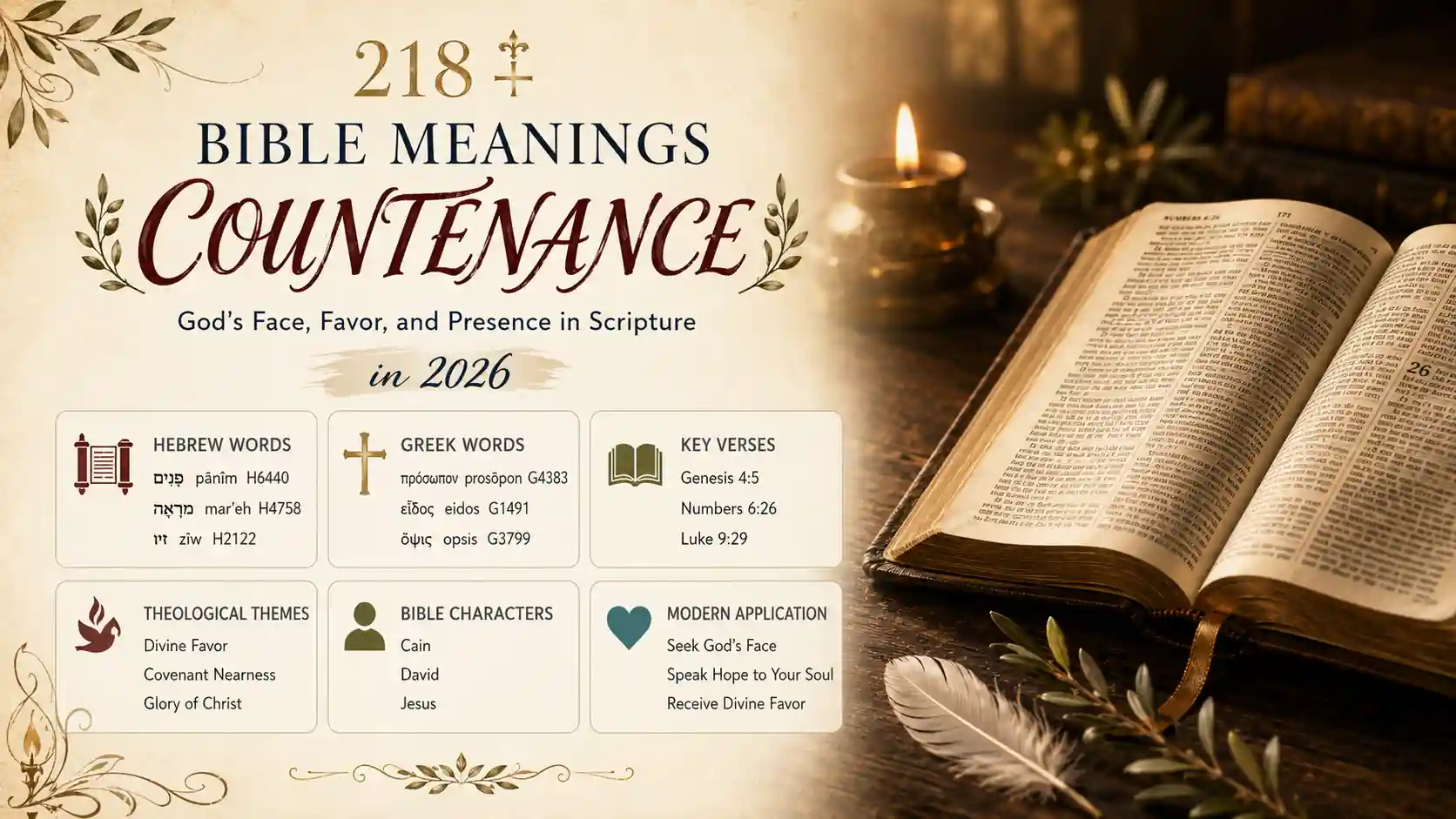
What does countenance mean in the Bible? In Scripture, “countenance” usually means the face, appearance, expression, or visible presence of a person. It can describe joy, shame, anger, grief, favor, courage, or divine blessing.
Your study of this word leads quickly into the language of “face.” In Hebrew and Greek, countenance is often not a separate inner feeling, but the outward face revealing the heart, the relational posture of God, or the spiritual condition of a human being.
Countenance Key Scripture References
| Verse | Passage Snippet | Context |
|---|---|---|
| Genesis 4:5 | “his countenance fell” | Cain’s anger |
| Genesis 4:6 | “why is thy countenance fallen?” | God questions Cain |
| Numbers 6:26 | “lift up his countenance” | Priestly blessing |
| Psalm 4:6 | “light of thy countenance” | Prayer for favor |
| Psalm 11:7 | “his countenance doth behold” | God sees the upright |
| Psalm 42:5 | “health of my countenance” | Hope in God |
| Proverbs 15:13 | “cheerful countenance” | Joy affects the face |
| Daniel 1:13 | “look upon our countenances” | Daniel’s test |
| Luke 9:29 | “his countenance was altered” | Transfiguration |
| Acts 2:28 | “joy with thy countenance” | Peter quotes David |
Countenance Bible Translation Comparison
| Verse | KJV | NIV | ESV | NASB |
|---|---|---|---|---|
| Genesis 4:5 | countenance fell | face was downcast | face fell | face was gloomy |
| Numbers 6:26 | lift up countenance | turn his face | lift up his countenance | lift up His face |
| Psalm 4:6 | light of countenance | light of your face | light of your face | light of Your face |
| Psalm 42:5 | health of countenance | Savior and God | salvation and God | help of His presence |
| Proverbs 15:13 | cheerful countenance | face is cheerful | cheerful face | cheerful face |
| Daniel 1:13 | our countenances | our appearance | our appearance | our appearance |
| Luke 9:29 | countenance altered | appearance changed | appearance altered | appearance became different |
| Acts 2:28 | thy countenance | your presence | your presence | your presence |
Countenance People and Characters Associated
| Person | Role | Connection |
|---|---|---|
| Cain | Adam’s son | Fallen countenance exposed anger |
| The Lord | Covenant God | His face gives favor |
| Aaron | High priest | Spoke blessing over Israel |
| David | Psalmist king | Sought God’s face |
| The sons of Korah | Worship leaders | Hoped amid a cast-down soul |
| Nehemiah | Cupbearer | Sad face before Artaxerxes |
| Daniel | Exile in Babylon | Countenance tested by diet |
| Jesus | Messiah | Countenance altered in glory |
| Peter | Apostle | Preached joy in God’s presence |
Countenance Original Hebrew and Greek Words
| Original Word | Transliteration | Strong’s # | Literal Meaning |
|---|---|---|---|
| פָּנִים | pānîm | H6440 | face, presence |
| מַרְאֶה | marʾeh | H4758 | sight, appearance |
| תֹּאַר | tōʾar | H8389 | form, outline |
| הָדָר | hādār | H1926 | splendor, majesty |
| זִיו | zîw | H2122 | brightness, radiance |
| רַע | raʿ | H7451 | bad, troubled |
| πρόσωπον | prosōpon | G4383 | face, presence |
| εἶδος | eidos | G1491 | appearance, form |
| ὄψις | opsis | G3799 | face, outward look |
Countenance Related Biblical Concepts
| Concept | Connection | Supporting Verse |
|---|---|---|
| Face | Main meaning of countenance | Genesis 4:5 |
| Presence | God’s nearness | Acts 2:28 |
| Favor | Lifted divine face | Numbers 6:26 |
| Shame | Downcast expression | Genesis 4:6 |
| Joy | Cheerful appearance | Proverbs 15:13 |
| Hope | Renewed face | Psalm 42:5 |
| Glory | Transfigured face | Luke 9:29 |
| Prayer | Seeking God’s face | Psalm 4:6 |
| Judgment | Hidden face | Psalm 30:7 |
Countenance Historical and Cultural Context
| Aspect | Detail | Biblical Source |
|---|---|---|
| Ancient blessing | Face lifted meant favor | Numbers 6:26 |
| Public emotion | Grief appeared on the face | Nehemiah 2:2 |
| Court danger | Sad face risked royal suspicion | Nehemiah 2:2 |
| Sacrifice setting | Cain’s face fell after rejection | Genesis 4:5 |
| Temple worship | God’s face meant covenant mercy | Psalm 4:6 |
| Wisdom tradition | Heart and face are linked | Proverbs 15:13 |
| Exile testing | Appearance showed health | Daniel 1:13 |
| Mountain revelation | Jesus’ face revealed glory | Luke 9:29 |
| Apostolic preaching | Presence fulfilled hope | Acts 2:28 |
Countenance Theological Themes
| Theme | Explanation | Scripture |
|---|---|---|
| Divine favor | God’s face blesses His people | Numbers 6:26 |
| Moral exposure | The face reveals inner sin | Genesis 4:6 |
| Covenant nearness | God’s countenance gives light | Psalm 4:6 |
| Spiritual hope | Faith speaks to a cast-down soul | Psalm 42:5 |
| Holy joy | Gladness changes the face | Proverbs 15:13 |
| Glory of Christ | Jesus’ face shines with majesty | Luke 9:29 |
| Resurrection hope | Presence brings fullness of joy | Acts 2:28 |
| God’s seeing | The Lord beholds the upright | Psalm 11:7 |
Countenance Modern Application for Believers
| Area | Practice | Scripture |
|---|---|---|
| Anger | Notice a fallen face | Genesis 4:6 |
| Worship | Seek God’s face | Psalm 4:6 |
| Blessing | Receive divine favor | Numbers 6:26 |
| Discouragement | Speak hope to your soul | Psalm 42:5 |
| Joy | Let the heart shape the face | Proverbs 15:13 |
| Integrity | Live before God’s gaze | Psalm 11:7 |
| Suffering | Trust God’s presence | Acts 2:28 |
| Witness | Reflect Christlike peace | Luke 9:29 |
פָּנִים And the Face That Reveals the Heart
The chief Hebrew word behind countenance is פָּנִים, pānîm. It is often translated “face,” yet it can also mean presence, expression, or relational attention. In Genesis 4, Cain’s fallen countenance is not a minor facial detail. It is the visible symptom of a heart turning toward resentment.
God’s question to Cain is gracious and searching. “Why is thy countenance fallen?” means God sees the anger before it becomes murder. In your study, countenance warns you that the face can become a window into inward resistance, grief, humility, fear, or worship.
The Aaronic Blessing and the Lifted Countenance of the Lord
Numbers 6:24 to 26 gives the most beloved theological use of countenance. The Lord blesses, keeps, shines His face, and lifts His countenance. This language is covenantal. Israel’s deepest need is not only safety, but the favor of God’s attentive presence.
When the Lord “lifts up his countenance,” He is pictured as turning toward His people with grace. This is not a claim that God has a body like ours. It is holy relational language, teaching that peace comes from God’s favor resting upon His covenant people.
What Does Countenance Mean in the Bible When Jesus Is Transfigured?
In Luke 9:29, the countenance of Jesus changes while He prays. The Greek text uses πρόσωπον, prosōpon, for His face, and His clothing becomes dazzling. This moment is not ordinary happiness showing on a human face. It is revealed glory.
The transfiguration gathers Moses, Elijah, the mountain, the cloud, and the Father’s voice around Jesus. His countenance displays the majesty of the Son before the cross. The face that will later be struck and mocked is the face of divine glory.
Countenance, Presence, and the Hope of Resurrection
Acts 2:28 uses countenance in the older English sense of presence. Peter quotes Psalm 16 and applies its hope to the risen Christ. The joy of God’s countenance is not a passing mood. It is life before God’s face.
This helps explain why some translations move from “countenance” to “presence.” The meaning is not lost. It is clarified. To be with God, welcomed by God, and gladdened by God is the final healing of every downcast face.
FAQ About Countenance in the Bible
Is פָּנִים, pānîm, always translated countenance?
No. It is usually “face” or “presence,” while “countenance” appears where expression or favor is emphasized.
Why did Cain’s countenance fall in Genesis 4:5?
His face showed anger and wounded pride after God rejected his offering.
Does Numbers 6:26 mean God literally has a human face?
No. It uses covenant language to describe God’s personal favor, attention, and peace.
Why do newer translations often avoid the word countenance?
Because modern readers more readily understand “face,” “appearance,” or “presence.”
How should believers apply the Bible’s teaching on countenance?
You can bring your anger, sorrow, joy, and hope honestly before the face of God.