
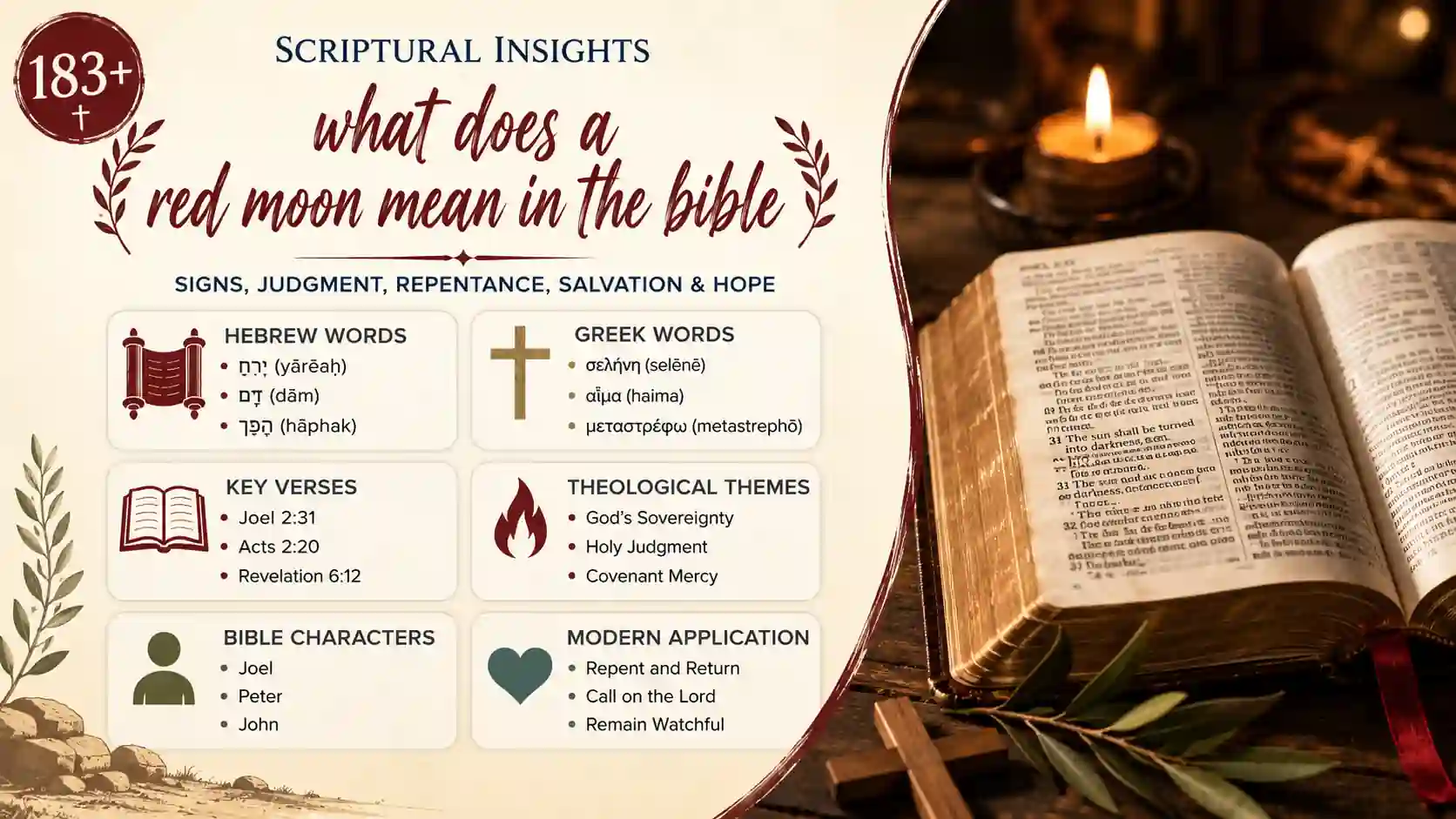
What does a red moon mean in the Bible? Scripture never uses the modern expression “red moon” as a technical prophecy term. Instead, Joel, Acts, and Revelation describe the moon becoming “blood” or appearing “like blood.” These images belong to prophetic and apocalyptic passages about divine judgment, the day of the Lord, and the final triumph of God.
As you study these texts, you should read the red moon within its literary and covenant setting. The biblical emphasis is not on predicting ordinary eclipses but on calling people to repentance, faith, watchfulness, and hope.
Red Moon Key Scripture References
| Verse | Passage Snippet | Context |
|---|---|---|
| Joel 2:10 | Sun and moon grow dark | Locust judgment imagery |
| Joel 2:30 | Wonders in heaven and earth | Signs before God’s day |
| Joel 2:31 | Moon turned to blood | Day of the Lord |
| Joel 2:32 | Whoever calls will be saved | Mercy beside judgment |
| Isaiah 13:10 | Moon will not shine | Judgment against Babylon |
| Isaiah 24:23 | Moon confounded | Lord reigns in Zion |
| Matthew 24:29 | Moon gives no light | Christ’s coming |
| Acts 2:20 | Moon turned to blood | Peter quotes Joel |
| Revelation 6:12 | Moon became like blood | Opening of sixth seal |
| Revelation 8:12 | Third of moon darkened | Fourth trumpet judgment |
Joel 2:31 contains the clearest Old Testament wording. The Hebrew text says that the moon will be turned “to blood” before the great and awe-inspiring day of the Lord. Acts 2:20 repeats this prophecy in Greek, while Revelation 6:12 says the whole moon became “like blood.”
Red Moon Bible Translation Comparison
| Verse | KJV | NIV | ESV | NASB |
|---|---|---|---|---|
| Joel 2:10 | Moon shall be dark | Moon are darkened | Moon are darkened | Moon grow dark |
| Joel 2:30 | Wonders in heavens | Wonders in heavens | Wonders in heavens | Wonders in sky |
| Joel 2:31 | Moon into blood | Moon to blood | Moon to blood | Moon into blood |
| Joel 2:32 | Shall be delivered | Will be saved | Shall be saved | Will be saved |
| Isaiah 13:10 | Moon shall not shine | Moon will not give light | Moon will not shed light | Moon will not give light |
| Matthew 24:29 | Moon shall not give light | Moon will not give light | Moon will not give light | Moon will not give its light |
| Acts 2:20 | Great and notable day | Glorious day | Great and magnificent day | Great and glorious day |
| Revelation 6:12 | Moon became as blood | Moon turned blood red | Moon became like blood | Moon became like blood |
| Revelation 8:12 | Third part of moon | Third of moon | Third of moon | Third of moon |
| Revelation 21:23 | No need of moon | Does not need moon | No need of moon | No need of moon |
The translations agree on the central image. Joel and Acts speak of the moon being turned to blood, while Revelation 6:12 preserves an explicit comparison by saying it became “like” or “as” blood. That difference should caution you against forcing every passage into a woodenly literal description.
Red Moon People and Characters Associated
| Person | Role | Connection |
|---|---|---|
| Joel | Prophet of Judah | Foretold moon to blood |
| The Lord | Covenant God | Sends signs and salvation |
| Judah’s inhabitants | Original hearers | Called to repentance |
| Priests | Covenant ministers | Led national lament |
| Peter | Apostle | Applied Joel at Pentecost |
| Jesus | Messiah and Judge | Taught cosmic signs |
| Jerusalem crowd | Pentecost hearers | Heard Joel explained |
| John | Apostle and seer | Saw moon like blood |
| Sixth-seal rulers | Terrified humanity | Hid from divine wrath |
| The redeemed | Saved worshipers | Stand secure before God |
Joel announced both judgment and restoration to a covenant community devastated by calamity. Peter later quoted Joel in Jerusalem to explain the outpouring of the Holy Spirit. John’s vision places the bloodlike moon within the terror of the sixth seal, when people recognize the approaching wrath of God and of the Lamb.
Red Moon Original Hebrew and Greek Words
| Original Word | Transliteration | Strong’s # | Literal Meaning |
|---|---|---|---|
| יָרֵחַ | yārēaḥ | H3394 | Moon |
| דָּם | dām | H1818 | Blood |
| הָפַךְ | hāphak | H2015 | Turn, overturn |
| חֹשֶׁךְ | ḥōshek | H2822 | Darkness |
| יוֹם | yôm | H3117 | Day |
| מוֹפֵת | môpēt | H4159 | Wonder, sign |
| σελήνη | selēnē | G4582 | Moon |
| αἷμα | haima | G129 | Blood |
| μεταστρέφω | metastrephō | G3344 | Turn, change |
| σκότος | skotos | G4655 | Darkness |
In Joel 2:31, יָרֵחַ, yārēaḥ, is the ordinary Hebrew noun for the moon, and דָּם, dām, means blood. The verb הָפַךְ, hāphak, communicates a turning or transformation. Acts uses the corresponding Greek nouns σελήνη, selēnē, and αἷμα, haima, with μεταστρέφω, metastrephō, for being turned or changed.
Red Moon Related Biblical Concepts
| Concept | Connection | Supporting Verse |
|---|---|---|
| Day of the Lord | Climactic divine intervention | Joel 2:31 |
| Cosmic disturbance | Creation shaken before God | Matthew 24:29 |
| Divine judgment | Nations face God’s justice | Isaiah 13:9-10 |
| Covenant warning | God summons repentance | Joel 2:12-13 |
| Salvation | Call on the Lord | Joel 2:32 |
| Pentecost | Joel applied by Peter | Acts 2:16-21 |
| Wrath of the Lamb | Christ judges rebellion | Revelation 6:16 |
| Prophetic symbolism | Visible images carry meaning | Revelation 6:12 |
| Human fear | Earthly powers tremble | Revelation 6:15 |
| New creation | God replaces created lights | Revelation 21:23 |
The red moon is never isolated from the larger message of Scripture. In Joel, the warning leads directly to an offer of salvation. In Acts, Peter’s quotation prepares his hearers to call upon the risen Christ. In Revelation, cosmic collapse exposes the inability of wealth, status, or political power to shelter sinners from divine judgment.
Red Moon Historical and Cultural Context
| Aspect | Detail | Biblical Source |
|---|---|---|
| Ancient agriculture | Moon marked seasons | Psalm 104:19 |
| Israelite calendar | Months followed lunar cycles | Numbers 28:11 |
| New moon worship | Regular sacred observance | Numbers 10:10 |
| Prophetic poetry | Cosmic signs portray upheaval | Isaiah 13:10 |
| Joel’s crisis | Land suffered devastating plague | Joel 1:4 |
| National lament | Priests and people gathered | Joel 2:15-17 |
| Ancient warfare | Smoke could darken skies | Joel 2:30 |
| Pentecost setting | Pilgrims gathered in Jerusalem | Acts 2:5 |
| Roman imperial world | Kings claimed earthly security | Revelation 6:15 |
| Apocalyptic genre | Visions reveal spiritual reality | Revelation 1:1 |
Ancient Israelites depended upon the moon for agricultural rhythms, feast calendars, and the marking of months. A darkened or bloodlike moon therefore suggested more than an unusual sky. It pictured the disruption of the created order upon which ordinary human life depended.
Prophets often used cosmic language when describing the downfall of kingdoms. Isaiah 13 applies darkened heavenly bodies to Babylon’s judgment. Such language can refer to historical upheaval, final judgment, or both, depending on the passage. You must allow each biblical context to control your interpretation.
Red Moon Theological Themes
| Theme | Explanation | Scripture |
|---|---|---|
| God’s sovereignty | Creation responds to its Maker | Joel 2:30-31 |
| Holy judgment | Evil will not endure forever | Isaiah 13:11 |
| Covenant mercy | God welcomes returning sinners | Joel 2:12-13 |
| Universal salvation call | All may call on the Lord | Joel 2:32 |
| Christ’s authority | The Lamb executes judgment | Revelation 6:16 |
| Spirit outpouring | Joel fulfilled at Pentecost | Acts 2:16-18 |
| Human accountability | Every social rank faces God | Revelation 6:15 |
| Prophetic fulfillment | Earlier promises shape later events | Acts 2:20 |
| Creation’s renewal | Present heavens are not ultimate | Revelation 21:23 |
| Christian hope | God’s kingdom will prevail | Revelation 11:15 |
The image joins two truths that should never be separated. God is holy and will judge persistent rebellion, yet he graciously invites sinners to call upon his name. Joel’s prophecy does not end with darkness. It moves toward deliverance, the Spirit’s work, and the preservation of a people who belong to the Lord.
Red Moon Modern Application for Believers
| Area | Practice | Scripture |
|---|---|---|
| Bible reading | Study the whole passage | Joel 2:28-32 |
| Repentance | Return to God sincerely | Joel 2:12 |
| Prayer | Call upon the Lord | Joel 2:32 |
| Watchfulness | Remain spiritually alert | Matthew 24:42 |
| Discernment | Test sensational claims | 1 Thessalonians 5:21 |
| Evangelism | Proclaim salvation in Christ | Acts 2:38 |
| Worship | Revere the Creator | Revelation 4:11 |
| Courage | Refuse panic and speculation | Luke 21:28 |
| Humility | Remember human limits | Matthew 24:36 |
| Hope | Await God’s renewed creation | Revelation 21:23 |
A lunar eclipse may make the moon appear red because of natural processes within God’s creation. Scripture does not command you to treat every eclipse as a newly coded prophetic message. Jesus warned against false alarms and taught that no human being knows the day or hour of his return.
Your proper response is neither mockery nor panic. You can receive unusual sights in creation with reverence while refusing date-setting, superstition, and fear. Biblical prophecy is given to strengthen faithfulness, not to reward speculation.
What Does a Red Moon Mean in the Bible within Joel’S Day of the Lord?
Joel’s bloodlike moon belongs to a sequence of wonders involving blood, fire, smoke, darkness, and the coming day of the Lord. These signs announce that history is moving toward divine reckoning. They reveal that God’s judgment is not a minor interruption but a world-shaking intervention.
Yet Joel 2:32 places grace beside warning. Anyone who calls upon the name of the Lord will be saved. When you read the red moon correctly, it should lead you toward repentance and trust rather than curiosity about secret calendars.
From יָרֵחַ YāRēaḥ to σελήνη SelēNē at Pentecost
Peter quotes Joel in Acts 2 after the Holy Spirit fills the disciples. He does not claim that every element of Joel’s prophecy was visually exhausted that morning. Rather, he announces that the promised last-days work of the Spirit has begun through the risen and exalted Jesus.
The change from Hebrew יָרֵחַ, yārēaḥ, to Greek σελήνη, selēnē, does not alter the image. Both mean “moon.” Peter preserves Joel’s prophetic connection between the Spirit’s outpouring, cosmic signs, the day of the Lord, and the offer of salvation.
The Moon “Like Blood” in Revelation’S Sixth Seal
Revelation 6:12 uses apocalyptic imagery. A great earthquake occurs, the sun becomes black, the moon becomes like blood, stars fall, and the sky recedes. The vision communicates the collapse of human security before the enthroned God and the Lamb.
Whether every detail should be understood as literal astronomy, symbolic portrayal, or symbolic language fulfilled through physical events, the theological center remains clear. Christ will judge evil, earthly powers cannot resist him, and humanity needs reconciliation with God before that day arrives.
Reading Blood-Moon Claims without Fear or Date-Setting
The Bible does not teach that every naturally occurring red moon fulfills Joel 2:31. Nor does it provide a formula linking a particular eclipse to a modern nation, election, war, or religious festival. Such claims go beyond what the text itself reveals.
You honor prophecy by letting it produce the responses Scripture names. Return to the Lord, receive the gospel, walk in the Spirit, remain watchful, and encourage others with the hope of Christ’s return. The sign points beyond itself to the sovereign Lord.
Red Moon Bible Study Questions
Does the Hebrew phrase יָרֵחַ לְדָם mean the moon literally becomes blood?
It literally reads “the moon to blood,” but prophetic context determines whether the transformation is physical, visual, symbolic, or a combination.
Why does Revelation 6:12 say the moon became “like blood”?
The Greek construction uses comparison, emphasizing the moon’s bloodlike appearance within John’s apocalyptic vision.
Was Joel 2:31 completely fulfilled in Acts 2:20?
Peter presents Pentecost as the arrival of Joel’s promised last-days era, while the prophecy’s final judgment imagery still points forward.
Should Christians interpret every red lunar eclipse as a prophetic sign?
No. Scripture never instructs believers to assign prophetic fulfillment to every eclipse or use lunar events to set dates.
What should you do after studying the red moon passages?
Call upon the Lord, turn from sin, trust Christ, remain watchful, and live with reverent hope rather than fear.