
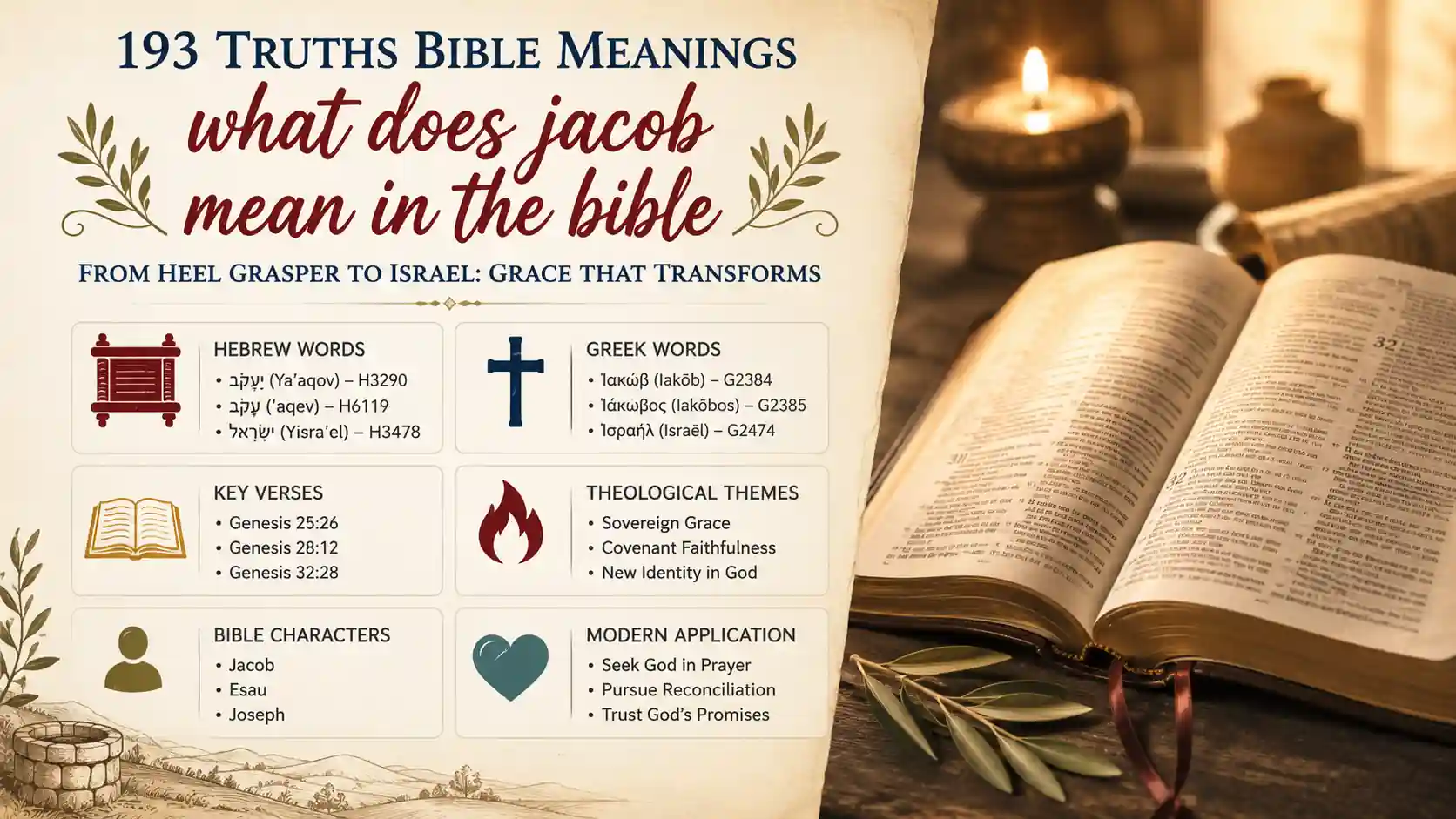
What does Jacob mean in the Bible? The name comes from the Hebrew יַעֲקֹב, Yaʿaqov, and is connected with עָקֵב, ʿaqev, meaning “heel.” Jacob received this name because he was born grasping the heel of his twin brother Esau.
Scripture develops that birth image through Jacob’s struggles, failures, and transformation. Though his name became associated with grasping and supplanting, God renamed him Israel and made him the father of the twelve tribes. Your study of Jacob therefore reveals both human weakness and covenant grace.
Jacob Key Scripture References
| Verse | Passage Snippet | Context |
|---|---|---|
| Genesis 25:23 | Two nations are in your womb | God foretells the twins’ destinies |
| Genesis 25:26 | His hand held Esau’s heel | Jacob receives his birth name |
| Genesis 25:31 | Sell me your birthright | Jacob seeks Esau’s privilege |
| Genesis 27:36 | He has supplanted me | Esau interprets Jacob’s name |
| Genesis 28:12 | A ladder set on earth | Jacob dreams at Bethel |
| Genesis 28:13 | God of Abraham and Isaac | The covenant is confirmed |
| Genesis 32:28 | Your name shall be Israel | Jacob is renamed after wrestling |
| Genesis 35:10 | Israel shall be your name | God formally repeats the new name |
| Genesis 46:2 | Jacob, Jacob | God speaks before the move to Egypt |
| Malachi 1:2 | Jacob I loved | God recalls covenant election |
Jacob Bible Translation Comparison
| Verse | KJV | NIV | ESV | NASB |
|---|---|---|---|---|
| Genesis 25:26 | Took hold on Esau’s heel | Grasping Esau’s heel | Holding Esau’s heel | Holding on to Esau’s heel |
| Genesis 27:36 | Rightly named Jacob | Rightly named Jacob | Rightly named Jacob | Rightly named Jacob |
| Genesis 28:12 | A ladder | A stairway | A ladder | A ladder |
| Genesis 28:15 | I am with thee | I am with you | I am with you | I am with you |
| Genesis 32:24 | Wrestled a man | A man wrestled | A man wrestled | A man wrestled |
| Genesis 32:28 | No more Jacob | No longer Jacob | No longer Jacob | No longer Jacob |
| Genesis 35:10 | Israel shall be thy name | Your name will be Israel | Israel shall be your name | Israel shall be your name |
| Hosea 12:3 | Took his brother by the heel | Grasped his brother’s heel | Took his brother by the heel | Took his brother by the heel |
| Malachi 1:2 | I loved Jacob | I have loved Jacob | I have loved Jacob | I have loved Jacob |
| Matthew 1:2 | Jacob begat Judas | Jacob the father of Judah | Jacob the father of Judah | Jacob fathered Judah |
The major English translations preserve the connection between Jacob and Esau’s heel, though their wording differs slightly. Genesis 25:26 presents the physical action, while Genesis 27:36 connects the name with Esau’s accusation that Jacob had supplanted him.
Jacob People and Characters Associated
| Person | Role | Connection |
|---|---|---|
| Abraham | Grandfather | First recipient of the patriarchal covenant |
| Sarah | Grandmother | Matriarch of the promised family |
| Isaac | Father | Blesses Jacob as covenant heir |
| Rebekah | Mother | Receives prophecy about the twins |
| Esau | Twin brother | Loses birthright and blessing |
| Laban | Uncle and employer | Deceives and tests Jacob |
| Leah | First wife | Mother of six sons |
| Rachel | Beloved wife | Mother of Joseph and Benjamin |
| Joseph | Son | Preserves Jacob’s household in Egypt |
| Judah | Son | Carries the royal and messianic line |
Jacob Original Hebrew and Greek Words
| Original Word | Transliteration | Strong’s # | Literal Meaning |
|---|---|---|---|
| יַעֲקֹב | Yaʿaqov | H3290 | Jacob, heel holder |
| עָקֵב | ʿaqev | H6119 | Heel, rear part |
| עָקַב | ʿaqav | H6117 | To follow at the heel |
| יִשְׂרָאֵל | Yisraʾel | H3478 | Israel, God strives |
| בְּכוֹרָה | bekhorah | H1062 | Birthright |
| בְּרָכָה | berakhah | H1293 | Blessing |
| Ἰακώβ | Iakōb | G2384 | Jacob |
| Ἰάκωβος | Iakōbos | G2385 | James, Greek form of Jacob |
| Ἰσραήλ | Israēl | G2474 | Israel |
| διαθήκη | diathēkē | G1242 | Covenant |
Strong’s H3290 identifies יַעֲקֹב, Yaʿaqov, as Jacob’s personal name and connects it with the idea of holding the heel or supplanting. Strong’s G2384 identifies Ἰακώβ, Iakōb, the Greek form normally used for the patriarch in the New Testament.
The related Greek name Ἰάκωβος, Iakōbos, appears in English Bibles as “James.” This explains why Jacob and James look unrelated in English even though they arise from the same ancient name.
Jacob Related Biblical Concepts
| Concept | Connection | Supporting Verse |
|---|---|---|
| Election | God chooses the younger twin | Genesis 25:23 |
| Birthright | Jacob acquires Esau’s status | Genesis 25:31 |
| Blessing | Isaac gives Jacob covenant privileges | Genesis 27:28 |
| Exile | Jacob flees from Esau | Genesis 27:43 |
| Bethel | God confirms His promises | Genesis 28:19 |
| Providence | God protects Jacob abroad | Genesis 31:24 |
| Wrestling | Jacob seeks divine blessing | Genesis 32:24 |
| New identity | Jacob receives the name Israel | Genesis 32:28 |
| Reconciliation | Jacob meets Esau peacefully | Genesis 33:4 |
| Covenant family | His sons become tribal fathers | Genesis 49:28 |
Jacob Historical and Cultural Context
| Aspect | Detail | Biblical Source |
|---|---|---|
| Twin rivalry | The brothers struggled before birth | Genesis 25:22 |
| Firstborn status | Esau possessed customary precedence | Genesis 25:25 |
| Birthright | Included family leadership and inheritance | Genesis 25:31 |
| Oral blessing | A father’s blessing carried legal weight | Genesis 27:33 |
| Household tents | Jacob lived among pastoral families | Genesis 25:27 |
| Bride service | Jacob worked years for his wives | Genesis 29:20 |
| Bride custom | Older daughters married before younger ones | Genesis 29:26 |
| Flocks | Livestock represented substantial wealth | Genesis 30:43 |
| Memorial stones | Stones marked encounters and agreements | Genesis 28:18 |
| Family burial | Machpelah represented ancestral belonging | Genesis 49:30 |
Jacob Theological Themes
| Theme | Explanation | Scripture |
|---|---|---|
| Sovereign grace | God chooses before human merit appears | Romans 9:11 |
| Covenant faithfulness | God preserves Abraham’s promises | Genesis 28:13 |
| Human sin | Jacob uses manipulation and deception | Genesis 27:19 |
| Divine discipline | Jacob experiences deception from Laban | Genesis 29:25 |
| Sanctification | God reshapes Jacob through hardship | Genesis 32:25 |
| Dependence | Jacob leaves the struggle physically weakened | Genesis 32:31 |
| New identity | Israel marks a changed covenant vocation | Genesis 35:10 |
| Reconciliation | Grace restores the divided brothers | Genesis 33:4 |
| Preservation | Joseph saves Jacob’s household | Genesis 45:7 |
| Messianic hope | Royal promise proceeds through Judah | Genesis 49:10 |
Jacob Modern Application for Believers
| Area | Practice | Scripture |
|---|---|---|
| Identity | Receive your identity from God | Genesis 35:10 |
| Ambition | Refuse manipulative advancement | Genesis 27:35 |
| Prayer | Bring fear honestly before God | Genesis 32:11 |
| Persistence | Seek God with earnest faith | Genesis 32:26 |
| Repentance | Face the relationships you have damaged | Genesis 32:6 |
| Reconciliation | Approach others with humility | Genesis 33:3 |
| Worship | Remember places of divine help | Genesis 35:7 |
| Family | Speak blessing with spiritual seriousness | Genesis 49:28 |
| Suffering | Trust God’s providence through loss | Genesis 48:16 |
| Mortality | Rest in God’s promises at life’s end | Hebrews 11:21 |
What Does Jacob Mean in the Bible Through יַעֲקֹב?
The most immediate meaning of יַעֲקֹב, Yaʿaqov, is tied to the heel. Jacob emerged from the womb with his hand grasping Esau’s heel, so his name preserved the unusual circumstances of his birth. The image suggests one who comes behind, follows closely, or takes hold of another’s heel.
“Supplanter” is therefore an interpretive meaning rather than a simple dictionary replacement. Genesis itself encourages that association when Esau complains that Jacob had “supplanted” him twice, first concerning the birthright and then the blessing. The narrative turns the name into a portrait of Jacob’s early conduct.
From Heel Grasper to Israel at Peniel
Jacob’s decisive transformation occurs beside the Jabbok River. Alone at night, he wrestles with a mysterious man until daybreak, refuses to release him without a blessing, and receives the name Israel. The encounter leaves Jacob blessed but limping.
His wound matters because it overturns his lifelong pattern of gaining advantage through cleverness. Jacob enters the night arranging people, gifts, and strategies, but he leaves dependent on God. His limp becomes a bodily reminder that covenant blessing is received through grace rather than controlled by human strength.
The Abrahamic Covenant in Jacob’S Life
At Bethel, God identifies Himself as the God of Abraham and Isaac and promises Jacob land, descendants, worldwide blessing, protection, and eventual return. Jacob has done nothing in that moment to earn such favor. He is a frightened fugitive sleeping outdoors after deceiving his father.
God’s promise shows that covenant faithfulness rests primarily on God’s character. Jacob’s moral failures remain serious, yet they do not defeat the divine purpose. God disciplines him through exile, family conflict, labor, fear, and grief while faithfully forming him into the patriarch Israel.
Jacob as a Person and a People
After the renaming, Scripture continues to use both Jacob and Israel. The two names can refer to the same man, but they also carry literary and theological associations. “Jacob” often recalls the patriarch’s personal history, while “Israel” emphasizes his covenant identity and the nation descending from him.
The prophets later address the people collectively as Jacob. This usage reminds Israel that its national story began not with human greatness but with a flawed man sustained by divine mercy. When Scripture calls God “the God of Jacob,” it proclaims that He remains faithful to needy and imperfect covenant people.
Questions About Jacob’S Biblical Meaning
Does יַעֲקֹב, Yaʿaqov, literally mean deceiver?
Not exactly, since it is directly connected with “heel,” while “deceiver” or “supplanter” reflects the narrative wordplay surrounding Jacob’s conduct.
Why does Esau connect Jacob’s name with supplanting in Genesis 27:36?
Esau interprets Jacob’s name through his grievances, claiming that Jacob displaced him in both the birthright and the paternal blessing.
Why did God change Jacob’s name to יִשְׂרָאֵל, Yisraʾel?
The new name marked Jacob’s transforming encounter with God and his vocation as the father of the covenant nation.
Why is Jacob called both Jacob and Israel after Genesis 32?
Both names remain useful because Scripture presents his continuing human weakness alongside his God-given covenant identity.
Is the New Testament name Ἰάκωβος, Iakōbos, related to Jacob?
Yes, it derives from the same name, although English translation tradition usually renders Ἰάκωβος as James and Ἰακώβ as Jacob.