
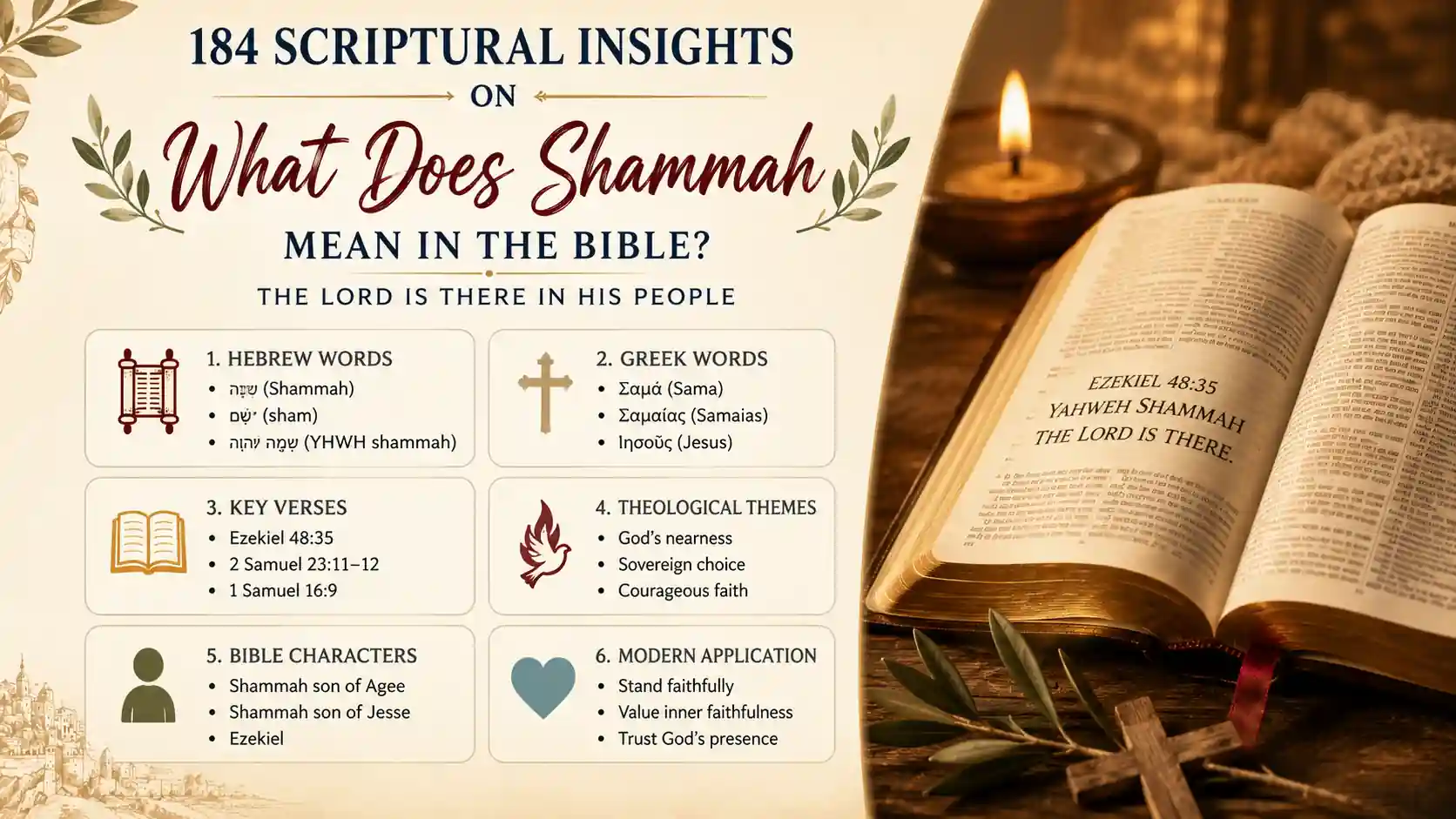
What does Shammah mean in the Bible? The answer depends on whether Scripture is referring to a person named Shammah or to the prophetic expression commonly written as Yahweh Shammah. The personal name שַׁמָּה, Shammah, is associated with several men and is traditionally understood as “astonishment.”
A different Hebrew form appears in Ezekiel 48:35. There, שָׁמָּה, shammah, means “there.” Joined with יהוה, YHWH, it forms the declaration “The LORD is there,” expressing the restored presence of God among his people.
Key Shammah Scripture References
| Verse | Passage Snippet | Context |
|---|---|---|
| Genesis 36:13 | “Shammah, and Mizzah” | Esau’s family line |
| Genesis 36:17 | “chief Shammah” | An Edomite clan chief |
| 1 Samuel 16:9 | “Jesse made Shammah pass by” | Samuel examines Jesse’s sons |
| 1 Samuel 17:13 | “the third Shammah” | David’s older brother |
| 2 Samuel 23:11 | “Shammah the son of Agee” | One of David’s mighty men |
| 2 Samuel 23:12 | “defended it” | Shammah protects the field |
| 2 Samuel 23:33 | “Shammah the Hararite” | Listed among David’s warriors |
| Ezekiel 48:35 | “The LORD is there” | Name of the restored city |
Shammah Bible Translation Comparison
| Verse | KJV | NIV | ESV | NASB |
|---|---|---|---|---|
| Genesis 36:13 | “Shammah, and Mizzah” | “Shammah and Mizzah” | “Shammah, and Mizzah” | “Shammah and Mizzah” |
| Genesis 36:17 | “duke Shammah” | “chief Shammah” | “chief Shammah” | “chief Shammah” |
| 1 Samuel 16:9 | “made Shammah to pass by” | “had Shammah pass by” | “made Shammah pass by” | “had Shammah pass by” |
| 1 Samuel 17:13 | “the third Shammah” | “the third Shammah” | “the third Shammah” | “the third Shammah” |
| 2 Samuel 23:11 | “Shammah the son of Agee” | “Shammah son of Agee” | “Shammah, the son of Agee” | “Shammah the son of Agee” |
| 2 Samuel 23:12 | “defended it” | “defended it” | “defended it” | “defended it” |
| 2 Samuel 23:33 | “Shammah the Hararite” | “Shammah the Hararite” | “Shammah the Hararite” | “Shammah the Hararite” |
| Ezekiel 48:35 | “The LORD is there” | “THE LORD IS THERE” | “The LORD Is There” | “The LORD is there” |
People and Characters Associated with Shammah
| Person | Role | Connection |
|---|---|---|
| Shammah son of Reuel | Edomite chief | Grandson of Esau |
| Shammah son of Jesse | David’s brother | Passed before Samuel |
| Shammah son of Agee | Mighty warrior | Defended a lentil field |
| Shammah the Hararite | Warrior of David | Named among the Thirty |
| Jesse | Father in Bethlehem | Father of one Shammah |
| David | King of Israel | Brother and military leader |
| Samuel | Prophet and judge | Declared Shammah unchosen |
| Ezekiel | Exilic prophet | Announced YHWH Shammah |
Original Hebrew and Greek Words for Shammah
| Original Word | Transliteration | Strong’s # | Literal Meaning |
|---|---|---|---|
| שַׁמָּה | Shammah | H8048 | Astonishment, personal name |
| שָׁם | sham | H8033 | There |
| שָׁמָּה | shammah | H8033 | There, toward there |
| יְהוָה שָׁמָּה | YHWH shammah | H3074 | The LORD is there |
| יְהוָה | YHWH | H3068 | The covenant name of God |
| שַׁמָּה | shammah | H8047 | Desolation or horror |
| Σαμά | Sama | None assigned | Greek form of the name |
| Σαμαίας | Samaias | None assigned | Greek rendering of Shammah |
The similar spellings should not be treated as identical definitions. Strong’s H8048 identifies the personal name, H8033 supplies the locative word “there,” and H3074 catalogues the complete symbolic title in Ezekiel 48:35. The Greek Septuagint generally transliterates the personal name rather than translating its Hebrew sense.
Related Biblical Concepts Connected with Shammah
| Concept | Connection | Supporting Verse |
|---|---|---|
| Divine presence | God dwells with his people | Ezekiel 48:35 |
| Covenant restoration | Exiles receive renewed hope | Ezekiel 36:24 |
| Holy dwelling | God’s glory returns | Ezekiel 43:4 |
| Courage | Shammah stands when others flee | 2 Samuel 23:11 |
| Deliverance | Victory is credited to the LORD | 2 Samuel 23:12 |
| Divine election | Shammah is not chosen as king | 1 Samuel 16:9 |
| Faithful service | David’s warriors serve loyally | 2 Samuel 23:8 |
| New creation | God dwells with humanity | Revelation 21:3 |
Historical and Cultural Context of Shammah
| Aspect | Detail | Biblical Source |
|---|---|---|
| Edomite ancestry | One Shammah descended from Esau | Genesis 36:13 |
| Clan leadership | “Chief” marked tribal authority | Genesis 36:17 |
| Bethlehem household | Jesse presented his sons | 1 Samuel 16:6-10 |
| Royal selection | God chose by the heart | 1 Samuel 16:7 |
| Philistine conflict | Israel faced repeated invasions | 2 Samuel 23:11 |
| Agricultural warfare | Crops could become battle sites | 2 Samuel 23:11 |
| Warrior companies | David had elite fighting groups | 2 Samuel 23:8 |
| Babylonian exile | Ezekiel spoke among displaced Judeans | Ezekiel 1:1-3 |
Theological Themes in Shammah
| Theme | Explanation | Scripture |
|---|---|---|
| God’s nearness | His restored city bears his presence | Ezekiel 48:35 |
| Restored glory | God returns after judgment | Ezekiel 43:1-5 |
| Sovereign choice | Appearance does not determine calling | 1 Samuel 16:7-9 |
| Courageous faith | One servant may stand against many | 2 Samuel 23:11 |
| Divine victory | The LORD brings deliverance | 2 Samuel 23:12 |
| Covenant faithfulness | God gathers and cleanses his people | Ezekiel 36:24-28 |
| Sacred community | God dwells among a holy people | Ezekiel 37:27 |
| Final fellowship | God’s dwelling comes to humanity | Revelation 21:3 |
Modern Application of Shammah for Believers
| Area | Practice | Scripture |
|---|---|---|
| Worship | Seek God rather than mere atmosphere | Psalm 27:4 |
| Courage | Stand faithfully when others retreat | 2 Samuel 23:11-12 |
| Calling | Value inward faithfulness over appearance | 1 Samuel 16:7 |
| Work | Protect responsibilities entrusted to you | Colossians 3:23 |
| Prayer | Remember that God hears and remains near | Psalm 145:18 |
| Suffering | Trust God’s presence in hardship | Psalm 46:1 |
| Community | Build relationships shaped by holiness | 1 Peter 2:5 |
| Hope | Anticipate unbroken fellowship with God | Revelation 21:3 |
What Does Shammah Mean in the Bible When It Names a Person?
The personal name שַׁמָּה, Shammah, is Strong’s H8048. Lexicons commonly associate it with “astonishment,” though biblical names do not always function as descriptions of a person’s character. Several unrelated men bear the name, so context must determine which Shammah a passage means.
One Shammah belonged to Esau’s descendants and became an Edomite chief. Another was Jesse’s third son and David’s older brother. At least one Shammah served among David’s mighty warriors, most memorably the son of Agee who defended a field against the Philistines.
Shammah Son of Agee and the Field of Lentils
Second Samuel 23:11-12 presents Shammah in a moment of crisis. The Philistines gathered where a lentil crop was growing, and Israel’s troops fled. Shammah placed himself in the middle of the field, held his ground, and struck down the attackers.
The narrative honors his courage, but its final emphasis rests on God. The text says that “the LORD worked a great victory.” Your study should therefore avoid turning Shammah into a model of self-sufficient heroism. His steadfast action mattered, yet deliverance belonged to God.
The field itself also carries significance. Agricultural land represented food, labor, inheritance, and community survival. Shammah did not defend a glamorous prize. He faithfully protected an ordinary place that had been entrusted to Israel.
His example can challenge you to recognize the value of seemingly small responsibilities. Faithfulness is often revealed when you refuse to abandon what God has placed before you, even when others consider it insignificant or the opposition appears overwhelming.
Shammah Son of Jesse and God’S Sovereign Choice
In 1 Samuel 16, Jesse brought his sons before Samuel so that the prophet could identify Israel’s next king. Shammah passed before Samuel, but the LORD had not chosen him. This does not present Shammah as wicked or rejected from covenant fellowship.
The scene teaches that kingship would not be determined by age, stature, or human expectation. God selected David, the youngest son who was tending sheep. Shammah’s appearance in the account helps reveal the freedom and wisdom of divine election.
This passage also guards you against assuming that public prominence is the measure of spiritual worth. Shammah was not chosen for David’s calling because that calling belonged to David. God’s differing assignments should produce humility rather than rivalry.
For your own discipleship, the question is not whether your role resembles someone else’s. The question is whether you will receive your place faithfully. Scripture can mention a person briefly while still placing that life within the larger unfolding of God’s purpose.
Yhwh Shammah and the Promise That the Lord Is There
In Ezekiel 48:35, Shammah is not the personal name found in the narratives about David’s family or warriors. The phrase is יְהוָה שָׁמָּה, YHWH shammah, meaning “The LORD is there.” Here, שָׁמָּה points to location and presence rather than astonishment.
This declaration concludes Ezekiel’s vision of a renewed land, reordered tribes, a restored sanctuary, and a holy city. Earlier in the book, the prophet had witnessed the glory of the LORD departing from the defiled temple. The closing name announces the reversal of that tragedy.
Ezekiel ministered during the Babylonian exile, when Jerusalem had been devastated and many Judeans had lost their homeland. To such hearers, “The LORD is there” promised far more than reconstruction. It declared renewed communion between the covenant God and his restored people.
The title should not be reduced to a vague statement that God is everywhere. Ezekiel’s emphasis is relational and covenantal. The God whose holiness exposed Israel’s sin would cleanse, gather, reorder, and dwell among his people again.
Christians also hear an echo of this hope in Revelation 21:3, where God’s dwelling is with humanity. Ezekiel’s city and John’s new Jerusalem share the central joy of redemption. The greatest blessing is not merely safety, beauty, or abundance, but God himself dwelling with his people.
Questions About Shammah in Scripture
Are שַׁמָּה, Shammah, and שָׁמָּה, shammah, the same Hebrew word?
No. They look similar, but H8048 is a personal name, while the form connected with H8033 means “there.”
Does Shammah mean “the LORD is there” by itself?
No. שָׁמָּה means “there,” while יְהוָה שָׁמָּה, YHWH shammah, forms the full declaration “The LORD is there.”
Was Shammah son of Jesse the warrior who defended the lentil field?
Scripture does not identify them as the same man, so they should be treated as distinct individuals.
Why do some translations call Shammah’s Edomite title “duke” and others “chief”?
The older KJV uses “duke,” while modern translations use “chief” for the Hebrew clan-leadership title אַלּוּף, alluph.
What should you learn from Shammah’s stand in 2 Samuel 23?
You can practice steadfast courage in your assigned place while recognizing that every true victory ultimately comes from the LORD.