
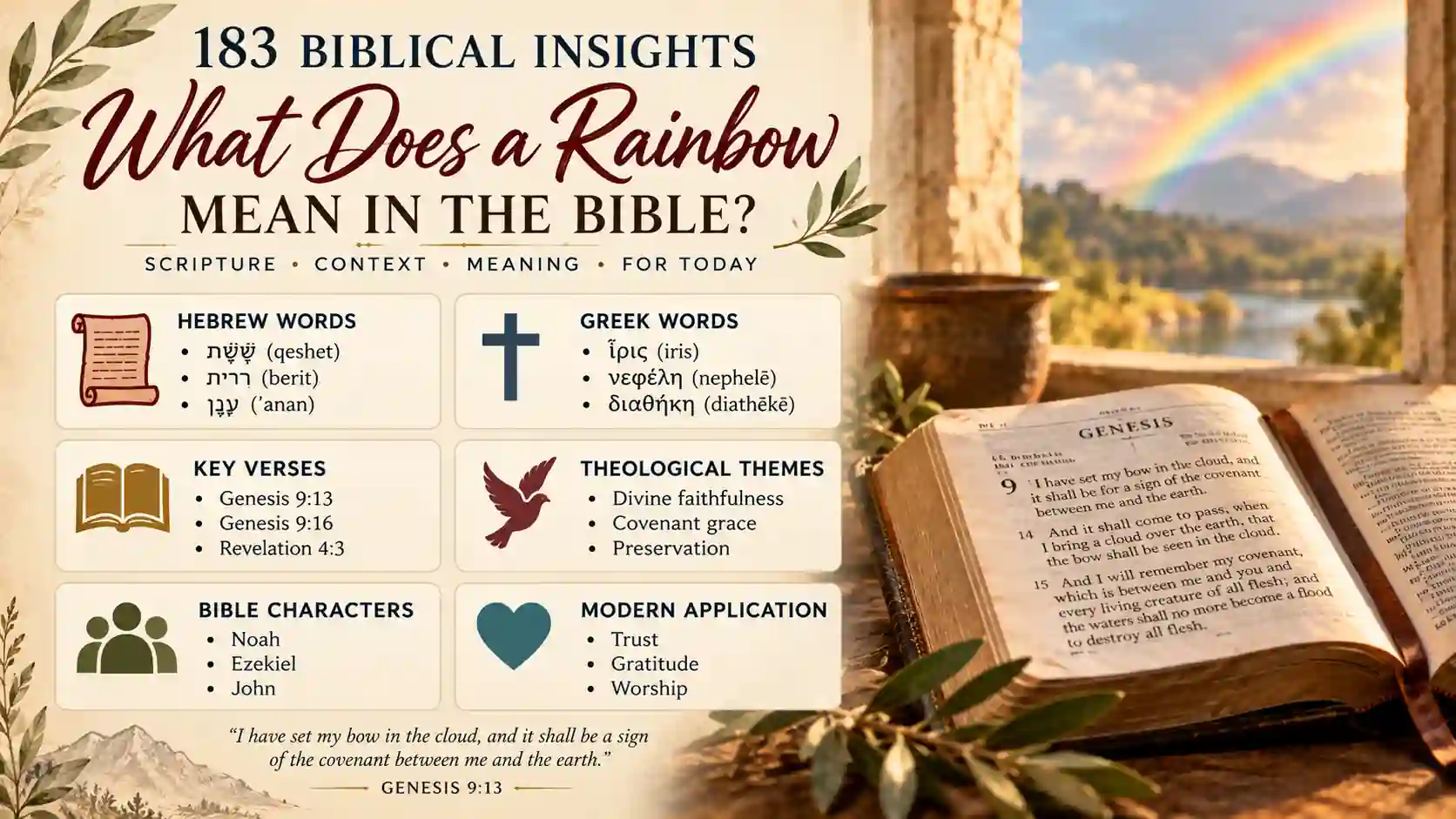
When you ask what does a rainbow mean in the Bible, Scripture leads you first to God’s covenant with Noah after the flood. The rainbow is not introduced merely as a beautiful feature of the sky. God identifies the bow as a covenant sign connected with His promise concerning the earth, humanity, and every living creature.
Later biblical writers use rainbow imagery in visions of divine glory. Ezekiel sees rainbow-like radiance around God’s throne, while Revelation places similar imagery around the heavenly throne and a mighty angel. Your study therefore moves from covenant promise to divine majesty, faithfulness, mercy, and judgment.
Rainbow Key Scripture References
| Verse | Passage Snippet | Context |
|---|---|---|
| Genesis 9:13 | “my bow in the cloud” | God establishes the covenant sign after the flood |
| Genesis 9:14 | bow appears in the clouds | God describes when the covenant sign becomes visible |
| Genesis 9:15 | God remembers His covenant | The flood will not again destroy all flesh |
| Genesis 9:16 | “everlasting covenant” | The bow points to God’s covenant with living creatures |
| Genesis 9:17 | sign of the covenant | God confirms the meaning of the bow to Noah |
| Ezekiel 1:28 | appearance of the rainbow | Ezekiel compares divine radiance to a rainbow |
| Revelation 4:3 | rainbow around the throne | John sees heavenly majesty surrounding God’s throne |
| Revelation 10:1 | rainbow upon his head | A mighty angel descends clothed with a cloud |
Rainbow Bible Translation Comparison
| Verse | KJV | NIV | ESV | NASB |
|---|---|---|---|---|
| Genesis 9:13 | “my bow” | “my rainbow” | “my bow” | “My rainbow” |
| Genesis 9:14 | “the bow” | “the rainbow” | “the bow” | “the rainbow” |
| Genesis 9:15 | “my covenant” | “my covenant” | “my covenant” | “My covenant” |
| Genesis 9:16 | “everlasting covenant” | “everlasting covenant” | “everlasting covenant” | “everlasting covenant” |
| Genesis 9:17 | “token of the covenant” | “sign of the covenant” | “sign of the covenant” | “sign of the covenant” |
| Ezekiel 1:28 | “the bow” | “a rainbow” | “the bow” | “the rainbow” |
| Revelation 4:3 | “a rainbow” | “a rainbow” | “a rainbow” | “a rainbow” |
| Revelation 10:1 | “a rainbow” | “a rainbow” | “the rainbow” | “the rainbow” |
The translation difference in Genesis is significant for your word study. The Hebrew noun does not specifically mean only “rainbow.” It is the ordinary word for a bow, including a weapon. Some translations retain “bow,” while others render the atmospheric meaning explicitly as “rainbow.”
Rainbow People and Characters Associated
| Person | Role | Connection |
|---|---|---|
| God | Covenant maker | Places His bow in the cloud |
| Noah | Flood survivor | First human recipient of the rainbow covenant |
| Shem | Son of Noah | Included in the post-flood covenant setting |
| Ham | Son of Noah | Present when God establishes the covenant |
| Japheth | Son of Noah | Shares in the renewed post-flood world |
| Ezekiel | Prophet | Sees rainbow-like radiance around divine glory |
| John | Apostle and seer | Sees a rainbow around the heavenly throne |
| Mighty angel | Heavenly messenger | Appears with a rainbow above his head |
Rainbow Hebrew and Greek Words
| Original Word | Transliteration | Strong’s # | Literal Meaning |
|---|---|---|---|
| קֶשֶׁת | qeshet | H7198 | bow |
| קַשָּׁת | qashshat | H7199 | archer, bowman |
| עָנָן | ʿanan | H6051 | cloud |
| בְּרִית | berit | H1285 | covenant |
| אוֹת | ʾot | H226 | sign, mark |
| זָכַר | zakhar | H2142 | remember |
| ἶρις | iris | G2463 | rainbow, halo |
| νεφέλη | nephelē | G3507 | cloud |
| διαθήκη | diathēkē | G1242 | covenant |
| θρόνος | thronos | G2362 | throne |
The central Old Testament term is קֶשֶׁת, qeshet, Strong’s H7198. It commonly means a bow, especially the weapon used by an archer. Genesis 9 applies that familiar word to the colored arc appearing in the clouds.
The New Testament word ἶρις, iris, Strong’s G2463, occurs in Revelation 4:3 and Revelation 10:1. In those visionary passages it describes rainbow-like heavenly splendor rather than retelling Noah’s story directly.
Rainbow Related Biblical Concepts
| Concept | Connection | Supporting Verse |
|---|---|---|
| Covenant | The rainbow identifies God’s post-flood pledge | Genesis 9:13 |
| Covenant sign | The bow visibly marks God’s promise | Genesis 9:17 |
| Mercy | God promises not to repeat the global flood judgment | Genesis 9:15 |
| Judgment | The sign appears after catastrophic judgment | Genesis 8:21 |
| Preservation | God pledges continuity for earthly life | Genesis 8:22 |
| Remembrance | God says He will remember His covenant | Genesis 9:15 |
| Divine glory | Rainbow radiance accompanies God’s glory | Ezekiel 1:28 |
| Heavenly throne | A rainbow surrounds the throne John sees | Revelation 4:3 |
| Creation | The covenant includes every living creature | Genesis 9:16 |
Rainbow Historical and Cultural Context
| Aspect | Detail | Biblical Source |
|---|---|---|
| Ancient bow | קֶשֶׁת normally names an archer’s bow | Genesis 27:3 |
| Flood setting | Rainbow sign follows the waters of judgment | Genesis 8 to 9 |
| Sacrifice | Noah offers burnt offerings after leaving the ark | Genesis 8:20 |
| Covenant audience | Noah and his descendants hear God’s promise | Genesis 9:8-9 |
| Animal inclusion | Every living creature is included | Genesis 9:10 |
| Universal scope | Covenant concerns the whole earth | Genesis 9:13 |
| Cloud imagery | The bow appears when clouds gather | Genesis 9:14 |
| Prophetic vision | Ezekiel describes heavenly glory symbolically | Ezekiel 1:26-28 |
| Apocalyptic vision | Revelation uses vivid throne-room imagery | Revelation 4:1-3 |
The ancient Hebrew wording gives the passage striking imagery. The same object associated with warfare becomes a visible sign connected with restraint and covenant preservation. Genesis itself does not explain this as God literally surrendering a weapon, so that interpretation should not be pressed beyond the text.
What Genesis clearly emphasizes is God’s initiative. God establishes the covenant, appoints its sign, declares its scope, and promises to remember it. The rainbow therefore directs attention more toward the character of the covenant-making God than toward human achievement.
Rainbow Theological Themes
| Theme | Explanation | Scripture |
|---|---|---|
| Divine faithfulness | God binds the sign to His own promise | Genesis 9:13 |
| Covenant grace | God initiates the covenant after judgment | Genesis 9:8-11 |
| Restraint of judgment | Floodwaters will not again destroy all flesh | Genesis 9:15 |
| Preservation | Earth’s ordinary rhythms continue | Genesis 8:22 |
| Universal concern | Humans and animals are included | Genesis 9:10 |
| Remembrance | God declares that He remembers His covenant | Genesis 9:16 |
| Glory | Rainbow brilliance accompanies divine splendor | Ezekiel 1:28 |
| Sovereignty | The rainbow surrounds God’s throne | Revelation 4:3 |
| Majesty | Heavenly rainbow imagery produces awe | Revelation 10:1 |
Rainbow Modern Application for Believers
| Area | Practice | Scripture |
|---|---|---|
| Trust | Remember that God keeps His declared promises | Genesis 9:16 |
| Worship | Let creation direct your attention toward its Creator | Genesis 9:13 |
| Gratitude | Receive ordinary seasons as gifts of preservation | Genesis 8:22 |
| Reverence | Read rainbow imagery alongside God’s holiness | Ezekiel 1:28 |
| Hope | Remember mercy even when studying judgment | Genesis 9:11 |
| Humility | Recognize that covenant faithfulness begins with God | Genesis 9:9 |
| Creation care | Value creatures included in God’s covenant language | Genesis 9:10 |
| Prayer | Praise God for faithfulness across generations | Genesis 9:12 |
| Bible study | Trace the image from Genesis through Revelation | Revelation 4:3 |
קֶשֶׁת Qeshet and the Bow God Set in the Clouds
The Hebrew קֶשֶׁת, qeshet is crucial for understanding Genesis 9. Elsewhere it commonly means the bow carried by an archer. English versions that translate it simply as “bow” therefore preserve the ordinary meaning of the Hebrew word, while translations using “rainbow” make the atmospheric sense explicit.
Genesis 9 repeatedly connects this bow with בְּרִית, berit, meaning covenant. The emphasis is not that humanity makes a pledge to God. God declares, “I establish my covenant,” and the bow becomes the אוֹת, ʾot, the sign that accompanies His promise concerning the earth and its creatures.
What Does a Rainbow Mean in the Bible After Noah’S Flood?
To answer what does a rainbow mean in the Bible, you must begin with judgment and mercy together. Genesis 6 through 9 presents the flood as divine judgment upon pervasive human wickedness. Noah is preserved with his family, and afterward God establishes a covenant extending to Noah’s descendants and every living creature.
The rainbow therefore does not mean that God ignores evil. It appears only after a narrative in which evil has been judged severely. Yet it also testifies that judgment does not cancel divine faithfulness. God promises that floodwaters will never again destroy all flesh in the manner described by the flood narrative.
Ezekiel’S Rainbow and the Glory of the Lord
Ezekiel 1 develops rainbow imagery beyond Genesis without abandoning its connection to God. The prophet sees an extraordinary vision involving living creatures, wheels, a throne, and a human-like figure surrounded by brilliant radiance. Ezekiel compares that radiance with “the appearance of the bow that is in the cloud on the day of rain.”
He then identifies what he has seen as the appearance of the likeness of the glory of the LORD. The rainbow comparison therefore contributes to a vision of overwhelming divine majesty. Ezekiel falls on his face, showing that biblical rainbow imagery can inspire not only comfort but also holy reverence.
ἶρις Iris Around the Throne in Revelation
Revelation uses the Greek noun ἶρις, iris in two dramatic visions. In Revelation 4:3, John sees a rainbow around the throne of God, described as having an emerald-like appearance. The setting is heavenly worship, sovereignty, and approaching judgment, so the image places radiant beauty beside the awesome authority of the enthroned God.
Revelation 10:1 describes a mighty angel clothed with a cloud, with a rainbow above his head. These scenes do not explicitly say that every appearance of ἶρις is a direct explanation of Genesis 9. Still, read within the whole canon, the shared imagery naturally reminds you that divine majesty, judgment, covenant faithfulness, and mercy belong to the same biblical story.
Rainbow Questions Bible Students Often Ask
Why does Genesis use קֶשֶׁת qeshet instead of a Hebrew word meaning only rainbow?
Because קֶשֶׁת normally means “bow,” and Genesis uses that word for the visible bow appearing in the clouds.
Does Genesis 9 say that the rainbow was created for the first time after the flood?
The text says God appointed His bow as the covenant sign, but it does not explicitly state whether atmospheric rainbows had never existed previously.
What does it mean when God says He will “remember” the covenant in Genesis 9:15?
Biblical remembrance often describes God acting faithfully according to His covenant commitment, not recovering information He had forgotten.
Is the ἶρις iris in Revelation 4:3 definitely a reference to Noah’s covenant?
Revelation does not explicitly identify it that way, though the shared rainbow imagery can reasonably recall themes of divine glory and covenant faithfulness.
Should a Christian see every rainbow as a reminder of Genesis 9?
Genesis gives believers solid biblical reason to let a rainbow recall God’s covenant faithfulness, mercy, preservation of creation, and sovereign rule.