
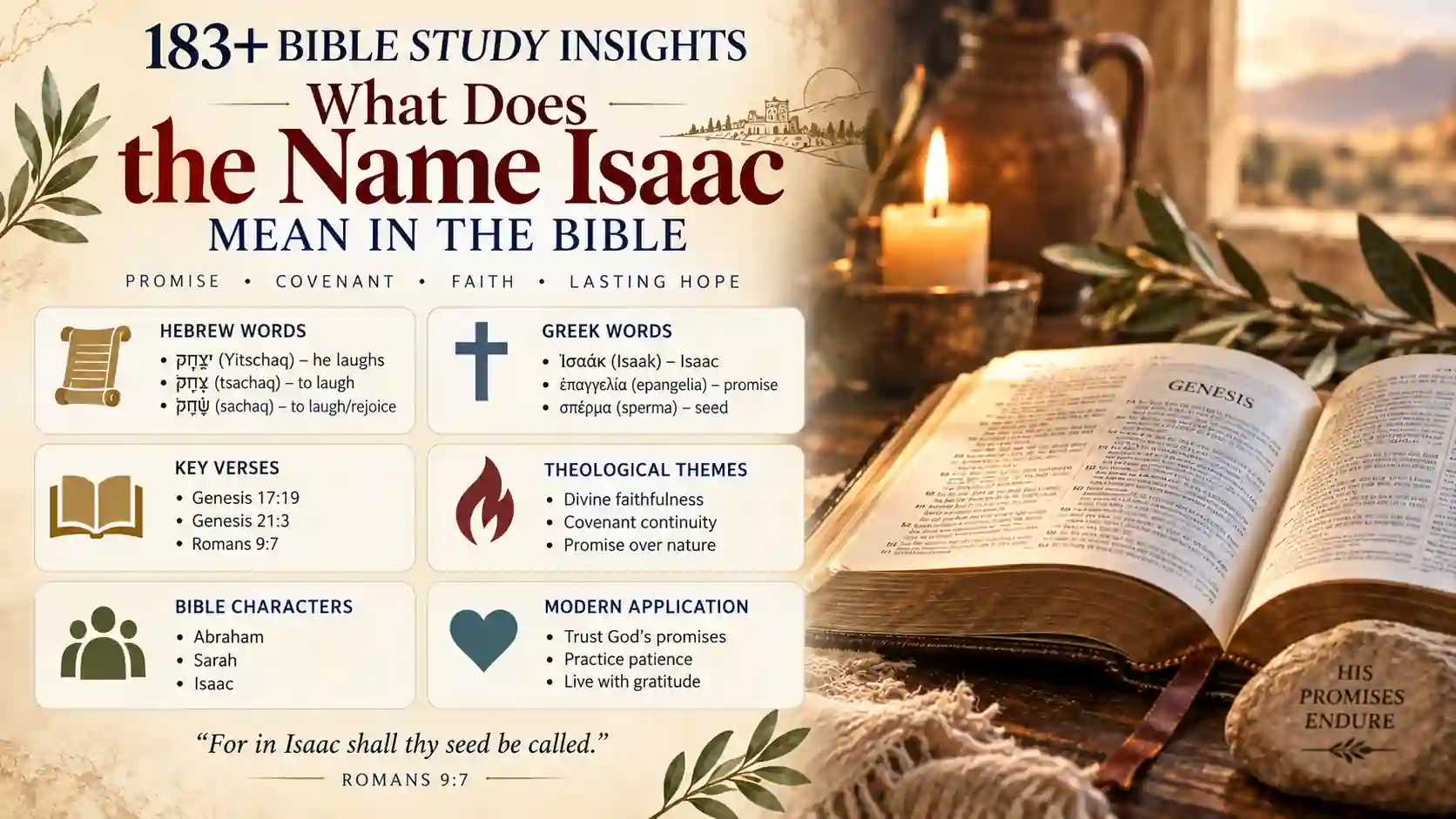
What does the name Isaac mean in the Bible? Isaac comes from the Hebrew יִצְחָק, Yitschaq, meaning “he laughs” or “he will laugh.” His name is rooted in the remarkable story of Abraham and Sarah, whose promised son arrived when humanly speaking, parenthood seemed impossible.
Isaac’s name carries more than a dictionary definition. As you follow his story through Genesis and the New Testament, laughter becomes connected with promise, covenant faithfulness, miraculous birth, testing, inheritance, and the unfolding purposes of God.
Isaac Key Scripture References
| Verse | Passage Snippet | Context |
|---|---|---|
| Genesis 17:17 | Abraham laughed | God promises Sarah a son |
| Genesis 17:19 | “call his name Isaac” | God personally names the child |
| Genesis 18:12 | Sarah laughed inwardly | She hears the birth promise |
| Genesis 21:3 | Abraham named him Isaac | The promised child is born |
| Genesis 21:6 | “God hath made me to laugh” | Sarah responds with joyful wonder |
| Genesis 22:2 | “thine only son Isaac” | Abraham faces the great test |
| Genesis 26:3 | God confirms His oath | Isaac receives covenant promises |
| Genesis 26:24 | “I am the God of Abraham” | God reassures Isaac |
| Romans 9:7 | “In Isaac shall thy seed be called” | Paul discusses the promised line |
| Hebrews 11:17 | Abraham offered Isaac | Faith trusts God’s promise |
Isaac Bible Translation Comparison
| Verse | KJV | NIV | ESV | NASB |
|---|---|---|---|---|
| Genesis 17:19 | call his name Isaac | call him Isaac | call his name Isaac | name him Isaac |
| Genesis 18:12 | Sarah laughed | Sarah laughed | Sarah laughed | Sarah laughed |
| Genesis 21:3 | called his name Isaac | gave the name Isaac | called his name Isaac | named him Isaac |
| Genesis 21:6 | made me to laugh | brought me laughter | made laughter for me | made laughter for me |
| Genesis 22:2 | whom thou lovest | whom you love | whom you love | whom you love |
| Genesis 26:3 | perform the oath | confirm the oath | establish the oath | establish the oath |
| Romans 9:7 | seed be called | offspring reckoned | offspring be named | descendants be named |
| Galatians 4:28 | children of promise | children of promise | children of promise | children of promise |
| Hebrews 11:17 | offered up Isaac | offered Isaac | offered up Isaac | offered up Isaac |
Isaac People and Characters Associated
| Person | Role | Connection |
|---|---|---|
| Abraham | Father | Receives God’s promise of Isaac |
| Sarah | Mother | Bears Isaac in old age |
| Isaac | Promised son | Covenant heir and patriarch |
| Hagar | Sarah’s servant | Mother of Isaac’s half brother |
| Ishmael | Half brother | Contrasts natural birth and promise |
| Rebekah | Wife | Becomes Isaac’s covenant partner |
| Esau | Son | Isaac’s elder twin son |
| Jacob | Son | Receives covenant blessing |
| Abimelech | Philistine ruler | Interacts with Isaac in Gerar |
| God | Covenant Lord | Names, protects, and blesses Isaac |
Isaac Original Hebrew and Greek Words
| Original Word | Transliteration | Strong’s # | Literal Meaning |
|---|---|---|---|
| יִצְחָק | Yitschaq | H3327 | he laughs |
| צָחַק | tsachaq | H6711 | to laugh |
| שָׂחַק | sachaq | H7832 | to laugh or rejoice |
| בֵּן | ben | H1121 | son |
| זֶרַע | zera | H2233 | seed, offspring |
| בְּרִית | berit | H1285 | covenant |
| בְּרָכָה | berakhah | H1293 | blessing |
| Ἰσαάκ | Isaak | G2464 | Isaac |
| ἐπαγγελία | epangelia | G1860 | promise |
| σπέρμα | sperma | G4690 | seed, offspring |
Isaac Related Biblical Concepts
| Concept | Connection | Supporting Verse |
|---|---|---|
| Laughter | Isaac’s name recalls laughter | Genesis 21:6 |
| Promise | His birth fulfills God’s word | Genesis 17:19 |
| Covenant | God establishes covenant through him | Genesis 17:21 |
| Miraculous birth | Sarah conceives in old age | Genesis 21:1-2 |
| Faith | Abraham trusts God concerning Isaac | Hebrews 11:17-19 |
| Testing | Abraham is commanded to offer Isaac | Genesis 22:1-2 |
| Provision | God supplies a ram | Genesis 22:13-14 |
| Inheritance | Isaac receives Abrahamic blessing | Genesis 26:3-4 |
| Election | Promise proceeds through Isaac | Romans 9:7-9 |
| Sonship | Isaac represents children of promise | Galatians 4:28 |
Isaac Historical and Cultural Context
| Aspect | Detail | Biblical Source |
|---|---|---|
| Patriarchal age | Isaac belongs to Abraham’s family era | Genesis 21 |
| Naming | Names often carried significance | Genesis 21:3-6 |
| Circumcision | Isaac circumcised on eighth day | Genesis 21:4 |
| Heirship | Isaac becomes Abraham’s covenant heir | Genesis 17:19-21 |
| Marriage | A wife is sought from Abraham’s kin | Genesis 24 |
| Betrothal customs | Family negotiations shape marriage | Genesis 24:50-58 |
| Pastoral life | Isaac possesses flocks and herds | Genesis 26:13-14 |
| Wells | Water rights create regional conflict | Genesis 26:18-22 |
| Famine | Isaac relocates during scarcity | Genesis 26:1 |
| Blessing | Patriarchal blessing affects succession | Genesis 27 |
Isaac Theological Themes
| Theme | Explanation | Scripture |
|---|---|---|
| Divine faithfulness | God fulfills an unlikely promise | Genesis 21:1-2 |
| Grace | Isaac’s birth exceeds human ability | Romans 9:8-9 |
| Covenant continuity | Abraham’s covenant continues through Isaac | Genesis 17:21 |
| Faith under testing | Abraham entrusts Isaac to God | Hebrews 11:17-19 |
| Divine provision | God provides the sacrifice | Genesis 22:13 |
| Promise over nature | God works beyond ordinary expectation | Romans 4:19-21 |
| Election | God identifies the covenant line | Romans 9:7 |
| Blessing | God repeats promises directly to Isaac | Genesis 26:3-5 |
| Providence | God guides Isaac’s marriage | Genesis 24:50-67 |
| Worship | Isaac builds an altar to the Lord | Genesis 26:25 |
Isaac Modern Application for Believers
| Area | Practice | Scripture |
|---|---|---|
| Trust | Believe God despite unlikely circumstances | Romans 4:20-21 |
| Patience | Wait for God’s appointed fulfillment | Genesis 21:1-2 |
| Gratitude | Receive answered prayer with joy | Genesis 21:6 |
| Obedience | Follow God when circumstances shift | Genesis 26:2-6 |
| Worship | Respond to revelation with devotion | Genesis 26:24-25 |
| Peace | Refuse needless conflict | Genesis 26:20-22 |
| Prayer | Bring family needs before God | Genesis 25:21 |
| Marriage | Seek God’s guidance in relationships | Genesis 24:63-67 |
| Faith | Hold promises above visible obstacles | Hebrews 11:17-19 |
| Identity | Live as one shaped by divine promise | Galatians 4:28 |
What Does the Name Isaac Mean in the Bible Through יִצְחָק Yitschaq?
The Hebrew name יִצְחָק, Yitschaq, Strong’s H3327, is commonly understood as “he laughs” or “he will laugh.” It is related to the Hebrew verb צָחַק, tsachaq, Strong’s H6711, which means to laugh. Genesis deliberately surrounds Isaac’s naming with repeated references to laughter.
Abraham laughs when God announces that Sarah will bear a son in her old age. Sarah later laughs when she hears the same promise, and after Isaac is born she declares that God has made laughter for her. The name therefore preserves the tension between astonishment at an apparently impossible promise and joy when God fulfills His word.
From Sarah’S Laughter to the Covenant Promise of Isaac
Isaac is not merely a child whose parents happened to choose a meaningful name. According to Genesis 17:19, God Himself instructs Abraham, “you shall call his name Isaac.” His identity is therefore bound from the beginning to the covenant promise God had made to Abraham and Sarah.
God distinguishes Isaac’s covenant role from Ishmael’s. Ishmael also receives divine care and blessing, but Genesis 17:21 specifically states that God will establish His covenant with Isaac. When Isaac is born in Genesis 21, his arrival demonstrates that God’s promise does not fail simply because its fulfillment appears humanly impossible.
Isaac later receives the covenant promises personally. During famine, God tells him not to go to Egypt and repeats the promises of land, descendants, and blessing given to Abraham. Genesis 26 thus presents Isaac not only as Abraham’s son but as the next patriarch through whom the covenant line continues.
This helps explain why later Scripture repeatedly speaks of “Abraham, Isaac, and Jacob.” Isaac stands at the center of that patriarchal sequence. His comparatively quiet life still carries immense biblical significance because God’s redemptive promises move through his family toward Israel and, ultimately, the larger biblical story of salvation.
Isaac on Moriah and the Faith Tested in Genesis 22
Genesis 22 gives Isaac’s name an especially solemn setting. God commands Abraham to take Isaac, “whom you love,” to the land of Moriah and offer him. The command is startling because Isaac is the very son through whom God has said the promised descendants will come.
Hebrews 11:17-19 interprets Abraham’s obedience as an act of faith. Abraham reasoned that God was able even to raise the dead. The point is not that Abraham abandoned God’s promise but that he trusted the Promise-Giver so deeply that even death could not finally overturn what God had spoken.
Isaac himself is central to the narrative. He carries the wood and asks where the lamb for the offering is. Abraham replies that God will provide. Before Isaac is slain, the angel of the Lord stops Abraham, and a ram caught in a thicket is offered in Isaac’s place.
Christian readers have long recognized themes here that resonate with later biblical teaching about beloved sonship, sacrifice, and divine provision. Yet Genesis first emphasizes God’s testing of Abraham, Abraham’s reverent obedience, Isaac’s preservation, and the Lord’s provision. Careful study allows those themes to remain rooted in the text before tracing broader canonical connections.
Ἰσαάκ Isaak and the Children of Promise in the New Testament
The Greek New Testament writes Isaac’s name as Ἰσαάκ, Isaak, Strong’s G2464. The name appears in genealogies and in theological discussions concerning faith, promise, covenant descent, and God’s purposes. Matthew 1:2, for example, places Isaac directly in the ancestry that leads from Abraham toward Jesus Christ.
Romans 9:7-9 emphasizes that Abraham’s physical descendants are not all identified in the same covenant sense. Paul quotes the statement that Abraham’s offspring would be called through Isaac and connects Isaac’s birth with God’s promise. His argument focuses on divine promise rather than mere natural descent.
Galatians 4:28 tells believers, “like Isaac,” that they are children of promise. Paul is using Abraham’s household within a larger theological argument about slavery and freedom. Isaac’s extraordinary birth becomes an illustration of life grounded in God’s gracious promise rather than confidence in human achievement.
For your study, this means Isaac’s name should never be reduced to the pleasant idea of laughter alone. Biblical laughter is the doorway into a richer story. Isaac embodies promise received after waiting, covenant preserved through apparent impossibility, faith tested severely, and joy produced when God proves faithful to His word.
Questions Bible Students Ask About Isaac
Does יִצְחָק Yitschaq mean “laughter” or “he laughs”?
יִצְחָק, Yitschaq, is best understood as “he laughs” or “he will laugh,” while the associated verb צָחַק, tsachaq, means “to laugh.”
Why did God choose the name Isaac before the child was born?
Genesis 17:19 shows God naming Isaac in advance, connecting his identity directly with the promised birth and the covenant God would establish through him.
Was Sarah’s laughter in Genesis 18 the reason Isaac received his name?
Sarah’s laughter contributes to the wordplay, but Abraham had already laughed in Genesis 17:17, and God had already commanded the name Isaac in Genesis 17:19.
Why does Paul call believers children of promise “like Isaac” in Galatians 4:28?
Paul uses Isaac’s supernatural, promise-based birth to illustrate an identity grounded in God’s gracious promise rather than merely natural descent or human effort.
How does Genesis 22 fit the meaning of Isaac’s name when the chapter is so serious?
The joyful promised son becomes the center of Abraham’s deepest test, showing that the God who gives the promise is also trusted to preserve and fulfill it.