
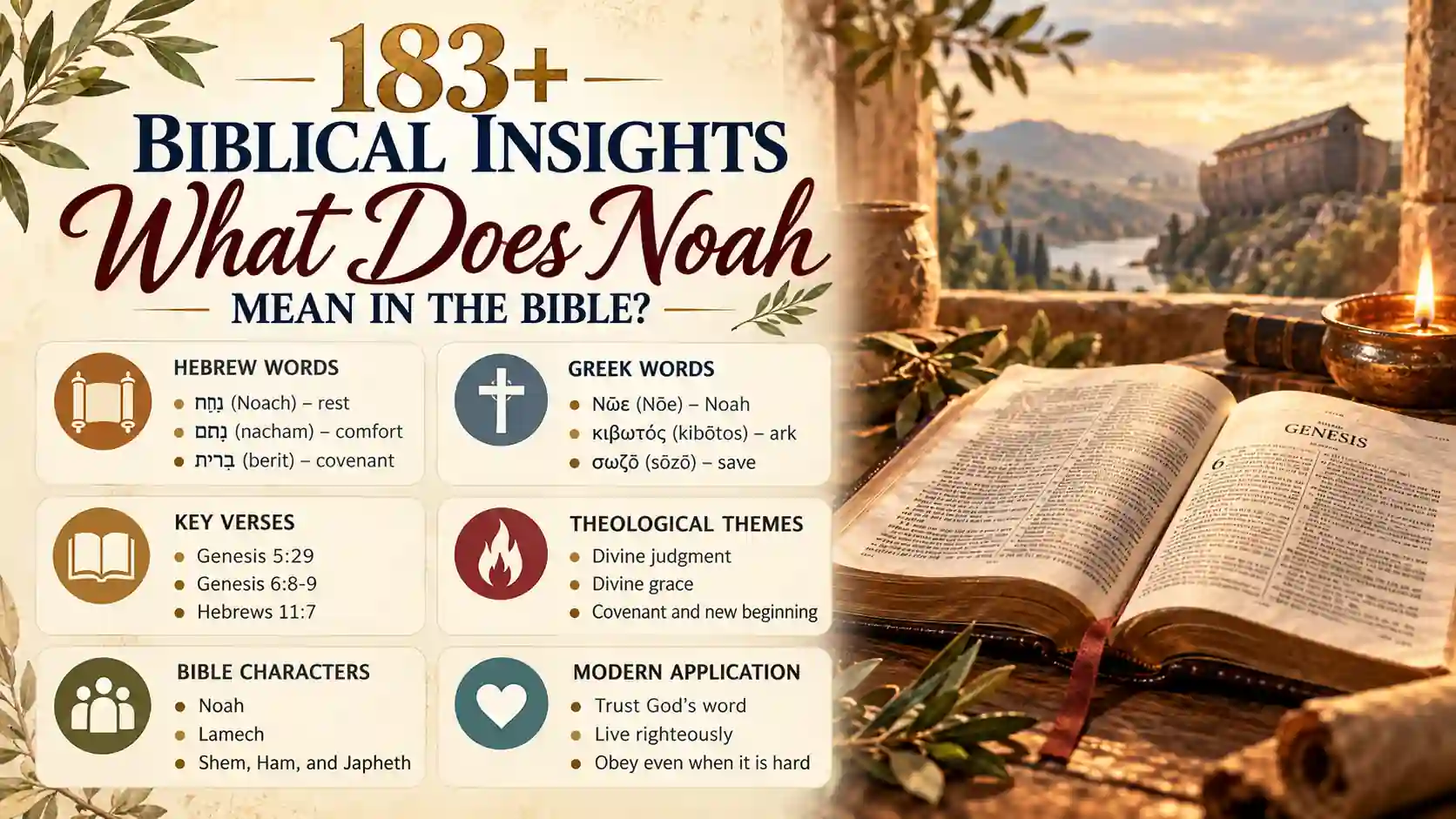
The question what does Noah mean in the Bible begins with his Hebrew name, נֹחַ (Noach), commonly associated with “rest.” Genesis 5:29 also makes a deliberate wordplay with נָחַם (nacham), “to comfort,” when Lamech expresses hope that his son will bring relief from humanity’s painful labor under the curse.
Noah’s name becomes especially meaningful as his story unfolds. His life connects rest with judgment, preservation, covenant, obedience, and a renewed creation. Studying his name therefore opens a window into some of Genesis’s most important theological themes.
Noah Key Scripture References
| Verse | Passage Snippet | Context |
|---|---|---|
| Genesis 5:29 | “called his name Noah” | Lamech connects Noah with comfort from cursed ground |
| Genesis 6:8 | “Noah found grace” | Noah receives divine favor amid widespread corruption |
| Genesis 6:9 | “just man” | Noah is described as righteous and walking with God |
| Genesis 6:18 | “covenant with thee” | God promises preservation through the ark |
| Genesis 7:5 | “Noah did” | Noah obeys the Lord’s commands concerning the flood |
| Genesis 8:1 | “God remembered Noah” | God acts for Noah after the waters prevail |
| Genesis 8:20 | “builded an altar” | Noah worships after leaving the ark |
| Genesis 9:11 | “establish my covenant” | God promises not to destroy all flesh by another flood |
| Hebrews 11:7 | “Noah…prepared an ark” | Noah becomes a New Testament example of faith |
| 1 Peter 3:20 | “eight souls” | Peter recalls preservation through the floodwaters |
Noah Bible Translation Comparison
| Verse | KJV | NIV | ESV | NASB |
|---|---|---|---|---|
| Genesis 5:29 | “shall comfort us” | “will comfort us” | “shall bring us relief” | “will give us rest” |
| Genesis 6:8 | “found grace” | “found favor” | “found favor” | “found favor” |
| Genesis 6:9 | “just man” | “righteous man” | “righteous man” | “righteous man” |
| Genesis 6:9 | “walked with God” | “walked faithfully” | “walked with God” | “walked with God” |
| Genesis 6:18 | “my covenant” | “my covenant” | “my covenant” | “My covenant” |
| Genesis 7:5 | “commanded him” | “commanded him” | “commanded him” | “commanded him” |
| Genesis 8:1 | “remembered Noah” | “remembered Noah” | “remembered Noah” | “remembered Noah” |
| Hebrews 11:7 | “moved with fear” | “in holy fear” | “reverent fear” | “in reverence” |
| 1 Peter 3:20 | “saved by water” | “saved through water” | “brought safely through water” | “brought safely through water” |
Noah People & Characters Associated
| Person | Role | Connection |
|---|---|---|
| Lamech | Noah’s father | Names Noah and speaks of comfort |
| Methuselah | Noah’s grandfather | Links Noah to the antediluvian genealogy |
| Enoch | Noah’s ancestor | Earlier patriarch who walked with God |
| Shem | Noah’s son | Survives the flood and continues a major genealogical line |
| Ham | Noah’s son | Survives aboard the ark |
| Japheth | Noah’s son | Survives and becomes ancestor of nations |
| Noah’s wife | Ark survivor | Preserved with Noah through the flood |
| Canaan | Noah’s grandson | Appears in the post-flood family account |
| Jesus | New Testament teacher | Compares His coming with the days of Noah |
| Peter | Apostle | Uses Noah’s flood in teaching about salvation and baptism |
Noah Original Hebrew & Greek Words
| Original Word | Transliteration | Strong’s # | Literal Meaning |
|---|---|---|---|
| נֹחַ | Noach | H5146 | Noah, rest |
| נוּחַ | nuach | H5117 | rest, settle, repose |
| נָחַם | nacham | H5162 | comfort, console, relent |
| יְנַחֲמֵנוּ | yenachamenu | H5162 | he will comfort us |
| חֵן | chen | H2580 | favor, grace |
| צַדִּיק | tsaddiq | H6662 | righteous, just |
| בְּרִית | berit | H1285 | covenant |
| תֵּבָה | tevah | H8392 | ark, vessel |
| Νῶε | Nōe | G3575 | Noah |
| κιβωτός | kibōtos | G2787 | ark, chest |
Noah Related Biblical Concepts
| Concept | Connection | Supporting Verse |
|---|---|---|
| Rest | Noah’s Hebrew name is associated with rest | Genesis 5:29 |
| Comfort | Lamech anticipates relief through Noah | Genesis 5:29 |
| Grace | Noah finds favor with the Lord | Genesis 6:8 |
| Righteousness | Noah is called righteous | Genesis 6:9 |
| Fellowship | Noah walks with God | Genesis 6:9 |
| Obedience | Noah follows God’s instructions | Genesis 6:22 |
| Judgment | The flood judges pervasive human wickedness | Genesis 6:5-7 |
| Salvation | Noah’s household is preserved | Genesis 7:23 |
| Worship | Noah builds an altar | Genesis 8:20 |
| Covenant | God establishes His covenant after the flood | Genesis 9:8-17 |
Noah Historical & Cultural Context
| Aspect | Detail | Biblical Source |
|---|---|---|
| Era | Noah belongs to the world before the flood | Genesis 5 |
| Genealogy | He descends from Adam through Seth | Genesis 5:3-29 |
| Generation | He is the son of Lamech | Genesis 5:28-29 |
| Family | He fathers Shem, Ham, and Japheth | Genesis 5:32 |
| Human condition | Violence and corruption fill the earth | Genesis 6:11-13 |
| Ark | God specifies a large protective vessel | Genesis 6:14-16 |
| Flood | Waters bring judgment upon the earth | Genesis 7 |
| Agriculture | Noah becomes a man of the soil | Genesis 9:20 |
| Sacrifice | Noah offers clean animals after the flood | Genesis 8:20 |
| Rainbow | The bow serves as covenant sign | Genesis 9:12-17 |
Noah Theological Themes
| Theme | Explanation | Scripture |
|---|---|---|
| Human sin | The flood narrative portrays deep human corruption | Genesis 6:5 |
| Divine judgment | God responds judicially to pervasive evil | Genesis 6:7 |
| Divine grace | Noah receives favor before deliverance | Genesis 6:8 |
| Righteous living | Noah stands distinct within his generation | Genesis 6:9 |
| Faith | Noah acts upon God’s warning | Hebrews 11:7 |
| Obedience | He builds according to divine instruction | Genesis 6:22 |
| Preservation | God keeps Noah and his household alive | Genesis 7:23 |
| New beginning | Noah emerges into a cleansed world | Genesis 8:15-19 |
| Covenant | God commits Himself to creation’s preservation | Genesis 9:8-17 |
| Future judgment | Jesus invokes Noah’s days in eschatological teaching | Matthew 24:37-39 |
Noah Modern Application for Believers
| Area | Practice | Scripture |
|---|---|---|
| Faith | Trust God before seeing the outcome | Hebrews 11:7 |
| Obedience | Follow God even when obedience is costly | Genesis 6:22 |
| Character | Pursue righteousness within a corrupt culture | Genesis 6:9 |
| Fellowship | Cultivate a life of walking with God | Genesis 6:9 |
| Family | Take spiritual responsibility seriously | Genesis 7:1 |
| Worship | Respond to deliverance with gratitude | Genesis 8:20 |
| Patience | Wait faithfully for God’s appointed time | Genesis 8:6-16 |
| Grace | Remember that divine favor precedes Noah’s deliverance | Genesis 6:8 |
| Covenant | Rest in God’s faithfulness to His promises | Genesis 9:11 |
| Readiness | Live watchfully in light of Christ’s teaching | Matthew 24:37-44 |
נֹחַ Noach and the Meaning of Noah’S Name
The Hebrew name נֹחַ (Noach, H5146) is associated with the idea of rest. It is related to the Hebrew verbal idea expressed by נוּחַ (nuach), meaning to rest, settle, or come to repose. That makes Noah’s name especially fitting in a Genesis narrative dominated by restless toil, corruption, judgment, and eventual renewal.
Genesis 5:29 adds a fascinating linguistic detail. Lamech says Noah will “comfort” or bring relief to them, using a form of נָחַם (nacham, H5162). Noach and nacham are not simply the same Hebrew root. Rather, Genesis employs a sound-based wordplay that links Noah’s name with Lamech’s longing for comfort from the painful ground.
What Does Noah Mean in the Bible within Genesis 5?
To understand Noah’s name, you need to hear Genesis 5:29 against Genesis 3:17-19. After Adam’s sin, the ground is cursed, and human beings must obtain food through painful toil. Generations later, Lamech names his son Noah while explicitly recalling that cursed ground. His words reveal a longing for relief from the burden introduced in Eden.
The expectation is fulfilled in a larger and more complex way than Lamech’s statement might initially suggest. Noah does not simply make farming easy. Through him, God preserves human and animal life through judgment and establishes a new beginning afterward. Genesis 8:21 also returns explicitly to the subject of the ground and God’s dealings with creation.
Noah’S Rest, the Flood, and God’S Covenant
Noah’s story combines grace and judgment rather than treating them as opposites. Genesis first declares that human wickedness had become great, then immediately tells you that Noah found favor in the Lord’s eyes. God judges a violent world while graciously preserving Noah, his family, and representatives of animal life.
After the flood, Noah builds an altar, and God establishes covenant commitments concerning the earth. The sign of the bow accompanies God’s promise concerning future floods. Noah’s “rest” therefore belongs within a broader movement from cursed ground and human violence toward preservation, worship, covenant, and renewed human vocation.
Νῶε NōE and Noah in the New Testament
The Greek New Testament calls Noah Νῶε (Nōe, G3575). Jesus refers to “the days of Noah” in Matthew 24:37-39 and Luke 17:26-27. His emphasis is on people carrying on ordinary life until judgment suddenly arrived, making Noah’s generation a warning about spiritual readiness.
Hebrews 11:7 emphasizes another dimension. Noah believes God’s warning concerning events not yet seen and responds by preparing the ark. First Peter 3:20 recalls the eight people preserved through water, while 2 Peter 2:5 calls Noah a “preacher of righteousness.” The New Testament therefore remembers Noah through the connected themes of faith, obedience, righteousness, preservation, and judgment.
Frequently Asked Questions About Noah
Does the Hebrew name נֹחַ (Noach) literally mean comfort?
More precisely, נֹחַ is associated with “rest,” while Genesis 5:29 makes a wordplay with נָחַם (nacham), the verb translated “comfort” or “bring relief.”
Why does Genesis 5:29 connect Noah with the cursed ground?
Lamech remembers the curse of Genesis 3 and expresses hope that Noah will bring relief from humanity’s painful labor upon the ground.
Why do translations use “rest,” “comfort,” or “relief” in Genesis 5:29?
They reflect both Noah’s name and the Hebrew verb נָחַם (nacham), while attempting to communicate the Hebrew wordplay naturally in English.
What is the Greek name for Noah in the New Testament?
The New Testament uses Νῶε (Nōe, Strong’s G3575), referring to the same Noah described in Genesis.
What should Noah’s name teach you as a believer?
Noah’s story encourages you to trust God’s word, obey faithfully, pursue righteousness, worship gratefully, and rest your confidence in God’s covenant faithfulness.