
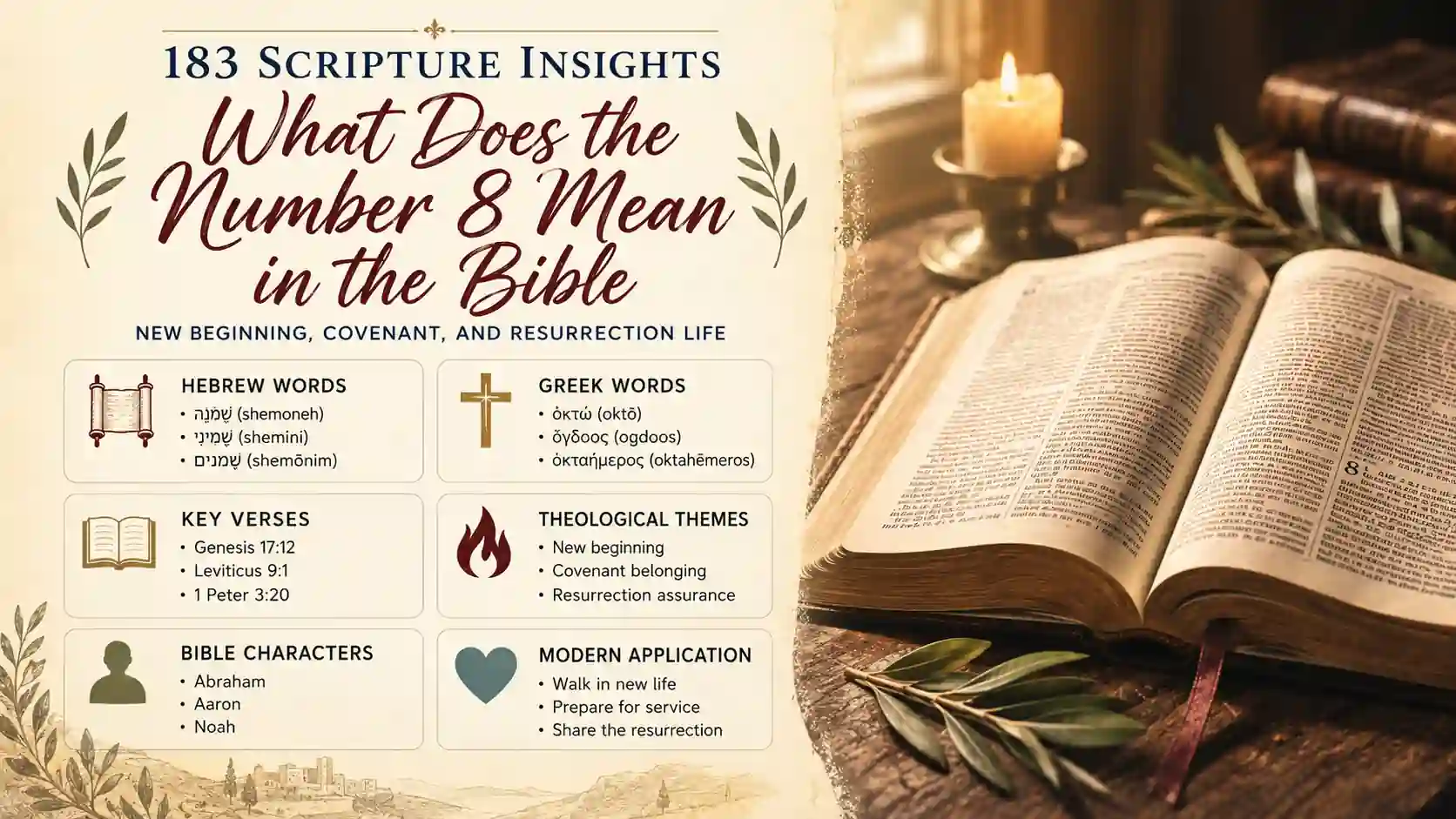
What does the number 8 mean in the Bible? Scripture does not provide a dictionary assigning one fixed spiritual definition to every number. Yet eight repeatedly appears at moments involving covenant identity, purification, priestly service, deliverance, resurrection, and renewed worship. These patterns have led many readers to associate eight with a new beginning or a new stage after completion.
Your study should begin with the biblical passages themselves. When those texts are read in context, eight emerges not as a mystical code, but as a recurring marker of God bringing people from preparation into consecrated life.
Key Number 8 Scripture References
| Verse | Passage Snippet | Context |
|---|---|---|
| Genesis 17:12 | Circumcised at eight days old | Abrahamic covenant sign |
| Genesis 21:4 | Isaac circumcised on day eight | Abraham obeys God |
| Leviticus 8:33 | Seven days of ordination | Preparation before service |
| Leviticus 9:1 | On the eighth day | Priestly ministry begins |
| Leviticus 12:3 | Eighth-day circumcision | Purification law |
| Leviticus 14:10 | On the eighth day | Cleansed person restored |
| Leviticus 23:36 | Sacred assembly on day eight | Feast of Booths |
| 1 Peter 3:20 | Eight persons saved through water | Noah’s household delivered |
| Luke 2:21 | Eight days completed | Jesus circumcised and named |
| John 20:26 | Eight days later | Jesus appears to Thomas |
Number 8 Bible Translation Comparison
| Verse | KJV | NIV | ESV | NASB |
|---|---|---|---|---|
| Genesis 17:12 | Eight days old | Eight days old | Eight days old | Eight days old |
| Leviticus 9:1 | Eighth day | Eighth day | Eighth day | Eighth day |
| Leviticus 12:3 | Eighth day | Eighth day | Eighth day | Eighth day |
| Leviticus 14:10 | Eighth day | Eighth day | Eighth day | Eighth day |
| Leviticus 23:36 | Eighth day | Eighth day | Eighth day | Eighth day |
| Luke 2:21 | Eight days accomplished | Eight days were completed | End of eight days | Eight days were completed |
| Acts 7:8 | Eighth day | Eighth day | Eighth day | Eighth day |
| 1 Peter 3:20 | Eight souls | Eight in all | Eight persons | Eight persons |
| John 20:26 | After eight days | A week later | Eight days later | Eight days later |
People and Characters Associated with Number 8
| Person | Role | Connection |
|---|---|---|
| Abraham | Covenant patriarch | Received the eighth-day command |
| Isaac | Promised son | Circumcised on the eighth day |
| Aaron | High priest | Began ministry on the eighth day |
| Aaron’s sons | Priests | Completed seven-day ordination |
| Moses | Covenant mediator | Directed eighth-day ceremonies |
| Noah | Flood survivor | One of eight preserved people |
| Noah’s wife | Flood survivor | Preserved within the ark |
| Noah’s three sons | New post-flood families | Shared deliverance with their wives |
| Jesus | Messiah | Circumcised and named after eight days |
| Thomas | Apostle | Saw the risen Christ eight days later |
Original Hebrew and Greek Words for Number 8
| Original Word | Transliteration | Strong’s # | Literal Meaning |
|---|---|---|---|
| שְׁמֹנֶה | shemoneh | H8083 | Eight |
| שְׁמֹנָה | shemonah | H8083 | Eight |
| שְׁמִינִי | shemini | H8066 | Eighth |
| שְׁמֹנִים | shemonim | H8084 | Eighty |
| שְׁמִינִית | sheminith | H8067 | An eighth or octave |
| ὀκτώ | oktō | G3638 | Eight |
| ὄγδοος | ogdoos | G3590 | Eighth |
| ὀκταήμερος | oktahēmeros | G3637 | Eight days old |
| ὀγδοήκοντα | ogdoēkonta | G3589 | Eighty |
Related Biblical Concepts of Number 8
| Concept | Connection | Supporting Verse |
|---|---|---|
| Covenant sign | Circumcision occurred on day eight | Genesis 17:12 |
| Promised offspring | Isaac received the covenant mark | Genesis 21:4 |
| Consecration | Priests served after seven preparation days | Leviticus 9:1 |
| Cleansing | Restored worship followed on day eight | Leviticus 14:10 |
| Sacred assembly | A final festival gathering occurred | Leviticus 23:36 |
| Deliverance | Eight people survived the flood | 1 Peter 3:20 |
| Messianic obedience | Jesus fulfilled the covenant requirement | Luke 2:21 |
| Resurrection witness | Thomas encountered the risen Jesus | John 20:26 |
| New creation | Resurrection begins renewed life | 2 Corinthians 5:17 |
| Heart circumcision | Covenant reality becomes inward | Romans 2:29 |
Historical and Cultural Context of Number 8
| Aspect | Detail | Biblical Source |
|---|---|---|
| Infant circumcision | Israelite males received the sign on day eight | Genesis 17:12 |
| Child naming | Jesus was named at circumcision | Luke 2:21 |
| Priestly ordination | Consecration lasted seven days | Leviticus 8:33 |
| Priestly inauguration | Public ministry began on day eight | Leviticus 9:1 |
| Purification rites | Offerings marked restored access | Leviticus 14:10 |
| Animal offerings | Newborn animals waited seven days | Leviticus 22:27 |
| Booths festival | Celebration included an eighth-day assembly | Leviticus 23:36 |
| Flood remembrance | Eight members of Noah’s family survived | 1 Peter 3:20 |
| Early Christian worship | Believers gathered on the first day | Acts 20:7 |
| Resurrection chronology | Jesus rose on the first day | Matthew 28:1 |
Theological Themes Connected with Number 8
| Theme | Explanation | Scripture |
|---|---|---|
| New beginning | A fresh stage follows a completed period | Leviticus 9:1 |
| Covenant belonging | Circumcision identified covenant members | Genesis 17:12 |
| Obedient faith | Abraham followed God’s command for Isaac | Genesis 21:4 |
| Holy service | Consecration preceded priestly ministry | Leviticus 8:33 |
| Restoration | Cleansed worshipers returned to fellowship | Leviticus 14:10 |
| Salvation through judgment | God preserved Noah’s household | 1 Peter 3:20 |
| Messianic faithfulness | Jesus entered Israel’s covenant life | Luke 2:21 |
| Resurrection assurance | The risen Christ overcame unbelief | John 20:26 |
| Inward renewal | True circumcision is of the heart | Colossians 2:11 |
| Eternal hope | Christ’s resurrection promises new life | 1 Corinthians 15:20 |
Modern Application of Number 8 for Believers
| Area | Practice | Scripture |
|---|---|---|
| Bible interpretation | Read numerical patterns in context | 2 Timothy 2:15 |
| New life | Walk in the life Christ provides | Romans 6:4 |
| Covenant faithfulness | Respond to grace with obedience | Genesis 21:4 |
| Spiritual preparation | Prepare before entering ministry | Leviticus 8:33 |
| Worship | Gather with reverence and gratitude | Acts 20:7 |
| Repentance | Seek inward rather than merely outward change | Romans 2:29 |
| Perseverance | Trust God through seasons of waiting | 1 Peter 3:20 |
| Restoration | Welcome repentant people into fellowship | Galatians 6:1 |
| Witness | Confess the reality of the resurrection | John 20:28 |
| Hope | Anticipate the final renewal of creation | Revelation 21:5 |
שְׁמִינִי Shemini and the Movement from Preparation to Service
The Hebrew ordinal שְׁמִינִי, shemini, means “eighth.” Its use in Leviticus 9 is especially significant. Aaron and his sons spent seven days at the entrance of the tabernacle completing their ordination. On the eighth day, they began their public priestly ministry and presented offerings before the Lord.
The sequence suggests transition rather than secret numerology. Seven days were devoted to consecration, and the eighth opened a new phase of service. God’s glory then appeared to the people, and fire came from before the Lord to consume the offering. Eight marks the day when preparation gives way to God-appointed ministry.
The same rhythm appears in cleansing ceremonies. A person healed of a serious skin disease passed through examination, washing, waiting, and sacrifice. On the eighth day, offerings were presented for formal restoration to the worshiping community. The day represented renewed access to covenant fellowship, not an independent magical power.
What Does the Number 8 Mean in the Bible’S Covenant Story?
In Genesis 17, God commanded that every male in Abraham’s household be circumcised at eight days old. The practice marked participation in the Abrahamic covenant. Isaac, the promised son, received this sign on his eighth day because Abraham obeyed the divine command.
The New Testament remembers this pattern in Acts 7:8 and Philippians 3:5. Paul could describe himself as “circumcised the eighth day,” showing his full standing within Israel from infancy. The number here is attached to covenant identity, inherited privilege, and obedience to the Torah.
Jesus also entered this covenant setting. Luke 2:21 records that He was circumcised and formally named Jesus when eight days were completed. His eighth-day circumcision displays His true participation in Israel’s life and His submission to God’s law from the beginning of His earthly life.
The apostles later teach that outward circumcision alone cannot produce saving righteousness. Romans 2:28-29 and Colossians 2:11-13 direct your attention toward an inward work accomplished by God. The eighth-day sign therefore contributes to a larger biblical movement from external covenant marking toward spiritual renewal in Christ.
ὀκτώ Oktō, Noah’S Household, and Salvation Through Judgment
The ordinary Greek cardinal number for eight is ὀκτώ, oktō, identified as Strong’s G3638. In 1 Peter 3:20, Peter states that eight persons were brought safely through the floodwaters. Genesis names this preserved household as Noah, his wife, their three sons, and the sons’ wives.
This was a genuine new beginning for human society after judgment, but Peter’s main emphasis is salvation through God’s patient mercy. The ark preserved Noah’s family while the waters judged the violent world. Eight is part of the historical account, while God’s saving action remains the theological center.
Peter connects the flood account with baptism, carefully explaining that salvation does not come through the physical removal of dirt. He points instead to an appeal to God for a good conscience through the resurrection of Jesus Christ. Your confidence must therefore rest in the risen Lord, not in a numerical formula.
The eight people in the ark may fittingly remind you that God can preserve a faithful remnant and begin anew after judgment. Yet the passage calls you beyond symbolism into allegiance to Christ, whose death, resurrection, and exaltation secure the believer’s hope.
The Eighth Day, Christ’S Resurrection, and New Creation
The Gospels say Jesus rose on the first day of the week. They do not directly call Resurrection Sunday “the eighth day.” Christians later used that expression because the first day of a new week can also be viewed symbolically as the day following a complete seven-day cycle.
This connection should be stated with care. The resurrection itself, rather than the numeral alone, establishes the promise of new creation. Jesus is the firstfruits of those who have fallen asleep, and everyone united to Him receives the hope of resurrection life.
John 20:26 adds a striking eighth-day scene. Eight days after Jesus’ earlier appearance to the disciples, He came again while Thomas was present. Christ answered Thomas’s doubt by showing His wounds, leading the apostle to confess, “My Lord and my God.”
For your study, this passage joins the eighth-day pattern to confirmed resurrection faith. A completed period of doubt gives way to sight, confession, and blessing. Still, Jesus directs attention beyond Thomas to those who believe without seeing. The ultimate message is faith in the risen Son of God.
Questions Bible Students Ask About Number 8
Does שְׁמֹנֶה, shemoneh, literally mean “new beginning”?
No. שְׁמֹנֶה literally means “eight,” while new beginning is a theological association drawn from several biblical contexts.
Why does Leviticus repeatedly prescribe action on the שְׁמִינִי, shemini, or eighth day?
The eighth day often follows a seven-day period of waiting, consecration, purification, or preparation and begins a restored stage of covenant life.
Is ὀκτώ, oktō, in 1 Peter 3:20 meant as a hidden prophetic code?
The word simply identifies the eight people preserved in the ark, while Peter’s central concern is salvation through Christ’s resurrection.
Why do some translations say “a week later” in John 20:26 instead of “after eight days”?
“A week later” expresses the inclusive ancient way of counting the same weekday-to-weekday interval described literally as eight days.
Should you use the number 8 to predict events or make major decisions?
No. Scripture calls you to seek wisdom through God’s Word, prayer, faithful counsel, and obedience rather than numerical divination.